

Parental alienation grief is a specific kind of mourning: grieving a living child who is still here yet psychologically out of reach. It does not move through tidy stages, and it rarely reaches closure. Naming it as ambiguous loss helps a targeted parent carry the weight without being crushed by it.
A note on safety
A child’s distancing is not always alienation. A parent grieving a child lost to abuse-driven estrangement is in a different situation, and this page is about alienation, not that. Where a child pulls away because of genuine abuse, neglect, or real danger from the rejected parent, that is justified estrangement, not alienation. If anyone’s safety is at risk, contact local authorities or a crisis resource first.
This page is general information, not clinical advice. It does not create a professional relationship and does not address any one family’s situation. Anyone struggling with their own mental health, or making decisions for a real case, should consult a licensed clinician who knows that situation.
What parental alienation grief is
Parental alienation grief is the mourning a targeted parent feels when a child rejects them, not because of harm, but because of one parent’s influence. The child is alive. The child may live a few miles away. Yet the relationship is gone, and there is no funeral, no card, and no shared ritual to mark it.
This grief is unlike bereavement. A death is final and socially recognized. Alienation grief is open-ended. The loss has no verified ending, so the mind cannot file it away. That open loop is part of what makes it so disorienting.
Many targeted parents describe a private ache that few people around them understand. Friends sometimes ask why the parent cannot simply move on. The honest answer is that the loss keeps happening. Each blocked call or returned gift reopens the wound. Researchers Jennifer Harman, Edward Kruk, and Denise Hines, writing in Psychological Bulletin, describe alienating behaviors as a form of coercive control and family violence. Naming the harm accurately is not self-pity. It is the ground on which honest grief stands.
Why this grief does not follow the usual stages
Popular culture teaches that grief moves through neat stages and ends in acceptance. Alienation grief rarely behaves that way. Pauline Boss, the family therapist who originated ambiguous loss theory, calls this “frozen grief”: mourning that stalls because the loss never resolves. Richard Warshak, a psychologist who studies these cases, adds a vivid image, comparing an alienated child to someone caught in an avalanche, and the parent’s mourning gets stuck instead of resolving.
The reason is structural. Ordinary grief can settle because the loss holds still. Here the situation keeps shifting. A child might send one warm text, then go quiet for a year. Hope rises and falls on a schedule the parent does not control. Grief cannot finish its work while the outcome stays uncertain.
Frozen grief is not a sign of weakness or failure to cope. It is a normal response to a loss that refuses to stay fixed. Putting a name to it can ease the shame that often rides alongside it.
Ambiguous loss: grieving a child who is still here
The clearest frame for this experience comes from Pauline Boss, who developed the theory of ambiguous loss. Boss studied families of soldiers missing in action and families living with Alzheimer’s. She described a loss with no body, no closure, and no social permission to mourn. Counselors who work with alienated parents, including Kelley Baker of the Parental Alienation Study Group, apply that frame directly to alienation.
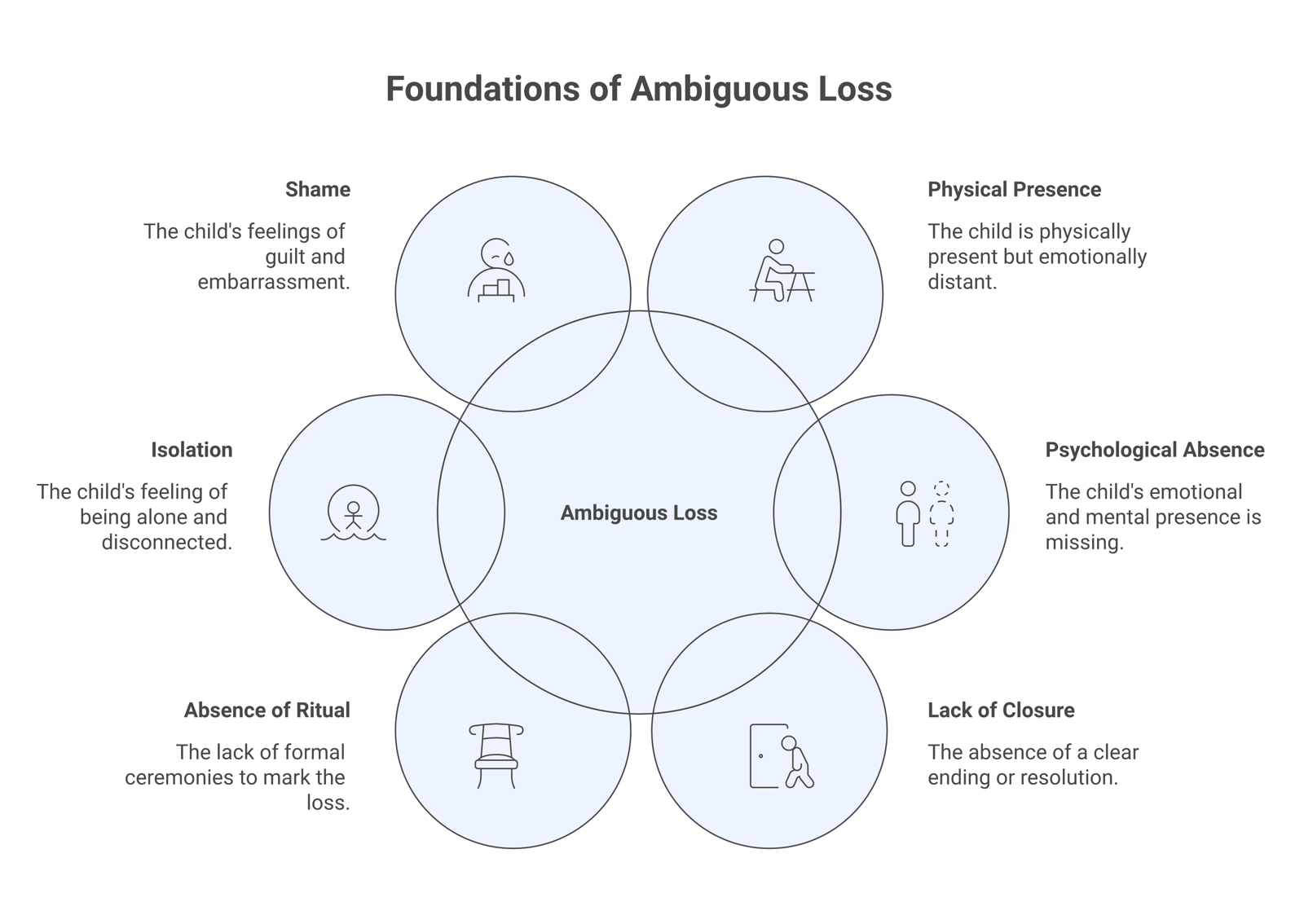
Ambiguous loss in alienation has a few recognizable features. There is no closure, because the child is alive and no ending is confirmed. There are no rituals, so the extended family grieves in silence. There is isolation, since few people grasp what alienation is. And there is shame, often fueled by replaying old decisions.
Boss noticed a strange doubling. A child can be physically gone yet vividly present in a parent’s mind. A child can also stand right there at an exchange yet feel psychologically absent behind a closed car door. Naming this as ambiguous loss does not remove the pain. It gives the pain a shape, which Boss treats as the first step toward living with it.
The phases targeted parents tend to move through
Grief over alienation tends to move in phases rather than fixed stages. The phases are not a ladder, and progress is rarely straight. Lisa Cohen, an alienated mother who has lived with this for many years, describes a four-phase arc that a lot of parents recognize.
The first phase is desperation, a period that can feel like utter destruction. The second is survival, where a parent simply gets through each day. The third is starting to live again, which for some arrives years in. The fourth is embracing life, where grief still visits but no longer runs everything.
Cohen offers a guiding aim for the long haul: stay a wholesome person. The idea is to keep living so that, if a child ever returns, they meet a parent who is whole rather than someone shriveled by the fight. That aim is not about performing happiness. It is about protecting the self that grief keeps trying to erode.
When grief hardens into a trauma response
For some parents the grief stops being grief and becomes a trauma response. Clinical psychologist Faust Ruggiero explains that alienation rarely arrives as one large blow. It comes as a long string of smaller ones: a blocked call, a hostile text, a returned birthday gift. Over months and years, that pattern can settle into something closer to post-traumatic stress.
Ruggiero describes a recognizable signature. A parent may dread the mail or flinch at a text alert. Sleep breaks down. Small noises trigger outsized reactions. Rumination crowds out ordinary daily function. He offers a plain self-check: when a parent keeps thinking “if I could just get my body to calm down, I could think this through,” the nervous system is likely stuck.
This matters for grief because trauma and mourning tangle together. A parent cannot grieve well while the body stays in alarm. Calling it trauma, rather than weakness, opens the door to treating it. A licensed clinician can help, and therapy for alienated parents covers what that support can look like. For how this strain can affect health over the long term, see long-term effects of parental alienation.
How to carry parental alienation grief without self-destruction
No technique ends this grief on command. The realistic goal is to carry it in a way a parent can sustain for years, without burning down their own health on the way. A few principles, drawn from clinicians and peer communities, point toward that.
Lawrence Joss, who founded a peer recovery community for alienated parents, frames recovery as the parent’s own work, not a plan to win the child back. His first principle is blunt: recovery is for the parent, not for the child. A parent who rebuilds a steady life has more to offer, not less, if contact ever returns.
Joss adds that community is the substrate that makes recovery hold. Isolation deepens grief, so re-entering a safe group matters. Parental alienation support groups can break the silence that ambiguous loss creates. Capacity is also finite, so saying no during hard stretches counts as care, not failure.
Ruggiero offers a companion idea for the long arc: focus on process, not destination. A parent does not control whether or when a child returns. A parent does control the daily practice of steadying the body, protecting sleep, and easing off the substances that worsen the spin. The destination is shaped by the process, and only the process sits within reach.
Honest hope belongs in this picture, held with care. Boss frames hope as something to keep realistic, so it sustains a parent rather than corroding them. Hope that hangs on a guaranteed reunion can curdle into despair. Hope aimed at living well today tends to hold. General guidance on the stress of divorce and custody is available from the American Psychological Association. For the rawest early stretch, see surviving the crisis phase, and for the full library, start at the Help pillar.
Frequently asked questions
What is parental alienation grief?
Parental alienation grief is the mourning a targeted parent feels when a child rejects them because of another parent’s influence rather than any real harm. The child is alive but psychologically out of reach. Because there is no death and no closure, the grief stays open-ended. Clinicians describe it as a form of ambiguous loss, which is grief without a verified ending.
Why does parental alienation grief not go away like other grief?
Ordinary grief can settle because the loss is final. Alienation grief stays open because the situation keeps changing, with contact that may rise and fall without warning. Pauline Boss calls this “frozen grief.” The mourning gets stuck because the outcome is never confirmed. This is a normal response to an unresolved loss, not a personal failing.
Is it normal to feel traumatized by the grief of parental alienation?
Yes. Clinical psychologist Faust Ruggiero notes that alienation often arrives as a long string of smaller blows rather than one event, and that pattern can settle into a trauma response. Common signs include dread of the mail, broken sleep, hypervigilance, and rumination. This is a normal reaction to chronic stress, and it can improve with support and professional treatment.
How can a parent cope with the grief of parental alienation?
Start by naming the loss as ambiguous loss and breaking the isolation around it. A safe peer or support community, paired with professional help where needed, gives grief somewhere to go. From there, a steady daily practice of protecting sleep, regulating the body, and focusing on process rather than outcome makes the grief possible to carry over the long term.
Can a parent heal if the child never comes back?
Healing here is measured by the parent’s own steadiness and wellbeing, not by the child’s return. Pauline Boss’s work on ambiguous loss describes building a meaningful life even when a loss has no closure. No honest source can promise reunion. What a parent can build is a life worth living today, which also keeps them whole and available if reconnection ever comes.
Where to go next
- For the broader Help library, start at the Help pillar.
- For the rawest early stretch, see surviving the crisis phase.
- For treatment options, see therapy for alienated parents.
- For breaking the isolation, see parental alienation support groups.
- For staying regulated when the grief spikes, see the window of tolerance.
- For the hardest days of the year, see surviving the holidays as a targeted parent.
- For how this strain affects health, see long-term effects of parental alienation.
Sources and further reading
- Boss, P. Ambiguous loss theory. A loss with no closure, no ritual, and six sequenced therapeutic goals. Applied to parental alienation by Kelley Baker, Ph.D., LPC, Parental Alienation Study Group.
- Warshak, R. The avalanche metaphor for the alienated child and the targeted parent’s stuck mourning.
- Cohen, L. The targeted parent’s four-phase grief arc (desperation, survival, starting to live, embracing life) and “stay a wholesome person.”
- Ruggiero, F. Trauma-to-PTSD pathway for alienated parents, and the process-over-destination recovery model.
- Joss, L. Recovery quadrant and operating principles for alienated parents; recovery is for the parent; community as catalyst.
- Harman, J. J., Kruk, E., & Hines, D. A. (2018). Parental alienating behaviors: An unacknowledged form of family violence. Psychological Bulletin, 144(12), 1275 to 1299. https://doi.org/10.1037/bul0000175
- American Psychological Association. Divorce and child custody. apa.org/topics/divorce-child-custody
If you or your child are in crisis
Free and confidential help is available right now.
- 988 Suicide and Crisis Lifeline. Call or text 988. 988lifeline.org
- Childhelp National Child Abuse Hotline. 1-800-422-4453. childhelp.org
- NAMI HelpLine. 1-800-950-6264. nami.org/help
Last reviewed: 2026-06-10. Author: Alex Buckles, Founder.