

This page is general information, not clinical advice. It does not create a professional relationship.
The window of tolerance is the zone where you can think and feel at the same time. Under enough stress, you drop out of it into fight-or-flight, where the thinking brain goes offline. For a targeted parent, learning to notice the early signs and come back into the window is a protective, learnable skill.
A note before you start
These are self-regulation tools, not a treatment and not a substitute for professional care. They are for managing the ordinary, grinding stress of a hard situation. If you are in danger, or in crisis, use the resources at the foot of this page first.
What the window of tolerance is
The window of tolerance is a term from the psychiatrist Dan Siegel for the state in which your nervous system is settled enough that you can think clearly and feel your feelings at the same time. Inside the window, you can take in hard news, weigh options, and respond rather than react. It is the state from which good decisions are made.
For a parent in an alienation case, the window matters more than usual. So much of the situation is built to push you out of it: hostile messages, canceled visits, court dates, a child repeating words that break your heart. Each of these can flood the system. Knowing what the window is, and that you can return to it, turns a vague sense of “falling apart” into something you can actually work with.
Green, yellow, red: reading your own state
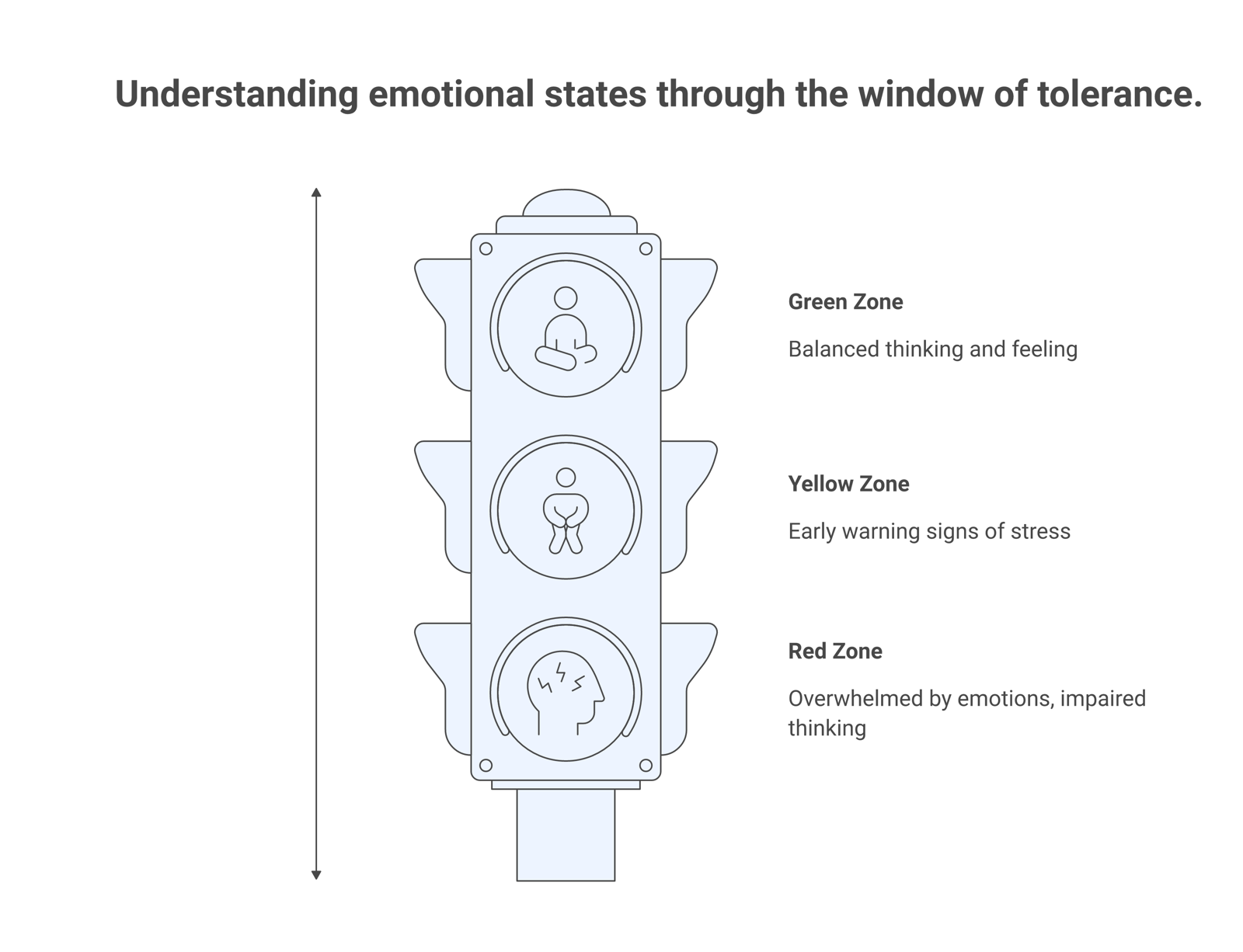
A simple way to track your state is a traffic-light model. Green is regulated, the window itself, where thinking and feeling work together. Yellow is the early warning zone, where the body starts to signal stress before the mind catches up. Red is flooded, where the amygdala has taken over and the thinking brain is largely offline.
The skill is to notice yellow. The body almost always speaks first: a tight chest, a clenched stomach, hands that grip, a jaw that sets, a quickening breath. These are not signs of weakness. They are early data. Catching them gives you a window of a few seconds to act before the system tips into red.
This is the practical heart of it: it is far easier to step back into the green zone from yellow than to climb back from red. Once you are flooded, reasoning with yourself barely works, because the part of the brain that reasons is not fully online. So the whole game is to act early, at the first yellow signal, rather than waiting until you have already said or sent something you cannot take back.
Why staying in the window matters for your case and your child
Staying regulated is not only about feeling better, though it does help you feel better. It has two concrete payoffs in an alienation situation.
The first is how you are seen. A targeted parent often arrives at court, mediation, or an exchange carrying real and justified distress, and that distress can read badly to a neutral observer who does not know the history. A parent who stays in the window reads as the steady one. Preparing for those high-stakes moments is partly emotional rehearsal, which the page on how to prepare for child custody mediation discusses.
The second payoff reaches the child. Clinicians who study these families point out that one regulated adult can steady an entire system, the way one calm animal settles a startled herd. When a child is dysregulated or hostile, a parent who stays in the window becomes the safe, stable presence the child can eventually orient toward. Your regulation is not just self-care. It is part of the repair.
The Four Elements: tools to come back
When you catch yourself sliding toward red, a small set of grounding tools can bring you back. One memorable version, often taught as the Four Elements, gives you four quick moves you can do almost anywhere.
Earth is grounding. Feel your feet on the floor and your weight in the chair, and name a few things you can see around you. This orients you to the present and the fact that, right now, you are safe. Air is breathing. Slow the breath down, for example in for four counts, a short hold for two, out for four. A longer exhale tells the nervous system the threat has passed. Water is about the mouth: under stress it goes dry, so gently generating a little saliva sends the body a quiet signal of safety. Light is a rehearsed calm image paired with gentle bilateral movement, such as the butterfly hug, crossing your arms and slowly tapping your shoulders left and right while you picture a place where you feel at ease.
None of these tools involve causing yourself discomfort, and that is deliberate. Healthy regulation works by signaling safety to the body, not by shocking it. Used together, even for a minute, the Four Elements can move you from yellow back toward green so you can respond from your thinking brain again.
Building the skill before you need it
Regulation is a skill, which means it is built with practice, not summoned on demand. The best time to practice the Four Elements is when you are already calm, so the moves are familiar when a hard moment comes. A tool you have rehearsed in green is one you can actually reach for in yellow.
Two habits support the skill. One is an honest look at your inner voice. The way you talk to yourself before a stressful event tends to set the script you follow during it; a steady, realistic inner voice is easier to hold onto under pressure than a catastrophic one. The other is professional support. A therapist can help you build regulation in a lasting way, especially if trauma is part of the picture, which the page on therapy for alienated parents covers. For the larger project of becoming the steady center of your own life again, see becoming the anchor and finding your values first.
Frequently asked questions
What is the window of tolerance?
The window of tolerance, a term from psychiatrist Dan Siegel, is the state in which your nervous system is settled enough to think clearly and feel your emotions at the same time. Inside it you can respond thoughtfully; outside it, in fight-or-flight, the thinking brain goes largely offline and you react instead.
How do you stay in your window of tolerance?
You notice the early body cues that signal stress, the yellow zone, and act before you tip into being flooded. Grounding tools like the Four Elements, slow breathing, feeling your feet on the floor, and a rehearsed calm image, help bring you back. Acting early, at the first signal, is the key.
What are the Four Elements grounding techniques?
They are four quick moves: Earth (ground through your feet and orient to the room), Air (slow, paced breathing with a longer exhale), Water (gently generate saliva to signal safety), and Light (a rehearsed calm image paired with gentle bilateral tapping, like the butterfly hug). They work by signaling safety to the body.
How do you calm down before court or an exchange?
Rehearse a grounding routine in advance so it is familiar, then use it in the moment: slow your breathing, feel your feet, and picture a calm place. Treat the preparation as emotional rehearsal, picturing the hard moment and yourself staying steady, so the steadiness is available when you need it.
Why do I lose my temper or freeze under stress?
Because under enough stress the nervous system drops out of the window of tolerance and into a survival state, where the reasoning brain is not fully online. Losing your temper or freezing is the body doing what it does under threat, not a character flaw. The skill is catching the early signs and coming back.
What this page does not do
This page does not replace professional mental-health care, and it does not promise that staying regulated will change the outcome of a case. It does not recommend any technique that uses pain or discomfort, because healthy regulation works by signaling safety, not by shocking the body. It is general information, not clinical advice.
Sources and further reading
- Siegel, D. J. The window of tolerance. drdansiegel.com
- American Psychological Association. Stress effects on the body. apa.org/topics/stress
- National Center for Biotechnology Information (NIH). Physiology, stress reaction. ncbi.nlm.nih.gov/books/NBK541120
If you or your child are in crisis
Free and confidential help is available right now.
- 988 Suicide and Crisis Lifeline. Call or text 988. 988lifeline.org
- Childhelp National Child Abuse Hotline. 1-800-422-4453. childhelp.org
- NAMI HelpLine. 1-800-950-6264. nami.org/help
Last reviewed: 2026-06-10. Author: Alex Buckles (PAC Founder). Editorial review: held to the PAC Editorial Standards (balance, primary-source citation, reader safety); an independent expert review board will be appointed.