

This page is general information for attorneys, not legal advice, and it does not create an attorney-client relationship. It does not address any one state’s procedure or rule. Practitioners should follow the law and local rules of their own jurisdiction.
A motion for custody evaluation asks the court to appoint a neutral expert to assess the family and report back. In a suspected alienation case, a sound evaluation can give the court its most comprehensive view, but only if it screens for genuine abuse as well as alienation and follows defensible methods.
A note on safety
A child’s rejection of a parent is not always alienation, and a competent evaluation never assumes it is. A sound evaluation screens for genuine abuse and family violence with the same rigor it applies to alienation, because hybrid cases, where real safety concerns and alienating behavior coexist, are common. An evaluation that screens for only one and ignores the other is not methodologically sound. If a child’s safety is at risk, contact local law enforcement or a domestic-violence resource first.
What a motion for custody evaluation is
A motion for custody evaluation asks the court to appoint a neutral professional to study the family. That professional then reports findings to the court. The evaluator is often a psychologist or another qualified mental-health professional. The evaluator interviews the parties, observes the children, and reports on the parenting issues in dispute. Some courts call this a custody evaluation. Others call it a parenting evaluation or a psychological evaluation in a custody case. The label varies, and so does the procedure for requesting one. The Cornell Legal Information Institute keeps a general reference on child custody and the issues courts weigh.
The defining feature of this evaluator is neutrality. The evaluator is not retained by either side to support a position. The evaluator answers to the court. That posture gives the report its weight. It is also why the judge usually has to appoint the evaluator rather than let a party hire one. An expert that one parent pays to reach a favorable conclusion carries far less weight. A competent court knows the difference.
How the motion is framed, who may file it, who pays, and how the evaluator is selected all turn on local rules. Some courts appoint from a roster. Some require the parties to agree on a name or to submit competing nominees. Because these mechanics vary so widely, this page does not state any one state’s procedure as if it were universal. The aim here is the framework, not the form.
When a custody evaluation helps a suspected alienation case
A custody evaluation earns its cost when the court needs a full, neutral view that competing affidavits cannot supply. Alienation cases are exactly the kind of dispute that defeats a paper record. Each parent submits a story. Each story holds together on its own. The child’s stated wishes may sound rehearsed to one parent and real to the other. A judge who reads the file alone cannot test which account holds up across both homes and over time.
An evaluation can test it. A neutral expert sees both parents. The expert observes the children with each parent. The expert gathers information from teachers, therapists, and other collateral sources. That expert can then describe the dynamic the court cannot see from the bench. This is the comprehensive view a sound evaluation offers. It is the single strongest reason to seek one in a contested alienation matter. For the broader picture of how courts weigh these cases, see how courts handle parental alienation.
There is a second reason, less obvious but important. Alienation can hide from plain view. A child who does well at school and has friends looks, on a quick check, like a child who is fine. A careful evaluation is built to look past that surface. A quick one stops there. The evaluation matters most where the truth is hardest to see.
The four ways an expert enters the case
Not every expert in a custody case plays the same role, and the role determines the access. Forensic psychiatrist Alan Blotcky describes four scenarios for how an expert can be involved, and the differences are decisive for what each expert can credibly say.
Scenario one, the court-appointed custody evaluator. This expert has the broadest access of the four. Appointed by the court as a neutral, the evaluator can interview both parents, see all of the children, and reach out to all of the collateral sources. The evaluator reports directly to the judge, which means the findings reach the decision-maker with the least filtering and the least bias to attack. The cost of that access is real. A full evaluation is expensive, it takes months, and, as Blotcky puts it, “almost 99.9% of the time it has to be ordered by the judge or it just won’t happen.” That is the case for the motion in a single sentence.
Scenario two, the blind consultant who educates the court. This expert reviews the matter and teaches the court about the relevant science without examining the parties. The role is neutral and useful for framing, but it carries no independent access to the family.
Scenario three, the behind-the-scenes consultant to the attorney. This expert supports counsel directly, helping shape strategy, questions, and the reading of the other side’s evaluation. The support is full, but this expert is not a witness and offers no independent diagnosis.
Scenario four, the retained testifying expert. This expert testifies, but a credible one will not offer a definitive diagnosis of a parent or child the expert has never interviewed. Without access to all parties, the testimony is the most open to cross-examination on exactly that gap. For more on the testifying role, see parental alienation expert witness, and on the underlying qualifications, see parental alienation forensic psychologist.
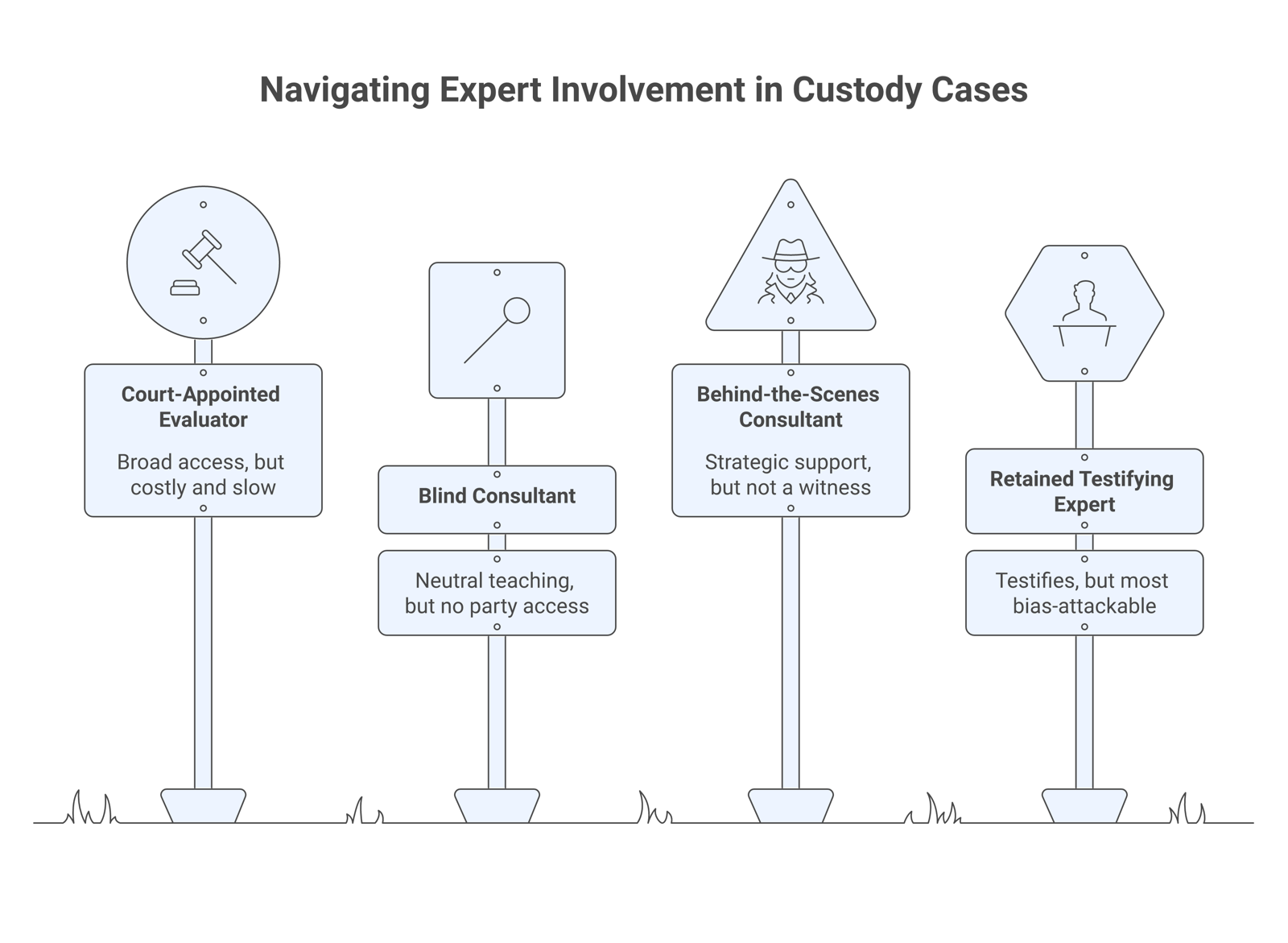
The comparison explains why the motion exists. The role with the most comprehensive access and the least vulnerability to a bias attack is the one the parties almost never control. It comes from the court.
What a competent evaluation includes
A competent custody evaluation is defined by its method, not by its conclusion. The professional standards in the field describe what that method looks like, and an attorney can read an evaluation against them. The APA Guidelines for Child Custody Evaluations in Family Law Proceedings and the AFCC Model Standards of Practice for Child Custody Evaluation set out the expectations.
A sound evaluation uses multiple methods rather than any single source. It interviews both parents, not one. It includes all of the children at issue, not a convenient subset. It involves direct observation of each parent with the children. That matters, because what people report about themselves and what an observer sees are not always the same. It gathers collateral sources: the teachers, treating clinicians, and others who see the family outside the litigation. Where useful, it adds psychological testing, read with care rather than treated as a verdict.
A competent evaluation also screens for genuine abuse and family violence, not only for alienation. This is not a side note. Hybrid cases, where a real safety concern and alienating behavior both exist, are common. An evaluation that looks for one while ignoring the other reaches an unreliable result. The discipline of screening in both directions is what separates a defensible evaluation from a partisan one. For the clinician’s view of how the work is conducted, see the companion page on the parental alienation custody evaluation, and for the client-facing preparation, see preparing for a custody evaluation.
Cost, time, and access tradeoffs
The court-appointed evaluation buys the best access, and it costs the most in money and time. A full evaluation runs up real fees and unfolds over months, not weeks. Who pays varies by jurisdiction and by order. Some courts split the cost. Some assign it to one party. Some draw on a public roster for low-income parties. Because these terms differ so much, no single figure or rule belongs on a national page.
The other expert roles trade access for speed and cost. A blind consultant who educates the court is faster and cheaper, but reaches no finding of its own about the family. A behind-the-scenes consultant supports counsel well, but cannot testify to a diagnosis. A retained testifying expert can be hired quickly, but the lack of access to all parties caps what the expert can credibly say. The choice among these is a real cost-benefit call. The right answer depends on what the court actually needs to decide. When the core question is the family dynamic across both homes, the full evaluation is usually worth its price, even at the cost of months of delay.
The timeline itself carries weight in an alienation case, where dynamics can harden while the case waits. That tension does not argue against the evaluation. It argues for moving for it early, when the court still has time to use the result.
Methodological red flags evaluators make in alienation cases
Even a credentialed, court-appointed evaluator can produce a flawed report, and alienation cases expose a specific failure mode. The most common one is the encapsulation problem, sometimes called the Warshak fallacy. A child caught in alienation can function well in the visible parts of life. The child does well at school, keeps friends, and seems untroubled. An evaluator may treat that ordinary functioning as proof that nothing is wrong. The evaluator then concludes the child is “fine” and misses the alienation entirely. The trouble is that the dysfunction is encapsulated around the rejected parent. Ordinary functional assessment does not reach it. An evaluation that screens only for global impairment is built to overlook the very thing it was ordered to find.
A related risk is overreliance on clinical intuition. The point lands hard in the field. Long experience does not immunize an evaluator against error, and even a veteran with thousands of evaluations behind them can read a case wrong. As one practitioner frames it, five thousand evaluations is no guarantee of accuracy in the next one. Intuition that is not disciplined by method and corroboration is exactly where confident evaluators go astray.
The third red flag is one-sided screening, the mirror image of the safety point made earlier. An evaluator who arrives sure the case is alienation may underweight genuine abuse. An evaluator sure it is abuse may dismiss real alienating behavior as a justified response. Either error produces a report that cannot be trusted. The mark of a sound evaluation is that it tested both hypotheses and showed its work.
How to support a sound evaluation
The attorney’s job around an evaluation is to enable a defensible one, not to engineer a favorable one. The honest, non-weaponized approach follows a clear sequence.
- Identify the genuine need. Confirm that the court actually requires a comprehensive neutral view, rather than a narrower question a consultant or a focused hearing could answer.
- Move for appointment and propose scope. Ask the court to appoint a qualified neutral and frame the questions the evaluation should address, including both alienation and any safety concerns, so the evaluator screens in both directions.
- Give the evaluator complete access. Make the client, the children, and the records available, and identify collateral sources honestly rather than curating a flattering subset. An evaluation built on partial access is easy to discredit.
- Let the neutral work. Resist the urge to steer the evaluator. The value of the report is its independence, and any attempt to manage it toward a result undermines the very weight the appointment was meant to create.
- Assemble the supporting record in parallel. A clean, organized factual record helps the evaluator and the court alike. See building a parental alienation case file for that work.
When the question shifts to challenging an evaluation, the discipline is the same, applied in reverse. Obtain the complete expert file: the raw data, the notes, and the testing protocols, not just the polished report. Gaps and shortcuts hide in that underlying material, the way they do in a medical-malpractice review. Test the methodology against the published standards. Probe admissibility under the governing reliability standard. In many courts that means a Daubert analysis of whether the methods are sound and properly applied. Where the stakes justify it, a second qualified expert can review the same data. The bracketing of two experts often surfaces where the first analysis broke down. A weak evaluation fails on method, and method is where a careful challenge lives.
Frequently asked questions
What is a motion for custody evaluation?
A motion for custody evaluation is a request asking the court to appoint a neutral expert to assess the family and report findings to the court. The evaluator, usually a psychologist or qualified mental-health professional, interviews the parties, observes the children, and addresses the disputed parenting issues. The procedure for requesting one varies by jurisdiction.
When should you request a custody evaluation?
A custody evaluation helps when the court needs a comprehensive, neutral view that competing affidavits cannot provide. Suspected alienation is a strong candidate, because the dynamic is contested and hard to see from the bench. Requesting one early gives the court time to use the result, since a full evaluation can take months.
What does a custody evaluation include?
A competent evaluation uses multiple methods. It interviews both parents, includes all the children at issue, observes each parent with the children, gathers collateral sources such as teachers and treating clinicians, and uses psychological testing where appropriate. It also screens for genuine abuse and family violence, not only for alienation, because hybrid cases are common.
How much does a custody evaluation cost?
A full court-appointed evaluation is expensive and takes months, though the exact cost varies widely by jurisdiction, scope, and evaluator. Who pays also varies, and a court may split the cost, assign it to one party, or draw on a public roster. Narrower consulting roles cost less but offer far less access.
Can you challenge a custody evaluation?
Yes. A flawed evaluation can be challenged on methodology, scope, bias, and admissibility. Effective challenges start with the complete expert file, the raw data and notes, not only the report, test the work against published standards, probe reliability under the governing admissibility standard, and may use a second expert to review the same data.
What this page does not do
This page is general information for attorneys, not legal advice. It does not state any one state’s procedure or rule as if it were universal, and it does not tell anyone how to coach a client or steer an evaluation toward a result. Choices about whether and how to move for an evaluation belong to counsel working with the real facts and local rules. The page also does not frame the evaluation as a weapon against the other parent. The sound use of a custody evaluation is the neutral, methodologically defensible, child-centered one.
For how the evaluation is conducted, see the parental alienation custody evaluation page. For the expert’s qualifications, see parental alienation forensic psychologist. For the supporting record, see building a parental alienation case file. The full For Professionals hub covers the rest.
Sources and further reading
- American Psychological Association. Guidelines for Child Custody Evaluations in Family Law Proceedings. apa.org/practice/guidelines/child-custody
- Association of Family and Conciliation Courts. Model Standards of Practice for Child Custody Evaluation. afccnet.org
- Cornell Legal Information Institute (Wex). Child custody. law.cornell.edu/wex/child_custody
If you or your child are in crisis
Free and confidential help is available right now.
- 988 Suicide and Crisis Lifeline. Call or text 988. 988lifeline.org
- Childhelp National Child Abuse Hotline. 1-800-422-4453. childhelp.org
- NAMI HelpLine. 1-800-950-6264. nami.org/help
Last reviewed: 2026-06-08. Author: Alex Buckles (PAC Founder). Editorial review: held to the PAC Editorial Standards (balance, primary-source citation, reader safety); an independent expert review board will be appointed.