

How courts handle parental alienation has shifted from diagnosing a syndrome to finding documented behaviors, then matching a remedy to assessed severity. Family courts in the United States and Canada respond along a spectrum, from no action through graduated counseling and sanctions to custody reversal. The finding model a court uses predicts the action it takes.
General information, not legal advice
This page is educational information for licensed family-law attorneys and for informed parents working with counsel. It is not legal advice and does not create an attorney-client relationship. Family law and procedure vary materially by jurisdiction. Nothing here substitutes for a licensed attorney admitted in the relevant jurisdiction.
A note on abuse and estrangement
A child’s rejection of a parent is not always alienation. Where the rejected parent has been abusive, neglectful, or genuinely dangerous, the child’s distancing is justifiable estrangement, not parental alienation. The two are distinct and must not be conflated. Courts that miss this distinction err in the opposite direction from the type-II errors discussed below.
The shift from labels to behaviors
The most consequential change in how courts handle parental alienation is the move away from requiring a syndrome diagnosis. A court can find alienation and order relief based on a documented pattern of conduct, without an expert testifying that the child has a disorder.
Attorney Ashish Joshi, author of Litigating Parental Alienation: Evaluating and Presenting an Effective Case in Court (American Bar Association, 2021), frames the courtroom task in three sequential goals. Goal 1 is to convince the trier of fact that parental alienation is a real, studied phenomenon rather than an esoteric theory. Goal 2 is to convince the trier that it is occurring in the specific case. Goal 3 is to convince the trier that the child needs proper and timely intervention. Each goal is a precondition for the next, and Joshi’s recurring observation is that cases fail when counsel leaps to relief without first laying the conceptual ground.
A practical corollary runs through current practice: talk about behaviors, not labels. Litigants who arrive with diagnostic shorthand (narcissist, abuser, syndrome) but no fact pattern tend to lose. Litigants who arrive with a documented behavior pattern, organized and corroborated, do better. The shift is also visible in conference-stage research. Forensic researcher Shawn Wygant’s parental alienation child abuse model draws a clean line: parental alienation is the set of acts by the favored parent, while the symptom cluster that may or may not appear in the child afterward is downstream. Courts that wait for the syndrome before acting miss cases where the conduct is established but the child has not yet visibly turned. For the evidence framework that supports a behaviors-first record, see building a parental alienation case file, and for the practitioner hub see For Professionals. This page is the attorney-audience treatment of case patterns; the parent-facing companion on judicial attitudes sits at how judges view parental alienation.
Two finding models, two action rates
The broadest case-coding effort to date comes from Wygant and colleagues, who coded 1,259 of 1,452 appellate cases across all fifty states and the District of Columbia using a three-coder protocol. The work was presented at the Parental Alienation Study Group conference in October 2025 and has not yet been published in a peer-reviewed journal, so every figure below is preliminary and may change on publication. In the coded sample, parental alienation was found in roughly 55% of cases where it was alleged. Among the cases where it was found, two distinct frameworks were in use.
About 72% of found-alienation cases applied the older symptoms model, which looks for the syndrome in the child before naming the problem. About 28% applied a behaviors-plus-child-psychological-abuse model, which treats exposure to alienating conduct as the threshold. The action rates diverged sharply. Courts using the behaviors model took protective action in roughly 99% of found cases. Courts using the symptoms model acted less often, and sometimes declined to act precisely because the symptoms were already so entrenched.
Across the not-found cases, the study identified a type-II error rate of about 22%: real alienation present, missed by the court. That figure is the central practitioner takeaway. The framing of a claim, behaviors versus syndrome, does measurable work on the outcome. The behaviors framing rests on a recognized standard for child psychological harm, which is both easier to meet and earlier to trigger than a full syndrome presentation. The research case that alienating behaviors function as a form of coercive control and family violence is set out by Harman and colleagues in Psychological Bulletin (2018).
The documented error modes
Knowing where courts go wrong is part of reading how they decide. The record shows characteristic failure patterns in both directions.
Type-II errors: missing real alienation
Wygant’s coded sample surfaced three recurring patterns that produce false negatives. The first is the “it must be the syndrome” court, which requires the symptom cluster in the child before it will act, and so misses cases where exposure is proven but the child has not yet hardened. The second is the “too alienated to protect” court, which declines to intervene because the rejection looks so entrenched that the court doubts any order will reach the child. The third is the “both parents’ fault” court, which skips a but-for causation analysis and treats the targeted parent’s reactive frustration as morally equivalent to the favored parent’s sustained conduct. Joshi’s caution against conceding the hybrid case addresses this third pattern directly: the test is whether the targeted parent’s sub-optimal behavior caused the rejection or merely reacted to it.
Type-I errors: misclassifying affinity or estrangement
The opposite error is finding alienation where there is none. Law professor Nicholas Bala notes that a child’s temporary preference for one parent during a developmental stage is affinity or alignment, not alienation, and that misclassifying it produces false positives that damage the field’s credibility. The DV and abuse caveat at the top of this page is the other half of the same discipline. A cut-off driven by genuine abuse is justifiable estrangement, and labeling it alienation is itself an error. Child age and temperament are first-order factors in any sound assessment, and the clinical side of that screen is covered on the identifying parental alienation companion.
The credibility gap
A structural pattern shapes many findings before the substance is reached. A recurring practitioner observation, summarized as the “four A’s versus four C’s,” describes how the two parents typically present. The targeted parent often appears angry, anxious, agitated, and afraid, an understandable response to prolonged conflict but a corrosive one on the stand. The favored parent often appears cool, calm, charming, and convincing. Triers of fact are human and tend to credit the more composed party. A related effect, spontaneous trait transference, means a parent who only attacks the other side ends up wearing the negativity in the listener’s mind. The practitioner point is descriptive, not strategic. Courts respond to presentation, and the presentation gap can invert the merits if it is not anticipated.
The three camps shaping the debate
Divergent rulings make more sense once the contested field is mapped. Bala describes three camps. The first is the traditional clinical camp (associated with Bernet and Baker), which treats alienation as a child disorder and pushes for formal diagnostic recognition. The second is the critical-feminist camp, which argues that alienation is junk science used by abusive parents to gain custody, and which has driven several legislative reforms internationally. The third is a middle group (Johnston, Kelly, Fidler, Bala), which treats alienation as one concept among several, alongside affinity-alignment and justified estrangement, and which holds that most cases are multifactorial and resolve short of custody reversal.
Hybrid cases, where both alienation and intimate partner violence are present, are common rather than exceptional. Bala’s position is that the most effective response to hybrid cases is judge-by-case adjudication on the evidence rather than a legislative ban, a frame he summarizes as “trust the judges.” For a practitioner, the camps explain why a claim that succeeds before one bench may meet open skepticism before another, and why building Goal 1 (alienation is real and studied) cannot be assumed away.
The remedy spectrum
Courts that find alienation do not reach for one remedy. They select from a graduated spectrum keyed to severity, and the most common response is far milder than the public imagination suggests. Bala’s account of Canadian and US trial practice is that the typical judicial response is more time to the rejected parent plus community-based family-systems counseling, not custody reversal.
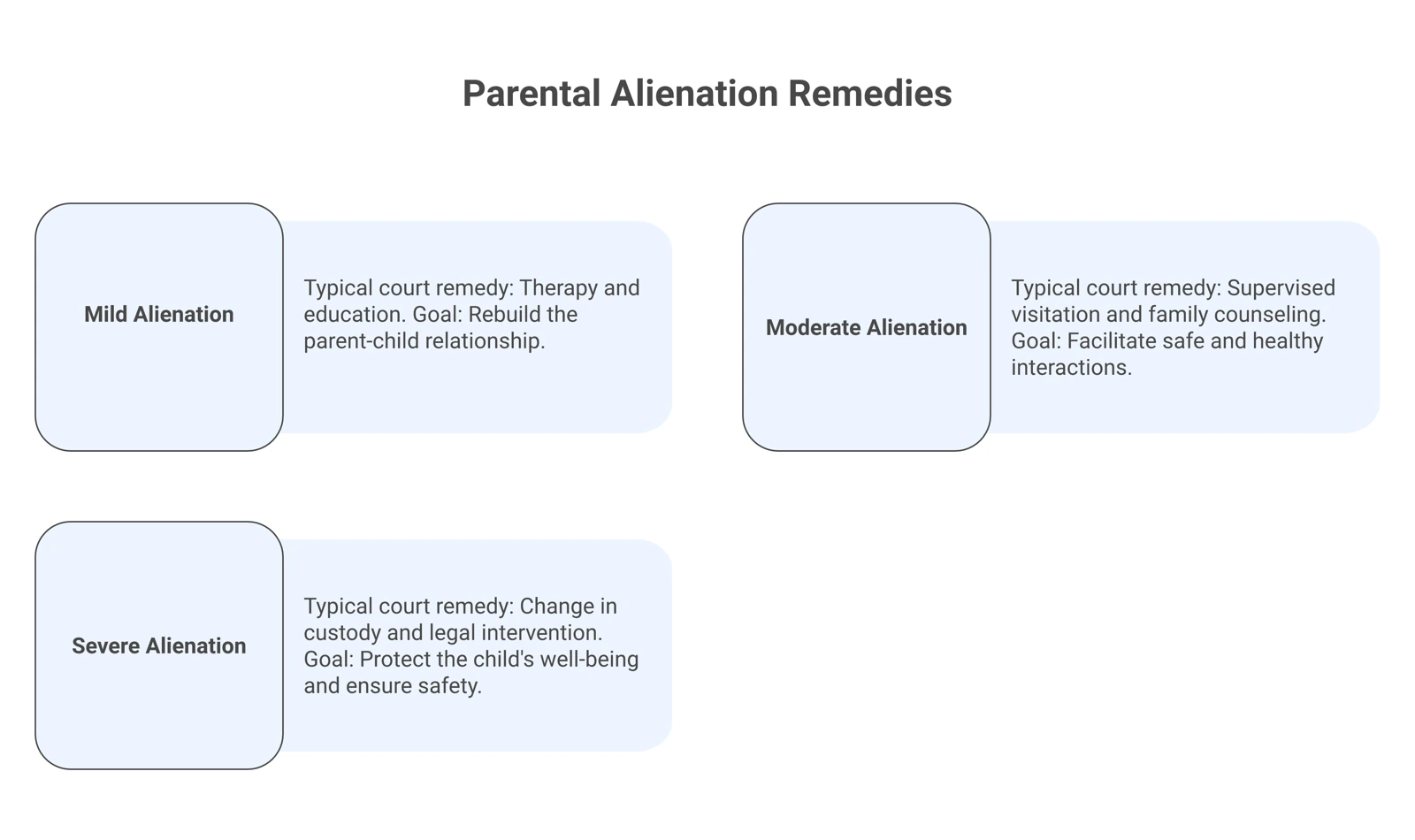
| Severity | Typical court response | Goal |
|---|---|---|
| Mild | More time to the rejected parent; parenting-coordination order; psychoeducation | Arrest the pattern early; preserve the relationship |
| Moderate | Makeup time; counseling with a directive (not alliance-based) structure; graduated financial sanctions for order violations; modified decision-making | Enforce the order; rebuild contact; deter interference |
| Severe | Structured reunification program with a defined protective no-contact period; in some cases custody modification or reversal | Treat as child protection; interrupt ongoing harm |
Two framework anchors inform the severe end, and both now operate against a changed statutory backdrop. Joshi’s Goal 3 argues that specialized reunification programs are established and outcome-studied rather than radical, and that a court-ordered no-contact period during such a program is therapeutic rather than punitive. Counsel should know the limits of that argument: the intensive programs’ outcome studies are program-affiliated self-report without control groups, and the federal Keeping Children Safe From Family Violence Act, known as Kayden’s Law (Title XV of the Violence Against Women Act Reauthorization of 2022), now gives states grant incentives to restrict court-ordered reunification treatment, with Colorado, California (Piqui’s Law), Pennsylvania, and Utah adopting conforming laws as of mid-2026; see Kayden’s Law. Brian Ludmer, drawing on Justice Gomery’s 1991 foundational principles, argues that severe alienation should be treated as a child-protection matter rather than a custody dispute, that failed conventional therapy is itself diagnostic of the dynamic, and that a conscripted child’s stated wishes cannot be read as the child’s authentic voice while the child remains in the alienating environment. Ludmer also documents the common failure modes of court-ordered systemic therapy, including pacing that is too slow and therapy that silos the child away from the targeted parent. For the parent-facing treatment of building a court record, see how to prove parental alienation.
The role of expert witnesses
Experts are not always required, but they shape contested and severe cases. Forensic practice maps four distinct ways a mental-health expert appears, each with its own value and cost.
The first is the court-appointed custody evaluator, who has the most comprehensive view (both parents, the children, collateral sources) and whose written report often sits at the top of the decision stack, but whose appointment usually requires a court order and significant time and money. The second is the blind consultant to the court, retained by neither party, who educates the bench on general principles and is largely insulated from “hired gun” attacks. The third is the behind-the-scenes consultant to the rejected parent’s attorney, who never testifies but trains counsel on the behaviors, the diagnostic factors, and cross-examination of an opposing evaluator. The fourth is the retained testifying expert, who reviews the record and addresses both general principles and a case-specific narrative.
A central limitation governs the fourth scenario: an expert who has not interviewed the favored parent and the children should avoid offering an explicit diagnosis, because the data to support one are absent. This caution matters for admissibility. Joshi’s Goal 1 treats expert testimony like Daubert-style foundation work, with adequate trial time, full voir dire, and the expert’s credentials and publications established before the substantive opinion. The reverse caution holds too: a treating clinician describes what was observed and should not offer a forensic diagnostic opinion on alienation. The American Psychological Association’s guidance on divorce and child custody is a useful general anchor on what evaluators weigh.
What the outcome record shows
The empirical record on outcomes is thinner than the volume of litigation, but it is not empty. The most-cited follow-up is the Birnbaum and Bala study (2024), which interviewed six children years after court-ordered custody reversals, drawn from sixty-seven reported Ontario cases with a judicial finding of alienation. All six children were reported to be doing well, and all said the judge had been right to force the change even though they had fought it at the time. The most counterintuitive finding was that many formerly favored parents dropped out of the children’s lives after losing custody, not because of any order, but because they disengaged once the court ruled against them. The targeted parents in the study supported continued contact with the formerly favored parent.
The sample is small, and the page presents it as a limited but real anchor rather than population data. Ludmer’s developmental point adds weight on the severity question: a child who exits childhood unable to feel empathy for a previously loved parent has experienced a failed developmental task, which is evidence of ongoing harm rather than a transient phase. Read together, the outcome record cautions against the “too alienated to protect” reflex while warning against treating reversal as a default. The common case is not the dramatic one.
What the case-law dataset shows
A larger window on judicial behavior comes from a published case-law study by Demosthenes Lorandos (Family Court Review, 2020), who searched US family-court decisions from 1985 to 2018 for “alienat*” near a family term. The raw pull of roughly 3,555 cases was narrowed, by conservative coding that kept only cases where an independent evaluating expert testified on alienation or the court raised it on its own, to about 1,181 decisions. It is one dataset with defensible but debatable coding choices, and it is best read as a map of how courts have actually treated the concept rather than as the last word.
Two findings matter most for practitioners. First, alienation is litigated and acted on far more than the “inadmissible fringe theory” narrative suggests: the cases rise over time, and courts ordered a substantial change in custody or parenting time in a large share of the coded decisions. Second, and most pointed, the study reports that none of the thousands of cases reviewed took a child away from a protective mother and handed the child to a physically abusive father. That single finding is the proponent side’s direct evidentiary answer to the most serious criticism of the field, the fear that an alienation claim is routinely used to strip children from protective parents. The counterpoint has its own dataset: Joan Meier’s 2020 national study of published custody opinions found that a father’s alienation cross-claim roughly doubled the rate at which mothers alleging abuse lost custody (from 26% to 50%) and made courts far less likely to credit the mother’s abuse claim. The Harman-Lorandos critique of Meier and Meier’s rebuttal remain an unresolved methodological standoff, which is why the honest framing is that the Lorandos dataset rebuts the categorical version of the charge without claiming the system never errs. For the wider scientific dispute, see is parental alienation junk science.
Frequently asked legal questions
How do courts decide parental alienation cases?
Courts in the US and Canada increasingly find alienation on a documented pattern of behaviors rather than on a syndrome diagnosis, then match a remedy to the assessed severity. The framing matters: in Wygant’s appellate sample (an unpublished October 2025 conference presentation, not yet peer reviewed), courts using a behaviors-plus-child-abuse model acted in about 99% of found cases, while courts requiring the syndrome acted less often. Jurisdiction, the bench, and the quality of the record all shape the result, and outcomes vary materially by jurisdiction.
What remedies do courts order for parental alienation?
A spectrum keyed to severity: no action; more time to the rejected parent; parenting-coordination and counseling orders; makeup time and graduated financial sanctions for order violations; modified decision-making; structured reunification programs with a defined protective no-contact period; and, in severe cases, custody modification or reversal. The most common response is more time plus family-systems counseling, not reversal.
Do courts always reverse custody in parental alienation cases?
No. Reversal is reserved for severe cases. Bala’s account of trial practice is that the typical judicial response is increased time to the rejected parent combined with community-based counseling. Reversal is a high-severity remedy, not a default.
What happens after a court orders custody reversal?
The limited follow-up data (Birnbaum and Bala, 2024; six children interviewed years after the orders) found the children doing well and endorsing the change in hindsight, although many formerly favored parents withdrew from contact after losing custody. The sample is small and self-selected, so the finding is suggestive rather than definitive.
Is an expert witness required for a court to find parental alienation?
Not always. Some courts find alienation on behavioral evidence without an expert diagnosing a syndrome. Experts strengthen contested and severe cases, and a retained expert who has not interviewed all parties should avoid an explicit diagnosis. The decision to retain an expert, and in which of the four roles, belongs to counsel in the relevant jurisdiction.
Where to go next
- For the practitioner hub, see the For Professionals pillar.
- For the case file and the evidence framework that build a behaviors-first record, see building a parental alienation case file.
- For the clinical identification companion, see identifying parental alienation.
- For the parent-facing court companion, see how to prove parental alienation and the Court pillar.
Sources cited
- Joshi, A. S. (2021). Litigating Parental Alienation: Evaluating and Presenting an Effective Case in Court. American Bar Association. americanbar.org
- Harman, J. J., Kruk, E., & Hines, D. A. (2018). Parental alienating behaviors: An unacknowledged form of family violence. Psychological Bulletin, 144(12), 1275 to 1299. https://doi.org/10.1037/bul0000175
- Lorandos, D. (2020). Parental alienation in U.S. courts, 1985 to 2018. Family Court Review, 58(2), 322 to 339.
- Meier, J. S., Dickson, S., O’Sullivan, C., Rosen, L., & Hayes, J. (2020). U.S. child custody outcomes in cases involving parental alienation and abuse allegations: What do the data show? Journal of Social Welfare and Family Law, 42(1), 92 to 105.
- Birnbaum, R., and Bala, N. (2024). A retrospective study of outcomes of custody reversal in parental alienation cases. University of New Brunswick Law Journal, 75, 62 to 95. journals.lib.unb.ca
- Wygant, S., et al. (2025). Parental alienation child abuse model: appellate case-coding study. Presented at the Parental Alienation Study Group conference, October 2025. Unpublished conference presentation; not peer reviewed.
- Keeping Children Safe From Family Violence Act (Kayden’s Law), Title XV, Violence Against Women Act Reauthorization Act of 2022, Pub. L. 117-103, codified at 34 U.S.C. 10446(k).
- American Psychological Association. (n.d.). Divorce and child custody. apa.org/topics/divorce-child-custody
If you or your child are in crisis
Free and confidential help is available right now.
- 988 Suicide and Crisis Lifeline. Call or text 988. 988lifeline.org
- Childhelp National Child Abuse Hotline. 1-800-422-4453. childhelp.org
- NAMI HelpLine. 1-800-950-6264. nami.org/help
Last reviewed: 2026-06-10. Author: Alex Buckles (PAC Founder).