

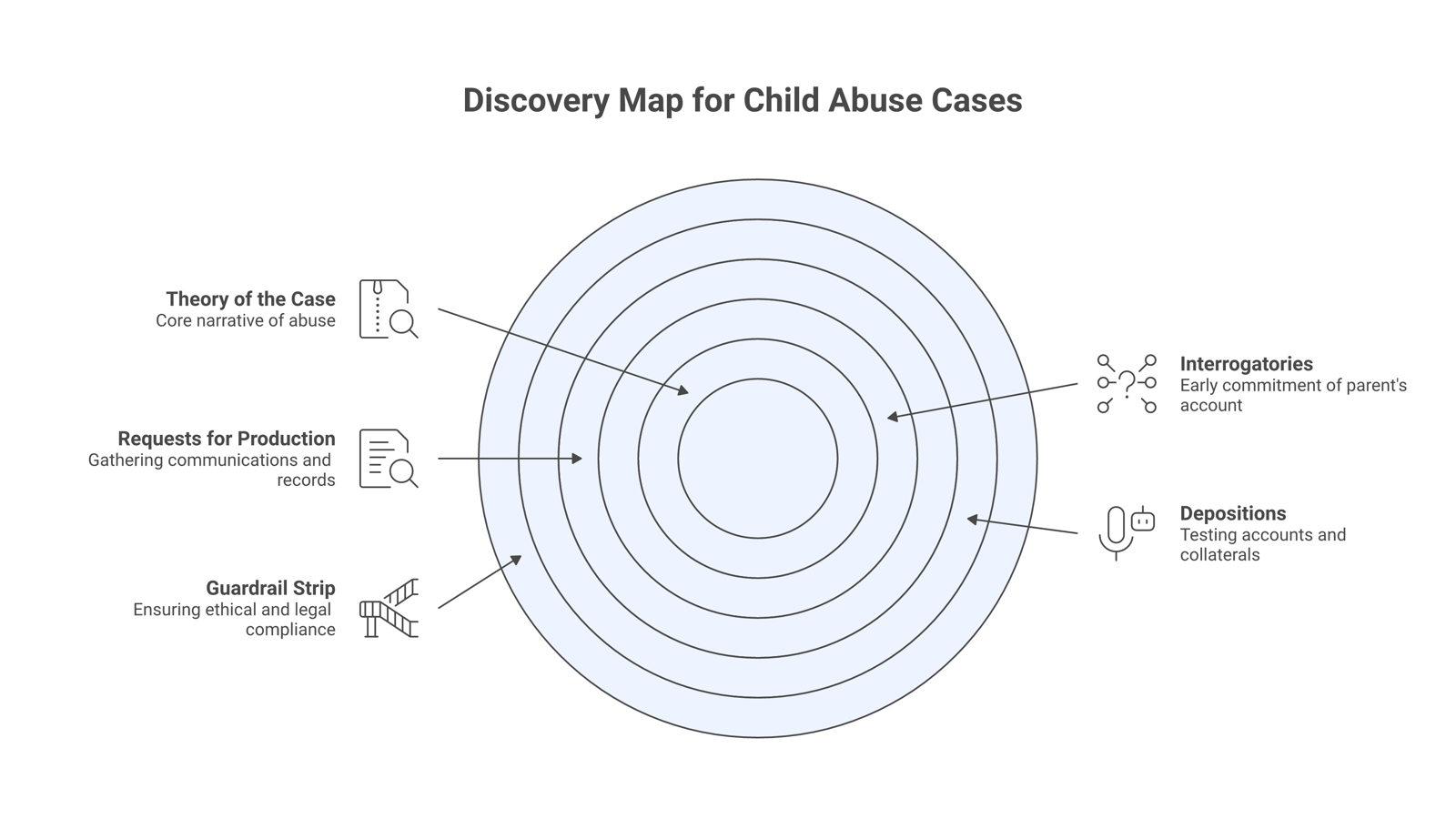
Discovery in parental alienation cases targets the pattern: interrogatories that pin down the favored parent’s account, document requests for communications and app data with a clean authentication chain, depositions of the favored parent and collaterals, and careful subpoenas to therapists and schools. Proportionality discipline matters as much as coverage, because scorched-earth discovery damages the client, the child, and the theory.
A note on purpose and misuse
Discovery exists to find facts, not to exhaust an opposing party. In family cases the line matters doubly: abusive litigants on either side use discovery as a harassment instrument, and a child’s distancing caused by genuine abuse is estrangement, not alienation, a distinction counsel must hold honestly through discovery rather than build a record to obscure. Discovery that surfaces abuse evidence against the client’s theory is information counsel needs, not a problem to bury.
This page is general professional information, not legal advice. Discovery rules, privilege law, and protective-order practice vary by state, and many family courts apply local rules and standing orders that depart from the civil default. It does not create an attorney-client relationship. Counsel must verify the law of the relevant jurisdiction before acting.
Discovery follows the theory of the case
Alienation litigation rewards counsel who treat discovery as proof of a pattern rather than a fishing expedition. The leading identification frameworks in the field, Baker’s four-factor model and the Bernet and Greenhill Five-Factor Model, are clinical constructs rather than legal elements, but they map usefully onto what a court will need to see: a prior positive relationship between the child and the now-rejected parent, the absence of abuse or neglect by that parent, a documented pattern of alienating behaviors by the favored parent, and the child’s own behavioral presentation. Counsel should also remember the frameworks are contested; discovery built to withstand a methodological cross is discovery built around conduct, dates, and documents, not labels.
That mapping disciplines everything that follows. Each interrogatory, request, and deposition hour should connect to one of those propositions or to a damages, remedy, or credibility issue. The intake-to-evidence pipeline that feeds this work is covered in building a parental alienation case file, and the broader litigation arc in litigating parental alienation.
Interrogatories: commit the account early
Interrogatories are cheap, limited in number in most jurisdictions, and best spent locking the opposing parent into specifics that later documents can confirm or contradict. Productive territory includes the parent’s complete account of why the child resists contact, with every incident, date, and witness identified; every communication channel the household uses with and about the child; the identity of every adult who has discussed the case or the other parent with the child; every therapist, school contact, coach, and physician with knowledge; and the factual basis for each allegation made against the client.
The drafting principle is contrast. A parent whose interrogatory answers attribute the child’s rejection to a vague history of fear, but whose contemporaneous messages show scheduling sabotage and disparagement, has built the cross-examination personally. Vague answers are themselves useful: they narrow the universe of justification evidence the other side can later produce without explaining the omission.
Requests for production: communications, app data, and the authentication chain
Document requests carry the heaviest load, because alienating conduct now lives in writing. Core categories include direct parent-to-parent communications across every channel; communications between the favored parent and the child during the other parent’s scheduled time; communications with third parties about the targeted parent or the child’s contact; co-parenting-app records, which platforms such as court-recognized parenting apps maintain with server-side time stamps; calendar and scheduling records; school and activity sign-ups and notification settings that show who was listed and who was omitted; and social-media content concerning the other parent or the litigation.
Two disciplines separate usable production from a pile. First, request native formats and metadata where the jurisdiction’s rules support it, with screenshots accepted only as a supplement; authenticity disputes are won at the request stage. Second, plan the authentication chain at the same time the request is drafted: who will testify the record is what it claims, what certification a provider or records custodian can supply, and how integrity is preserved from production to exhibit. That chain, through Federal Rule of Evidence 901 and its state analogues, is treated in depth in the companion page on digital evidence in custody disputes, including the text of Rule 901.
Device-level discovery, including forensic imaging of phones, is available in some circumstances but sits at the intrusive end of the spectrum. Courts increasingly expect a showing of need, a protocol, and a neutral examiner, and a motion for unrestricted access to a parent’s devices reads as harassment. Tailor by custodian, channel, and date range.
Depositions: the favored parent and the collaterals
The favored parent’s deposition is usually the centerpiece, and its goal is frequently misunderstood. The purpose is not confrontation; it is commitment and demonstration. Counsel wants the parent’s full narrative on the record, every justification for every missed exchange, every account of what the child has been told, locked in before the documentary record is deployed. Where the dynamic includes coaching, the deposition can also let the pattern show itself: rehearsed phrasing, claimed inability to influence the child paired with documented total control of the child’s schedule and communications, and warmth that collapses into rigidity when the questions reach specific dates.
Collateral depositions, or their cheaper cousins, records subpoenas plus short depositions, serve a different function: they test which parts of the favored parent’s account survive contact with neutral witnesses. Teachers, coaches, exchange supervisors, relatives, and household members often hold the small, dated observations that either corroborate a coached-rejection theory or undercut it. Counsel should want the answer either way, and should prepare the client for the possibility that collaterals corroborate the other side. Deposing children is disfavored across jurisdictions, often requires leave of court, and is rarely worth the harm; the child’s voice generally enters through forensic and best-interests channels instead, as discussed in how courts handle parental alienation.
Subpoenas to therapists and schools: privilege first
Third-party subpoenas in these cases run straight into privilege and confidentiality law, and the variation across jurisdictions is wide enough that only general observations are safe.
Therapist records sit behind the psychotherapist-patient privilege, recognized in federal law by Jaffee v. Redmond, 518 U.S. 1 (1996), and by statute in every state, each with its own exceptions, waiver doctrines, and procedures. A child’s privilege raises a further layer: who may assert or waive it can be contested where the parents are the adversaries, and some courts appoint a representative for exactly that question. A parent’s own therapy records may be reachable where that parent has put their mental condition in issue, or may not be. The disciplined route is the same everywhere: research the jurisdiction’s privilege law first, consider whether a release, an in camera review, or a court-appointed evaluator with records access serves the need better than a raw subpoena, and expect motions practice. School records are typically governed by FERPA and state analogues, which generally permit disclosure pursuant to a lawful subpoena or court order with notice requirements; attendance, enrollment-contact, and communication records are often more useful than counselors’ notes, and far less fraught.
A tactical warning belongs here: subpoenaing a child’s treating therapist can rupture the one stable therapeutic relationship the child has. Counsel should weigh whether the marginal evidentiary value justifies that cost, and courts notice when it plainly does not.
Expert discovery: bases, methods, and the new scrutiny
Where either side retains a mental-health expert, discovery of the expert’s bases is now among the highest-value work in the case. Counsel should obtain the complete file: everything reviewed, everything relied on, testing protocols and data where applicable, correspondence with retaining counsel within the jurisdiction’s limits, and the expert’s record of qualifications and prior testimony.
The policy environment has raised the stakes. The federal Keeping Children Safe From Family Violence Act, known as Kayden’s Law and enacted as Title XV of the Violence Against Women Act Reauthorization Act of 2022, conditions grant funding on, among other things, stricter standards for the experts courts rely on in cases involving abuse allegations, and conforming statutes have followed in Colorado, California, Pennsylvania, and Utah as of mid-2026. Whatever the forum, counsel should expect opposing experts, and their own, to face searching scrutiny of qualifications and methodology, and should build expert discovery accordingly. The courtroom side of this work is covered in parental alienation expert witness and the legislative context at Kayden’s Law.
Proportionality and the weaponization guardrail
The proportionality principle stated in Federal Rule of Civil Procedure 26, and echoed in state rules, is not a formality in family cases; it is the difference between discovery that serves a child-centered theory and discovery that becomes the abuse. The factors are familiar: importance of the issues, amount and stakes, access to information, resources, and whether burden outweighs benefit. Family courts apply the same logic through their own rules and through protective orders.
Concretely: date-limit requests to the period the theory actually covers. Sequence discovery so cheap tools narrow expensive ones. Take the depositions the theory needs, not the depositions the client’s anger wants. Do not subpoena the other parent’s employer, extended family, and dating history on a theory of general impeachment. Do not demand forensic images without a genuine, articulable need. And counsel representing targeted parents should remember the mirror image: clients can be on the receiving end of oppressive discovery, and protective orders, cost-shifting requests, and judicial management exist for both sides. Professional resources from the American Bar Association’s Section of Family Law address discovery management in high-conflict family litigation. A reputation for disciplined discovery is itself an asset before the judge who will eventually weigh the pattern evidence this work exists to assemble.
Frequently asked questions
What should discovery target in a parental alienation case?
The pattern, organized around what the court must ultimately see: the prior parent-child relationship, the screening out of abuse or neglect as the explanation, the favored parent’s documented conduct, and the child’s presentation. Communications, co-parenting-app records, scheduling documents, and collateral observations carry more weight than characterizations.
Are co-parenting app records discoverable?
Generally yes, like other electronically stored information, subject to the jurisdiction’s rules. They are often high-value because leading platforms maintain server-side time stamps and tamper-evident logs, which simplifies authentication. Request native exports or provider certifications rather than screenshots alone, and plan the authentication chain when drafting the request.
Can you subpoena a child’s therapist in a custody case?
Sometimes, but privilege law controls and varies by state. The psychotherapist-patient privilege, its exceptions, and the question of who holds a child’s privilege when parents are adversaries all require jurisdiction-specific research. Alternatives such as releases, in camera review, or an evaluator with records access are often better, and the therapeutic cost to the child weighs against raw subpoenas.
Should the alienated child be deposed?
Rarely, and in many jurisdictions only with leave of court. Deposing a child risks real harm and usually produces evidence of the script rather than the dynamic. Children’s perspectives generally enter through custody evaluations, guardians ad litem, in camera interviews where permitted, and forensic interview protocols.
How does proportionality limit discovery in family cases?
Courts can restrict discovery whose burden outweighs its likely benefit, considering the stakes, the issues, and the parties’ resources, the principle codified in Rule 26 and state analogues. In high-conflict custody litigation judges watch for discovery used as harassment, and protective orders and cost-shifting are available. Disciplined, theory-driven discovery is both ethically required and tactically stronger.
What this page does not do
This page does not supply a playbook for burying an opposing parent in process, and it is not a substitute for the rules, case law, and standing orders of any actual jurisdiction. It does not treat an alienation theory as established before discovery tests it, and it assumes counsel will follow the evidence honestly, including when the evidence points to estrangement rather than alienation. The right use of this material is as a structural checklist to adapt to the law of the forum and the facts of the case.
For the adjacent work, see digital evidence in custody disputes, building a parental alienation case file, motion for custody evaluation, and litigating parental alienation. The hub is For Professionals.
Sources and further reading
- Federal Rule of Civil Procedure 26 (duty to disclose; scope and proportionality of discovery). Legal Information Institute, Cornell Law School. law.cornell.edu
- Federal Rule of Evidence 901 (authenticating or identifying evidence). Legal Information Institute, Cornell Law School. law.cornell.edu
- Jaffee v. Redmond, 518 U.S. 1 (1996) (psychotherapist-patient privilege under Federal Rule of Evidence 501).
- American Bar Association, Section of Family Law. Resources on family law practice. americanbar.org
- Bernet, W., and Greenhill, L. L. (2022). The Five-Factor Model for the diagnosis of parental alienation. Journal of the American Academy of Child and Adolescent Psychiatry, 61(5), 591 to 594. https://doi.org/10.1016/j.jaac.2021.11.026
- Keeping Children Safe From Family Violence Act (Kayden’s Law), Title XV, Violence Against Women Act Reauthorization Act of 2022, Pub. L. 117-103, codified at 34 U.S.C. 10446(k).
If you or your child are in crisis
Free and confidential help is available right now.
- 988 Suicide and Crisis Lifeline. Call or text 988. 988lifeline.org
- Childhelp National Child Abuse Hotline. 1-800-422-4453. childhelp.org
- NAMI HelpLine. 1-800-950-6264. nami.org/help
Last reviewed: 2026-06-10. Author: Alex Buckles (PAC Founder).