

This page is general information, not legal or clinical advice. It does not create a professional relationship, and it does not address any one state’s procedures or admissibility standards. Evaluators should consult the current AFCC and APA standards directly, and litigants should consult a licensed professional in their own jurisdiction.
Signs of a bad custody evaluation are usually methodological, not personal. A sound evaluation rests on multiple data sources, interviews with both parents, collateral contacts, and tested hypotheses. A flawed one cuts those corners, and the most consequential corner is mistaking an enmeshed alienating bond for a healthy one. Here is what separates the two.
A note on safety
A sound custody evaluation screens for genuine abuse as carefully as it screens for alienation. A child’s rejection of a parent is sometimes a justified response to real harm, and a competent evaluator distinguishes that from induced rejection. Hybrid cases, in which both genuine protective concern and alienating behavior are present, are common. A flawed evaluation is one that ignores either possibility.
Signs of a bad custody evaluation: sound versus flawed
A custody evaluation is a professional work product, and like any professional work product it can be judged against published standards of practice. Two documents carry most of the weight in the United States. The APA Guidelines for Child Custody Evaluations in Family Law Proceedings set out the aspirational practice for psychologists. The AFCC Model Standards of Practice for Child Custody Evaluation describe the methodological floor for evaluators across disciplines. The general legal context that surrounds these evaluations is summarized by the Cornell Legal Information Institute.
Both standards converge on the same core principles. An evaluator should use multiple methods rather than a single source. An evaluator should interview both parents, observe each parent with the child, and contact collateral sources who know the family from the outside. An evaluator should generate and test rival hypotheses rather than confirm a first impression. An evaluator should screen for the full range of concerns, abuse and alienation alike, without privileging one story.
A flawed evaluation departs from those principles. The departure is rarely dramatic. It shows up as a shortcut here and an untested assumption there, and the cumulative effect is a report that reaches a confident conclusion on a thin foundation. The sections that follow name the most common departures and connect each one to the standard it violates. Procedures and admissibility rules vary by jurisdiction, so this page speaks to method, not to the law of any one state.
Red flag: reliance on a single data source
The first sign of a weak evaluation is that it rests on one source of information. A report built almost entirely on a clinical interview with one parent, or on a single round of psychological testing, or on the evaluator’s impression of one office visit, has skipped the convergence that gives an evaluation its weight.
Both the APA Guidelines and the AFCC Model Standards call for multiple methods and multiple data sources. The reason is straightforward. Any single source can mislead. A parent can present well in an interview and behave poorly at exchanges. A test profile can suggest pathology that the rest of the record contradicts. A child can say one thing in the office and something different at home. Convergent data across interviews, observation, testing, records, and collateral contacts is what allows an evaluator to separate a reliable finding from an artifact.
Complete-file discipline is part of this principle. An evaluator who reviews only the documents one side provided, rather than the full record, has accepted a curated picture. The corrective is to read everything, including the material that complicates the preferred narrative. A report that cites a narrow slice of the file, or that never mentions whole categories of available evidence, signals that the foundation may be thinner than the conclusion suggests.
Red flag: not interviewing both parents and collateral sources
A closely related sign is a failure to interview both parents or to contact collateral sources. An evaluation that forms a view of a family while having spoken to only one parent, or having ignored the teachers, physicians, relatives, and prior providers who see the family from outside, is missing the perspectives that test a hypothesis.
The point has a useful parallel in medicine. Hoffman draws an analogy to medical malpractice. An expert who offers a confident opinion about a patient without ever examining that patient invites a hard question about the basis for the opinion. The same question applies to a custody evaluator who reaches conclusions about a parent without interviewing that parent, or about a child’s relationship with a parent without observing the two together. The opinion may be sincere, but its foundation is incomplete, and an incomplete foundation is exactly what a careful reader looks for.
Collateral contacts do more than add volume. They are the independent checks on what the parties report. A parent’s account of the other parent is interested testimony. A teacher’s account of the child’s functioning, a pediatrician’s record, a coach’s observation of pickups and dropoffs, these are the data points that confirm or contradict the family’s self-report. An evaluation that lists no collateral contacts, or only the collaterals one parent suggested, has left out the part of the method designed to catch error. For the role and qualifications of the professional doing this work, see the forensic psychologist page.
Red flag: untested assumptions and confirmation bias
A subtler sign is a report that treats a first impression as a conclusion. The APA Guidelines ask evaluators to generate and test multiple hypotheses and to take active steps against bias. A flawed evaluation skips that discipline. It settles early on a theory of the family and then reads every subsequent data point as confirmation.
Confirmation bias shows up in uneven scrutiny. One parent’s statements are accepted at face value while the other parent’s are probed for inconsistency. One parent’s anger is read as a sign of instability while the other parent’s identical anger is read as understandable. One parent’s request for the child to attend therapy is read as appropriate while the other parent’s identical request is read as manipulation. The tell is asymmetry, the application of a different standard to each side.
Hoffman’s observation about intuition belongs here. Even after thousands of evaluations, an experienced evaluator’s gut feeling is not a reliable instrument. Intuition fails, and it fails in ways the evaluator cannot detect from the inside, which is precisely why method exists to discipline it. One practical safeguard is two-expert bracketing, the use of independent experts whose conclusions can be compared. When two careful evaluators working from the same record reach sharply different conclusions, the difference itself is information about where the soft spots are. A report that shows no sign of having tested its own theory, that never considers and rejects an alternative explanation, is a report whose conclusion may be an artifact of where the evaluator started. The discipline of an expert witness is partly the discipline of showing that work.
The error that misses alienation: mistaking enmeshment for a healthy bond
The single most consequential error in custody evaluation, and the one most likely to cause an evaluator to miss parental alienation, is mistaking pathological enmeshment for a healthy bond. This error deserves its own section because it is both common and invisible to ordinary observation.
A child who is aligned with one parent against the other often presents as deeply, warmly attached to the favored parent. The two seem close. They finish each other’s sentences. The child speaks the parent’s language about the other parent. To an evaluator relying on surface impression, this looks like a strong, loving relationship, and the rejected parent, by contrast, looks like the source of the trouble. Hoffman’s central caution is that this surface reading is exactly backward in some cases. A bond that looks unusually close can be pathological enmeshment, a fusion in which the child has surrendered an independent view to maintain the favored parent’s approval. Intuition does not reliably tell the warm-and-healthy bond from the enmeshed-and-harmful one.
The corrective is method, not better instinct. An evaluator who documents specific behaviors, rather than applying a global label, can describe what is actually happening. Does the child offer borrowed, adult phrasing? Can the child give any positive memory of the rejected parent, or only a rehearsed catalog of grievances? Is the rejection proportionate to anything that actually occurred? Joshi’s emphasis on documented behaviors over diagnostic labels is the discipline that exposes enmeshment, because the behaviors of an enmeshed alignment differ from the behaviors of a healthy attachment even when the surface warmth looks the same. For the clinical signs themselves, see identifying parental alienation.
The error that misses alienation: ignoring encapsulation
A second alienation-specific error is ignoring encapsulation. Warshak’s account of the fallacies in custody reasoning includes a trap that catches careful evaluators. A child who is doing well at school, who has friends, who performs in ordinary settings, looks “fine.” From that observation, an evaluator may conclude that the child is psychologically healthy, and from there conclude that the rejected parent must be the real problem, because a healthy child would not reject a good parent without cause.
Encapsulation defeats that chain of reasoning. The distorted beliefs and the rejection can be sealed off, encapsulated, within the parent-child relationship while the child functions normally everywhere else. Flood’s framing makes the point that ordinary functional assessment, the kind that checks grades and friendships and conduct, will not detect a problem that is confined to one relationship. The child is genuinely fine at school and genuinely not fine in the rejected relationship at the same time, and the two facts do not contradict each other.
An evaluation that rests its conclusion on the child’s general functioning has fallen into this trap. The sign of the error is a report that reasons from “the child is doing well” to “therefore the rejection is justified” without examining the rejection itself on its own terms. Good functioning in the wider world is not evidence about the quality of one specific relationship, and an evaluator who treats it as such has skipped the assessment that matters.
Red flag: failing to screen for both abuse and alienation
A sound evaluation screens for genuine abuse with the same care it brings to screening for alienation. A flawed evaluation ignores one or the other. Both failures are serious, and they fail in opposite directions.
An evaluation that screens for abuse but never considers alienation will read every instance of a child’s rejection as protective and justified, and will miss the cases where the rejection was induced. An evaluation that screens for alienation but never considers abuse will read genuine, protective estrangement as if it were manipulation, and will push a child toward a parent who actually harmed them. Neither error is acceptable, and the standards require the evaluator to hold both possibilities open until the data resolves them.
Hybrid cases make this harder and more important. In many families, both things are present in some measure. A parent may have engaged in genuinely concerning behavior and the other parent may also be encouraging rejection beyond anything the behavior warrants. A flawed evaluation collapses the hybrid into a single story, choosing one explanation and discarding the other. A sound evaluation does the harder work of holding the tension and weighing both. The willingness to screen for both, and to say so explicitly in the report, is one of the clearest signs of competent practice.
What good practice looks like instead
The constructive picture follows directly from the red flags. A sound custody evaluation uses multiple methods and multiple data sources rather than leaning on one. It interviews both parents, observes each parent with the child, and contacts collateral sources who see the family from outside. It generates rival hypotheses and tests them, applying the same scrutiny to each parent. It documents specific behaviors rather than reaching for a global label, which is what allows it to tell enmeshment from a healthy bond. It looks past surface functioning, so encapsulation does not slip by. It screens for both abuse and alienation, and it names hybrid possibilities rather than collapsing them.
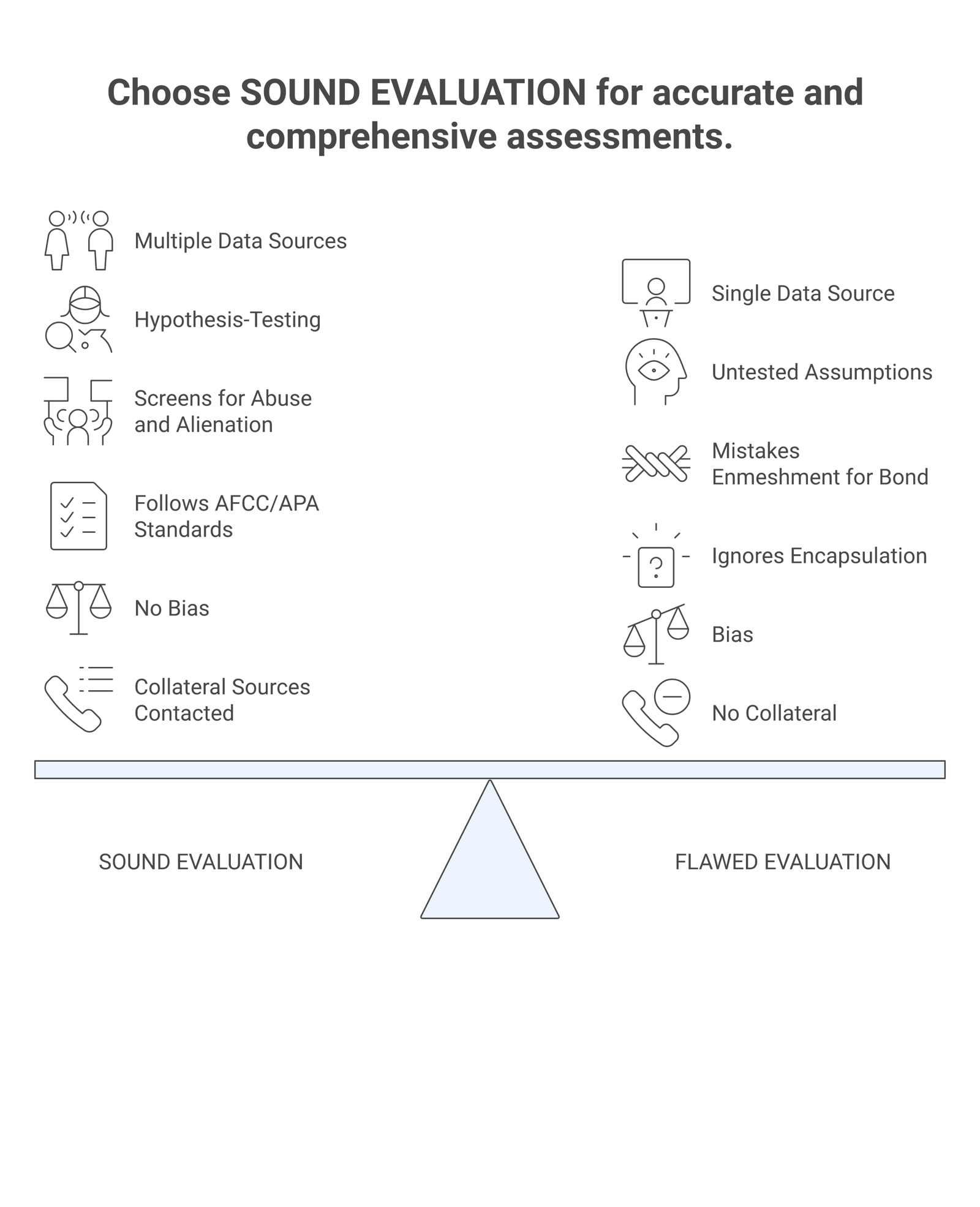
Two further disciplines round out good practice. Complete-file review means reading the whole record, including the material that complicates the preferred conclusion. Two-expert comparison, where it is available, gives a check on conclusions that a single evaluator cannot give alone. An evaluator who builds practice around these habits produces reports that hold up, and an attorney who reads a report against these habits can tell quickly whether the foundation matches the conclusion. For the constructive how-to from the evaluator’s side, see conducting a parental alienation custody evaluation, and for the parent-facing view, see preparing for a custody evaluation.
Frequently asked questions
What are signs of a bad custody evaluation?
The signs are methodological. A bad custody evaluation tends to rest on a single data source, skip an interview with one parent, contact no independent collateral sources, treat a first impression as a settled conclusion, and apply uneven scrutiny to the two parents. In parental alienation cases, the most consequential sign is mistaking an enmeshed alignment for a healthy bond. Each of these departs from the AFCC Model Standards and the APA Guidelines.
What makes a custody evaluation biased?
Bias usually enters through untested assumptions rather than open prejudice. An evaluator settles early on a theory of the family and then reads every data point as confirmation, accepting one parent’s statements at face value while probing the other’s. Reliance on intuition, which is not a reliable instrument even for experienced evaluators, compounds the problem. The standards counter bias by requiring multiple hypotheses, equal scrutiny, and convergent data.
Can you challenge a custody evaluation?
Generally yes, although the procedure varies by jurisdiction and is a matter for counsel. A methodologically flawed report can be examined against the published standards of practice, the AFCC Model Standards and the APA Guidelines, and against the record it claims to rest on. The goal of any such examination is accuracy, not the discrediting of sound work. A licensed attorney in the relevant jurisdiction can explain what is possible there.
What standards do custody evaluators follow?
In the United States, two documents carry most of the weight. The APA Guidelines for Child Custody Evaluations in Family Law Proceedings describe aspirational practice for psychologists, and the AFCC Model Standards of Practice for Child Custody Evaluation describe the methodological floor across disciplines. Both call for multiple methods, interviews with both parents, observation, collateral contacts, hypothesis-testing, and active steps against bias.
Why do custody evaluations miss parental alienation?
Two errors account for most missed cases. The first is mistaking pathological enmeshment for a healthy bond, because an aligned child often presents as warmly attached to the favored parent, and intuition cannot reliably tell the difference. The second is ignoring encapsulation, the way distorted beliefs and rejection can be sealed inside one relationship while the child functions well at school. Surface functioning then misleads the evaluator into blaming the rejected parent.
What this page does not do
This page is not legal or clinical advice, and it does not diagnose any individual or assess any specific report. It does not name any one state’s procedures or admissibility standards as if they applied everywhere, because those rules vary. It is not a guide to discrediting a methodologically sound evaluation, and it is not a strategy for winning a custody case. The purpose is the opposite, to describe what sound practice looks like so that evaluators can meet it and so that readers can tell a thin foundation from a solid one.
For the constructive evaluator’s how-to, see conducting a parental alienation custody evaluation. For the forensic role, see the parental alienation forensic psychologist. For the attorney-side view, see how courts handle parental alienation. The full For Professionals section covers the rest.
Sources and further reading
- American Psychological Association. Guidelines for Child Custody Evaluations in Family Law Proceedings. apa.org/practice/guidelines/child-custody
- Association of Family and Conciliation Courts. Model Standards of Practice for Child Custody Evaluation. afccnet.org
- Cornell Legal Information Institute (Wex). Child custody. law.cornell.edu/wex/child_custody
If you or your child are in crisis
Free and confidential help is available right now.
- 988 Suicide and Crisis Lifeline. Call or text 988. 988lifeline.org
- Childhelp National Child Abuse Hotline. 1-800-422-4453. childhelp.org
- NAMI HelpLine. 1-800-950-6264. nami.org/help
Last reviewed: 2026-06-08. Author: Alex Buckles (PAC Founder).