

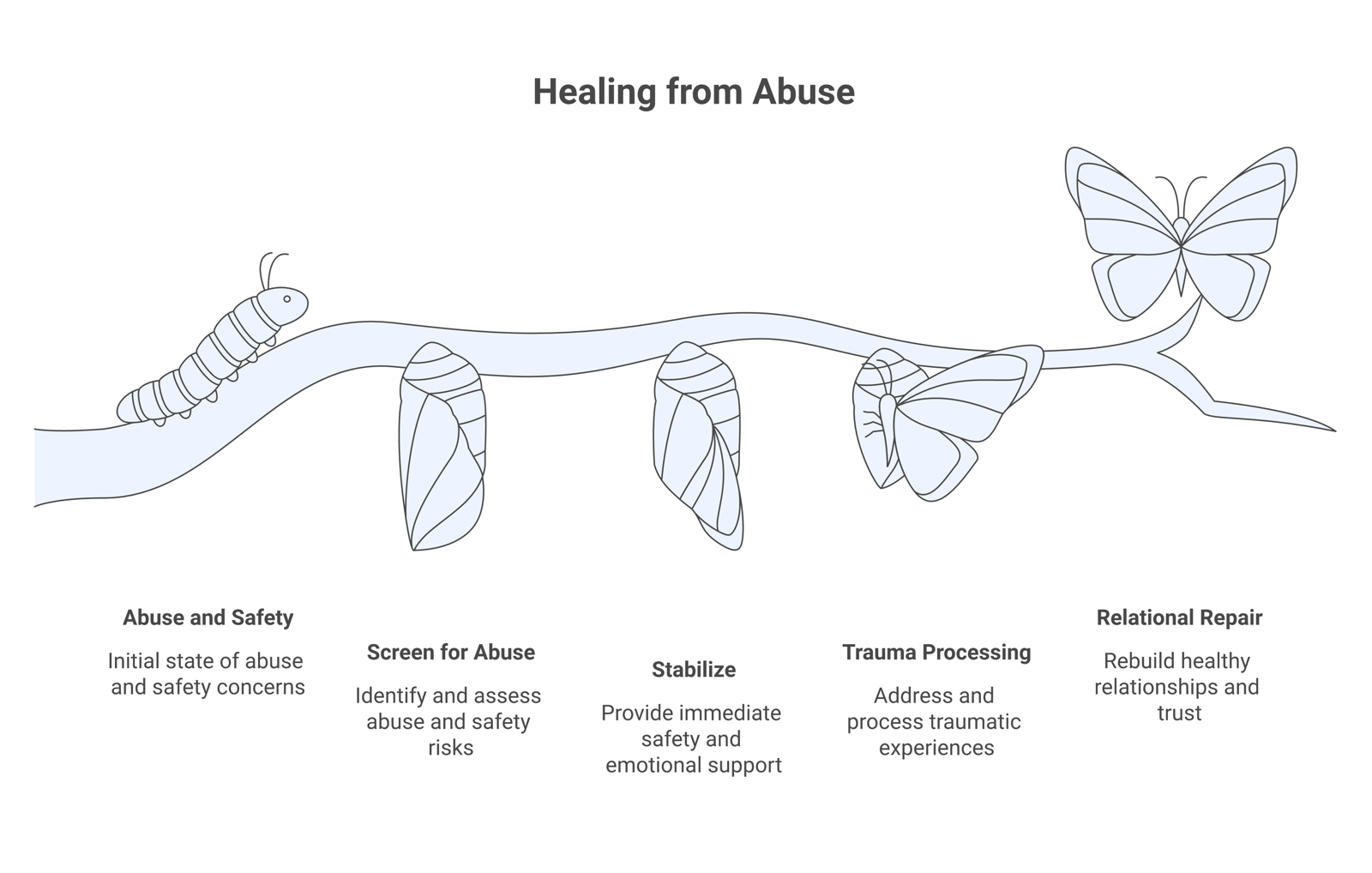
Trauma therapy for parental alienation is best delivered as trauma-informed care in sequence: screen for genuine abuse and current safety first, stabilize the nervous system before processing, then use established trauma modalities, and only after protection and stabilization support relational repair. Alienation is not a formal DSM diagnosis, so clinicians treat the trauma and attachment disruption they can observe, not a label.
General professional education, not clinical advice. This page is educational information for licensed clinicians and for students working under supervision. It is not clinical advice, does not create a treatment relationship, and is not a substitute for supervision, consultation, or your own clinical judgment within your scope of practice.
A note on abuse and estrangement
A child’s rejection of a parent is not always alienation. Where the rejected parent has been abusive, neglectful, or genuinely frightening, the child’s distancing is justifiable estrangement, not parental alienation (Coleman), and the treatment plan is different. Screening for genuine abuse and current safety is the first clinical step, never an afterthought.
A trauma-informed frame, not a diagnosis
Clinicians who take an alienation-related case are not treating a diagnosis. Parental alienation does not appear as a standalone disorder in the DSM-5-TR, and the construct remains contested in the scholarly literature. Some researchers argue for formal recognition, some treat it as one explanation among several for a child’s contact refusal, and some warn that the term can be misused. A trauma-informed clinician can hold that debate open and still act, because the work targets observable trauma exposure, attachment disruption, and dysregulation rather than a labeled syndrome.
The trauma frame is well established even where the alienation label is not. The Substance Abuse and Mental Health Services Administration describes trauma-informed care as a stance that recognizes the widespread impact of trauma, integrates that knowledge into practice, and actively resists re-traumatization. That stance translates cleanly to these cases. Where alienating behaviors are present, researchers such as Harman, Kruk, and Hines have argued they function as a form of coercive control and family violence, which is precisely the kind of relational trauma that trauma-informed practice is built to address. The clinician’s task is to assess the harm in front of them and to treat it without overclaiming what the field has not settled.
Screen for genuine abuse first
The single most important clinical move comes before any treatment plan. Distinguishing alienation from justified estrangement is a safety gate, not a labeling exercise. A child who avoids a parent who has hurt them is responding adaptively, and a treatment plan that pushes that child toward contact would compound harm. Screening separates the two pathways before anything else proceeds.
Why the differential is a safety question
Coleman’s taxonomy places alienation inside the larger category of estrangement and names several distinct pathways into a cut-off, including genuine abuse, triangulation, mental illness, and alienation. Each pathway calls for a different response. A trauma-informed assessment therefore begins by ruling abuse and neglect in or out, using collateral records, prior reports, and direct screening rather than the account of either parent alone. The differential is the foundation that every later decision rests on.
Dual-screening when a case is contested
Alienation and intimate-partner violence are not mutually exclusive, and they co-occur more often than a binary frame suggests. In survey work behind the r-PASS instrument, a majority of self-identified alienated parents also reported being victims of intimate-partner violence, and the developers recommend dual screening: screen for partner violence whenever alienation is alleged, and screen for alienating behaviors whenever partner violence is alleged. Documented abuse reclassifies a case as estrangement rather than alienation. For the clinical differential in depth, see the companion pages on the differential diagnosis of contact refusal and on identifying parental alienation. Holding both possibilities open protects the child and protects the clinician’s formulation from capture by either parent.
Stabilize before you process
Once safety is established, the sequence follows the standard architecture of trauma treatment. Judith Herman’s three-stage model places safety and stabilization first, the processing and mourning of traumatic material second, and reconnection and integration third. Skipping to the painful material before a client can tolerate it tends to fail, and it can re-traumatize. The order is not optional, and it applies to children and parents alike.
Stabilization has a physiological target. Drawing on van der Kolk’s work, clinicians distinguish top-down regulation, which works through the thinking brain with cognitive and skills-based tools, from bottom-up regulation, which works through the body with breath, movement, and somatic methods. A chronically dysregulated nervous system shows an overactive threat response, impaired memory and mood regulation, and weakened executive function, so stabilization aims to widen the client’s window of tolerance before any reprocessing begins. The American Psychological Association maintains general clinician resources on trauma and post-traumatic stress that support this staged approach.
For the rejected parent, Ruggiero’s account of how alienation becomes durable post-traumatic stress is useful at this stage. Alienation rarely presents as a single catastrophic event. It usually accumulates as complex or lifespan trauma, many smaller injuries over months or years, and the diagnostic signature is a failure to reset: the body stays accelerated and the mind keeps replaying. Stabilization for this population balances physical, cognitive, emotional, and spiritual domains rather than trying to fix the family situation directly while the client is still flooded.
Trauma-informed modalities clinicians use
No single modality owns these cases. Clinicians draw on several established trauma treatments and match them to the client, the stage, and the evidence base. A key honesty point runs through all of them: the evidence supports these modalities for trauma and post-traumatic stress, not for alienation as a named condition, so claims should track the trauma target rather than the contested label.
TF-CBT and cognitive work
Trauma-focused cognitive behavioral therapy is a structured, evidence-based treatment for children and adolescents with trauma symptoms. The National Child Traumatic Stress Network describes its components, including psychoeducation, affect regulation, cognitive coping, gradual exposure to the trauma narrative, and caregiver involvement. In alienation-related cases, the caregiver component requires care, because the protective and the favored caregiver have different roles, and the clinician decides who participates and when based on the safety screen.
EMDR and somatic work
Eye movement desensitization and reprocessing is a recognized trauma-processing modality and a representative bottom-up approach. The EMDR International Association and the International Society for Traumatic Stress Studies both maintain practice standards for it. EMDR and other somatic methods are introduced after stabilization, not before, because reprocessing an unstabilized client can overwhelm the very window of tolerance the early work was meant to build. Bailey’s co-regulation framing adds a useful principle here: co-regulation precedes self-regulation, so the regulating adult, whether clinician or parent, must be regulated themselves for the work to hold.
Attachment-based and family-systems approaches
Because alienation injures an attachment relationship, attachment-based and family-systems methods are often central. These approaches read the child’s stated rejection in the context of the whole family system and the child’s developmental needs, rather than at face value. Bailey’s polyvagal lens reframes a child’s apparent siding with one parent as an unconscious appeasement response, a survival act rather than a settled preference. The family-systems therapy approach is treated as its own modality on a companion page; here it sits inside the broader trauma-informed sequence.
How reunification work intersects with trauma care
Reunification is not a separate track that runs around trauma care. It is the relational-repair stage that comes only after protection and stabilization. Gottlieb’s protection-first, reunification-second sequence is explicit on this point: where a court has found alienation and the conduct meets the threshold for child psychological maltreatment, protecting the child from continued exposure is the primary intervention, and reunification with the rejected parent is the downstream goal. Reversing the order, forcing contact while the harmful dynamic continues unobstructed, predicts failure and can re-traumatize the child.
A trauma-informed posture also changes how the clinician reads the child. As Gottlieb frames it, the child’s stated preferences are the symptom, not the data. A trauma-informed therapist treats a child’s expressed rejection as material to understand rather than a verdict to honor or to override by force. That stance is different both from rubber-stamping the rejection and from coercing the child into contact, and it keeps the work inside the trauma frame. For the child-focused treatment relationship in general, see counseling alienated children. Pacing matters throughout: reunification sessions move at the speed the child’s nervous system can tolerate, with the rejected parent prepared to meet the child with calm rather than urgency.
Working with the targeted or rejected parent
The rejected parent is a patient in their own right, not only a collateral participant. Many arrive carrying complex or lifespan trauma and meeting criteria for post-traumatic stress, with the avoidance, hypervigilance, and intrusive rumination Ruggiero documents. A dysregulated parent who walks into a reunification session flooded will struggle to provide the steady, attuned presence the child needs, so the parent’s own stabilization is part of the treatment plan rather than a side issue.
The same staged logic applies. Herman’s first stage, safety and stabilization, comes before processing the grief and the injustice, and reconnection and meaning-making come later still. Therapist selection matters for this population, because a clinician without specific familiarity with alienation dynamics can misread a parent’s understandable distress as evidence that the parent caused the rupture. Matching the parent to a trauma-informed clinician who understands the dynamic protects both the parent’s care and the accuracy of the formulation.
Ethical cautions: do no harm
The trauma-informed frame carries its own guardrails, and they are not optional. Coercive, forced, or punitive reunification practices are inconsistent with trauma-informed care, because they re-traumatize the client the work is meant to protect. The goal is relational repair the child can tolerate, not compliance extracted under pressure. A clinician who finds a method relies on force, isolation, or shaming should treat that as a contraindication rather than a technique.
Several principles keep the work honest. Informed assent from the child, calibrated to age and capacity, belongs in the plan alongside the caregivers’ informed consent. Claims should stay inside the evidence: outcomes vary, the construct is contested, and no modality guarantees reunion. Where genuine abuse is present, Harman’s guidance on protecting a child without alienating them applies, gather evidence and use the proper channels, while telling the child the parent needs help rather than that the parent never loved them. Stay within scope, document the reasoning, and seek supervision and consultation, especially in contested or court-involved cases. The reframe of alienation as a treatment issue rather than a custody issue is useful, but it does not license a clinician to step outside their competence or their license.
Frequently asked clinical questions
What kind of therapy is used for parental alienation?
There is no single therapy for parental alienation, because alienation is not a formal diagnosis. Clinicians deliver trauma-informed care in sequence: screen for abuse and safety, stabilize the nervous system, process trauma using modalities such as TF-CBT and EMDR, and then support attachment-based relational repair. The modality is matched to the client, the stage, and the evidence, and outcomes vary.
Is parental alienation a trauma?
Alienation-related harm is commonly framed through a trauma and attachment lens, and where alienating behaviors are present they have been described as a form of coercive control. Parental alienation itself is not a DSM diagnosis, and the construct is contested, so clinicians treat the observable trauma and attachment disruption rather than diagnosing a syndrome.
Can EMDR help with parental alienation?
EMDR is one recognized trauma-processing modality clinicians may use after a client is stabilized. The evidence base supports EMDR for trauma and post-traumatic stress broadly, not for alienation as a named condition. It is introduced after stabilization, not before, and like every modality here its results vary by client and circumstance.
Should you screen for abuse before reunification therapy?
Yes. Distinguishing alienation from justified estrangement is a clinical safety gate. A child avoiding an abusive parent is responding adaptively, so documented abuse reclassifies the case and changes the plan. Dual screening, for partner violence and for alienating behaviors, is recommended whenever a case is contested.
Where to go next
- For the practitioner hub, see the For Professionals pillar.
- For the differential that the safety gate depends on, see differential diagnosis of contact refusal and identifying parental alienation.
- For specific modalities and the child relationship, see family-systems therapy for parental alienation and counseling alienated children.
- For the cross-silo foundation, see parental alienation and trauma.
Sources cited
- Substance Abuse and Mental Health Services Administration. Trauma and trauma-informed care. samhsa.gov
- American Psychological Association. Trauma. apa.org/topics/trauma
- National Child Traumatic Stress Network. Trauma-focused cognitive behavioral therapy (TF-CBT). nctsn.org
- Harman, J. J., Kruk, E., & Hines, D. A. (2018). Parental alienating behaviors: An unacknowledged form of family violence. Psychological Bulletin, 144(12), 1275 to 1299. https://doi.org/10.1037/bul0000175
- EMDR International Association; International Society for Traumatic Stress Studies (ISTSS). Practice standards for EMDR and trauma treatment (cited by name).
If you or someone you support is in crisis
Free and confidential help is available right now.
- 988 Suicide and Crisis Lifeline. Call or text 988. 988lifeline.org
- Childhelp National Child Abuse Hotline. 1-800-422-4453. childhelp.org
- NAMI HelpLine. 1-800-950-6264. nami.org/help
Last reviewed: 2026-06-07. Author: Alex Buckles (PAC Founder).