

A parental alienation forensic psychologist evaluates, for the court, why a child rejects a parent and what arrangement serves that child. The role is distinct from a treating clinician’s. The forensic psychologist screens first for abuse, tests alienation against other explanations, and offers a bounded, probabilistic opinion within recognized ethics standards.
The differential comes first
The forensic evaluator’s first task is the differential. Justified estrangement from an abusive or neglectful parent must never be misclassified as alienation. Screening for abuse, neglect, and coercive control precedes any alienation hypothesis, and a substantiated safety concern triggers reporting obligations that supersede every framework on this page.
This page offers general professional information, not clinical, forensic, or legal advice. It is not a substitute for the evaluator’s own judgment and applicable practice and ethics standards. A defensible forensic opinion requires direct, court-authorized work by a qualified evaluator operating within recognized guidelines.
What a parental alienation forensic psychologist does
A parental alienation forensic psychologist applies psychological science to a legal question: why a child rejects a parent, and what custody arrangement serves that child. The work is forensic, which means it serves the court rather than a patient. Its product is a reasoned opinion for a judge, not treatment for a family. This orientation separates the role from clinical care and sets the boundaries that follow.
Alienation is treated as one hypothesis among several, never as a premise. A defensible analysis weighs alienation against justified estrangement, realistic preference, and mixed presentations, then states which explanation the evidence favors and how strongly it does so. The methodology and the instruments behind that differential are covered in parental alienation custody evaluation. The present page addresses the role itself: its scope, its standards, and its limits. A wider map of professional roles sits in the For Professionals hub.
Two recognized standards frame the work. The APA Guidelines for Child Custody Evaluations in Family Law Proceedings set expectations for scope, multiple data sources, and impartiality. The Association of Family and Conciliation Courts publishes model standards that many jurisdictions adopt. Neither document names a parental alienation protocol, yet both require the structured, impartial posture that a defensible forensic opinion depends on.
The treating clinician and the forensic evaluator
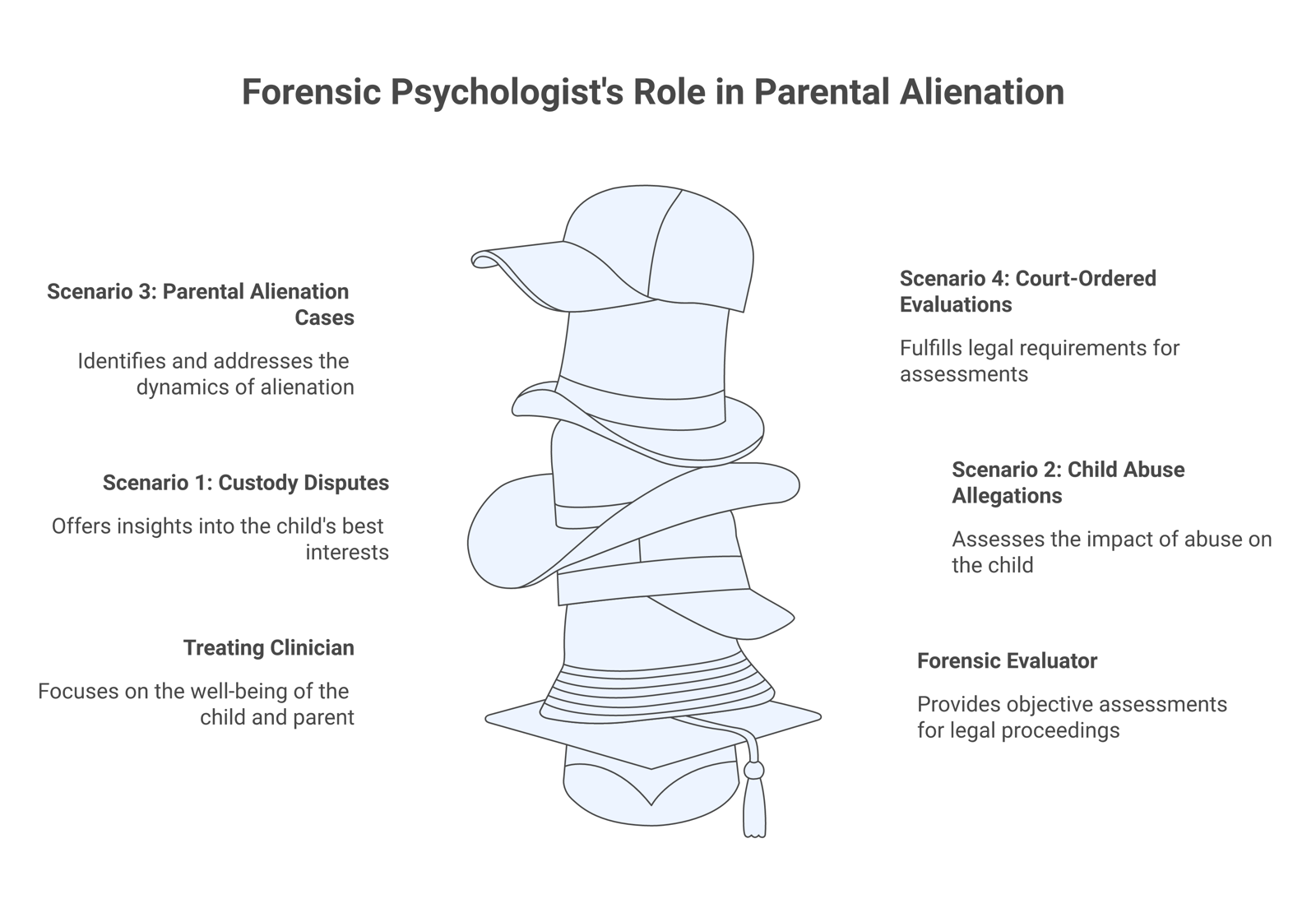
The most consequential distinction in this area is the line between a treating clinician and a forensic evaluator. A treating clinician serves a patient, builds a therapeutic alliance, and generally accepts the patient’s account in order to help. A forensic evaluator serves the court, tests every account against external evidence, and owes no alliance to anyone in the family. The two roles answer different questions and operate under different ethical duties.
Mixing them is a recognized error. A clinician who has treated one parent or the child cannot then offer the court an impartial custody opinion about the same family, because the therapeutic relationship compromises the neutrality a forensic opinion requires. The Specialty Guidelines for Forensic Psychology and the APA custody guidelines both caution against this dual-role conflict. A child’s therapist may describe what the child said in session, yet that therapist is poorly placed to opine on which parent should hold primary custody.
Litigators who try parental alienation cases build around the same separation, framing a serious case as a scientific case rather than a credibility contest and often describing a two-expert structure. One is a generic educating expert who teaches the court what alienation is and how to rule it in or out. The other is a case-specific forensic expert who reviews the records and maps the facts to a severity determination. Treatment is a third function again, and it can work against the litigation when it merely reinforces the child’s rejection. Keeping these functions apart protects the court from opinions that outrun their evidentiary base.
Four scenarios in which forensic input is sought
Forensic practice maps four distinct ways a mental-health expert appears in a parental alienation case. Each carries a different reach and a different vulnerability, and naming the role clarifies what opinion the expert can defensibly offer.
The court-appointed custody evaluator has the most comprehensive view, with access to both parents, the children, and collateral sources. Because no party retained the role, it is least exposed to bias attacks, and its written report often sits near the top of the court’s decision stack. This posture, and only this posture, supports an individualized opinion about a specific family.
A blind consultant educates the court on general principles without examining the family. Through hypothetical questions, this expert connects established research to the case facts while stopping short of an individual diagnosis. Because the court invited the testimony, relevance objections are less likely to succeed.
A behind-the-scenes consultant trains the retaining attorney and never testifies. This expert prepares deposition questions, explains the recognized behavioral indicators, and helps counsel read a custody evaluation critically. The work stays invisible to the court yet shapes how the case is built.
A retained testifying expert reviews the timeline, pleadings, recordings, and messages, then addresses both general principles and a case-specific narrative. The rule for this role is firm: when one parent and the children have not been interviewed, the expert should avoid offering a clear diagnosis. The reach of the opinion is bounded by the access the role allowed.
Expert-witness standards and admissibility
A forensic opinion reaches the court only if it survives the applicable admissibility standard. Most jurisdictions apply some version of the Daubert standard or the older Frye standard, and a forensic psychologist should know which one governs in the venue.
Under Daubert, the court acts as a gatekeeper and examines whether a method can be tested, whether it has been peer-reviewed, whether it has a known or potential error rate, and whether it is generally accepted in the field. Under Frye, the central question is narrower: whether the method has gained general acceptance in the relevant scientific community. Both standards reward methods grounded in published research and applied transparently.
Framing matters here. Parental alienation is not a recognized syndrome in the DSM-5, and testimony that asserts a freestanding “parental alienation syndrome” invites a sharper admissibility challenge than testimony anchored in observable behavior and peer-reviewed research. Attorney Ashish Joshi and Judge Jon Van Allsburg describe a behaviors-not-labels approach drawn from the bench and the bar: a court can find and act on alienating conduct based on documented behaviors, without requiring an expert to certify a syndrome. As the Michigan Court of Appeals observed in Martin v. Martin, high-conflict custody disputes frequently involve acts by one parent designed to obstruct the other parent’s relationship with the child, and courts have long been able to evaluate such conduct. An opinion built on behaviors, data sources, and stated limits proves more durable under cross-examination than one built on a contested label. The litigation context for this testimony is developed in litigating parental alienation and in the parental alienation expert witness overview.
Neutrality and the limits of advocacy
Impartiality is the forensic psychologist’s defining obligation, and it is also the most contested point in practice. The Specialty Guidelines for Forensic Psychology direct evaluators to remain impartial and to weigh alternative hypotheses, and the court-appointed evaluator’s entire value rests on the absence of allegiance to either party. An evaluator who functions as a party’s champion forfeits the credibility that makes the opinion useful.
Some practitioners argue that experts should state conclusions firmly rather than retreat into vague neutrality, and the point has merit when read carefully. A forensic psychologist advocates for the data and for a well-supported opinion, not for the parent who paid the retainer. Stating a conclusion clearly once the evidence supports it is intellectual honesty. Shading an opinion to favor a side is partisanship, and it is the failure mode that opposing counsel is trained to expose. The distinction holds across all four expert roles: the court-appointed evaluator stays strictly neutral between the parties, while even a retained expert’s credibility depends on candor about what the evidence does and does not show.
Avoiding advocacy also means avoiding the language of winning. A forensic opinion is not a weapon, and framing it as one undermines both the child’s interest and the opinion’s reception. The defensible output describes a pattern, weighs it against alternatives, and recommends what serves the child, leaving the legal decision to the court.
Forensic discipline and the limits of the science
The credibility of a forensic opinion rests on investigative discipline. A sound case-investigation method treats every claim as a hypothesis to be checked rather than a fact to be accepted. Read the correspondence trail between the parties for contemporaneous tone and pattern. Canvass both extended families for what each actually witnessed. Verify the provenance of claimed-injury photographs before accepting them, since images can be copied from elsewhere and presented as a child’s. The full collateral method is detailed in the custody evaluation page, and the point here is narrower: the forensic role demands this skepticism as a matter of method, not suspicion.
Forensic investigators add a bias warning the forensic psychologist must hold consciously. A small, articulate, highly educated parent is rarely suspected of being the controlling party, and that presentation bias must be overridden so the same investigation runs regardless of how a parent appears. Coercive control can run in either direction, a point Jennifer Harman, Edward Kruk, and Denise Hines develop in arguing that parental alienating behaviors map onto recognized patterns of family violence. Screening must therefore look for control as carefully as for overt violence, and in both parents.
Honesty about limits completes the picture. Parental alienation is not a standalone diagnosis, the science supports a careful differential rather than certainty, and the appropriate output is probabilistic. A forensic psychologist describes the weight of the evidence favoring one explanation, names the alternatives considered, and states the boundaries that the role and the data impose. The recognition side of this work, distinct from the forensic evaluation, is addressed in identifying parental alienation. An opinion offered within its limits survives the scrutiny that an overclaimed certainty does not.
Frequently asked questions
What does a parental alienation forensic psychologist do?
A parental alienation forensic psychologist evaluates, for the court, why a child rejects a parent and what arrangement serves the child. The work serves a legal decision-maker rather than a patient. It screens first for abuse and coercive control, tests alienation against justified estrangement and other explanations, and offers a probabilistic opinion anchored in recognized custody-evaluation standards.
What is the difference between a treating clinician and a forensic evaluator?
A treating clinician serves a patient, builds a therapeutic alliance, and works to help. A forensic evaluator serves the court, tests every account against external evidence, and owes no alliance to any family member. A clinician who has treated a parent or child should not also offer the court an impartial custody opinion about the same family, because the therapeutic relationship compromises forensic neutrality.
Can a forensic psychologist diagnose parental alienation?
Parental alienation is not a standalone diagnosis in the DSM-5. A court-appointed evaluator with comprehensive access can describe a behavioral pattern and offer a probabilistic opinion within a differential. An expert who has not interviewed all parties should avoid a definitive diagnosis. Testimony anchored in observable behaviors and peer-reviewed research is more defensible than a claim of a freestanding syndrome.
What standards govern a forensic psychologist’s testimony on parental alienation?
Admissibility usually turns on the Daubert or Frye standard, which examine whether a method is testable, peer-reviewed, and generally accepted. Professional conduct is governed by the APA custody-evaluation guidelines, the AFCC model standards, and the Specialty Guidelines for Forensic Psychology, which require impartiality, multiple data sources, and stated limits.
Should a forensic psychologist be neutral or an advocate?
The forensic psychologist stays impartial between the parties and advocates only for a well-supported opinion and the data behind it. Stating a conclusion firmly once the evidence supports it is appropriate. Shading an opinion to favor the retaining party is partisanship, which destroys credibility and invites successful cross-examination.
Sources and further reading
- American Psychological Association. Guidelines for Child Custody Evaluations in Family Law Proceedings. apa.org/practice/guidelines/child-custody
- Association of Family and Conciliation Courts (AFCC). afccnet.org
- Harman, J. J., Kruk, E., & Hines, D. A. (2018). Parental alienating behaviors: An unacknowledged form of family violence. Psychological Bulletin, 144(12), 1275 to 1299. https://doi.org/10.1037/bul0000175
If you or a family you work with is in crisis
Free and confidential help is available right now.
- 988 Suicide and Crisis Lifeline. Call or text 988. 988lifeline.org
- Childhelp National Child Abuse Hotline. 1-800-422-4453. childhelp.org
- NAMI HelpLine. 1-800-950-6264. nami.org/help
Last reviewed: 2026-06-06. Author: Alex Buckles (PAC Founder).