

Family Bridges and similar reunification programs are short, intense workshops. They try to rebuild the bond between a child and a rejected parent. Supporters call them a class, not therapy. Critics doubt the evidence and warn about pressure. Where a child’s fear is justified by abuse, such a program is the wrong response. It can make things worse.
A safety note first
A child’s refusal to see a parent is not always alienation. The rejected parent may have been abusive, neglectful, or scary. If so, the child’s distancing is justified estrangement, not alienation. In that case an intense reunification program is the wrong response and can harm the child. Pressure to reunite hurts a child when the fear is real. A program that fails, or an order that goes badly, is not proof that alienation existed. If a child’s safety is at risk, call local law enforcement or a domestic-violence resource first.
This page is general education. It is not clinical or legal advice. It does not endorse or recommend any program. It is not a directory and gives no booking help. Anyone weighing a step for a real child should work with licensed pros who know the case.
What Family Bridges is
Family Bridges is a short, intense class. It is built to help a child who refuses contact reconnect with a rejected parent. So it usually runs over a few days. In most cases a court has already ordered a change in custody first. The best known program comes from psychologist Richard Warshak and his colleagues. But several similar programs now run under other names.
The model treats deep contact refusal as a learned habit. It does not treat it as the simple truth about the rejected parent. So the workshop tries to give the child new facts and new time with that parent. So the stated goal is to rebuild a workable bond. This page lays out what these programs say they do. It lays out what critics say back. And it shows why the abuse question sits at the center of the whole debate.
What the programs claim
Warshak calls Family Bridges a class, not therapy. In his account, published in Family Court Review, the workshop helps children adjust to a court order. That order places them with a parent they say they hate or fear. So the program reports strong results in its own write-ups. For example, in the published case report, 22 of 23 children rebuilt a good bond with the rejected parent by the end. All of them had failed at earlier counseling first.
Supporters make a few core claims. First, they say weekly therapy often fails in severe cases. So a different tool is needed. Second, they say leaving a child in total rejection is itself harmful. So the child loses a parent and learns that cruelty works. Third, they describe the workshop as kind and child-friendly, not harsh. These are the stated aims, but whether the evidence backs them up is what the next parts weigh.
How a program is typically structured
These programs share a rough shape, though the details differ. A court first finds severe alienation. It also rules out abuse as the reason for the refusal. The court then orders a change of custody to the rejected parent. Then the child and that parent go to the workshop together. Meanwhile, they are away from the favored parent. Then trained staff lead lessons, talks, and activities over several days.
One feature draws a lot of attention. Most programs add a stretch with no contact between the child and the favored parent. This pause can last days, weeks, or longer, so the length depends on the order. So the people who run the programs say the break gives the new bond room to grow. Critics read the same feature very differently. So the no-contact rule is both a core part of the model and one of its most argued-over parts.
The criticisms and safety concerns
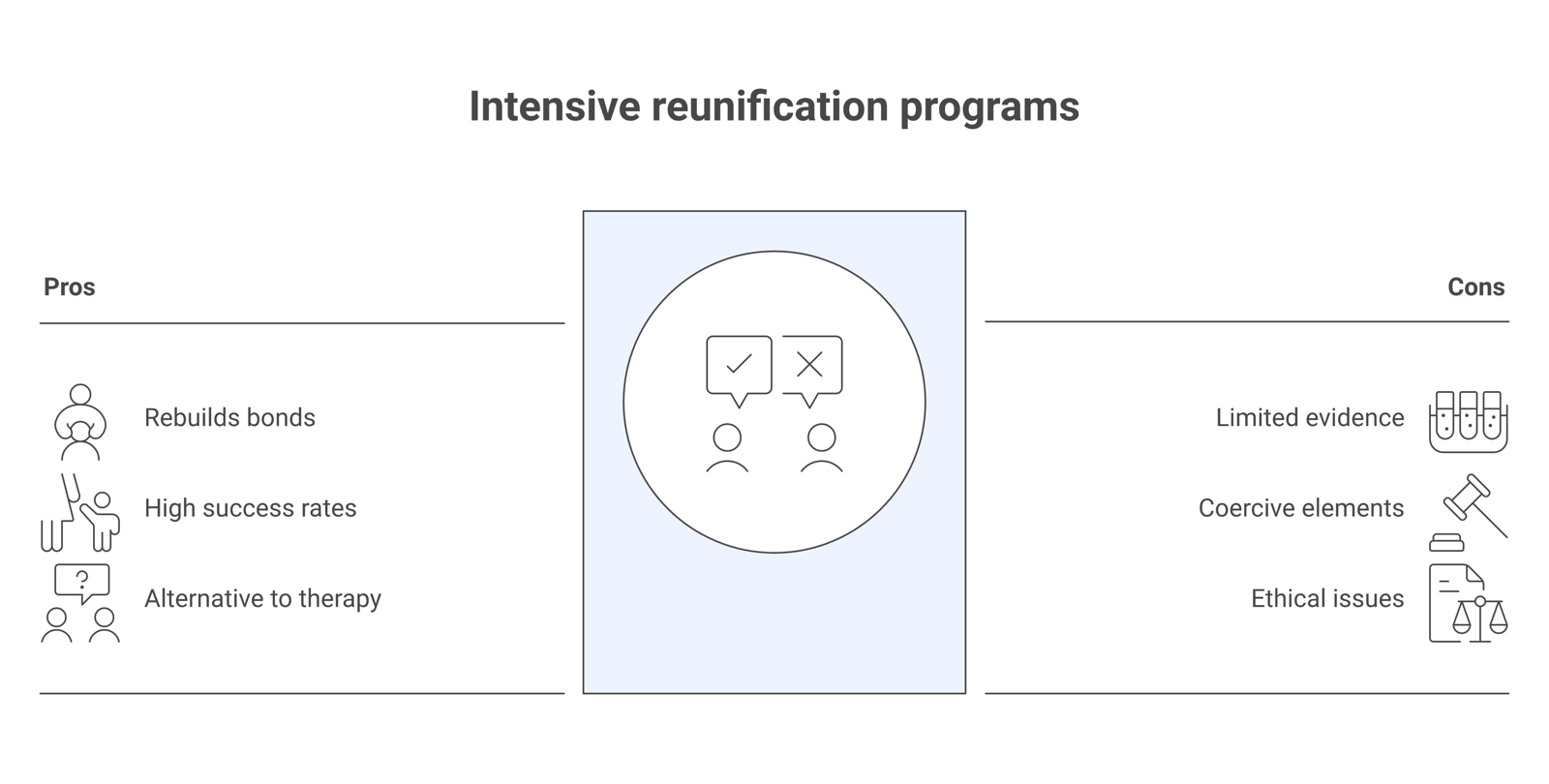
The criticism here is large, and a fair page has to give it full weight. The main concern is about evidence. Jean Mercer is a psychologist who reviewed the published work. She finds that these treatments have not been shown to work. But she warns they may even cause harm. The strong success rates come from studies the program teams run themselves. Because those studies use picked cases and no control group, that falls short of the bar used for other child treatments.
A second concern is about pressure. The model leans on a court forcing a child into a program the child does not want. First, it removes the child from the parent they prefer. Critics say the no-contact stretch can feel like a punishment. Instead, it can feel like pressure, not a class. Mercer and Margaret Drew edited a book on this topic. They argue that forced separation from a child’s main attachment figure clashes with how children grow and bond. Some former kids in these programs call the time scary or forced, not helpful.
A third concern is about the idea itself. Parental alienation is not a named diagnosis in the main manuals. The American Psychological Association and the DSM-5 have not adopted it. The World Health Organization has not, and several court bodies stay doubtful. So building an intense program on a debated idea raises the stakes if the review is wrong. The honest summary is short. So the programs claim a lot, but the outside evidence is thin, and the safety questions are real.
The cost and the court-order question
News reporting adds another layer to the debate. ProPublica looked at how courts use these programs and what they cost. It found intense reunification camps that can run about fifteen thousand dollars for roughly four days, but it also found cases where a wrong call was severe. In one Utah case, a judge ruled the mother was alienating. Then the judge had the children moved to the father. But state authorities had already confirmed the father’s sexual abuse.
That report also cites research funded by the Department of Justice. The study, led by Joan Meier, found a clear pattern. A mother who alleged abuse was about twice as likely to lose custody when the father claimed alienation. The report notes who has turned down the parental alienation label. It lists the American Psychological Association and the DSM-5, the World Health Organization, and the National Council of Juvenile and Family Court Judges. A 2023 United Nations report called it a pseudo-concept. Several states have since limited court-ordered programs that cut a child off from a parent. These are serious concerns from courts, reporters, and lawmakers. They belong in any fair account.
When an intensive program is the wrong response
The abuse question is the line that matters most. An intense program is built for one narrow case. That case is a child who refuses a safe, loving parent out of made-up fear, not real harm. Where the fear is earned, the same program turns dangerous. It would push a child toward a parent the child has good reason to avoid. Instead it would treat a protective response as a problem to fix.
This is why careful review has to come first. It is also why critics worry when it does not. The outside behavior of an alienated child and a truly scared child can look the same. So telling them apart takes skilled, abuse-aware review, not a quick label. A program is the wrong response in several clear cases. First, it is wrong when abuse has not been truly ruled out. Second, it is wrong when the only proof of alienation is the rejected parent’s own word. And it is wrong when the child’s fear tracks real harm. For more on this line, see parental alienation trauma and the broader Learn silo.
How to think about this as a parent
This page does not recommend Family Bridges or any other program. It does not tell anyone to enroll or to stay away, because those calls belong to courts and to licensed pros who know the family. What a learning resource can offer is a clear way to ask questions. So a reader can ask what outside evidence exists, how abuse was ruled out, what the no-contact rule involves, and what happens if the child does not respond.
It also helps to keep hopes real. Supporters report high success rates. But those numbers come from the programs themselves. Critics report harm. But that often comes through single stories. The solid, controlled evidence that would settle the question does not yet exist. So the fair stance is care and curiosity, not sureness either way. For more context, see what is reunification therapy, the court view in court-ordered reunification therapy, and the outcomes piece what happens after a custody reversal.
Frequently asked questions
Is Family Bridges therapy or education?
Its developers call Family Bridges a class, not therapy. It gives a child new facts and new time with a rejected parent over a few intense days. Critics ask whether the label changes the core concern. The program still leans on a court order, a change of custody, and a stretch with no contact with the favored parent.
Do reunification programs work?
The programs report high success rates. But those results come from studies the teams run themselves. They use picked cases and no control group. But outside, controlled research is limited. Critics such as Jean Mercer find the treatments have not been shown to be safe or to work. The honest answer is that strong outside evidence does not yet exist either way.
Why do critics object to Family Bridges?
Critics raise three main points. The outside evidence is thin. The model leans on pressure, including a custody change and a no-contact stretch that can feel like punishment. And it rests on parental alienation, an idea the main manuals have not adopted. Some former kids call the time scary.
Is a reunification program safe if my child was abused?
No. Where a child’s fear is a justified response to abuse, an intense program is the wrong and harmful response. It would push a child toward a parent the child has real reason to avoid, so abuse has to be ruled out by skilled pros before any such program is even weighed.
How much do reunification camps cost?
By ProPublica’s reporting, intense reunification camps can cost about fifteen thousand dollars for roughly four days. That does not count related legal and travel costs. Cost is one more reason these programs draw scrutiny, above all when a court orders a family to attend.
What this page does not do
This page does not endorse, recommend, rank, or book any program. It is not a directory. The page does not diagnose alienation in any child. Nor does it treat a child’s distress as proof of alienation. And it does not frame a program as a way to win a custody fight. The right use of this page is simple. Understand a debated step honestly, including its real risks. Bring careful questions to licensed pros who know the actual case.
For related reading, see what is reunification therapy, parental alienation trauma, court-ordered reunification therapy, clinical failure stories, and the clinician resource on family systems therapy for parental alienation. The full Learn silo covers the basics.
Sources and further reading
- Warshak, R. A. (2010). Family Bridges: Using insights from social science to reconnect parents and alienated children. Family Court Review, 48(1), 48 to 80. https://doi.org/10.1111/j.1744-1617.2009.01288.x
- Mercer, J. (2019). Examining parental alienation treatments: Problems of principles and practices. Child and Adolescent Social Work Journal, 36(4), 351 to 363. https://doi.org/10.1007/s10560-019-00625-8
- Dreyfus, H. (2023). Parental alienation and its use in family court. ProPublica. propublica.org
- American Psychological Association. Divorce and child custody. apa.org/topics/divorce-child-custody
If you or your child are in crisis
Free and confidential help is available right now.
- 988 Suicide and Crisis Lifeline. Call or text 988. 988lifeline.org
- Childhelp National Child Abuse Hotline. 1-800-422-4453. childhelp.org
- NAMI HelpLine. 1-800-950-6264. nami.org/help
Last reviewed: 2026-06-07. Author: Alex Buckles (PAC Founder).