

This page is general information, not legal or clinical advice. It does not diagnose any child or parent, and it is not a self-assessment tool. Concerns about a child should be discussed with a qualified mental-health professional.
The five-factor model of parental alienation is the framework clinicians use to tell alienation apart from other reasons a child rejects a parent. It asks five questions, and all five must be answered yes before alienation is named. One of those questions, ruling out real abuse, is the safeguard that keeps the model honest.
A note on safety
A child’s rejection of a parent is not always alienation. When a child resists a parent because of genuine abuse, neglect, or frightening behavior, that is estrangement, a reasonable response to real harm, not alienation. The model exists precisely to keep those two apart. If a child’s safety is at risk, contact local law enforcement or a domestic-violence resource first.
What the five-factor model of parental alienation is
The five-factor model is a clinical framework. It was proposed by psychiatrists William Bernet and Laurence Greenhill in a 2022 commentary in the Journal of the American Academy of Child & Adolescent Psychiatry, and it builds directly on the four-factor model that psychologist Amy J.L. Baker validated in 2020. The Five-Factor Model is Baker’s four factors with the child’s contact refusal added as factor one: factor one establishes that there is a problem to explain, and factors two through five distinguish alienation from justified estrangement.
The model treats alienation as a conclusion, not a starting point. A clinician does not assume it and then hunt for proof. The clinician works through five factors and asks whether each one is present. Only when all five are met does the picture point to alienation.
This is a real shift from older thinking. Earlier ideas about parental alienation syndrome leaned on the child’s symptoms alone. The five-factor model is broader. It looks at the child, the rejected parent, the favored parent, and the past bond. The Learn hub ties this framework to the wider set of questions families ask.
The five factors, one by one
Here are the five factors a clinician works through. Each one matters, and the order helps tell why.
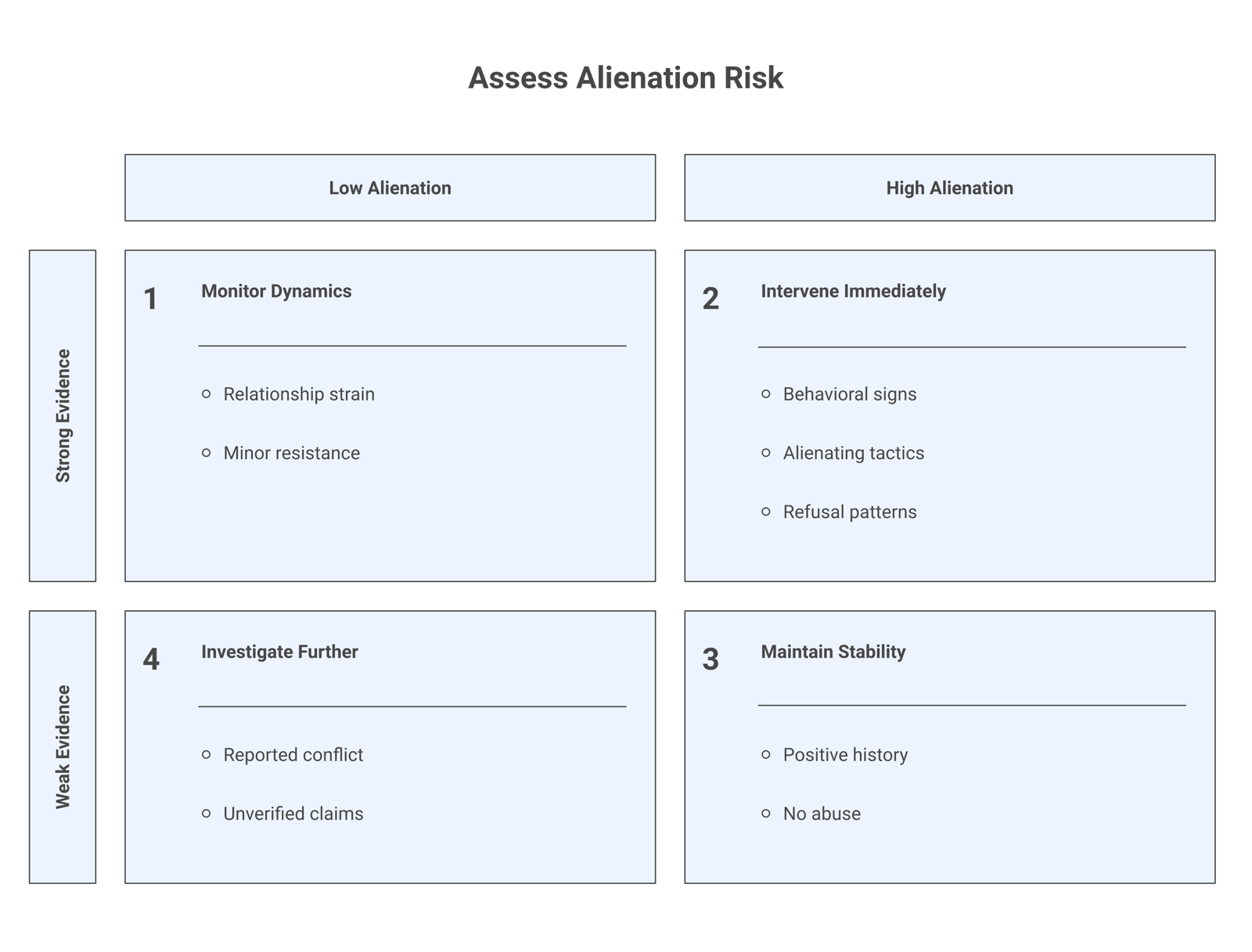
Factor one: the child resists or refuses a relationship
The first factor is the visible problem. The child avoids, resists, or refuses a bond with one parent. This is sometimes called the resist-refuse pattern. It can look like skipped visits, cold silence, open anger, or a flat refusal to see the parent at all.
This factor only says what is happening. It does not yet say why. A child can resist a parent for many reasons, so this factor alone proves nothing about alienation.
Factor two: a prior positive relationship existed
The second factor looks backward. Before the trouble started, did the child and the now-rejected parent have a warm, normal bond? In real alienation, the answer is usually yes. The child once loved and trusted this parent, and that bond later broke down.
A sudden flip is telling. When a once-loving bond turns to rejection with no real cause from the rejected parent, something has changed the child’s view from the outside.
Factor three: no abuse, neglect, or seriously deficient parenting
The third factor is the safeguard. Before alienation can be weighed, a clinician must rule out real abuse, neglect, or seriously poor parenting by the rejected parent. If the child has good reason to pull away, the rejection is not alienation.
This factor protects children. Some scholars call the abuse rule-out the heart of the model. Skip it, and a real protective response can be wrongly tagged as alienation. A child who fears a parent for a genuine reason deserves to have that fear believed and checked. If abuse or neglect is present, the correct term is estrangement, not alienation, and screening for abuse comes first.
Factor four: the favored parent uses alienating behaviors
The fourth factor looks at the favored parent. Are they using tactics that push the child away from the other parent? Researchers have listed many such tactics. Common ones include badmouthing the other parent, limiting contact, erasing that parent from the child’s life, and making the child choose sides.
One tactic is rarely enough on its own. A pattern over time carries far more weight than a single comment in a hard moment.
Factor five: the child shows the behavioral manifestations of alienation
The fifth factor returns to the child, but with a sharper lens. Does the child show the classic signs of alienation? These signs form a clear cluster. They include a one-sided view of the parents, weak or borrowed reasons for the rejection, and no normal guilt about being cruel to the rejected parent. The page on the 8 behaviors of an alienated child lays out this cluster in plain language, and the symptoms overview sets it in context.
Why all five factors have to be present
The whole point of the model is the “all five” rule. A child rejecting a parent is the symptom, not the diagnosis. Many things can cause that symptom. Divorce stress, a child’s own nature, a rocky reunion after time apart, normal teen distance, or real fear of a harmful parent can all look alike from the outside.
This is what clinicians mean by a differential diagnosis of contact refusal. The task is to sort among the possible causes, not to leap to one. Professionals who work on the resist-refuse continuum treat this sorting as careful, slow work.
Requiring all five factors guards against quick answers. Other lenses exist: psychologist Craig Childress’s attachment-based model (AB-PA) is an influential minority view that remains contested within the alienation field and has not been adopted in mainstream guidelines. The field holds several views at once. No single sign settles the question. The strength of this model is that it forces a fuller look before anyone uses the word alienation.
How the model separates alienation from estrangement
The most important line the model draws is between alienation and estrangement. At first glance, the two can look identical. A child avoids a parent in both. What differs is the cause.
Estrangement is a child’s fair response to a parent’s own behavior. A parent who was abusive, scary, neglectful, or absent may face a child who wants distance. That distance is healthy self-protection. It is not alienation, and treating it as alienation can put a child back in harm’s way.
Alienation is different. The child rejects a parent who did nothing to earn it, swayed by the other parent. Factor three is the dividing line. By making a clinician rule out real harm first, the model keeps a protective response from being mislabeled. This rule-out requirement traces back to Joan Kelly and Janet Johnston’s 2001 reformulation, which insisted that justified estrangement and other causes be excluded before rejection is called alienation.
Who applies the model, and who should not
This is a professional tool. Trained mental-health and forensic experts apply it through interviews, records, and careful watching over time. They weigh each factor against evidence, not against a hunch.
It is not a tool for parents to use against each other. A parent in the middle of conflict cannot be neutral, and the model was never built for self-assessment. Reading the five factors and ticking them off about the other parent is not a diagnosis. It is a way to deepen a fight. The honest use of this page is to learn the framework, then bring real concerns to a qualified professional. The page on parental alienation diagnosis explains how that process actually works.
The contested status of the model
Honesty calls for one more point. Parental alienation remains a contested idea, and so is this model. Critics such as William O’Donohue and Madelyn Milchman reject the five-factor model as a premature diagnostic framework, and some scholars warn that the alienation label can be misused, often against protective parents. The model is not a DSM diagnosis; it is the field’s leading proposed identification framework. These concerns are serious and deserve a fair hearing.
Other researchers argue that alienation is real, that you can see it, and that it harms children. They hold that careful models like this one make it possible to spot without overreach. Courts, for their part, apply reliability tests before they accept expert testimony about it. The debate is live, and the page on whether parental alienation is real lays out both sides. This model is best read as one careful attempt to bring rigor to a hard, disputed area.
Frequently asked questions
What is the five-factor model of parental alienation?
It is a clinical framework for identifying parental alienation, proposed by William Bernet and Laurence Greenhill in 2022 and built on Amy J.L. Baker’s four-factor model. It uses five criteria, and all five must be present before a professional concludes that alienation is happening. The model is built to tell true alienation apart from the many other reasons a child might reject a parent.
How do you diagnose parental alienation?
Trained mental-health or forensic professionals apply a framework like the five-factor model. They gather interviews, records, and observations. Then they check whether all five factors are present, which includes ruling out genuine abuse. Parents cannot diagnose alienation themselves, since the task needs a neutral, trained eye.
What are the five factors?
The five factors are: the child resists or refuses a relationship with a parent; a prior positive relationship with that parent existed; there is no abuse, neglect, or seriously deficient parenting by the rejected parent; the favored parent uses alienating behaviors; and the child shows the behavioral signs of alienation. All five are required.
How is alienation different from estrangement?
Estrangement is a child’s reasonable response to a parent’s own harmful behavior, such as abuse or neglect. Alienation is rejection of a parent who did nothing to deserve it, shaped by the other parent. Factor three, ruling out real harm, is the line the model draws between the two.
Who can identify parental alienation?
Only trained professionals should identify alienation, such as forensic evaluators or qualified mental-health clinicians. The five-factor model is a clinical tool, not a self-test. A parent can spot warning signs and raise them. The assessment itself belongs to a neutral, trained professional.
What this page does not do
This page is not clinical or legal advice. It does not diagnose any child, parent, or family, and it does not tell anyone to apply the five factors to the other parent. The model is a professional tool, not a weapon in a custody fight. Using it to label or beat the other parent misuses it and can harm the very child everyone claims to protect.
To understand the diagnosis question overall, see parental alienation diagnosis. The older construct this model replaced is covered in parental alienation syndrome. For how severity progresses, see the stages of parental alienation. The full Learn silo covers the rest.
Evaluators sometimes pair a structured model with an objective measure. See our guide to measuring parental alienation with the PARQ.
Sources and further reading
- Bernet, W., & Greenhill, L. L. (2022). The Five-Factor Model for the diagnosis of parental alienation. Journal of the American Academy of Child & Adolescent Psychiatry, 61(5), 591 to 594. https://doi.org/10.1016/j.jaac.2021.11.026
- Baker, A. J. L. (2020). Reliability and validity of the four-factor model of parental alienation. Journal of Family Therapy, 42(1), 100 to 118. https://doi.org/10.1111/1467-6427.12253
- Kelly, J. B., & Johnston, J. R. (2001). The alienated child: A reformulation of parental alienation syndrome. Family Court Review, 39(3), 249 to 266.
- O’Donohue, W., Benuto, L. T., & Bennett, N. (2016). Examining the validity of parental alienation syndrome. Journal of Child Custody, 13(2-3), 113 to 125.
- Milchman, M. S., Geffner, R., & Meier, J. S. (2020). “Ideology and rhetoric replace science and reason…” Family Court Review, 58(2), 340 to 361.
If you or your child are in crisis
Free and confidential help is available right now.
- 988 Suicide and Crisis Lifeline. Call or text 988. 988lifeline.org
- Childhelp National Child Abuse Hotline. 1-800-422-4453. childhelp.org
- NAMI HelpLine. 1-800-950-6264. nami.org/help
Last reviewed: 2026-06-08. Author: Alex Buckles (PAC Founder). Editorial review: held to the PAC Editorial Standards (balance, primary-source citation, reader safety); an independent expert review board will be appointed.