

By the Parental Alienation Center Editorial Team. Last reviewed June 17, 2026. Jurisdiction: Indiana.
This page is general educational information about a published court opinion. It is not legal advice, and it does not predict any outcome in your situation. For advice about your own case, talk with a licensed family-law attorney in your state.
In Hanson v. Spolnik, 685 N.E.2d 71 (Ind. Ct. App. 1997), an Indiana appellate court affirmed changing joint legal custody to sole custody for the father. The court relied on one parent’s sustained animosity and obstructive conduct, tied to harm to the child, under Indiana’s substantial-change standard. Documented hostility, not ordinary disagreement, drove the result.
Before you read: scope and limits
This is one appellate decision from one state. It explains how an Indiana court reasoned, so it can help a targeted parent or an attorney understand what courts tend to weigh. It cannot tell you what a different judge, in a different state, on different facts, will do.
One point comes first because it matters most. Estrangement caused by genuine abuse is not parental alienation, and the two must never be conflated. A child who pulls away from a parent because that parent is frightening or harmful is responding rationally, not being alienated. Hanson is a useful case precisely because its own record contained abuse allegations that were not substantiated, so the line between the two ideas runs straight through it. We return to that line below.
What Hanson v. Spolnik decided
The court affirmed a trial court order that moved the child from a joint legal custody arrangement to sole custody with the father. As described in the opinion, the trial court found a concerted effort by the mother to damage the child’s relationship with the father. That finding, combined with harm to the child, supported the modification.
But the order did more than change custody. It restricted the mother’s visitation and then allowed it to expand over time, it entered a contempt finding, and it included a fee award exceeding sixty-five thousand dollars. So the case is often cited as a documented example of a court treating one parent’s conduct as legally significant. Still, it is not a template, and it is not a promise.
The legal standard the court applied
Indiana does not let a court change custody simply because one parent asks. Under Ind. Code section 31-17-2-21, a court may modify a custody order only when modification serves the child’s best interests and there is a substantial change in one or more of the statutory best-interest factors. Because of that standard, the question is never “which parent behaved worse.” Instead, the question is whether something changed substantially and whether the change to custody serves the child.
This framing is important for readers who came here after searching whether animosity alone can change custody. But animosity is not a freestanding ground. Instead, it becomes relevant only when it produces a substantial change and when the change harms, or threatens, the child’s welfare. A sustained effort to undermine a child’s relationship with the other parent, found to harm the child, can be the substantial change a modification statute requires. The conduct matters because of its effect on the child, not as punishment of the parent.
What the court weighed: from joint to sole custody
This move from joint to sole custody did not turn on a single fact. Several findings, taken together, supported it. The diagram below lays them out as the court’s reasoning ran, from documented conduct, through harm to the child, to the legal conclusion.
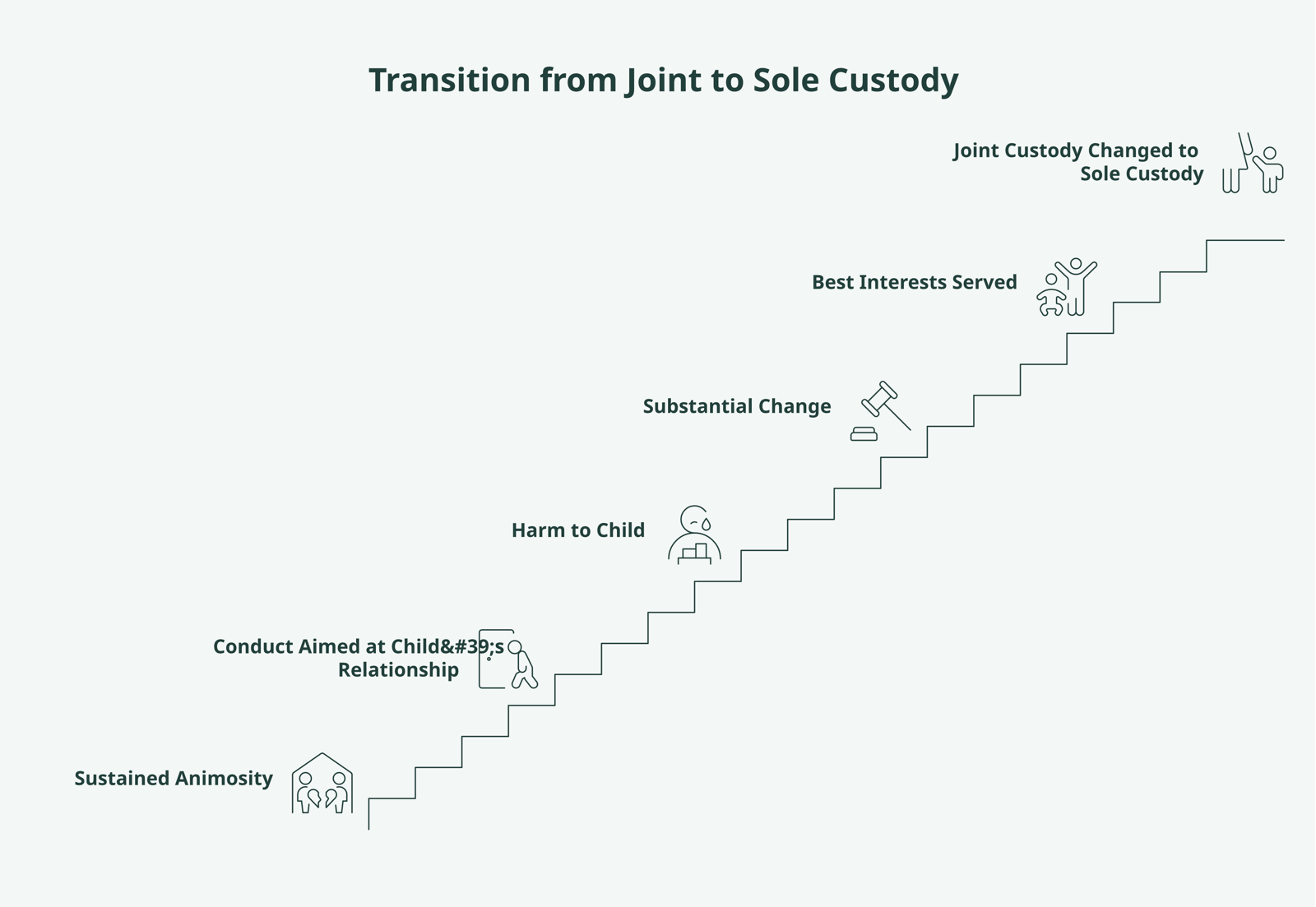
Sustained animosity and obstruction
First, the court looked at a pattern rather than an isolated incident. A one-time argument between parents is common and rarely changes custody. A sustained course of hostility and interference is different, because it can reshape the child’s relationship with a parent over months and years. The Hanson record reflected that kind of pattern.
Conduct toward the child’s relationship with the other parent
Second, the court considered conduct aimed at the bond between the child and the father. Interference with the relationship, not the existence of conflict by itself, is what courts in alienation-adjacent cases tend to scrutinize. A parent’s effort to undermine the child’s relationship with the other parent can be the substantial change the statute requires, when it reaches the child.
Harm to the child as the hinge
Third, and decisively, the court tied the conduct to harm. This is the hinge of the whole analysis, because conduct between adults is not the point. Instead, the effect on the child is the point. So without a finding that the child was harmed or at risk, animosity would not have carried the modification, since the statute keeps the child’s best interests at the center.
The abuse-not-alienation guardrail in this very record
Now the hardest part of the case, and the reason it deserves careful reading. The Hanson record included child-abuse allegations. Those allegations were not substantiated by the child-protection investigation. The court treated unsubstantiated allegations, raised as part of a broader campaign, differently from how any court should treat substantiated abuse.
That distinction is the whole game, and it cuts in both directions. So if abuse is real, a child’s withdrawal is protective, not alienation, and a court should never relabel safety-seeking as a custody problem. But if serious allegations are raised and not supported, a court may weigh how and why they were raised. Either way, the determination belongs to the court and the investigators, working from evidence, not to a parent and not to a website. Readers should hold both truths at once: alienation is real, and so is abuse, and confusing them harms children.
The limits of reading one case
A single opinion has limits, so treat Hanson as illustration rather than authority for your situation. Three limits stand out.
The first limit is jurisdiction. Hanson is Indiana law. Other states use their own modification standards, and the facts a court will weigh vary from place to place.
The second limit is fact-specificity. Custody rulings turn on detailed records. Because the appellate court reviewed a developed trial record, the outcome reflects that specific evidence, not a general rule that animosity changes custody.
The third limit is the real-world ending. The case had a mixed outcome: the father died about seven years after the ruling. A favorable order is not the same as a restored, lasting relationship. That sobering coda is part of why this site never frames litigation as a finish line.
What this means if you are researching a custody question
If you are a targeted parent or an attorney, the useful takeaway is narrow but real. So courts can treat documented animosity and interference as legally significant, but only through the lens of substantial change and the child’s best interests. Then the work is to understand the standard and to document facts accurately and calmly, not to manufacture a narrative.
This site does not tell anyone how to gain an edge over the other parent, because content written for tactical advantage harms children and misreads the law. For the next step that fits your situation, see how to document concerns for court and review what parental alienation is and is not before drawing conclusions. You may also find the guides on custody evaluations, choosing a family-law attorney, and recognizing alienating behavior versus justified estrangement useful, all reachable from the Court resources hub.
Frequently asked questions
Can a parent’s animosity change custody?
Animosity by itself is not a ground to change custody. In Hanson v. Spolnik, the court weighed sustained animosity and obstruction because it harmed the child and amounted to a substantial change under Indiana’s standard. The harm to the child, not the hostility alone, is what mattered.
What is the standard to modify custody in Indiana?
Under Ind. Code section 31-17-2-21, a court may modify custody only when modification serves the child’s best interests and there is a substantial change in one or more statutory best-interest factors. Both parts must be met.
Does Hanson v. Spolnik involve abuse?
The record included child-abuse allegations that were not substantiated by investigators. The case underscores the firm line between estrangement caused by genuine abuse, which is not alienation, and unsubstantiated allegations raised within a broader campaign.
Is parental alienation a change of circumstances?
It can be. A sustained effort to damage a child’s relationship with the other parent, found to harm the child, can be the substantial change a modification statute requires. A court decides that on the evidence.
Crisis resources
If you or a child is struggling, support is available. Call or text the 988 Suicide and Crisis Lifeline at 988 (988lifeline.org). Reach the Childhelp National Child Abuse Hotline at 1-800-422-4453 (childhelp.org/hotline). Contact the NAMI HelpLine at 1-800-950-6264 (nami.org/help).
Sources
- Hanson v. Spolnik, 685 N.E.2d 71 (Ind. Ct. App. 1997). CourtListener
- Ind. Code section 31-17-2-21 (custody modification standard), Indiana General Assembly. iga.in.gov