
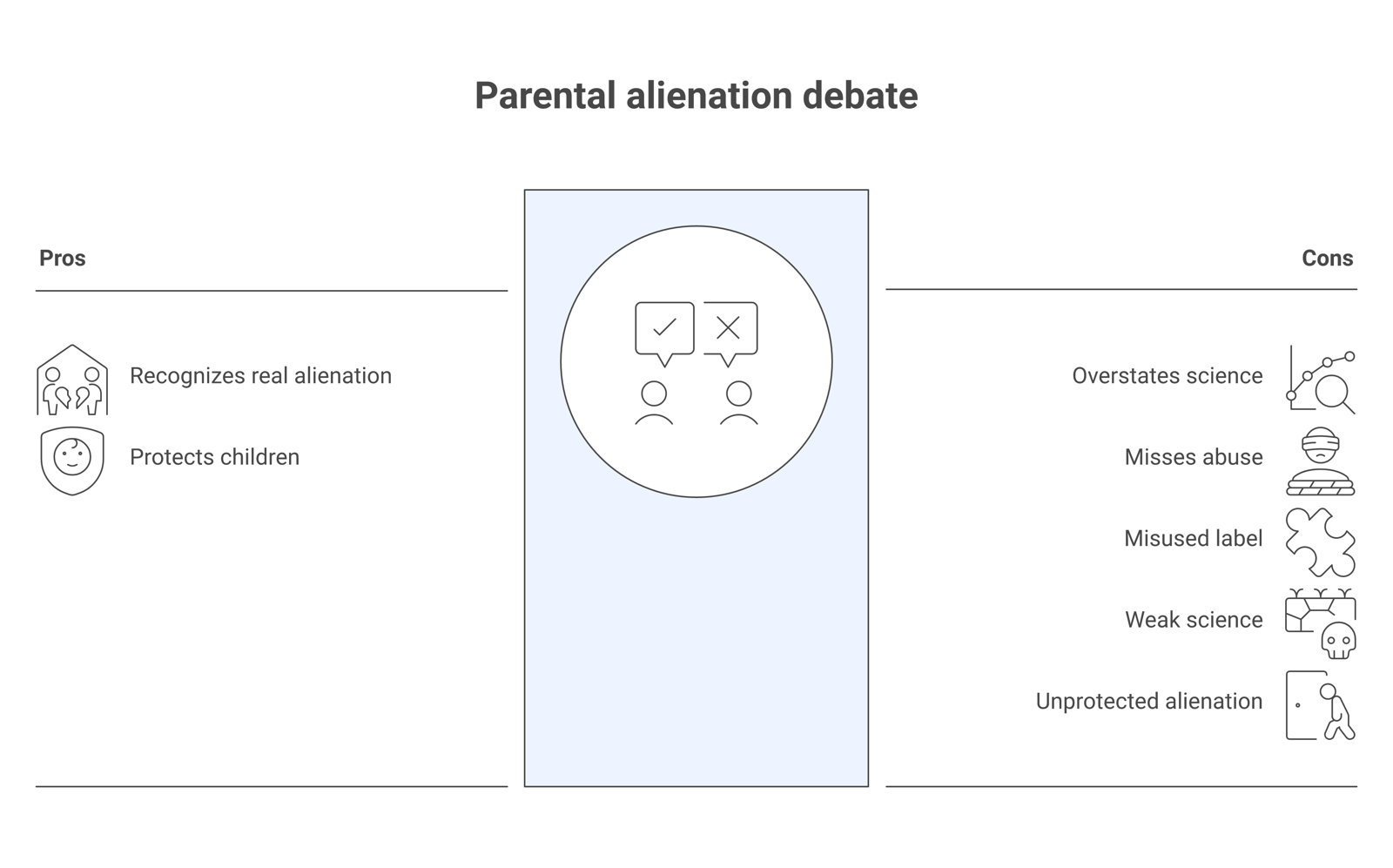
The parental alienation debate divides into three camps. One holds that parental alienation is real and can be a form of abuse. A second warns that the label is often misused against protective parents and rests on weak science. A third says contact refusal is multi-determined and each case must be assessed on its facts.
A note on safety
A child’s rejection of a parent is not always alienation. When a parent has been abusive, neglectful, or frightening, the child’s distancing can be a protective response called estrangement, and it must never be relabeled as alienation. A court or an expert using the word alienation does not make the label true. If a child’s safety is at risk, contact local law enforcement or a domestic-violence resource first.
General education, not legal or clinical advice. This page offers education only. It is not legal, clinical, or diagnostic advice, and it does not create a professional relationship. Anyone facing a custody dispute or a mental-health concern should consult a licensed professional in their own area.
The short answer
The arguments about parental alienation can feel like noise until you sort the speakers into groups. A useful map comes from the Canadian family-law scholar Nicholas Bala, who describes three broad camps in the field. The first camp affirms parental alienation as a real and harmful pattern. The second camp is critical and protective, warning that the concept is weaponized in custody fights, often against mothers reporting abuse. The third camp sits in the middle and treats a child’s rejection of a parent as one possible outcome among several, each needing its own assessment.
None of these camps is a fringe. Each includes serious researchers, clinicians, and courts. Each gets something right, and each draws fair criticism. This page lays out all three without declaring a winner, because the honest state of the evidence does not support a tidy verdict. For the related question of whether the concept holds up scientifically, see is parental alienation junk science. For the more basic question, see is parental alienation real.
Why a three-camp map helps
People argue past each other when they assume one word means one thing. “Parental alienation” carries at least three meanings at once: a specific child disorder, a set of parental behaviors, and a courtroom label. A parent who says alienation is real may mean the behaviors. A critic who says it is junk may mean the disorder. A judge who is cautious may mean the label. Sorting the speakers by camp keeps these claims from blurring together.
The map also keeps the abuse question in view. Across all three camps, careful voices agree on one boundary. A child who pulls away from a parent because that parent has been abusive is showing justified estrangement, not alienation. The camps disagree about how often that happens and how easy it is to tell, but the boundary itself is shared ground. Holding it steady is the first job of any fair reading.
The map is a tool, not a verdict. People can move between camps as the evidence changes, and many thoughtful clinicians borrow from more than one. Reading the debate this way lowers the temperature, because it replaces the question of who is a good or bad person with the question of what a given claim actually rests on.
Camp 1: Parental alienation is real and can be abuse
The affirming camp argues that parental alienation names a genuine pattern, that it harms children, and that in its severe form it amounts to psychological abuse or family violence. The leading figures include the psychiatrist William Bernet, who founded the Parental Alienation Study Group, the social-science researcher Jennifer Harman, and the author and researcher Amy Baker.
This camp makes several claims. Bernet argues that the pattern of a child being turned against a loved parent was described long before the term existed, citing court records from the 1800s and clinical writing from the 1940s. Harman and colleagues, in a 2018 review in the journal Psychological Bulletin, argue that alienating behaviors map onto the recognized patterns of coercive control and belong in the family-violence literature. Baker has catalogued a recurring set of strategies, such as badmouthing the other parent, limiting contact, and pressing the child to take sides, and has studied adults who say they lived through it as children.
What this camp gets right is hard to dismiss. The behaviors it describes are real and observable, and many clinicians who work with high-conflict separation report seeing them. The harm to a child who loses a parent for no good reason is serious. The argument that the concept is gender-neutral, rather than a tool of fathers alone, is backed by case-file studies finding alienating parents of both sexes.
Critics push back on three fronts. They argue that the affirming camp sometimes overstates the science, citing clinical illustration as if it were controlled research. They note that the most prominent affirming figures are also the people who built the advocacy organizations, which raises questions about independence. They warn that an enthusiastic alienation lens can lead an evaluator to miss real abuse. The affirming camp answers that untreated alienation is itself a harm and that careful clinicians do rule out abuse first, a point covered in parental alienation as child abuse.
Camp 2: The label is misused and rests on weak science
The critical, domestic-violence-protective camp argues that parental alienation is often a weapon. In this view, the label is raised in custody court to discredit a parent, usually a mother, who is reporting abuse, and the underlying science is too thin to carry the weight courts give it. Leading voices include the law professor Joan Meier, the developmental researcher Madelyn Milchman, the social-work scholar Jean Mercer, the United Nations Special Rapporteur on violence against women, Reem Alsalem, and the Safe and Together Institute.
This camp points to data and to policy. Meier and colleagues, in a 2020 study funded by the National Institute of Justice, found that when fathers cross-claimed alienation in custody cases where mothers alleged abuse, the mothers’ risk of losing custody roughly doubled. Milchman, Geffner, and Meier argued in a 2020 critique that proponents lack the methodology to establish alienation as a diagnosis and that legitimate causes must be ruled out before alienation is inferred. Mercer has questioned the safety and evidence base of the reunification programs courts sometimes order. In a 2023 report, the UN Special Rapporteur described parental alienation as a pseudo-concept that is used to dismiss abuse allegations on a global scale.
What this camp gets right is also serious. Misuse of the label happens, and the consequences for a protective parent and child can be severe. The evidence base for many affirming claims really is weaker than courtroom confidence suggests. The warning to rule out abuse before reaching for an alienation explanation is sound clinical practice.
The affirming camp and the middle camp both push back. They argue that the strongest critical document, the UN report, reflects one appointed rapporteur’s view rather than a binding United Nations position, and that several professional bodies and many practitioners disagree with it. They note that the Meier study drew on published appellate opinions, which over-represent cases where mothers lost, and that a separate 34-year case-law analysis by Harman and Lorandos did not find alienation working as an abuser’s tool. They observe that calling the whole concept a “myth” can leave real alienated children unprotected. This empirical clash is the subject of research on parental alienation and abuse.
Camp 3: Resist-refuse dynamics are multi-determined
The middle, differentiated camp treats a child’s rejection of a parent as a problem with many possible causes, not a single syndrome. Its central figures include the researchers Janet Johnston and Joan Kelly, the law professor Nicholas Bala, the clinician Barbara Jo Fidler, and the team of Matthew Sullivan and Kyle Pruett. This camp reformulated the old “parental alienation syndrome” into a broader account of why children resist contact after separation.
Johnston and Sullivan, in a 2020 Family Court Review paper titled “In Search of Common Ground,” argued for a more differentiated theory that holds several truths at once. A child’s resistance can come from alienating behavior by one parent, from genuinely poor or abusive parenting by the rejected parent, from a normal developmental preference, from the strain of the separation itself, or from some mix of these. Kelly and Johnston’s earlier reformulation reframed “the alienated child” as the unit of concern, rather than treating one parent as simply guilty. Bala summarizes the stance with a symmetrical rule: there are false allegations of abuse, false allegations of domestic violence, and false allegations of alienation, and each needs case-by-case proof.
What this camp gets right is balance. It takes both alienation and abuse seriously, refuses to assume either is the answer, and matches the complexity that frontline evaluators actually see. Its weakness is that “assess each case” is harder to apply than a bright-line rule. It offers courts less certainty, and it depends on skilled evaluators who can tell pathological enmeshment from healthy bonding, a distinction non-specialists often get backwards. For how that assessment works in practice, see the clinician resource on the differential diagnosis of contact refusal.
| Affirming | Critical / DV-protective | Middle / Differentiated | |
|---|---|---|---|
| Core claim | PA is real and can be abuse | The label is misused and rests on weak science | Contact refusal is multi-determined; assess each case |
| Key figures | Bernet, Harman, Baker | Meier, Mercer, Milchman, UN Rapporteur Alsalem, Safe and Together | Johnston, Kelly, Bala, Fidler |
| Main critique | Overstates the science; can miss abuse | Can leave real alienation unprotected; UN view is one rapporteur | Harder to apply; needs skilled evaluators |
Where the field is heading
No camp has won, and the most influential recent guidance does not pick one. In 2022 the Association of Family and Conciliation Courts and the National Council of Juvenile and Family Court Judges, the two leading family-court bodies in the United States, issued a joint statement on parent-child contact problems. It declines to treat either alienation or intimate partner violence as automatically decisive. It names alienating behaviors as one legitimate factor among several and asks courts to assess each family on its facts, screening carefully for abuse.
One reason the middle approach has gained ground is that real cases are rarely pure. Many involve both alienating behavior and genuine abuse at the same time, which neither a strict affirming frame nor a strict critical frame handles well. A both-and method lets a court find, for example, that one parent engaged in alienating conduct while the other parent’s behavior also frightened the child, and then craft an order that responds to both findings. Supporters of bright-line rules reply that this flexibility can let a skilled abuser reframe a protective parent as an alienator, which is exactly the risk the critical camp warns about. The disagreement does not vanish under the middle approach. It moves into the details of each case.
That posture is closest to the middle camp, and it is where many courts and evaluators are moving. The trend is away from single-cause stories in either direction, toward a both-and approach that can hold abuse and alienation in the same frame when a case calls for it. Bala’s preferred summary, drawn from the Canadian experience, is to trust trained judges to weigh the evidence case by case rather than to ban the concept or to apply it reflexively. Whether that approach protects children better than a brighter line is itself contested, which is exactly why the debate continues. For how judges actually weigh these claims, see how judges view parental alienation.
Frequently asked questions
What are the three camps in the parental alienation debate?
The first camp affirms parental alienation as a real and harmful pattern that can amount to abuse, led by figures such as William Bernet, Jennifer Harman, and Amy Baker. The second camp is critical and protective, arguing that the label is misused against parents reporting abuse and rests on weak science, led by figures such as Joan Meier, Jean Mercer, and the UN Special Rapporteur. The third camp sits in the middle and treats contact refusal as multi-determined, requiring case-by-case assessment.
Who created the three-camp map?
The Canadian family-law scholar Nicholas Bala is widely credited with describing the field as three camps: the traditional affirming group, the critical group, and a middle group that includes Janet Johnston, Joan Kelly, and Barbara Jo Fidler. The map is a way to organize the debate, not a ruling on who is correct.
Is parental alienation a recognized diagnosis?
No. There is no standalone diagnosis named parental alienation in the major diagnostic manuals. The behaviors and the family pattern are described in the research literature, but the formal diagnostic status is limited. The scientific-status question is covered in is parental alienation junk science.
Which camp is correct?
The honest answer is that the evidence does not support a single verdict. Each camp gets something right and draws fair criticism. Many courts and the 2022 AFCC and NCJFCJ joint statement now lean toward the middle, both-and approach that assesses each case rather than assuming alienation or abuse in advance.
How does this relate to abuse cases?
A child who rejects a parent because that parent was abusive is showing justified estrangement, not alienation. All three camps accept that boundary, even as they disagree about how common misuse is. The empirical overlap of alienation and abuse is covered in research on parental alienation and abuse.
What this page does not do
This page does not tell readers which parent is right in any real dispute, and it does not diagnose anyone. It does not present one camp as the truth and the others as error. The state of the science genuinely supports disagreement, and a fair resource shows that. Choices about a custody case or a child’s care belong to the reader together with licensed professionals working from the actual facts.
For the science-and-admissibility question, see is parental alienation junk science. For the term’s history, see parental alienation syndrome. For the misuse concern, see parental alienation false allegations. The full Learn silo covers the rest.
Sources and further reading
- Johnston, J. R., & Sullivan, M. J. (2020). Parental alienation: In search of common ground for a more differentiated theory. Family Court Review, 58(2), 270 to 292. https://doi.org/10.1111/fcre.12472
- Meier, J. S., et al. (2020). U.S. child custody outcomes in cases involving parental alienation and abuse allegations. National Institute of Justice. nij.ojp.gov
- Harman, J. J., Kruk, E., & Hines, D. A. (2018). Parental alienating behaviors: An unacknowledged form of family violence. Psychological Bulletin, 144(12), 1275 to 1299. https://doi.org/10.1037/bul0000175
- UN Human Rights Council (2023). Report of the Special Rapporteur on violence against women and girls, A/HRC/53/36. ohchr.org
If you or your child are in crisis
Free and confidential help is available right now.
- 988 Suicide and Crisis Lifeline. Call or text 988. 988lifeline.org
- Childhelp National Child Abuse Hotline. 1-800-422-4453. childhelp.org
- NAMI HelpLine. 1-800-950-6264. nami.org/help
Last reviewed: 2026-06-07. Author: Alex Buckles (PAC Founder).