

This page is general information, not legal or clinical advice. It does not create a professional relationship, and it does not address any one state’s law. Anyone facing a custody or safety concern should consult a licensed family-law attorney or a qualified mental-health professional in their own area.
Parental alienation and visitation are closely linked, because parenting time is often where alienation first shows. One parent may withhold visits, sabotage exchanges, or reframe the other parent as unsafe. Still, not every missed or resisted visit is alienation. This page explains how the concept works and how to tell it from normal reluctance.
A note on safety
A child’s reluctance to visit is not always alienation. A parent who limits contact to protect a child from genuine abuse is not alienating, and estrangement caused by real harm is its own situation. Safety comes first. If a child’s safety is at risk, contact local law enforcement or a domestic-violence resource before anything else.
What parental alienation in visitation means
Parental alienation in visitation describes a pattern. One parent uses parenting time to weaken the child’s bond with the other parent. The pressure can be loud or quiet. It can look like a blocked weekend, a phone that never gets answered, or a child who arrives anxious and leaves cold.
Parenting time is a common first vector for a simple reason. Visits are where the relationship actually lives. A parent who wants to erode that bond has the most leverage at the exact points where contact happens. The American Psychological Association keeps a general resource on divorce and child custody that frames how separation shapes children.
This page stays conceptual. It explains what the pattern is and how to recognize it. It does not tell a parent what to do during an active refusal, and it does not cover how a court enforces parenting time. Those belong on the Help and Court pages linked below.
How alienation operates through parenting time
Researcher Amy Baker described seventeen primary strategies that alienating parents use. Several of them run straight through visitation, which is why parenting time is where the pattern so often surfaces.
Limiting contact is the most direct one. The alienating parent cuts the amount of time the child spends with the other parent, often with a string of reasons that sound plausible one at a time.
Interfering with communication is next. Calls go unanswered. Messages do not get passed along. The child starts to feel forgotten by a parent who was, in fact, trying to reach them.
Interfering with symbolic communication adds another layer. Gifts disappear, photos come down, and the absent parent slowly fades from the home’s daily life.
Creating the impression that the targeted parent is dangerous reframes the visits themselves. The child is told, directly or by hint, that the other parent is unsafe, unstable, or uncaring. Over time the child may dread the very contact they once enjoyed.
Forcing or allowing the child to choose puts the weight of an adult conflict on a young person. The child learns that picking one parent earns approval, and that wanting the other costs something. For help tracking these patterns over time, see how to document parental alienation.
Why not every resisted visit is alienation
Here is the part many worried parents need most. A child who resists a visit is not proof of alienation. Children pull toward and away from parents for many ordinary reasons, and most of those reasons have nothing to do with manipulation.
Legal scholar Nicholas Bala and psychologist Janet Johnston describe a useful range. A child can feel simple affinity, a mild preference for one parent at a given time. A child can feel alignment, a stronger lean toward one parent during a tense season. Neither of those is alienation. Both can be normal.
Age matters a great deal here. Young children, roughly four to six, can flip allegiance quickly and may favor whichever parent they just left. Older children, around ten to twelve, often feel real pressure to pick a side as they sense the conflict around them. A preference at these ages is frequently developmental, not orchestrated.
The honest test is not whether the child resists. The test is why. A child reacting to age, mood, or a hard week is very different from a child taught to reject a parent without cause. To see how the pattern develops if it is genuine, review the stages of parental alienation.
The reluctance-to-refusal spectrum
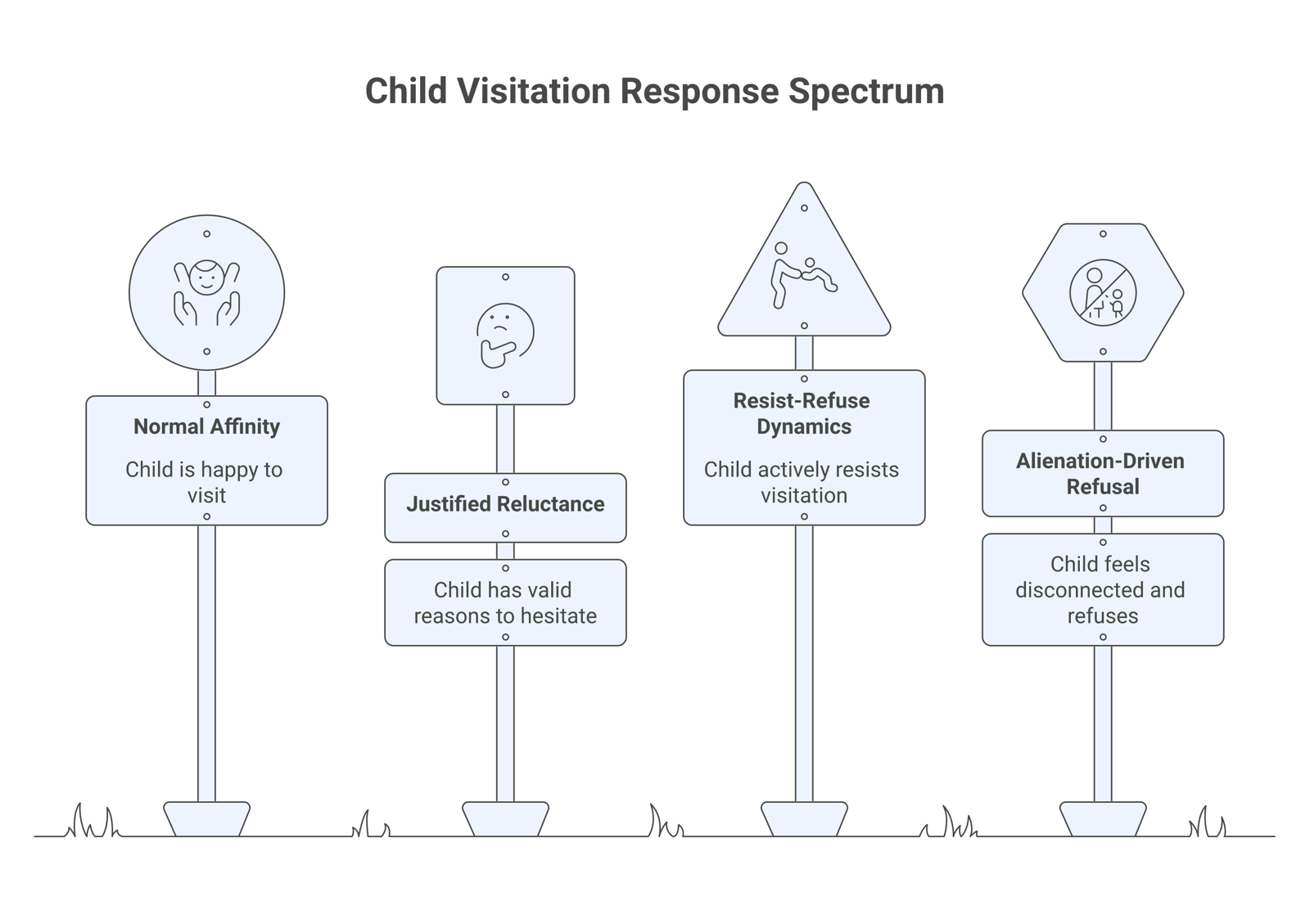
It helps to picture a child’s response to visitation as a spectrum that runs from healthy to concerning. Placing what you see on this range is calmer and more accurate than reaching for a single label.
Band one is normal affinity. The child shows an age-typical, mild preference. The bond with both parents stays intact, and the preference shifts over time.
Band two is justified reluctance. The child resists for a real reason, such as a genuine safety worry or a strained but understandable relationship issue. The resistance points at something true.
Band three is resist-refuse dynamics. The causes are mixed. Some real friction blends with some outside pressure, and the picture is genuinely hard to read. Many real cases sit here.
Band four is alienation-driven refusal. The child rejects a parent with no valid reason, often using adult phrases that do not fit a child’s own experience. The refusal is orchestrated rather than felt.
The safety boundary: when withholding is protective
One boundary deserves its own section. A parent who limits a child’s contact to protect them from real abuse is not committing alienation. Protective withholding and alienating withholding can look similar from the outside, but the reason behind them is opposite.
Specialists who study child abuse stress that safety gets screened first. Estrangement that grows from genuine harm is the child’s reasonable response to that harm. Calling it alienation would be wrong, and it could push a child back toward danger. Research on parent-child contact problems after separation, collected through resources like PubMed, underlines how carefully these situations need to be assessed.
This is why every credible discussion of alienation pairs it with a safety check. The question is never just whether contact dropped. The question is whether there was a real protective reason. When there is, the situation is about protection, not alienation.
What tends to help: graduated, supported contact
When a relationship needs rebuilding, the approach matters. The evidence and field experience point the same way. Graduated, supported contact tends to help more than abrupt, all-or-nothing demands.
A sudden order to resume full visits often backfires when a child is already anxious. A slower path works better for many families. Short, low-pressure contact can grow into longer time as trust returns, ideally with skilled support guiding each step.
This page is the concept, not the action plan. A parent living through an active refusal right now will find practical steps on the page for a child refusing visitation. A parent weighing legal enforcement can read what visitation interference is and how contempt for parental alienation works. The wider Learn hub and the page on parental alienation after divorce round out the picture.
Frequently asked questions
What is parental alienation in visitation?
It is a pattern where one parent uses parenting time to weaken the child’s bond with the other parent. The pressure shows up as withheld visits, blocked calls, or a child taught to see the other parent as unsafe. The visits become the place where the relationship is slowly undermined rather than supported.
How does parental alienation affect visitation?
It turns parenting time into a point of friction. Exchanges get missed or sabotaged, communication gets cut, and the child may grow anxious about contact they once enjoyed. Over time the child can begin to resist or refuse visits, even when the targeted parent has done nothing to deserve that reaction.
Is refusing visitation parental alienation?
Not always. A child can refuse for age-typical reasons, for a justified safety concern, or because of orchestrated pressure. The cause is what matters. Refusal alone proves nothing, so the honest step is to look at why a child resists before reaching for the word alienation.
What is the difference between a child’s reluctance and parental alienation?
Reluctance can be normal and developmental, or it can point at a real problem like a safety worry. Alienation is rejection of a parent with no valid reason, often shaped by the other parent’s pressure. The difference lies in whether the child’s response fits the child’s actual experience or has been planted from outside.
Can a parent legally withhold visitation?
Generally a parent cannot withhold court-ordered visitation on their own, unless there is a genuine safety basis or a court allows it. Protective withholding tied to real danger is different from alienating withholding. The Cornell Legal Information Institute keeps a general overview of child custody, and a licensed attorney can explain the rules in a given area.
What this page does not do
This page is not legal or clinical advice. It does not diagnose any family, name the other parent as an alienator, or tell a reader what to file. Those decisions belong to qualified professionals who know the real facts. The page also does not treat every hard visit as alienation, and it does not frame parenting time as a weapon.
For an active refusal happening now, see the page on a child refusing visitation. For the legal side, see what visitation interference is and contempt for parental alienation. The full Learn hub covers the rest.
Sources and further reading
- American Psychological Association. Divorce and child custody. apa.org/topics/divorce-child-custody
- Cornell Legal Information Institute (Wex). Child custody. law.cornell.edu/wex/child_custody
- National Center for Biotechnology Information (PubMed). Research on parent-child contact problems after divorce. ncbi.nlm.nih.gov
If you or your child are in crisis
Free and confidential help is available right now.
- 988 Suicide and Crisis Lifeline. Call or text 988. 988lifeline.org
- Childhelp National Child Abuse Hotline. 1-800-422-4453. childhelp.org
- NAMI HelpLine. 1-800-950-6264. nami.org/help
Last reviewed: 2026-06-08. Author: Alex Buckles (PAC Founder). Editorial review: held to the PAC Editorial Standards (balance, primary-source citation, reader safety); an independent expert review board will be appointed.