

Parental alienation after divorce happens when one parent works to harm a child’s bond with the other after a split. Most divorces never cause it. In a smaller share, normal conflict tips into a steady campaign that can grow worse once the case ends, and that sometimes hides inside a friendly split.
A note on safety
A child pulling away after a divorce is not always alienation. When a parent has been abusive, neglectful, or scary, a child’s distance can be a healthy, protective response called estrangement. Abuse-driven estrangement is real, and it is a separate matter. A child’s safety always comes first.
This article offers general information, not clinical or legal advice. Every family and every case is different. Readers who want help with their own situation should talk to a family therapist or a licensed attorney in their area.
What parental alienation after divorce means
Parental alienation after divorce is a pattern. One parent, on purpose or by habit, works to harm a child’s bond with the other parent after a split. The pattern can be loud or quiet. It may show up as put-downs, rewritten memories, blocked phone calls, or a slow drip of remarks that teach a child to fear or reject a once-loved parent. The result is a child who turns away from a parent for no fair reason.
This is not the same as the normal sadness that follows almost every divorce. Children often feel torn, sad, or angry when a family splits. That reaction is normal, and it tends to fade. Alienation is different. It is a lasting push toward total rejection of a parent who has done nothing to earn it. To see how the pattern unfolds step by step, read the stages of parental alienation. For the history and debate around the term, see parental alienation syndrome.
Most divorces do not cause alienation
Most divorces do not cause alienation. Most separating parents, even ones who fight hard, still want their children to love the other parent. Some conflict, hurt, and the odd sharp remark are common. They do not add up to alienation on their own. Experts save the term for a smaller, more serious pattern.
Keeping this in proportion matters. For one, it is fair: it stops parents from calling normal co-parenting friction abuse. For another, it keeps the focus on the smaller set of cases where real harm is being done. A worried parent can take some comfort here. A few rough weeks after a split are not, on their own, a sign of alienation.
How separation creates the conditions
A split changes the shape of a family, and it can open a door. In a marriage, both parents share one home, one routine, and one view of the children. After a split, each parent runs a separate home, holds separate time, and tells a separate story. That gap between two worlds is the opening.
Three shifts stand out:
- Two stories. Each home now tells its own version of why the family broke apart. A child hears one account at one house and a very different one at the other.
- Private time. A parent who wants to shape a child’s view now has time alone to do it. No other adult is there to balance the message.
- High emotion. A split stirs fear about money, housing, and the future. A parent under that strain may pass worry and blame straight to the child, by choice or not.
None of these shifts forces alienation. They just describe the soil where it can grow when one parent chooses to plant it.
When ordinary conflict tips into alienation
The line is crossed when a parent starts to rewrite a child’s reality. Richard Warshak, a clinical psychologist and author of Divorce Poison, describes how an alienating parent reshapes a child’s memory of the other parent. The parent does more than complain. The parent edits the story.
Warshak names a few forms. One is exaggeration: a small moment, like a tickle fight, becomes a tale of a violent attack. Another is plain invention: events that never happened. A third is withholding, where the parent quietly grabs cards, screens calls, and tells the child the other parent has lost interest. Withholding does the most harm, because the child sees no sign of the missing parent’s love and slowly decides they were left behind.
Warshak compares the worst version to propaganda. To make a child believe a once-loved parent is now a villain, the alienating parent reaches back and edits the past itself. A parent who began long work hours only after the split is recast as one who never cared. A family trip becomes the week a parent supposedly vanished. The goal is a child who no longer trusts their own happy memories.
Why alienation can escalate after the divorce is final
A common myth says alienation stops once the divorce is over and the court has ruled. In many cases, the opposite is true. Ryan Thomas, a coach and survivor, points to two patterns that push the behavior up, not down, after a final order.
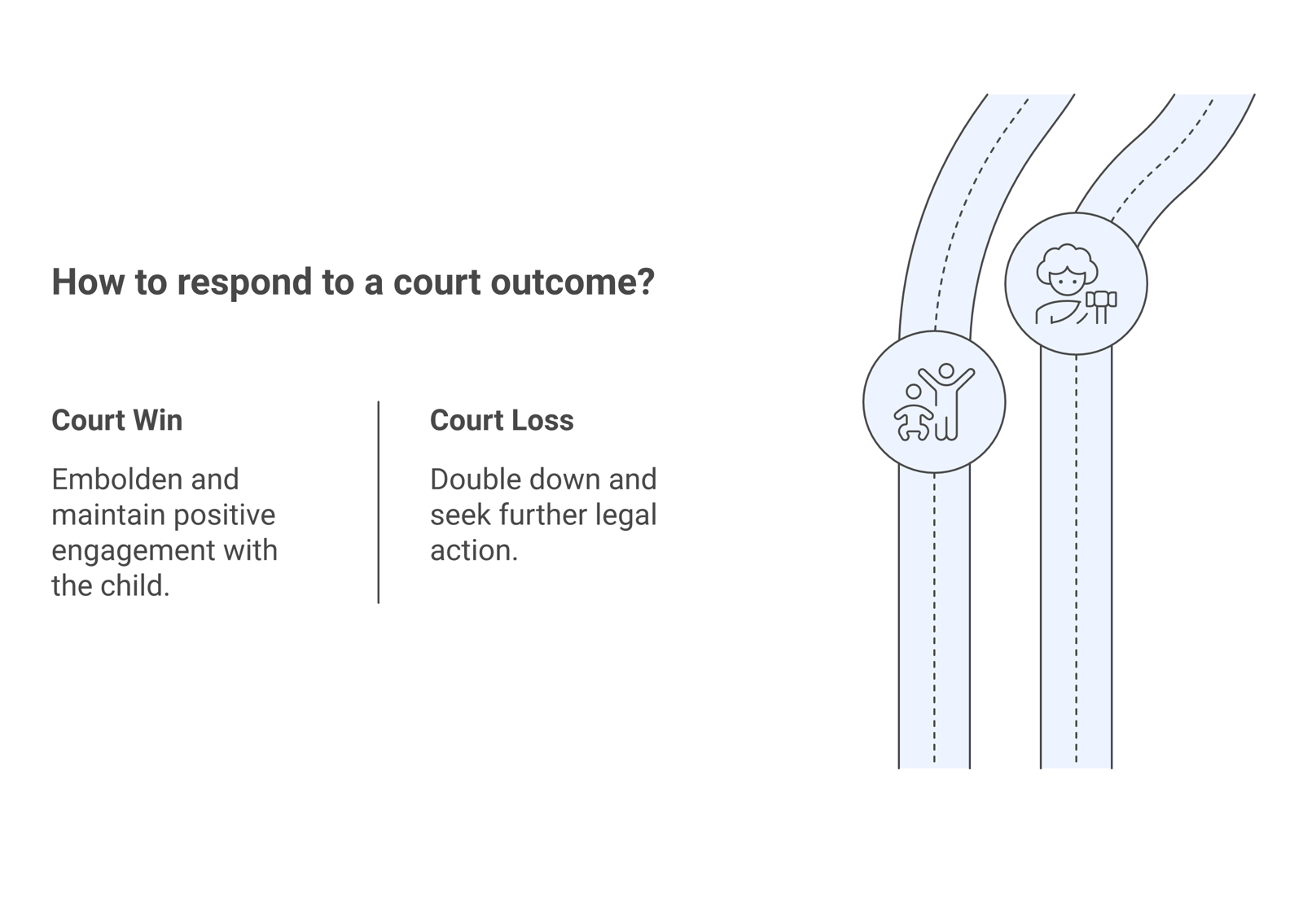
The first is the embolden pattern. When an alienating parent wins what they wanted in court, such as more time or more control, the pressure seems to have worked. The thinking is simple: what got me here can get me more. So the parent keeps going. Sometimes they work to upset the child so much that the child refuses court-ordered time with the other parent.
The second is the double-down pattern. When an alienating parent does not get what they wanted, they may decide they did not push hard enough. They work to make the child more upset, so the child’s pain can later be used as proof the court got it wrong. In both patterns, the child becomes the evidence. The pressure rises instead of easing.
The stealth pattern in amicable separations
Alienation does not always look like open war. A second myth says it only happens in high-conflict divorces. In truth, the quiet version can be harder to catch, because nothing on the surface looks wrong.
Ryan Thomas calls this the stealth pattern. The dig comes in a calm or even sad tone, never an angry one. A parent might sigh that the other parent “has other priorities that don’t always include us.” Or, “I’ll try to get the relationship back, but it’s really your choice.” Each line is mild on its own. Stacked over months, they teach a child to doubt the other parent’s love.
The stealth pattern is risky because the targeted parent’s guard is down. In a friendly split, that parent has little reason to suspect a thing. A few warning signs help. Watch for a child who suddenly frets about money or stability they never questioned before. Notice if a child starts to think the other parent does not care. A good-parent and bad-parent story that hardens is another clue, even though no one is openly fighting.
The link to coercive control
Why does this matter so much? More and more, researchers see steady alienating behavior as a form of family violence. In a 2018 review in the journal Psychological Bulletin, Jennifer Harman, Edward Kruk, and Denise Hines argue that these behaviors match the known patterns of coercive control, the same control tactics seen in abusive adult relationships.
In that view, the child is used as a tool to control and punish the other parent. The targeted parent often holds little power, while the alienating parent holds nearly all of it. This helps explain why the harm can be so hard to stop, and why experts treat severe cases as child protection, not a routine custody fight. The long-term effects of parental alienation on children reflect how serious it is.
What tends to help
There is no quick fix, and no court order can make a child feel different on command. A few steps still tend to help. None of them involve fighting the other parent in front of the child.
Steady, low-key contact matters more than frequent contact. A targeted parent who stays calm, keeps showing up, and does not argue the case to the child leaves a safe door open. Keeping a plain record of missed visits and broken deals can help if a court gets involved later. A family therapist who knows alienation can support both parent and child in ways a courtroom cannot. For tips on shielding children from conflict during a split, see protecting children during divorce.
Frequently asked questions
Does divorce cause parental alienation?
No. Most divorces do not lead to alienation, even when parents argue. A divorce can set up the conditions where it becomes possible, such as two homes and private time with the children. Alienation only happens when one parent actively works to harm the child’s bond with the other. Normal post-divorce sadness and conflict are not the same thing.
How common is parental alienation after divorce?
Estimates vary, and there is no single agreed number. Experts do agree on one point: the severe, lasting form is far less common than normal divorce conflict. The behavior sits on a range, from mild bad-mouthing that fades to a relentless push that turns a child fully against a parent. Only the severe end is what most clinicians mean by alienation.
Why does alienation sometimes get worse after the divorce is final?
Because the final order does not remove the motive. A parent who won in court may feel bold enough to keep going. A parent who lost may push harder to prove the ruling was wrong. In both cases the child can become the way the conflict continues, so the pressure rises rather than fades once the case ends.
Can parental alienation happen in an amicable divorce?
Yes. Alienation does not need open conflict. A quieter, stealth version can grow inside a friendly split, sent through calm remarks and subtle digs rather than shouting. It can be harder to spot because the surface looks cooperative. That is why warning signs still matter, even when a split seems calm.
Sources and further reading
- American Psychological Association. Divorce and child custody. apa.org/topics/divorce-child-custody
- Harman, J. J., Kruk, E., & Hines, D. A. (2018). Parental alienating behaviors: An unacknowledged form of family violence. Psychological Bulletin, 144(12), 1275 to 1299. https://doi.org/10.1037/bul0000175
- Warshak, R. A. Divorce Poison: How to Protect Your Family from Bad-mouthing and Brainwashing. Harper.
For more on the broader topic, visit the Learn silo, or read the stages of parental alienation and the long-term effects of parental alienation.
If you or your child are in crisis
Free and confidential help is available right now.
- 988 Suicide and Crisis Lifeline. Call or text 988. 988lifeline.org
- Childhelp National Child Abuse Hotline. 1-800-422-4453. childhelp.org
- NAMI HelpLine. 1-800-950-6264. nami.org/help
Last reviewed: 2026-06-06. Author: Alex Buckles (PAC Founder).