

Protecting children during divorce starts with one rule: keep the adult conflict away from the child. Shield them from arguments and legal details, never use them as a messenger or spy, and support their bond with both safe parents. Watch for early warning signs of harm, and get help early.
A note on safety
This guidance assumes both parents are safe. Supporting a child’s bond with both parents is protective only when both are safe. Where a parent is abusive or dangerous, protection means safety, not forced contact. A child’s distancing from an abusive parent is justifiable estrangement, not parental alienation. If a child is in danger, contact local emergency services or a child-abuse hotline first.
This page offers general information, not clinical or legal advice. Every family and every child is different. A licensed child therapist, family counselor, or family-law attorney can advise on a specific situation.
What protecting children during divorce really means
Protecting children during divorce is mostly about one thing: keeping the conflict between the adults away from the child. Decades of research point the same direction. It is not the divorce itself that harms children most. It is ongoing exposure to parental conflict, hostility, and being pulled into the middle. The American Psychological Association notes that most children adjust over time when the adults manage their conflict well.
This page is a preventive guide. The goal is to reduce harm before it takes hold. Five practices carry most of the weight. Keep the adult conflict out of the child’s world. Never use the child as a messenger, a spy, or a confidant. Support the child’s bond with the other safe parent. Watch for early warning signs that conflict is escalating. Get help early. Parental alienation is one specific risk among these broader harms, and the warning-sign section below covers it directly.
Keep the adult conflict away from the child
Children do best when they are kept out of the crossfire. That means the child should not hear the arguments, see the angry texts, or learn the legal details. Conflict the child cannot see does far less damage than conflict the child is dragged through.
A few habits help here. Save hard conversations with the other parent for times the child is not present. Keep handovers calm and brief. Put difficult co-parenting talk in writing through a co-parenting app or email, so it stays off the child’s radar. Avoid venting about the case where small ears can hear, including phone calls in the next room.
Children also read tone and body language. A parent does not have to say a word to signal hostility. Tense exchanges at the door still register. The American Academy of Child and Adolescent Psychiatry encourages parents to keep routines steady and conflict low so children feel secure during the transition. Calm is itself a form of protection.
None of this requires pretending everything is fine. Children can be told, in simple and honest terms, that the parents are separating and that both still love them. What they do not need is the adult anger, the blame, or the play-by-play of the dispute.
Never make the child a messenger, spy, or confidant
A child caught between two parents carries a weight that is not theirs. Three roles do the most damage, and all three are worth naming plainly.
The messenger trap
It feels efficient to say, “Tell your dad he owes me for the field trip.” It is not. A child asked to carry messages becomes the bearer of every adult tension. They get blamed for tone they did not choose. Parents should speak to each other directly, through a call, an email, or an app, and leave the child out of the relay.
The spy trap
Questions like “What did your mom buy?” or “Who was at your dad’s place?” turn the child into an informant. The child senses that loving one home means betraying the other. That bind is corrosive. Curiosity about the other household is best set aside. A child’s time at each home belongs to the child.
The confidant trap
A divorcing parent is hurting and may lean on the child for comfort. That is understandable, and it is still harmful. A child should not hold a parent’s grief, fear, or anger about the marriage. Adults need adult support: friends, family, a therapist, a support group. Letting the child be a child is the protective move.
Support the child’s bond with the other parent
When both parents are safe, the child’s relationship with each one is worth protecting. Children generally fare better when they keep a warm bond with both parents after a divorce. Supporting that bond is an active job, not a passive one.
Speak about the other parent with basic respect in front of the child. Bad-mouthing does real harm. Psychologist Richard Warshak, author of Divorce Poison, describes how repeated one-sided storytelling can slowly rewrite a child’s memory of a loved parent until affection curdles into fear or contempt. A child does not need to hear a parent’s grievances. Those belong in adult spaces.
Practical support matters too. Keep the other parent’s time predictable. Pass along the school flyer and the soccer schedule. Let calls and video chats happen without a hovering audience. Encourage the child to enjoy the other home rather than apologize for it. Small signals that both relationships are welcome give the child permission to love both parents freely.
Watch for early warning signs of escalation
Most post-divorce conflict stays within ordinary, if painful, limits. Sometimes it does not. Parental alienation is the pattern in which one parent, through repeated behavior, pushes a child to reject the other safe parent without a good reason. Researchers Jennifer Harman, Edward Kruk, and Denise Hines describe these alienating behaviors as a form of coercive control and family violence. The risk is serious, even though it is not the most common outcome of divorce.
Five signs the conflict is escalating
Adult-child survivors and clinicians point to a recognizable drift toward parental elimination. Five signs stand out.
- The goal shifts from custody to removal. The aim is no longer more parenting time but cutting the other parent out entirely.
- Watchfulness hardens into fixation. Reasonable concern turns into a conviction that the other parent is dangerous, and every neutral act gets read as proof.
- The language turns dehumanizing. The other parent is described as an obstacle or a threat rather than a mother or father.
- Other people get recruited into one story. Relatives, new partners, and friends are pulled into a shared belief that one parent must be protected against the other.
- The child starts voicing adult conclusions. A young child repeats grown-up grievances and feels that loving one parent betrays the other.
The deeper question is not simply whether a child pulls away. It is how the child got there. A loyalty bind built by an adult is very different from a child’s own honest feelings.
Why amicable splits can hide it
Alienation is easy to picture in a loud, high-conflict divorce. It can also be quiet. Former alienated child Ryan Thomas warns that the pattern can be stealthy, and that an amicable surface can lower a parent’s guard. The undercutting may arrive in a calm or even sad voice: “Your other parent has other priorities.” “I’ll try to fix this, but it’s really up to you.” Watch for a child who suddenly questions their security, or who forms a one-sided good-parent and bad-parent view with no visible fight behind it. For a deeper checklist, see the signs your ex is alienating your child, and if a pattern is already forming, see dealing with parental alienation.
Protective practices, step by step
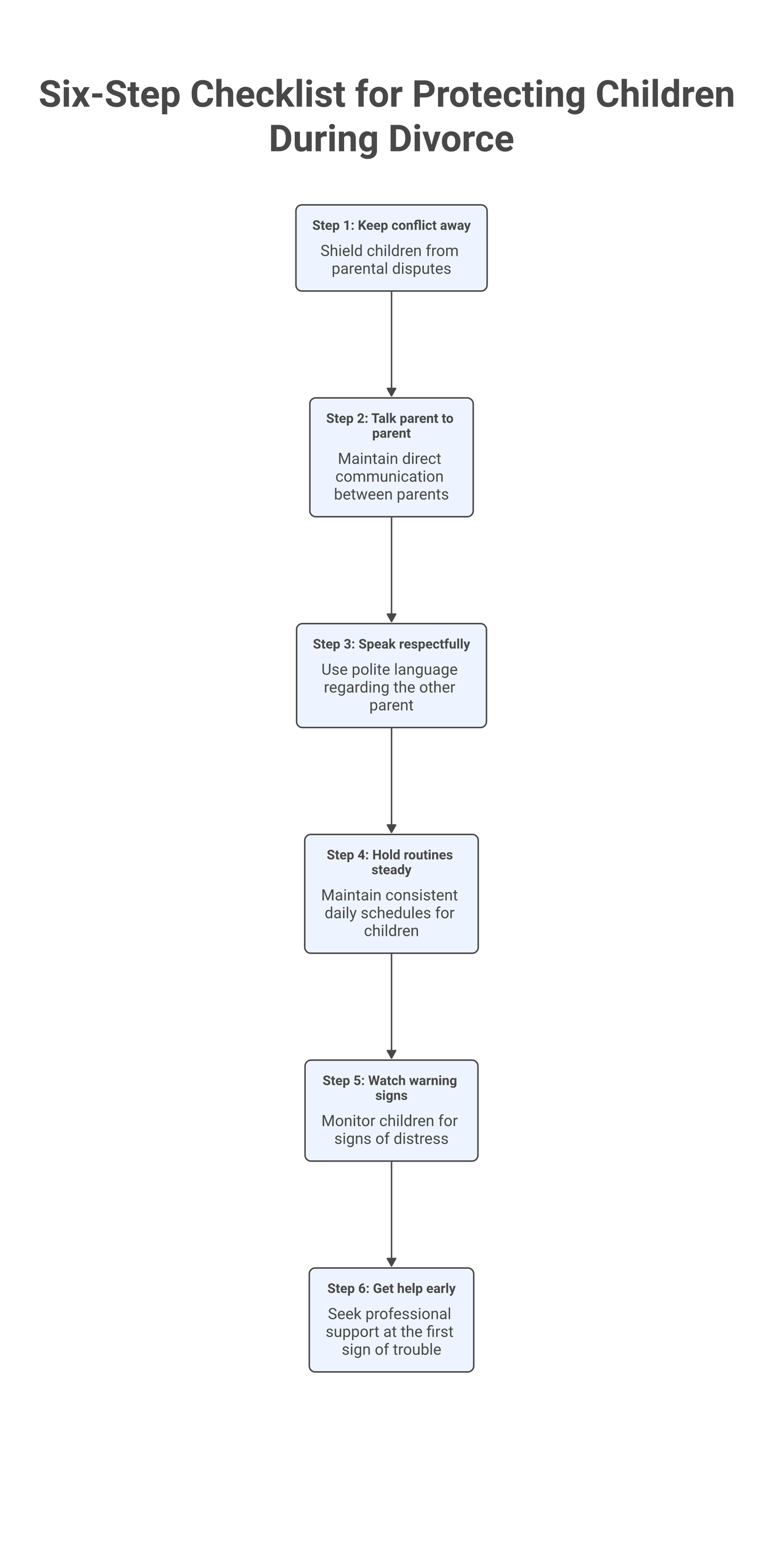
These six steps turn the ideas above into action a parent can take this week.
- Keep conflict away from the child. Handle disputes when the child is not present, and keep handovers calm.
- Talk parent to parent, not through the child. Use a call, an email, or a co-parenting app for every logistics message.
- Speak respectfully about the other safe parent. Save grievances for adult ears, and never ask the child to take sides.
- Hold the child’s routines and both relationships steady. Protect bedtimes, school, activities, and the other parent’s time.
- Watch for early warning signs. Note new anxiety, withdrawal, or a sudden one-sided view of one parent, and track changes over time.
- Get help early. Bring in a child therapist or family counselor before patterns harden.
A worried parent can also fall into self-defeating habits. Clinician Randy Flood describes common missteps among parents who feel a child slipping away. Taking the rejection personally, ramping up discipline, recruiting relatives to lecture the child, retaliating against the other parent, and showing up to professionals angry all tend to backfire. The steadier path is calm documentation, warmth toward the child, and professional support.
When divorce harm becomes parental alienation
Most divorce distress is a normal reaction to a hard change. Sadness, anger, clinginess, and testing limits are common and usually ease with time and stability. Alienation looks different. The child’s rejection is one-sided, scripted, and far out of proportion to the actual relationship, and it points at a parent who has been loving and safe.
One distinction matters above all. A child who pulls away from a parent who has been abusive or frightening is not being alienated. That is justifiable estrangement, and it calls for safety, not forced contact. Alienation describes the erasure of a safe and loving parent. The two must never be confused.
When the signs of alienation appear, early action helps most. A child who is already refusing contact needs a careful, supportive response rather than pressure, and the page on a child refusing visitation covers that. Conflicted co-parents who can still talk may benefit from co-parenting counseling. The broader Help section gathers active-situation guidance in one place.
Get help early
Reaching for help early is protective, not a sign of failure. Children often show stress in ways that are easy to miss, and a trained eye catches patterns sooner. The American Academy of Child and Adolescent Psychiatry supports early professional input when a child is struggling with family change.
Several kinds of help fit different needs. A child therapist gives the child a neutral place to process feelings. A family counselor can steady communication between the parents. Co-parenting classes or a coordinator can lower conflict at handovers. School counselors can watch for changes during the day. The earlier these supports start, the less chance harmful patterns have to set.
Frequently asked questions
How can I protect my children during divorce?
Keep the adult conflict away from the child, and never use the child as a messenger, spy, or confidant. Support the child’s bond with the other safe parent by speaking respectfully and protecting routines. Watch for early warning signs that conflict is escalating, and get help from a child therapist or family counselor early. These steps reduce the harm of divorce and lower the risk of parental alienation.
What should you never do to a child during a divorce?
Never make the child carry messages between the parents, report on the other household, or hold an adult’s grief and anger. Never bad-mouth the other safe parent in front of the child, and never ask the child to choose sides. Each of these puts the child in a loyalty bind that causes lasting harm.
How do I know if the divorce is hurting my child?
Watch for changes that persist: new anxiety, trouble sleeping, a drop in school performance, withdrawal from friends, or anger that does not ease. A sudden one-sided view of one parent is a particular concern. Children grieve a divorce in normal ways, but persistent or worsening changes deserve a check from a child therapist or pediatrician.
Is it parental alienation or a normal reaction to divorce?
Most divorce distress is a normal reaction and eases with stability. Alienation is suspected when a child’s rejection of a safe parent is one-sided, scripted, and far out of proportion to the relationship. A child pulling away from a parent who has been abusive is not alienation; that is justifiable estrangement and calls for safety.
How early should I get help during a divorce?
As early as possible. A child therapist or family counselor is most effective before patterns harden, and early help is a protective choice rather than a sign that anything has failed. Parents who notice warning signs, or who simply want support for their child, do not need to wait for a crisis to reach out.
Sources and further reading
- American Psychological Association. Divorce and child custody. apa.org/topics/divorce-child-custody
- American Academy of Child and Adolescent Psychiatry. aacap.org
- Harman, J. J., Kruk, E., & Hines, D. A. (2018). Parental alienating behaviors: An unacknowledged form of family violence. Psychological Bulletin, 144(12), 1275 to 1299. https://doi.org/10.1037/bul0000175
- Warshak, R. A. Divorce Poison: How to Protect Your Family from Bad-mouthing and Brainwashing. Harper.
If you or your child are in crisis
Free and confidential help is available right now.
- 988 Suicide and Crisis Lifeline. Call or text 988. 988lifeline.org
- Childhelp National Child Abuse Hotline. 1-800-422-4453. childhelp.org
- NAMI HelpLine. 1-800-950-6264. nami.org/help
Last reviewed: 2026-06-06. Author: Alex Buckles, Founder.