
Parental alienation and narcissism often overlap, though they are not the same thing. Narcissistic traits can drive a parent to alienate a child. The child gets treated as an extension of the parent, not a separate person. Yet many alienation cases involve no personality disorder at all.
A note on safety
A child pulling away from a parent is not always alienation. When a parent has been abusive, neglectful, or frightening, a child’s distancing can be healthy estrangement, not alienation. A child rejecting a genuinely harmful parent is not proof that the other parent is a narcissist. Safety comes first. If a child is in danger, contact local law enforcement or a domestic-violence resource.
This page offers general information, not clinical advice, and it does not diagnose any individual. A personality disorder can only be assessed by a qualified professional who has evaluated the person directly. Reading about traits online is not a diagnosis of a co-parent, a former partner, or anyone else.
How parental alienation and narcissism connect
Parental alienation and narcissism connect through one shared pattern. A parent who centers their own needs can begin to treat a child as a possession instead of a person with two parents. Clinicians describe how narcissistic traits, part of the Cluster B group of personality patterns, can fuel the behaviors that turn a child against a loving parent.
The link is real, yet it is not a rule. Alienating behavior can also grow from fear, untreated conflict, or a parent’s own unhealed wounds. Narcissism is one possible driver among several. This page explains how the two ideas relate. It also draws a firm line: understanding a pattern is not the same as diagnosing a person.
What “narcissism” means in this context
Everyday speech uses “narcissist” loosely, often to mean someone selfish or vain. Clinical language is narrower. Narcissistic personality disorder is one of the Cluster B personality disorders, a group that also includes borderline, antisocial, and histrionic patterns. These patterns involve intense or unpredictable ways of relating to other people.
A person can show narcissistic traits without meeting the full criteria for a disorder. Traits sit on a spectrum. Only a qualified professional who has directly evaluated someone can say whether a diagnosis fits. For that reason, this page speaks about traits and patterns, never about labels for any named or implied person.
The American Psychological Association notes that divorce and custody disputes place real strain on children. High-conflict separations can bring out controlling behavior in a parent who would otherwise cope. That strain alone does not make a difficult co-parent a narcissist.
Why narcissistic traits can drive alienating behavior
Narcissistic traits can drive alienation because of how such a parent sees the child. In a healthy bond, a parent supports the child’s separate identity, including the child’s love for the other parent. A narcissistic pattern works differently. The child exists to meet the parent’s needs for admiration, loyalty, and control.
The narcissistic-abuse educator Randi Fine describes an operating model in which the parent assigns children roles that serve the parent’s supply needs. One child may be the “golden child” who reflects the parent’s image. Another may be the “scapegoat” who carries blame. The roles can rotate the moment a child stops conforming. The family organizes around the parent, not around the children.
Within that model, the other parent becomes a threat. A child who loves both parents divides the loyalty the narcissistic parent demands. Removing the other parent restores control. Alienating tactics tend to follow: subtle put-downs, rewritten history, and pressure on the child to choose.
The educator Ryan Thomas describes a related driver he calls the best-parent delusion. The alienating parent becomes convinced that they alone are good for the child and that the other parent is a danger. That belief works like a permission slip. It licenses the parent to shrink the other parent’s place in the child’s life, step by step, while casting themselves as the hero. Revenge may be present, but the deeper engine is the conviction that the child belongs to them.
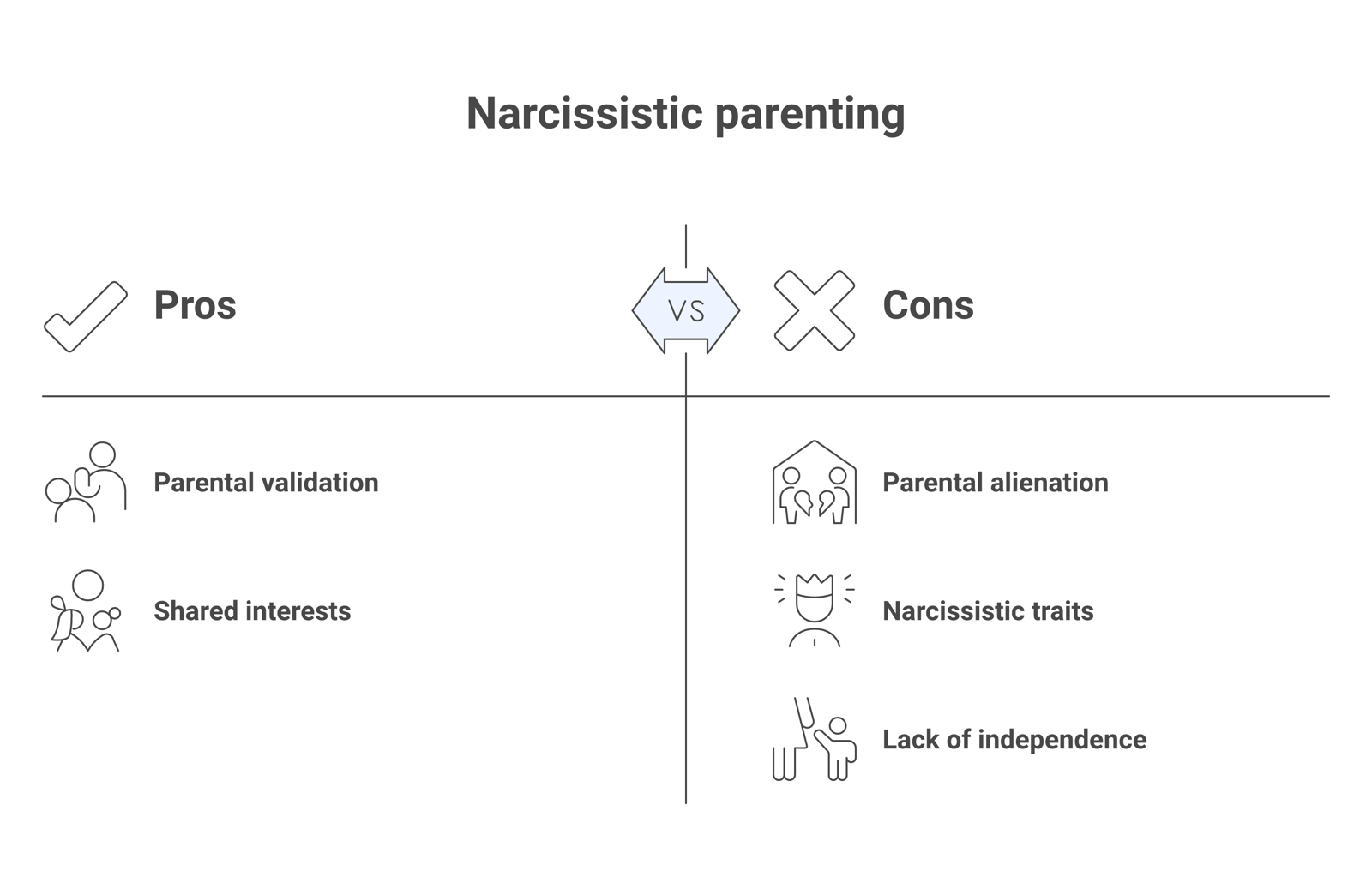
The operating model: engulfing, ignoring, and the child as an extension
Fine’s model describes two broad styles. The engulfing parent merges with the child emotionally and treats the child’s separateness as a betrayal. The ignoring parent neglects and isolates the child while keeping up a good public image. The same household can hold both styles, and the same parent can swing between them as their needs shift.
The engulfing parent often relies on enmeshment tactics. Parentification turns the child into the parent’s caretaker. Emotional incest casts the child as a stand-in partner and confidant. Infantilization keeps the child dependent and small. Triangulation routes all family communication through the parent, so nothing passes between others without their control.
The common thread is that the child is treated as an extension of the parent. The child’s job is to mirror, soothe, and obey. When that child also has a loving relationship with the other parent, the bond becomes hard for the narcissistic parent to tolerate. Alienation is one way the parent resolves that tension in their own favor.
“Mimicry, not love”: a careful clinical claim
Some clinicians make a stronger claim. Fine argues that a parent with narcissistic personality disorder cannot love a child in the ordinary sense, and that what looks like love is mimicry of an emotion the parent has not felt. In this view the deficit is structural, a feature of the disorder rather than a choice.
This is a clinical position, not a settled fact, and it applies to a diagnosed disorder, not to ordinary selfishness. It appears here to explain a pattern many targeted parents notice: warm words that do not match cold actions, or affection that vanishes when the child stops performing. Whether that pattern reflects a disorder in any specific case is a question for a qualified professional, never for an online article.
Real parental love, by contrast, tends to be steady, patient, and unconditional. It survives a child’s growing independence. A parent who punishes a child for loving someone else is showing something other than that steady love.
Severe alienation and the Cluster B prediction
The family therapist Linda Gottlieb, drawing on decades of custody work, predicts that severe alienators most often show one or more Cluster B personality disorders. These are the parents who pursue total removal of the other parent through repeated false allegations. Borderline patterns can bring abandonment rage. Narcissistic patterns can bring grandiosity and entitlement. Antisocial patterns can bring a lack of remorse and a willingness to use the child as a tool.
Gottlieb also explains why these parents often seem credible to courts and therapists. The Cluster B presentation can be composed, articulate, and convincing in short meetings, while the targeted parent looks anxious and upset. The signal is not in a single interview. It shows in the pattern over time.
Two cautions belong with this prediction. First, it describes severe cases, not every case. Second, it is a clinical hypothesis about a group, never a diagnosis of any individual parent. Courts decide cases on documented behavior, not on labels.
The crucial caution: not all alienation involves narcissism
This is the heart of the page. Parental alienation and narcissism overlap, but neither one proves the other. Plenty of alienating behavior comes from parents who are frightened, grieving, poorly advised, or caught in a high-conflict divorce. Some alienation is situational and eases once the conflict cools. Labeling every alienating parent a narcissist is inaccurate and unhelpful.
The reverse error matters just as much. A child who pulls away from a parent is not always being alienated. When a parent has been abusive or frightening, the child’s distance can be a healthy, protective response. A child rejecting a genuinely harmful parent is not evidence that the other parent is a narcissist. Estrangement and alienation are different, and the difference protects children.
Honesty about this caution does not minimize the harm. Researchers Jennifer Harman, Edward Kruk, and Denise Hines describe parental alienating behaviors as a form of family violence rooted in coercive control. That framing keeps the focus where it belongs, on the behavior and its effect on the child, not on a label pinned to a parent from a distance.
This page does not diagnose anyone. It does not tell a reader that a co-parent “is a narcissist.” A personality disorder is a serious clinical judgment that requires direct evaluation by a licensed professional. What a reader can do is describe behavior accurately, document it, and seek qualified help.
For parents managing daily contact with a difficult co-parent, the companion guide on how to deal with a narcissistic co-parent covers practical coping. To understand the wider concept, see the Learn hub, the explainer on parental alienation syndrome, the stages of parental alienation, and how alienation overlaps with emotional abuse.
Frequently asked questions
Is every alienating parent a narcissist?
No. Parental alienation and narcissism often overlap, but many alienating parents have no personality disorder. Alienation can come from fear, grief, high-conflict divorce, or poor advice. Narcissistic traits are one possible driver among several. Only a qualified professional can assess whether a disorder is present, and this page does not diagnose anyone.
Why would a narcissistic parent alienate a child?
A narcissistic pattern treats the child as an extension of the parent rather than a separate person. The child is expected to mirror, admire, and stay loyal. A child who also loves the other parent divides that loyalty. Removing the other parent restores the control and admiration the parent seeks, so alienating tactics tend to follow.
What is the difference between alienation and estrangement?
Alienation is when a child rejects a safe, loving parent because of another parent’s influence. Estrangement is when a child pulls away from a parent who has been abusive, neglectful, or frightening. The child’s distancing is protective in estrangement. A child rejecting a harmful parent is not proof that the other parent is a narcissist.
Can a reader tell if a co-parent has a personality disorder?
No, and neither can this page. A diagnosis requires direct evaluation by a licensed mental-health professional. What a parent can do is describe and document specific behaviors, focus on the child’s wellbeing, and seek guidance from a qualified clinician or family-law professional. Online checklists are not assessments.
Are Cluster B traits the same as parental alienation?
No. Cluster B is a group of personality patterns that includes narcissistic, borderline, and antisocial styles. Parental alienation is a behavior pattern that turns a child against a parent. The two can occur together, and severe alienation is often linked to Cluster B traits, but each can exist without the other.
What this page does not do
This page does not diagnose any individual and does not label any named or implied person. It does not claim that every alienating parent is a narcissist, or that narcissism always leads to alienation. It does not pathologize ordinary conflict between separated parents. And it does not frame these ideas as ammunition for court. The goal is understanding, grounded in the child’s wellbeing. For coping strategies, see how to deal with a narcissistic co-parent. For the broader concept, start at the Learn hub.
Sources and further reading
- American Psychological Association. Divorce and child custody. apa.org/topics/divorce-child-custody
- Harman, J. J., Kruk, E., & Hines, D. A. (2018). Parental alienating behaviors: An unacknowledged form of family violence. Psychological Bulletin, 144(12), 1275 to 1299. https://doi.org/10.1037/bul0000175
If you or your child are in crisis
Free and confidential help is available right now.
- 988 Suicide and Crisis Lifeline. Call or text 988. 988lifeline.org
- Childhelp National Child Abuse Hotline. 1-800-422-4453. childhelp.org
- NAMI HelpLine. 1-800-950-6264. nami.org/help
Last reviewed: 2026-06-06. Author: Alex Buckles (PAC Founder).