

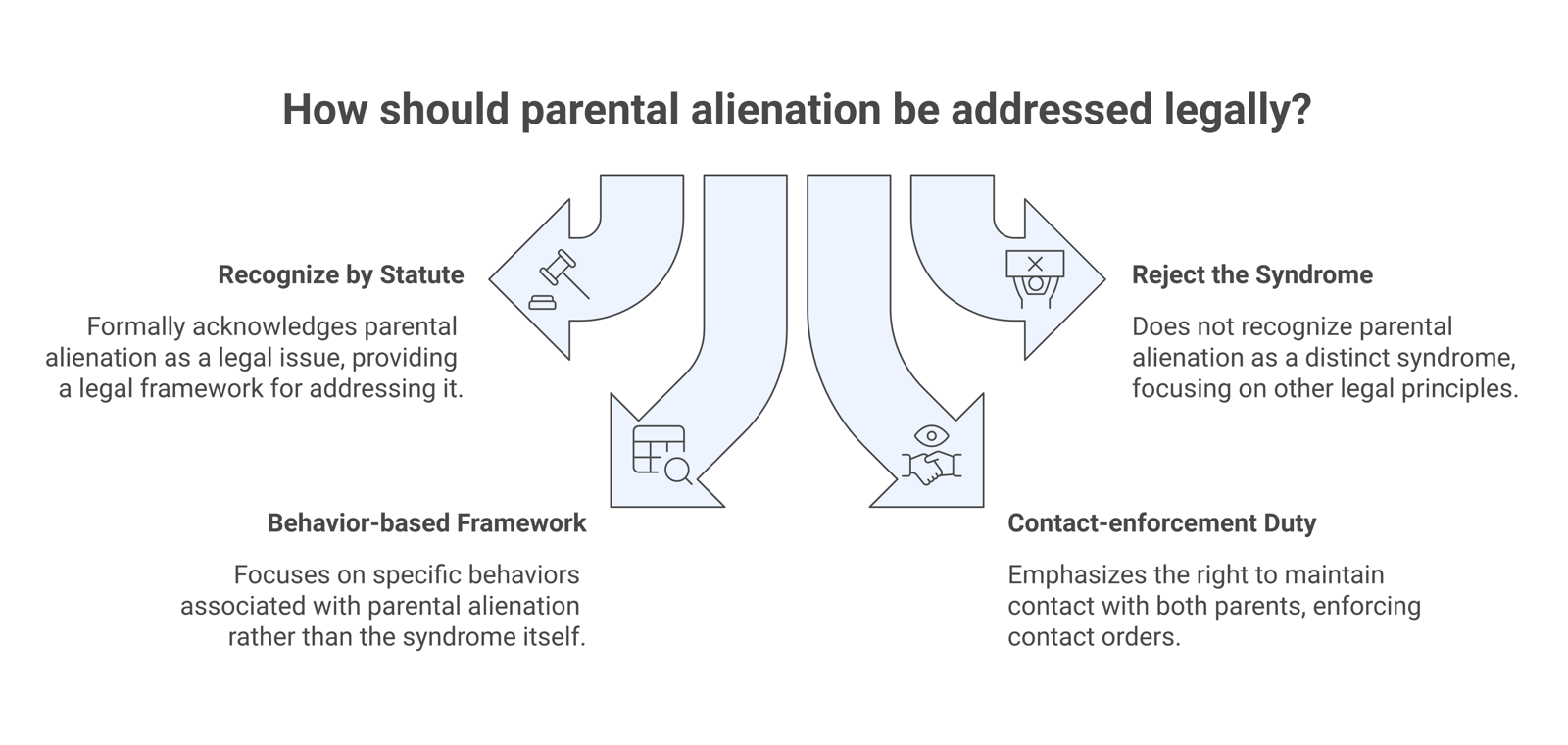
Parental alienation around the world has no single legal answer. Some countries recognize it by statute, some bodies reject the “syndrome” as pseudoscience, and international courts stress a duty to keep parents and children in contact. The clearest balanced model, from England and Wales in 2024, focuses on behaviors, screens for abuse first, and assesses each case.
A note on safety
A child’s reluctance to see a parent is not always alienation. When it follows genuine abuse, neglect, or danger, it can be an understandable, justified response, not alienation, and the two must never be equated. Most modern frameworks reviewed here insist that courts screen for abuse before treating a contact problem as alienation.
This page is general education, not legal or clinical advice. It describes other countries’ laws and policies factually for context and does not imply that any foreign law applies in the United States or anywhere else. Anyone with a specific legal question should consult a licensed lawyer in their own jurisdiction.
The short answer: no global consensus
There is no international consensus on parental alienation. Jurisdictions sit at very different places. At one end, a country like Brazil recognizes parental alienation in a dedicated statute. At the other end, Spain, a United Nations Special Rapporteur, and Council of Europe bodies have rejected or cautioned against the idea of a parental alienation “syndrome.” Between these poles, the European Court of Human Rights presses states to facilitate contact between a child and a parent, while the England and Wales Family Justice Council has built a careful, behavior-based framework.
Read together, the picture is genuinely split, but it is not random. The clear direction of travel is away from a single diagnosable “syndrome” label and toward assessing specific behaviors, screening for abuse first, and deciding each case on its own facts. Whether the underlying construct is sound at all is the subject of is parental alienation real, and the competing schools of thought are mapped on the three camps in parental alienation.
England and Wales: a behavior-based balanced model
The most developed balanced model comes from England and Wales. In December 2024, after one of the largest consultations in its history, the Family Justice Council published guidance on how courts should respond to a child’s “unexplained reluctance, resistance or refusal” to spend time with a parent, and to allegations of alienating behaviour. The President of the Family Division endorsed it.
The guidance is explicit on the central scientific question. It states that “parental alienation syndrome” has no evidential basis and is “a harmful pseudo-science,” and that alienation is not a syndrome capable of being diagnosed. The move it makes is to shift the focus from a label to specific behaviors and their impact on a particular child.
The terms the guidance uses
Rather than ask whether a child is “alienated,” the guidance separates several possibilities. Alienating Behaviours are psychologically manipulative behaviours by a parent that have led to a child’s reluctance, resistance or refusal to spend time with the other parent. Protective Behaviours are steps a parent takes to shield a child from the other parent’s abuse, and the guidance is clear that protective behaviours cannot amount to alienating behaviours. Appropriate Justified Rejection describes a child’s understandable rejection of a parent because of that parent’s own conduct. A separate category, attachment, affinity and alignment, covers the ordinary reasons a child may simply favour one parent without any manipulation at all. The relevant terms are discussed further on parental alienation syndrome.
The three-element test
Before a court in England and Wales can find that alienating behaviour has occurred, three elements must all be established. First, the child is reluctant, resisting or refusing a relationship with a parent. Second, that reluctance is not an appropriate justified rejection caused by that parent’s own actions, and is not explained by another factor such as the child’s alignment, affinity or attachment. Third, the other parent has engaged in behaviours that directly or indirectly caused the child’s reluctance, resistance or refusal. If any one element is missing, the allegation fails.
Why it starts with abuse
The guidance is careful about the order of analysis. It notes that allegations of alienating behaviour are often raised in response to allegations of domestic abuse, and that domestic abuse appears in a large share of private-law children cases. It instructs courts to begin with the domestic-abuse allegations and to review any alienation allegation “through that prism.” If a court finds that abuse caused the child’s justified rejection, the alienation allegation fails. The guidance also stresses that a child’s reluctance is not, by itself, evidence of manipulation just because no other explanation can be found. This is the balance the whole framework is built to hold.
Brazil: recognition by statute
Brazil sits at the recognition end of the spectrum. Its Federal Law 12.318, enacted in 2010 and later amended in 2022, is one of the clearest examples of a country writing parental alienation into binding law. The statute defines an act of parental alienation as interference in the psychological formation of a child, promoted or induced by a parent or other figure, so that the child comes to repudiate a parent or so that the child’s bond with that parent is harmed.
The Brazilian law does more than name the concept. It sets out examples of alienating conduct and gives judges a ladder of measures to respond, from warnings to changes in the custody arrangement. This statutory approach is the opposite pole from the systems that reject the syndrome label, and it shows how differently two democracies can treat the same underlying problem. The exact provisions and their later amendment should be confirmed against the official Brazilian text, which is noted in the sources below for a reviewer to verify.
Spain, the UN, and the Council of Europe: caution and rejection
A second cluster of authorities pushes the other way, treating parental alienation, and especially “parental alienation syndrome,” with deep caution or open rejection.
Spain
Spain is a leading national example. Its judiciary and lawmakers have moved to keep the parental alienation “syndrome” out of custody decisions, treating it as lacking scientific recognition, through guidance from the governing body for the judiciary and a 2021 legislative reform that reinforced this stance. The result is a system that declines to give the syndrome legal weight, on the view that it is not a recognized diagnosis. The specific Spanish instruments should be confirmed against the official texts, which is noted for a reviewer to verify.
The UN Special Rapporteur
At the international level, the most quoted critical document is a 2023 report by the United Nations Special Rapporteur on violence against women and girls, Reem Alsalem, catalogued as A/HRC/53/36. The report describes parental alienation as a “pseudo-concept” and warns that alienation claims can be used to dismiss a mother’s or child’s account of abuse. This is an influential document, and it deserves to be read carefully on its own terms. It is also important to be precise about its status: it is one appointed Special Rapporteur’s thematic report, not a binding resolution of a United Nations body, and it is contested by groups who affirm the parental alienation construct.
Council of Europe bodies
Within the Council of Europe, the picture is mixed rather than uniform. A 2015 parliamentary resolution encouraged shared parenting and the enforcement of contact decisions, while carving out cases of abuse and neglect. More recent expert bodies within the Council of Europe system, focused on violence against women, have cautioned against the use of parental alienation in ways that sideline abuse allegations. The same institutional family can therefore hold both a contact-enforcement instinct and a protective caution, which is part of why the international picture resists a simple summary. How these debates connect to United States policy is covered on Kayden’s Law and the wider legislation hub.
The European Court of Human Rights: a duty to facilitate contact
A different emphasis comes from the European Court of Human Rights. Its case law under Article 8 of the European Convention on Human Rights holds that states have a positive obligation to take adequate measures to facilitate contact and, where a relationship has been disrupted, to help reunite a parent and child. A frequently cited recent judgment in this line is L.B. v. Slovakia, decided in 2024.
This duty has limits worth stating plainly. It is an obligation of means, not of results, so a state must make genuine and prompt efforts but is not required to guarantee a particular outcome. Courts in this line also stress that the passage of time can quietly settle a case, so authorities are expected to act with diligence. At the same time, the European Court does not treat a child’s stated objection as an automatic veto; a child’s views are weighed within an assessment of the child’s best interests rather than treated as the final word. The precise holding of any named case should be confirmed against the official judgment, and the case is cited here by name for that reason.
The treaty backdrop: the CRC and the Hague Convention
Two binding treaties form the backdrop to all of this. The United Nations Convention on the Rights of the Child, in Articles 3, 9 and 10, anchors the best interests of the child and the child’s right to maintain personal relations and direct contact with both parents on a regular basis, except where that would be contrary to the child’s best interests. That last clause is the abuse and safety carve-out, and both the affirming and the critical camps cite the Convention for their own purposes.
The Hague Convention of 1980 on the Civil Aspects of International Child Abduction addresses a narrower problem: when one parent wrongfully removes or retains a child across borders, it provides for the child’s prompt return, subject to defenses including a grave risk of harm. The Hague framework is procedural, about which country should decide, not about who is right on the merits. Parental alienation arguments are sometimes raised within these proceedings, which is one more place the concept surfaces internationally without any shared definition behind it.
The trend: behaviors, not a syndrome
Step back, and a pattern emerges from the disagreement. The systems building new guidance are converging on a few shared instincts, even as they reach different formal conclusions about the word “alienation.”
They tend to reject a single diagnosable “syndrome.” They tend to insist that courts screen for abuse before treating a contact problem as alienation. They tend to ask about specific, evidenced behaviors and their impact on a particular child, rather than applying a label. And they tend to keep the child’s welfare, not either parent’s victory, at the center. England and Wales rejects the syndrome while still giving courts a way to address genuine manipulative behavior. Spain and the United Nations report lean harder toward rejection. Brazil recognizes the concept by statute. The European Court keeps the pressure on states to maintain contact. No consensus exists, and the honest takeaway is that the global direction runs toward behavior-based, abuse-screened, case-by-case assessment rather than a syndrome label. For how this connects back to the gender debate, see gender and parental alienation, and for the broader foundations, the Learn silo.
Frequently asked questions
Is parental alienation recognized internationally?
There is no international consensus. Some countries, such as Brazil, recognize parental alienation by statute. Others, including Spain, reject the “syndrome” as lacking scientific basis. International courts and bodies are split between a duty to facilitate contact and a caution that alienation claims can mask abuse. The clear trend is toward behavior-based, abuse-screened, case-by-case assessment rather than a single diagnostic label.
Which countries have parental alienation laws?
Brazil has a dedicated statute, Law 12.318/2010, amended in 2022, that defines and sanctions parental alienation. Most countries do not have a law by that name and instead address the underlying behaviors through general child-welfare, custody, and contact law. England and Wales, for example, uses court guidance rather than a statute and deliberately avoids a diagnosable syndrome.
Does the UN recognize parental alienation?
A 2023 report by the United Nations Special Rapporteur on violence against women and girls described parental alienation as a “pseudo-concept” and warned it can be used to dismiss abuse allegations. That report is influential, but it is one appointed mandate-holder’s thematic report, not a binding position of a United Nations body, and it is contested by groups that affirm the construct.
What is the England and Wales approach to parental alienation?
The Family Justice Council’s December 2024 guidance rejects a diagnosable “parental alienation syndrome” and uses a behavior-based test. A court must find three things before concluding that alienating behaviour occurred: that the child is reluctant, resisting or refusing a relationship; that this is not a justified response to the parent’s own conduct or another factor; and that the other parent’s behaviours caused it. Courts begin with any abuse allegation.
What does the European Court of Human Rights say?
Under Article 8 of the European Convention on Human Rights, states have a positive obligation to take adequate measures to facilitate contact and, where needed, to help reunite a parent and child. This is a duty of means, not of guaranteed results, and the court expects authorities to act with diligence because delay can settle a case by default. A child’s objection is weighed within a best-interests assessment, not treated as an automatic veto.
Sources and further reading
- Family Justice Council (December 2024). Guidance on responding to a child’s unexplained reluctance, resistance or refusal to spend time with a parent and allegations of alienating behaviour. Judiciary of England and Wales. judiciary.uk
- United Nations Special Rapporteur on violence against women and girls (2023). Custody, violence against women and violence against children (A/HRC/53/36). OHCHR. ohchr.org
- Brazil, Federal Law No. 12.318 of 2010 (Lei da Alienacao Parental), amended by Law No. 14.340 of 2022. Cited by name; verify against the official Planalto text.
- European Court of Human Rights. L.B. v. Slovakia, application no. 5541/22, judgment of 12 September 2024. Cited by name; verify the holding on HUDOC.
If you or your child are in crisis
Free and confidential help is available right now.
- 988 Suicide and Crisis Lifeline. Call or text 988. 988lifeline.org
- Childhelp National Child Abuse Hotline. 1-800-422-4453. childhelp.org
- NAMI HelpLine. 1-800-950-6264. nami.org/help
Last reviewed: 2026-06-07. Author: Parental Alienation Center.