

This page is general information, not legal or clinical advice. It does not create a professional relationship and does not address any one state’s rules.
A parental alienation advocate is a non-clinical, non-legal support person who helps a targeted parent understand alienation, get organized, and stay steady through a painful process. An advocate offers education and encouragement, not therapy and not legal advice. The role works best alongside a licensed therapist and a family-law attorney, never instead of them.
A note on abuse
Estrangement caused by genuine abuse is not parental alienation, and no advocate should treat it as if it were. When a child pulls away because a parent has harmed them, that is a protective response, not alienation. A good advocate keeps that distinction front and center.
What a parental alienation advocate is
A parental alienation advocate is a support person, not a licensed clinician or lawyer, who helps a targeted parent understand the dynamic and navigate the process. Some advocates call themselves coaches. Some are former targeted parents who came through their own case and now help others. Some run support groups or programs. What they share is a role built on guidance and encouragement rather than diagnosis or legal strategy.
The job is mostly steadying and orienting. An advocate can explain how alienation tends to unfold, help a parent keep a calm and factual record, and prepare the questions a parent wants to ask a lawyer or a therapist. The Association of Family and Conciliation Courts describes a whole field of family professionals who support separating families, and a peer advocate sits at the informal, non-licensed end of that field.
It helps to be clear about the limits of the title. There is no single license or governing board for “parental alienation advocate.” That does not make the role worthless. It does mean the title alone tells you little, so what a particular advocate offers, and where they draw their lines, matters far more than the word itself.
Advocate vs therapist vs attorney vs expert witness
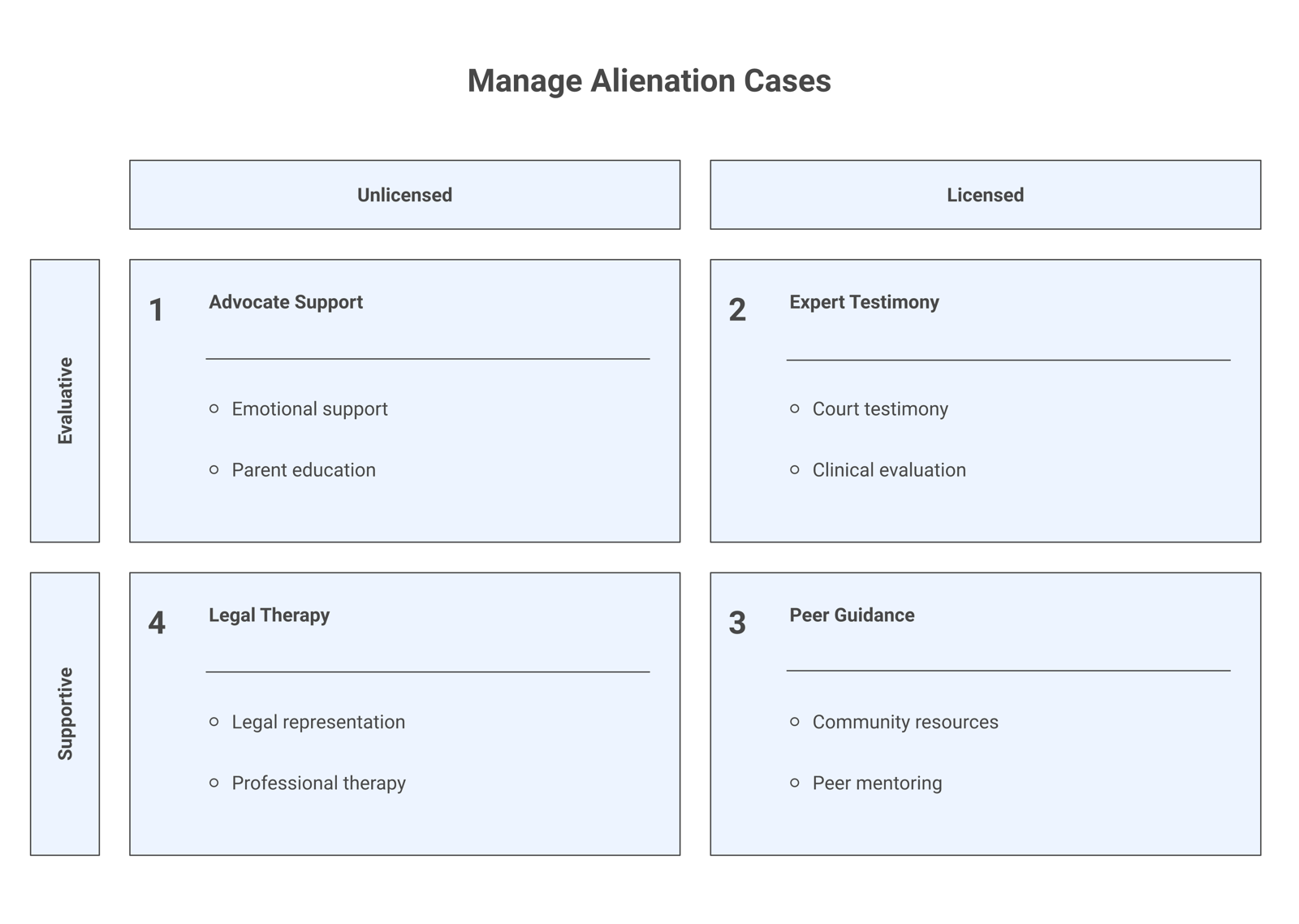
Four very different people get called “help” in a parental alienation case. Confusing them costs time, money, and hope. Here is how they differ.
The advocate
The advocate supports and educates. They help you understand what you are seeing, keep you organized, and keep you grounded. They are usually unlicensed, and they do not assess your child, treat anyone, or advise you on the law.
The therapist
A therapist is a licensed mental-health professional who can assess a person and provide treatment. The American Psychological Association explains what working with a licensed clinician involves and why credentials matter. A therapist, not an advocate, is the person who can address trauma, anxiety, or the strain a case puts on a parent. See therapy for alienated parents for more on that kind of support.
The attorney
An attorney is licensed to give legal advice and to represent you in court. The Cornell Legal Information Institute describes what an attorney does and the line a non-lawyer cannot cross. An advocate can help you get ready for a meeting with your lawyer, but an advocate cannot tell you what to file or what the law requires. For the legal role, see parental alienation lawyer.
The expert witness
An expert witness is a qualified clinician who can evaluate a case and testify about it under oath. That is a formal, credentialed role with courtroom standards, and it is not the same as a support advocate. The page on the parental alienation expert covers that role in full.
What an advocate can and cannot do
Setting honest expectations protects you. An advocate can do real and useful things, and there are real things an advocate cannot do.
An advocate can explain how alienation works, point you to the stages and patterns so you feel less lost, and help you build a clean, factual record instead of an angry one. An advocate can help you prepare for appointments, sit with you through the hard weeks, and steer you toward a support group so you are not carrying it alone.
An advocate cannot diagnose your child, provide therapy, give legal advice, serve as a courtroom expert, or guarantee any outcome. Anyone who offers those things while holding only an advocate’s role is stepping outside it. The most useful advocates know exactly where their lane ends, and they refer you to a licensed professional the moment a question crosses into clinical or legal ground.
A short way to remember it: an advocate helps you carry the process. A therapist helps you heal. A lawyer handles the law. You may need all three, and they do different jobs.
Advocacy is not the same as recovery
There is a distinction in this field that changes how a parent uses help. Advocacy names what happened to you. Recovery is the work of moving through it.
Both halves are necessary. Naming the wound is real and validating, and many parents need that naming before anything else makes sense. The trouble starts when a parent gets stuck in the naming, because knowing what is happening is not the same as having a path through it. A parent can spend years collecting articles and learning every tactic while the actual work of staying regulated and reaching for the child goes undone.
So a good advocate does both jobs in the right order. They validate what you have lived through, then keep nudging you toward recovery, toward a therapist, a support group, and the slow practice of becoming the steady parent your child can come back to. If an advocate keeps you angry and stuck in the story of the wound, they are doing half the job. For the forward half, see recovering from parental alienation.
How to vet a parental alienation advocate
Because the role is unregulated, a few minutes of vetting saves a lot of grief. Ask any advocate these things before you commit time or money.
Ask about their training and their scope. A trustworthy advocate will tell you plainly what they do, what they do not do, and what they refer out. Ask what happens when a question turns clinical or legal, and listen for a clear answer about handing you to a licensed professional.
Watch for promises. Anyone who guarantees you will win custody, reverse the alienation by a date, or beat the other parent is selling something the role cannot deliver. Watch for pressure to escalate, to fight harder, to record secretly, or to defy a court order. A sound advocate steadies you rather than inflames you, and never advises you to break a court order.
Confirm they respect the line between abuse and alienation. An advocate who treats every case of a child pulling away as alienation, with no room for the possibility that a child is reacting to real harm, is one to avoid. The honest ones hold that distinction carefully, because getting it wrong hurts children.
Do you need an advocate?
Not every parent needs a paid advocate. Some parents get exactly what they need from a support group, a good therapist, and a competent attorney. Others find that a steady guide who has walked this road makes the difference between spinning out and staying functional.
A reasonable way to decide is to look at what is missing. If you understand the dynamic but feel alone, a support group may be enough. If you are dysregulated and reactive, a therapist matters most. If the legal questions are pressing, the attorney comes first. An advocate is the person who helps you hold all of it together when the process feels like too much to carry by yourself. There is no wrong answer here, only the mix of help that fits your situation. For a starting overview, see dealing with parental alienation and the wider Learn section.
Frequently asked questions
What does a parental alienation advocate do?
A parental alienation advocate helps a targeted parent understand the dynamic, stay organized, and stay steady. They educate, encourage, help you build a calm record, and prepare you for meetings with your therapist or lawyer. They do not diagnose, treat, give legal advice, or testify as an expert.
What is the difference between a parental alienation advocate and a therapist?
An advocate is usually unlicensed and offers support and education. A therapist is a licensed mental-health professional who can assess a person and provide treatment. Only the therapist can address trauma or mental-health needs. Many parents work with both, because they do different jobs.
Do I need a parental alienation advocate?
Not always. Some parents get what they need from a support group, a therapist, and an attorney. Others benefit from a steady guide who has been through it. A useful way to decide is to look at what feels missing, then add the kind of help that fills that gap.
How do I find a good parental alienation advocate?
Ask about their training and scope, ask what they refer out, and avoid anyone who promises a court outcome or pressures you to escalate or defy an order. Confirm they respect the line between genuine abuse and alienation. The best advocates know exactly where their role ends.
Can a parental alienation advocate testify in court?
Generally no. Testifying about parental alienation is the role of a qualified clinical expert witness, which is a formal, credentialed role with courtroom standards. A support advocate is not a substitute for that. See the page on the parental alienation expert for how the expert role works.
What this page does not do
This page does not recommend specific advocates and does not run a directory. It does not promise that hiring an advocate changes a custody outcome, and it does not frame advocacy as a tactic against the other parent. It is general information, not legal or clinical advice, and it does not address any one state’s rules. Decisions about your case belong to a licensed professional working with the real facts.
Sources and further reading
- American Psychological Association. Divorce and child custody. apa.org/topics/divorce-child-custody
- Association of Family and Conciliation Courts. afccnet.org
- Cornell Legal Information Institute (Wex). Attorney. law.cornell.edu/wex/attorney
If you or your child are in crisis
Free and confidential help is available right now.
- 988 Suicide and Crisis Lifeline. Call or text 988. 988lifeline.org
- Childhelp National Child Abuse Hotline. 1-800-422-4453. childhelp.org
- NAMI HelpLine. 1-800-950-6264. nami.org/help
Last reviewed: 2026-06-09. Author: Alex Buckles (PAC Founder). Editorial review: held to the PAC Editorial Standards (balance, primary-source citation, reader safety); an independent expert review board will be appointed.