
Is parental alienation junk science? It is not a recognized diagnosis in the DSM-5 or the ICD-11, and experts and courts genuinely disagree about its scientific status. Some scholars call it pseudoscience. Others describe a real, studied pattern of parental behaviors. The honest answer is that the question remains contested.
A note on safety
A child’s rejection of a parent is not always alienation. When a parent has been abusive, neglectful, or frightening, the child’s distancing can be a protective response called estrangement, and it must never be relabeled as alienation. A court or an expert using the label does not make it scientifically valid. If a child’s safety is at risk, contact local law enforcement or a domestic-violence resource first.
General education, not legal or clinical advice. This page offers education only. It is not legal, clinical, or diagnostic advice, and it does not create a professional relationship. Anyone facing a custody dispute or a mental-health concern should consult a licensed professional in their own area.
The short answer
“Junk science” is a courtroom phrase, not a scientific one, so the better question is whether parental alienation meets the standards a court or a journal expects of expert knowledge. On that question the field is split. Critics argue that the concept lacks a validated definition, a reliable test, and the controlled studies that would make it a science. Supporters argue that the behaviors are real, observable, and increasingly studied, and that the harm to children is documented. Both sides agree on one narrow fact. Parental alienation is not a standalone diagnosis in the major diagnostic manuals.
This page is about the deeper scientific and courtroom debate. For the simpler consumer question of whether the pattern exists at all, see is parental alienation real. For the wider map of who believes what, see the three camps in the parental alienation debate.
What the diagnostic manuals say
The two manuals that define mental-health conditions are the American Psychiatric Association’s DSM-5 and the World Health Organization’s ICD-11. Neither lists parental alienation, or the older “parental alienation syndrome,” as a disorder. This is the single hardest fact in the debate, and both sides accept it.
Supporters read the manuals more narrowly than critics do. The psychiatrist William Bernet, who lobbied for inclusion, points out that the DSM-5 does contain a code for “parent-child relational problem” (on page 715) and that the ICD-11 contains a similar “caregiver-child relationship problem.” His argument is that alienation can be described as an example of these relational problems, which are not mental disorders inside the child but troubles in the relationship between people. Critics answer that a general relational-problem code is not an endorsement of parental alienation as a distinct, validated condition, and that proponents overstate what the manuals grant.
There is also a history that critics cite. The ICD briefly indexed the term “parental alienation” and then removed it in 2020, a step the UN Special Rapporteur on violence against women later pointed to as evidence that the concept had been “broadly dismissed.” Supporters counter that the index term was a caregiver-relationship pointer, not a diagnosis, and that its removal changed little. The dispute over that one edit captures the larger fight in miniature.
The case that it lacks scientific validity
Critics make a serious, specific argument. It is not that no child is ever manipulated, but that the concept as used in court fails the tests a science must pass.
One line of attack is about methodology. Madelyn Milchman, Robert Geffner, and Joan Meier argued in a 2020 Family Court Review critique that proponents lack the methods to establish alienation as a diagnosable condition, that it is at best an inference, and that legitimate causes such as abuse or poor parenting must be ruled out first. A second line is about the evidence base. A 2016 structured appraisal by Michael Saini, Janet Johnston, Barbara Jo Fidler, and Nicholas Bala, in the reference volume Parenting Plan Evaluations, concluded that the research remains methodologically young, with small nonrandom samples, no consensus definition, and no validated instrument to separate alienation from justified estrangement. A government-commissioned review in Wales reached a similar verdict, finding “a dearth of robust empirical studies.”
A third line is about consequences. Jean Mercer has questioned the safety and effectiveness of the reunification programs courts sometimes order on an alienation theory, noting the absence of controlled outcome studies. Joan Meier’s 2020 study, funded by the National Institute of Justice, found that when fathers raised alienation against mothers alleging abuse, the mothers’ risk of losing custody roughly doubled. For critics, that is the real-world cost of treating a contested construct as settled science. These critiques anchor the false allegations concern.
Critics add a logical worry. If a child’s hostility is read as proof of alienation, and a child’s loyalty to the favored parent is read as proof too, then the theory can look unfalsifiable, explaining every outcome and predicting none. A claim that cannot be disproven, they argue, behaves more like an interpretation than a science. Supporters reply that careful clinicians do set criteria and do rule out other causes first, so the charge lands on sloppy use rather than on the concept itself.
The affirming rebuttals
Supporters answer that the critics attack a straw version of the concept and misread the literature.
Their central move is to separate two things: parental alienation syndrome, the disputed 1980s idea of a diagnosable disorder in the child, and alienating behaviors, the observable actions of a parent. Most modern proponents no longer defend the syndrome and instead study the behaviors, which they say are easier to measure. Jennifer Harman and colleagues argue, in a 2018 paper in Psychological Bulletin, that these behaviors fit the recognized patterns of coercive control and belong in the family-violence literature.
A second rebuttal targets the critical literature itself. Bernet and a co-author, Xu, published a citation analysis in 2022 in Behavioral Sciences and the Law arguing that a large amount of anti-alienation writing rests on a recurring misrepresentation, that proponents supposedly blame the favored parent merely because a child refuses contact. They reported dozens of instances of the claim being repeated through secondary sources rather than checked against the originals. Critics, in turn, dispute that framing, noting that the authors are themselves proponents and that calling for corrections of opposing work is part of what worries them. The clash over that paper is itself part of the controversy, and it is examined further in research on parental alienation and abuse.
Supporters also point to history and convergence. Bernet argues that clinicians described the same family pattern independently across more than a century, well before any single label existed, which he reads as a sign the pattern is real rather than invented. Other proponents cite survey estimates suggesting millions of adults report being alienated from a child. Critics answer that a long record of describing something does not validate it as a diagnosis, and that prevalence figures depend heavily on how the question is asked.
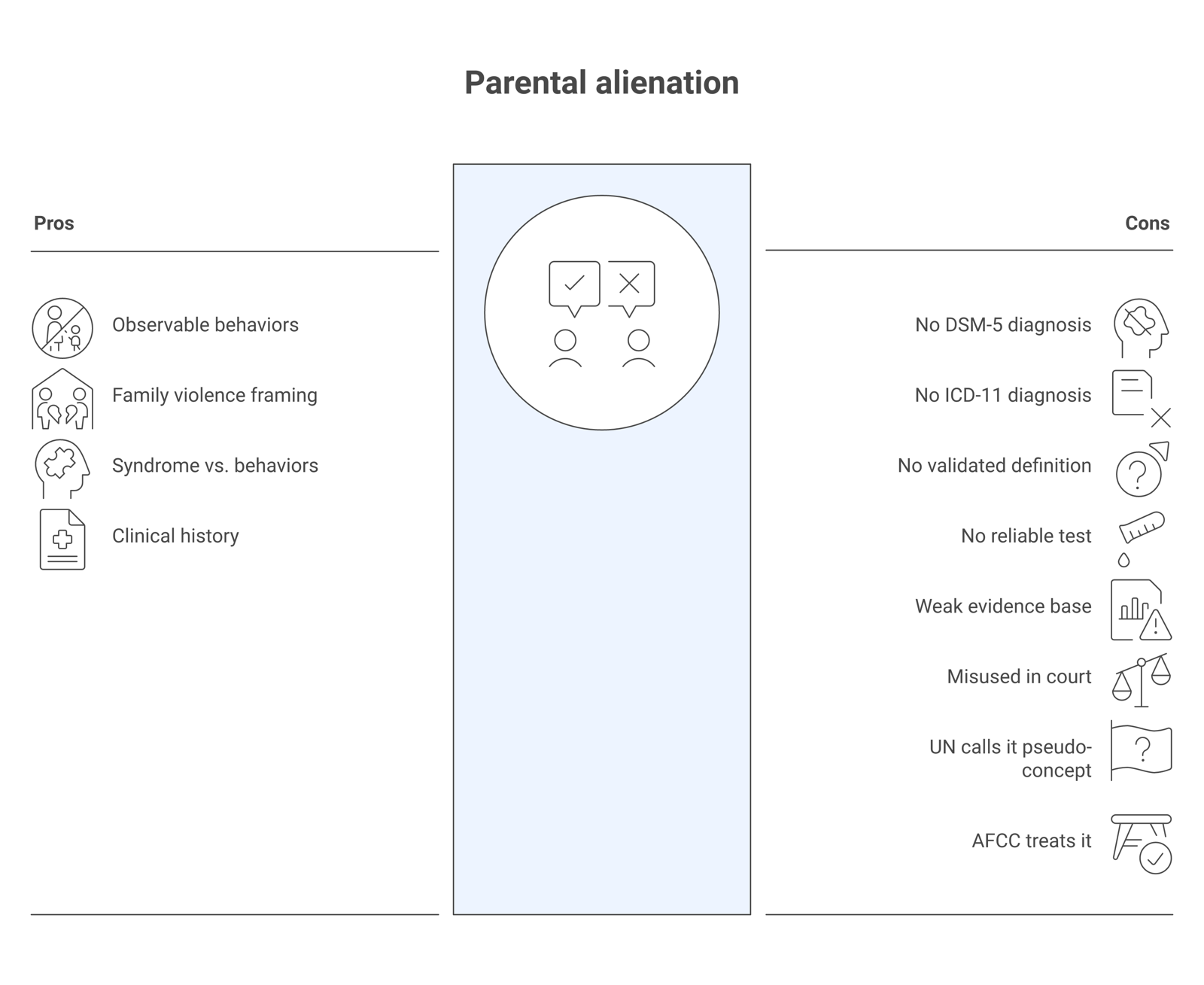
| Arguments it lacks scientific validity | Arguments the behaviors are real and studied |
|---|---|
| Not a DSM-5 or ICD-11 diagnosis | Observable alienating behaviors can be described and rated |
| No validated definition or reliable test | Research frames the behaviors as a form of family violence |
| Evidence base judged weak and early | Modern work separates the disputed syndrome from the behaviors |
| Risk of misuse against parents reporting abuse | A clinical pattern described across many decades |
What the research-quality metrics show
Beyond the rhetoric, proponents point to formal appraisals of the literature’s quality. In their 2022 review in the American Psychological Association journal Developmental Psychology, Jennifer Harman, Richard Warshak, Demosthenes Lorandos, and Matthew Florian appraised the empirical literature and argued that much of it meets accepted quality standards. Proponents add that the critical camp often judges the field with the wrong yardsticks, using tools built for medical drug trials that exclude the qualitative and observational research common in this area.
Supporters also describe a maturing field rather than a fringe one. That same 2022 review, a literature review of 213 empirical studies in ten languages through December 2020, characterizes the research as having grown into a broader body of theory-driven work. Critics counter that volume is not the same as validity, that the review is not a meta-analysis and computes no pooled effects, and that agreement among researchers who share a viewpoint proves less than it appears.
There is also a pointed claim about where the criticism concentrates. William Bernet has argued that a sizable share of the hostile literature clusters in a small number of outlets that cite one another, which he frames as a closed citation loop rather than broad scientific consensus against the concept. That characterization is itself contested by critics, who note that Bernet is a proponent and that disagreement is not the same as a citation conspiracy. As with the rest of this debate, the honest reading is that the rigor metrics strengthen the proponents’ case without ending the argument.
Admissibility in court
A separate question is whether alienation evidence is allowed in a courtroom at all. In US federal courts and many state courts, expert testimony must pass the Daubert standard, which asks whether a method is testable, peer-reviewed, has a known error rate, and is generally accepted in its field. Parental alienation can be challenged on each prong, and lawyers on both sides litigate it.
Practice varies widely. Some judges admit testimony about alienating behaviors while refusing testimony that diagnoses a child with a syndrome. Some exclude the concept entirely, and at least one national court, Germany’s Constitutional Court, has restricted alienation evidence. Others allow it as one factor among many. The pattern matches the science: courts are more comfortable with described behaviors than with a claimed diagnosis. How individual judges handle this is covered in how judges view parental alienation, and the clinical side in the differential diagnosis of contact refusal.
The split reaches the experts themselves. A court may let a qualified evaluator describe what they observed in a family while barring them from testifying that a recognized syndrome exists, because the first is closer to observation and the second closer to a contested diagnosis. Critics worry that a jury hears the word alienation and treats it as established fact regardless of these limits. Supporters worry that excluding the concept entirely can blind a court to a real pattern of harm. Both worries are on the record, and both have support among practitioners.
The 2026 retraction episode
A recent event shows how heated the science fight has become, and it has two competing accounts that this page presents side by side.
In May 2026 an academic journal, the Integrated Journal for Research in Arts and Humanities, removed a review article by Robert Head that argued parental alienation theory is unsupported and fails basic validity requirements. Retraction Watch reported on June 3, 2026, that the removal followed the Parental Alienation Study Group’s complaint and threat of legal action. In a related opinion piece in a Frontiers journal, titled “When retraction replaces rebuttal,” Head argued that critical scholarship is being suppressed through legal pressure rather than answered with evidence.
The journal and the proponents tell it differently. By their account, the removal was not dictated by threats but followed a secondary review by the editorial board and independent psychometric experts who found critical methodological and structural flaws in the paper, and proponents separately filed a letter of concern about Head’s opinion piece. One narrative is suppression of dissent. The other is ordinary quality control. The public record contains both, this page does not resolve which is correct, and a reader weighing the validity question should know the episode is itself disputed.
How to read the debate
Major bodies are spread across the spectrum, which is why no single answer is honest. The American Psychiatric Association and the World Health Organization decline to list parental alienation as a disorder. The UN Special Rapporteur has called it a pseudo-concept. Family-court professional bodies such as the Association of Family and Conciliation Courts treat alienating behaviors as one possible factor while warning against using the label to override abuse concerns. Many practicing clinicians and litigators continue to use it.
A workable reading holds three points together. The formal diagnostic status is limited, and that is settled. The behaviors the term points to are real and can harm a child, which most camps accept. The scientific and courtroom standing of “parental alienation” as a validated, court-ready construct is genuinely contested, and overconfidence in either direction is the actual error. For the term’s origin in Richard Gardner’s work, see parental alienation syndrome.
Frequently asked questions
Is parental alienation junk science?
There is no settled answer. Critics, including some psychologists and the UN Special Rapporteur, call it pseudoscience because it lacks a validated definition, a reliable test, and controlled studies. Supporters argue the underlying parental behaviors are real, observable, and studied, even if the older “syndrome” idea is not. Parental alienation is not a recognized diagnosis in the DSM-5 or ICD-11, and experts and courts disagree about its status.
Is parental alienation in the DSM-5 or ICD-11?
No. Neither manual lists parental alienation or parental alienation syndrome as a disorder. Both contain a general code for a parent-child or caregiver-child relationship problem, which proponents say can describe alienation and critics say is not an endorsement of it as a distinct condition.
Who says parental alienation is pseudoscience?
Critics include the developmental psychologist Jean Mercer, the researchers Madelyn Milchman and Robert Geffner, the law professor Joan Meier, and the UN Special Rapporteur on violence against women. They argue the evidence base is weak and the label is misused in custody court, especially against parents reporting abuse.
What do supporters say in response?
Supporters distinguish the disputed “syndrome” from observable alienating behaviors, which they say are measurable and harmful. Jennifer Harman frames those behaviors as a form of family violence, and Bernet and Xu published a citation analysis arguing much anti-alienation writing repeats a misrepresentation through secondary sources.
Can parental alienation be used as evidence in court?
Sometimes, and it varies. Expert testimony must often pass the Daubert standard for reliability. Many courts admit testimony about specific alienating behaviors while excluding a claimed diagnosis of a child, and some exclude the concept more broadly. Outcomes depend on the jurisdiction and the judge.
What this page does not do
This page does not declare parental alienation valid or invalid, because the science and the courts have not. It does not present the affirming rebuttals as the last word, and it does not present the validity critiques as the last word. It keeps the abuse boundary explicit, because a contested label must never be used to dismiss a real safety concern. Choices about a custody case or a child’s care belong to the reader together with licensed professionals working from the actual facts.
For the consumer question, see is parental alienation real. For the wider debate, see the three camps in the parental alienation debate. For the misuse concern, see parental alienation false allegations. The full Learn silo covers the rest.
What the peer-reviewed measurement work adds
The construct remains contested, and a fair page holds two things at once. On one side, Bernet et al., Journal of Forensic Sciences (2018) and the follow-up PARQ-Gap study put a validated, peer-reviewed number on the splitting pattern clinicians describe, which is real measurement rather than opinion. On the other, critics such as law professor Joan Meier argue that alienation claims are sometimes overused in court and can eclipse genuine abuse. Neither point settles the question. The honest reading is that the measurement work is sound while the courtroom use of the construct still deserves scrutiny.
Sources and further reading
- Bernet, W., & Xu, S. (2022). Scholarly rumors: Citation analysis of vast misinformation regarding parental alienation theory. Behavioral Sciences & the Law. https://doi.org/10.1002/bsl.2605
- Harman, J. J., Warshak, R. A., Lorandos, D., & Florian, M. J. (2022). Developmental psychology and the scientific status of parental alienation. Developmental Psychology, 58(10), 1887 to 1911. https://doi.org/10.1037/dev0001404
- Harman, J. J., Kruk, E., & Hines, D. A. (2018). Parental alienating behaviors: An unacknowledged form of family violence. Psychological Bulletin, 144(12), 1275 to 1299. https://doi.org/10.1037/bul0000175
- Saini, M., Johnston, J. R., Fidler, B. J., & Bala, N. (2016). Empirical studies of alienation. In Parenting Plan Evaluations (2nd ed.). Oxford University Press.
- Milchman, M. S., Geffner, R., & Meier, J. S. (2020). “Ideology and rhetoric replace science and reason…” Family Court Review, 58(2), 340 to 361.
- Meier, J. S., Dickson, S., O’Sullivan, C., Rosen, L., & Hayes, J. (2020). U.S. child custody outcomes in cases involving parental alienation and abuse allegations: What do the data show? Journal of Social Welfare and Family Law, 42(1), 92 to 105.
- Mercer, J. (2019). Examining parental alienation treatments: Problems of principles and practices. Child and Adolescent Social Work Journal, 36(4), 351 to 363.
- Alsalem, R. (2023). Custody, violence against women and violence against children. UN Doc A/HRC/53/36. ohchr.org report page
- Retraction Watch (2026, June 3). Journal retracts paper criticizing parental alienation theory after group threatens to sue. retractionwatch.com
- Head, R. K. (2026). When retraction replaces rebuttal. Frontiers in Research Metrics and Analytics. frontiersin.org
- American Psychiatric Association. DSM-5 (Diagnostic and Statistical Manual of Mental Disorders, 5th ed.). psychiatry.org
If you or your child are in crisis
Free and confidential help is available right now.
- 988 Suicide and Crisis Lifeline. Call or text 988. 988lifeline.org
- Childhelp National Child Abuse Hotline. 1-800-422-4453. childhelp.org
- NAMI HelpLine. 1-800-950-6264. nami.org/help
Last reviewed: June 17, 2026. Author: Alex Buckles (PAC Founder).