

How to document parental alienation starts with one habit: keep a dated, factual record of what happens, written close to the event. Log denied parenting time, saved messages, and missed calls. Describe behaviors, not labels or feelings. A clean, contemporaneous record is more credible than memory, and it serves the child’s wellbeing.
A note on safety and honesty
A child’s distancing is not always alienation. If a child pulls away because a parent has been abusive, neglectful, or frightening, that is justifiable estrangement, not parental alienation, and it is a different safety matter. Documentation must be honest. It should never be used to exaggerate, stage, or manufacture a case. If a child’s safety is at risk, contact local law enforcement or a domestic-violence resource first.
This page is general education, not legal advice. It does not create an attorney-client relationship and does not address any one state’s evidence rules, which vary widely. Anyone preparing records for a custody matter should consult a licensed family-law attorney in their own jurisdiction.
How to document parental alienation: the short answer
To document parental alienation, write down what you observe, when it happens, and who was present, using plain factual language. Save the messages, voicemails, and emails that show the pattern. Track every denied call, refused exchange, and missed event in a simple dated log.
The goal is a record built on observable facts. Litigators and clinicians who work these cases stress the same point: the value sits in specific behaviors, not in opinions. A record that says “Dad’s call on Tuesday at 7 p.m. was refused, child was told he was busy” is worth more than a page that says “Mom is an alienator.” For where these records eventually get used, see the stages of parental alienation and the broader Learn library.
Document behaviors, not labels
The single most important rule is to record behaviors, not labels. This is the spine of credible documentation. Judges and litigators who handle these cases put the standard plainly: labels give a court no basis on which to rule; facts do. Parents who arrive with diagnoses like “narcissist” but no fact pattern tend to lose ground.
So a strong record avoids clinical terms. It does not call the other parent a name. It does not diagnose. It states what happened. Instead of “she is poisoning the kids,” a useful entry reads: “At pickup, child said, ‘You don’t love us, Mom told me.’ Child had not said this before this month.” The reader of that note can see the behavior for themselves.
This discipline matters because the harm is real and well studied. Researchers Jennifer Harman, Edward Kruk, and Denise A. Hines argue that parental alienating behaviors constitute an unacknowledged form of family violence that maps onto coercive control. The seriousness of the harm is exactly why the record must stay factual. Facts hold up. Conclusions invite argument. To understand the term itself, see parental alienation syndrome.
How to document parental alienation, step by step
A good record is a habit, not a one-time project. The method below can start tonight and run for as long as it is needed.
Start a contemporaneous log
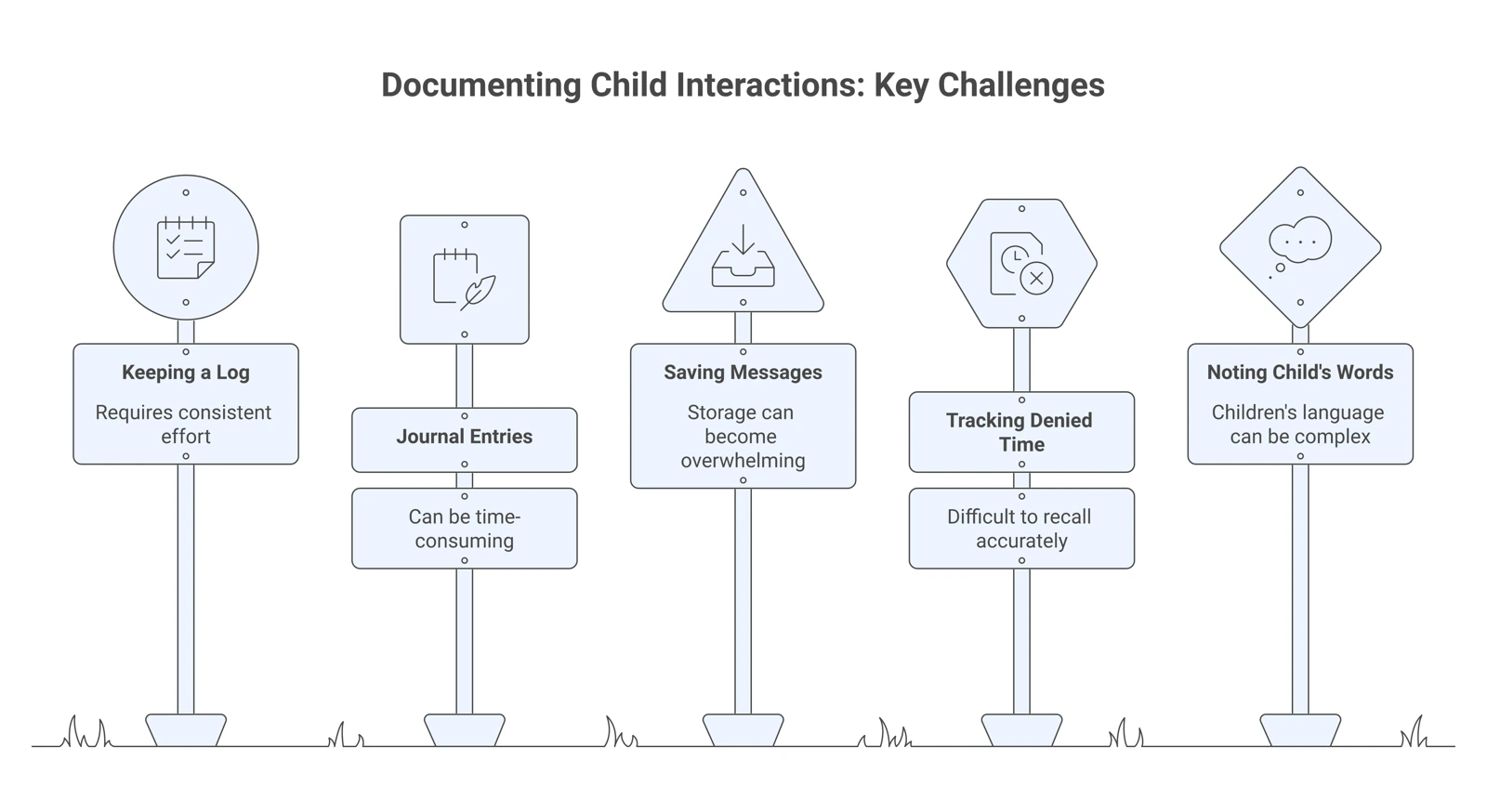
A contemporaneous log is a record written close to the time of the event, while memory is fresh. Use a notebook, a dated document, or a simple app. For each entry, write the date, the time, the place, who was present, and what was said or done. Keep entries short and neutral. Memory fades and shifts, so the value of a note comes from writing it the same day, not weeks later.
Keep a parenting and communication journal
A parenting journal records the ordinary rhythm of contact: scheduled time that happened, time that did not, exchanges, calls, and any friction around them. A communication journal does the same for messages between the parents. Write what occurred in neutral language. Avoid editorial comments, sarcasm, and name-calling. The journal is a timeline, not a diary of grievances.
Save and back up messages
Texts, emails, and voicemails often carry the clearest record of a pattern. Keep the originals. Do not edit, crop, or delete them. Capture full conversations with visible dates and sender details, rather than single screenshots pulled out of context. Back everything up in more than one place, such as a cloud folder and a separate drive, so nothing is lost if a phone breaks or is replaced.
Keep a missed-time and denied-contact log
A denied-contact log is one of the most useful records a parent can keep. Make a simple table with columns for the date, the scheduled time, what was refused (a call, an exchange, an event), and any reason that was given. One line per incident is enough. Over months, this log shows whether missed contact is rare and explainable or steady and patterned. Litigation frameworks describe these same materials, emails, voicemails, and records of refused time, as the building blocks of a case.
Note the child’s specific words and conduct
When a child says or does something striking, write it down in their own words as closely as possible. Quote the phrase. Note the date and the setting. Children who are being influenced sometimes repeat adult phrases they cannot explain, or reject a parent with reasons that seem out of proportion. A record of exact wording, gathered over time, captures that pattern far better than a summary written from memory months later.
Keep it factual and honest
Every entry should be something a neutral person could verify or picture. Write only what happened. Do not add what you assume the other parent intended. Do not round up, fill gaps, or invent detail to make a point. An honest record is stronger and safer than an embellished one, and it keeps the focus where it belongs, on the child.
What is worth recording
Not everything needs to be logged, and over-collecting can bury the signal. It helps to know the categories that matter. Dr. Amy J.L. Baker’s widely cited four-factor model points to the behaviors worth capturing: a prior warm relationship that has changed, the favored parent’s specific actions, and the child’s specific responses. Baker’s research catalogs seventeen common alienating strategies; the eight behavioral signs in the child trace to Richard Gardner’s earlier work and are used within Baker’s model.
Cheryl Mefferd, BSN, RN, a nurse, educator, and founder of the nonprofit Parental Alienation Speaks, groups Baker’s catalog into five plain functions that are easy to watch for. The grouping is her own educational organization of Baker’s list, not a clinical taxonomy:
- Isolation: limiting or blocking contact, calls, cards, and gifts.
- Fear: framing the other parent as dangerous when there is no real danger.
- Erasing: removing photos, gifts, and reminders of the other parent.
- Undermining authority: contradicting house rules or mocking the other parent.
- Encouraging betrayal: asking the child to keep secrets, spy, or relay messages.
These categories tell a parent what is worth a note. A pattern that some readers also research is malicious parent syndrome, though the documentation method stays the same: record the behavior, plainly, with a date.
Organizing records so they stay usable
A record only helps if someone can read it. Keep the raw items (messages, the log, the journal) in dated order, and keep a short summary that points to them. One workable structure is to sort entries under Baker’s four factors: evidence of the earlier positive relationship, the absence of any real abuse, the other parent’s behaviors, and the child’s responses. Sorting this way makes the record easy to hand to a lawyer, an evaluator, or a therapist.
The American Bar Association’s Section of Family Law publishes general consumer information on keeping records for custody matters. Rules on what a court will accept, and how records must be authenticated, vary by state and are a question for counsel. Building the record is the upstream work covered here. Turning it into courtroom proof is a separate step, covered in how to prove parental alienation.
Protecting your credibility while you document
How a record reads matters as much as what it contains. Family-law practitioners describe a recurring courtroom pattern: targeted parents often come across as angry, anxious, agitated, and afraid, while the other parent presents as cool, calm, and convincing. A record full of fury can make the calmer party look more reliable, even when the facts favor the upset parent.
There is a known effect behind this. When a person speaks harshly about someone else, listeners start attaching that harshness to the speaker. A journal of insults can rebound on its author. The fix is steady discipline: write calm, dated facts, and leave the conclusions to the reader. Litigation experts add a related rule, that credibility is king, and warn against venting about the case on social media. Anything posted in anger can surface later and weaken an otherwise solid record.
Keep documentation honest
Documentation is honest record-keeping for the child’s wellbeing. It is not a weapon, and it is never a script to be staged. Baker’s model is explicit that genuine abuse or neglect by a parent is not alienation, and a child who pulls away from a frightening parent is responding reasonably. A record must reflect what truly happened, including facts that complicate the picture.
The reason to keep the record clean is the same reason the harm is taken seriously. Alienating behavior can leave lasting marks, as the long-term effects of parental alienation describe, and the American Psychological Association treats children’s adjustment after divorce as a real clinical concern. An honest record protects the child. An exaggerated one puts the child, and the parent’s own credibility, at risk.
Frequently asked questions
How do you document parental alienation?
Keep a dated, factual, contemporaneous log written close to the event. Record what happened, when, where, and who was present, in neutral language. Track denied parenting time, save messages without editing them, and note the child’s specific statements and conduct. Describe behaviors, not labels or diagnoses. A clean, honest record is the goal, and a licensed attorney can advise on how it may be used in a custody matter.
What should I write in a parenting journal?
Write what happened and when, who was present, and what was said or done. Use plain, neutral language. Avoid name-calling, diagnoses, and editorial commentary. Record scheduled time that happened, time that was missed, calls and exchanges, and any friction around them. Treat the journal as a factual timeline, not a place to vent, because a calm record is more credible and more useful later.
How do I save text messages for a custody case?
Keep the original messages and do not edit or delete them. Capture full conversations that show dates and sender details, rather than isolated screenshots taken out of context. Back the messages up in more than one place, such as a cloud folder and a separate drive. Rules on what a court will accept vary by state, so check with a licensed family-law attorney in your jurisdiction.
Should I keep a log of missed or denied parenting time?
Yes. A dated denied-contact log is one of the most useful records a parent can keep. Note the date, the scheduled time, what was refused, and any reason given, one line per incident. Over time the log shows whether missed contact is rare and explainable or steady and patterned, which is exactly the kind of factual record that professionals can read and act on.
Can my documentation be used against me?
It can if it reads as angry venting, exaggeration, or invented detail. A record full of insults or guesses about motive can make its author look less reliable. A calm, factual, honest log does the opposite and protects credibility. Keep entries to verifiable facts, avoid posting about the case on social media, and let the documented behaviors speak for themselves.
Sources and further reading
- Harman, J. J., Kruk, E., & Hines, D. A. (2018). Parental alienating behaviors: An unacknowledged form of family violence. Psychological Bulletin, 144(12), 1275 to 1299. https://doi.org/10.1037/bul0000175
- American Bar Association, Section of Family Law. americanbar.org/groups/family_law
- American Psychological Association. Divorce and child custody. apa.org/topics/divorce-child-custody
- Baker, A. J. L. (2020). Reliability and validity of the four-factor model of parental alienation. Journal of Family Therapy, 42(1), 100 to 118. https://doi.org/10.1111/1467-6427.12253
- Baker, A. J. L. (2007). Adult Children of Parental Alienation Syndrome: Breaking the Ties That Bind. W. W. Norton. (Source of the seventeen alienating strategies.)
- Lorandos, D., & Bernet, W. (Eds.) (2020). Parental Alienation: Science and Law. Charles C Thomas. (Litigation-side reference on presenting documented behaviors.)
If you or your child are in crisis
Free and confidential help is available right now.
- 988 Suicide and Crisis Lifeline. Call or text 988. 988lifeline.org
- Childhelp National Child Abuse Hotline. 1-800-422-4453. childhelp.org
- NAMI HelpLine. 1-800-950-6264. nami.org/help
Last reviewed: 2026-06-06. Author: Alex Buckles (PAC Founder).