

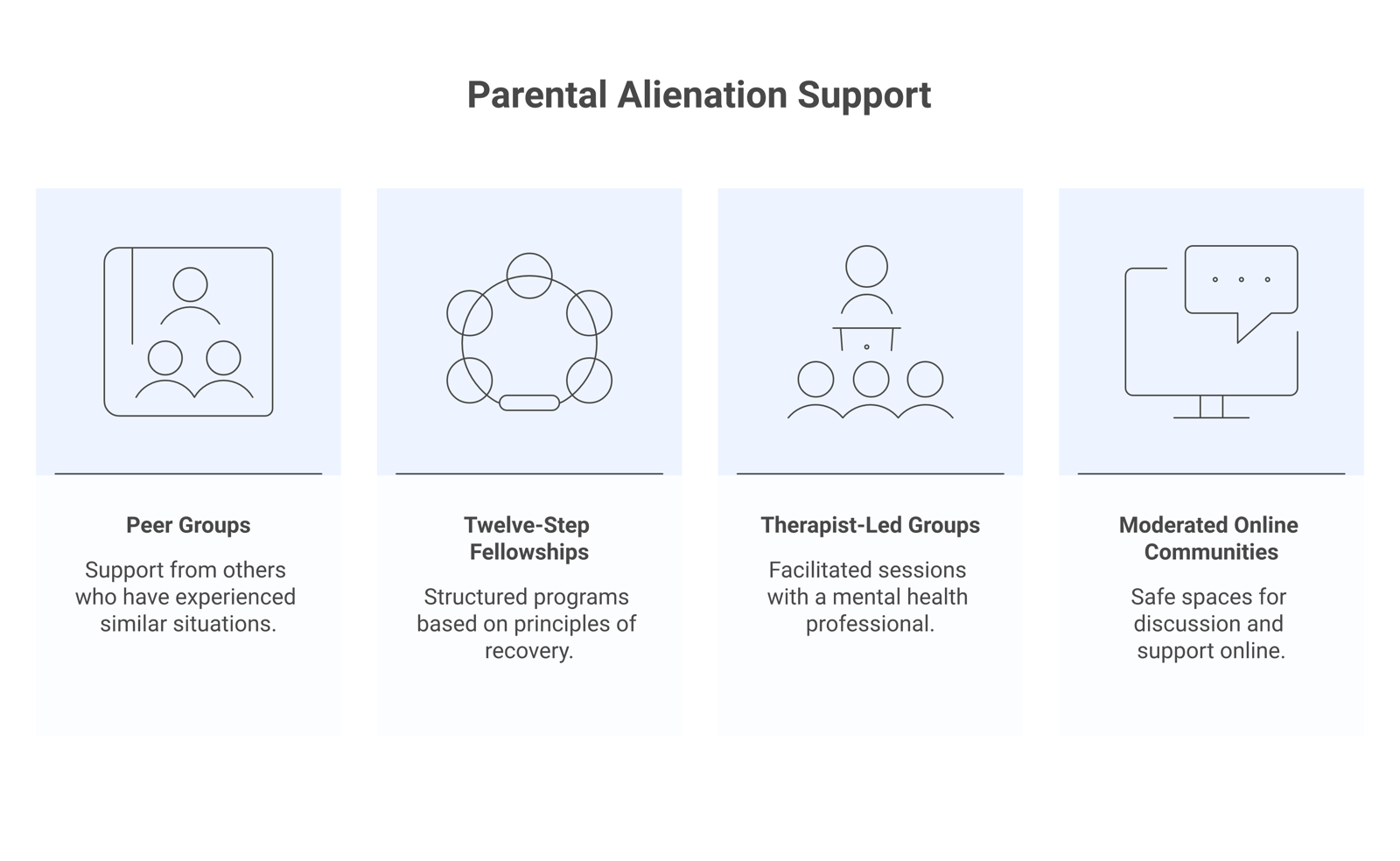
Parental alienation support groups give targeted parents a place to be understood, steady their thinking, and learn from people who have lived the same loss. Peer groups, twelve-step-style fellowships, therapist-led groups, and moderated online communities each work differently. The healthiest ones build skills and hope rather than feeding anger or despair.
A note on safety
Not every broken relationship is alienation. When a child pulls away because a parent was abusive, neglectful, or frightening, that distancing is justifiable estrangement, not parental alienation. A healthy support group respects this difference and never pressures a member to relabel real harm. If a child or parent is in danger, contact local emergency services or a domestic-violence resource first.
This article offers general information, not clinical or legal advice, and creates no therapist-client or attorney-client relationship. Support groups complement professional care; they do not replace it. Anyone in acute distress should reach a licensed clinician or one of the crisis lines listed at the end. For broader clinical context, see the American Psychological Association on divorce and child custody.
Why parental alienation support groups matter
Parental alienation can be one of the loneliest experiences a parent ever faces. Friends often do not understand it. Some relatives quietly take sides or change the subject. The parent starts to feel invisible, and that is exactly where the harm grows deeper.
Isolation is both a symptom and an accelerant
Lawrence Joss founded Parental Alienation Anonymous and hosts the Family Disappeared podcast. Drawing on many parent and grandparent panels, he describes a community-as-catalyst model of recovery. His central point is blunt. Isolation is both a symptom of alienation and one of the forces that keeps it going.
Alienation produces a loneliness that feels far larger than the facts on the ground. Early on, a parent pours energy outward, hoping to control the other parent or the court. Joss noticed that real change began only when the focus turned inward. Recovery, in his words, means coming home to ourselves. It grows through steadier talk and calmer reactions.
Community is what makes that turn possible. A safe group offers what Joss calls healthy mirroring. Without it, a parent can repeat the same reactions and keep the very harm alive. Peer support is not a luxury here. It is part of how a parent stops the spiral and starts to heal.
Why peers grasp a grief that has no funeral
The grief of alienation is unusual, which is part of why outsiders struggle to meet it. Dr. Pauline Boss named this kind of pain ambiguous loss, and Dr. Kelley Baker has applied it to parental alienation. The child is alive, yet the relationship is gone. There is no funeral, no closure, and no ritual to mark what was lost.
Boss described isolation, shame, and guilt as core features of this loss. A child may sit at an exchange yet feel psychologically absent behind a closed door. Most people in a parent’s life have never seen anything like it, so their comfort falls flat. Other targeted parents do not need the situation explained. They already live inside the same strange grief, which is why a room of peers can hold it when a well-meaning friend cannot.
What kinds of parental alienation support groups exist
Support comes in several forms, and they are not interchangeable. Each suits a different need, budget, and comfort level. Many parents use more than one over time.
Peer-led support groups
Peer-led groups are run by people who have lived through alienation rather than by clinicians. They meet in living rooms, community centers, and video calls. Their value is recognition. A new member hears their own story in someone else’s words and feels less alone for the first time in years. Peer groups are usually free or low cost. The trade-off is that they vary widely in tone and skill, so quality depends heavily on who leads and what norms the group keeps.
Twelve-step-style fellowships
Some parents find a structured path in twelve-step-style fellowships modeled on programs like Al-Anon. Joss built Parental Alienation Anonymous on this idea, and his recovery quadrant rests on four operating principles drawn from it.
The first principle is that recovery is for the parent, not a tactic to win the child back. A second holds that an imperfect community of fellow members is the ground of healing, where people model both what to do and what not to do. Personal capacity is finite and worth protecting, so resting during a hard stretch counts as recovery, not failure. The last principle is to show up for one’s own life first, since a fuller life is what any future reconnection grows from.
One borrowed tool many parents find steadying is the reminder that they did not cause, cannot control, and cannot cure the other parent’s behavior. Naming that limit releases the exhausting urge to force a child to see the truth.
Therapist-led groups
Therapist-led groups add a trained leader. That leader keeps the talk safe, helps members in crisis, and teaches skills for grief, anxiety, and stress. These groups often charge a fee or run through a clinic. For a parent who carries trauma, that safe container can matter. A group like this also pairs well with one-on-one parental alienation therapy.
Online communities
Online communities and moderated forums offer help around the clock. A parent awake at 3 a.m. after a blocked phone call can find someone who understands. The reach is both the strength and the risk. A well-run space stays supportive. A poorly run one drifts into a pile-on of rage and despair. One simple test helps. Read a group for a while before posting, and notice whether members tend to leave calmer or more upset.
What a healthy parental alienation support group looks like
Healthy groups share a recognizable feel. People can vent, yet venting is not the point. The center of gravity is coping, skill, and steadiness. Look for these signs.
- Members leave most meetings a little steadier, not more inflamed.
- Anger is allowed and then worked through, not stoked as the main event.
- The group respects the line between alienation and abuse-driven estrangement, and never pressures anyone to relabel real harm.
- Boundaries are modeled, and no one is shamed for resting, stepping back, or saying no.
- The focus stays on what a parent can control: their own health, regulation, and conduct.
- Hope is kept realistic rather than sold as a guaranteed reunion.
- Confidentiality is honored, and children are spoken about with care.
Warning signs of an unhealthy or venting-only group
Some groups do more harm than good, even with kind intentions. A few patterns are worth watching for.
- Every meeting circles the same grievances and ends with everyone angrier than they arrived.
- The group exists mainly to vent, with no path toward skills, coping, or healing.
- Members are urged to chase or test the child to prove they are still loved, which deepens the rift.
- Leaders push a single product, lawyer, or paid program, or treat the group as a sales funnel.
- Anyone who questions the consensus is shamed or pushed out.
- Talk turns to revenge, or to defeating the other parent rather than the child’s wellbeing.
- Real abuse is waved away, and members are pressed to relabel a child’s justified fear as alienation.
A venting-only space can feel good in the moment and still leave a parent more stuck. Joss describes the trap as pushing a rock down the hill while believing it is going up. Anger that only recycles becomes its own kind of harm.
How to evaluate a group before you commit
A few quiet questions help a parent judge a group without pressure.
- How do people feel at the end of a meeting, steadier or more wound up?
- Does the group build skills, or only collect grievances?
- Is there clear moderation and a basic agreement about respect and confidentiality?
- Does the group honor the difference between alienation and abuse?
- Is anyone being sold something, and is that pressure disclosed?
- Does the leader model boundaries and rest, or reward endless self-sacrifice?
There is no obligation to stay. A parent can attend once, notice how they feel, and move on if the fit is wrong. The goal is support that helps, not loyalty to a particular room.
Support groups are one part of recovery, not the whole
A group is a powerful support, yet it is not a complete plan. The deeper work of recovering from parental alienation happens inside the parent, day by day. Groups feed that work; they do not replace individual therapy, medical care, or legal guidance where it is needed.
Many parents pair a group with practical strategies for dealing with parental alienation in the active situation, and with clinical care for trauma and grief. Over years, the harm can echo into a child’s adult life, as research on the long-term effects of parental alienation shows, so steady support for the parent serves the child too. For the active situation, the court process, and reconnection, the broader Help center gathers the rest. The aim is not to win. The aim is to stay whole, stay healthy, and stay reachable.
Frequently asked questions
What are parental alienation support groups?
They are gatherings, in person or online, where parents who have been pushed out of a child’s life support one another. Some are peer-led, some follow a twelve-step structure, and some are guided by a therapist. The shared purpose is to break the isolation, share coping skills, and steady members through a grief that outsiders rarely understand.
Do parental alienation support groups actually help?
For many parents, yes. Isolation is both a symptom of alienation and a force that keeps it going, so reconnecting with people who understand is part of recovery. A healthy group reduces shame, models steadier ways of coping, and keeps hope realistic. A venting-only group can backfire, so the kind of group matters as much as the fact of joining one.
What is the difference between a peer group and a therapist-led group?
A peer group is run by people who have lived through alienation, usually free or low cost, and built on shared experience. A therapist-led group adds a trained facilitator who keeps the space safe, supports members in crisis, and teaches clinical skills, often for a fee. Many parents use both, and a therapist-led group pairs well with individual therapy.
How can a parent tell if a support group is unhealthy?
Watch how people feel at the end. If meetings only recycle anger, push members to chase the child, sell a single product, shame anyone who disagrees, or dismiss real abuse, the group is likely doing harm. A healthy group leaves members steadier, respects the line between alienation and abuse, and points toward skills rather than endless grievance.
Are online parental alienation support groups safe?
They can be, with good moderation. The strength of an online community is constant access; the risk is that a poorly run space can spiral into rage and despair. Read for a while before posting, notice whether members leave calmer, and step away from any group that feels like a pile-on. Online support works best alongside offline care.
Sources and further reading
- American Psychological Association. Divorce and child custody. apa.org/topics/divorce-child-custody
- National Alliance on Mental Illness (NAMI). Help and support. nami.org/help
- Harman, J. J., Kruk, E., & Hines, D. A. (2018). Parental alienating behaviors: An unacknowledged form of family violence. Psychological Bulletin, 144(12), 1275 to 1299. https://doi.org/10.1037/bul0000175
If you or your child are in crisis
Free and confidential help is available right now.
- 988 Suicide and Crisis Lifeline. Call or text 988. 988lifeline.org
- Childhelp National Child Abuse Hotline. 1-800-422-4453. childhelp.org
- NAMI HelpLine. 1-800-950-6264. nami.org/help
Last reviewed: 2026-06-06. Author: Alex Buckles, Founder.