

This page is general information, not legal or clinical advice. It does not create a clinical or attorney-client relationship, and it does not direct treatment in any individual case. Clinicians should apply these ideas within their training, scope of practice, and supervision.
The polyvagal reunification model applies Stephen Porges’s polyvagal theory to family reunification. Its core claim is simple: reconnection only takes hold when a child’s nervous system reads the moment as safe. That is why co-regulation and graduated, safety-first contact tend to work where pressure and force do not. Here is how the framework operates.
A note on safety
One boundary frames everything below. A child’s threat response to a genuinely unsafe parent is protective, not a symptom to be overridden. The polyvagal lens never counsels pushing a child toward someone who has harmed them. Where abuse or family violence is present, safety planning comes first, and reunification is not the goal.
What the polyvagal reunification model is
The polyvagal reunification model is a way of thinking about reunification that puts the child’s autonomic nervous system at the center of the work. It draws on Stephen Porges’s polyvagal theory, which describes how the body’s threat-and-safety system shapes whether a person can engage socially or shifts into defense. Applied to reunification, the model holds that a child cannot authentically reconnect with a parent while the child’s body is braced against threat.
Dr. Rebecca Bailey has been a leading voice in translating this theory into reunification practice. Her Transitioning Families model is polyvagal-informed, co-regulation-based, and graduated, meaning it paces contact to the child’s felt sense of safety rather than to a calendar or a court’s impatience. Bailey’s work on reunification and the nervous system has appeared in the Family Court Review (in 2016 and again in 2020), the journal of the Association of Family and Conciliation Courts.
The model is best understood as one lens among several, not a complete treatment system or a guaranteed cure. It pairs naturally with trauma-informed and family-systems approaches. What it adds is a precise account of the body-level conditions that have to be met before any relationship repair can begin. For the broader definition of the work it sits inside, see what is reunification therapy.
The three nervous-system states
Polyvagal theory describes an autonomic hierarchy: three broad states the nervous system moves through depending on whether it senses safety or danger. Porges calls the underlying detection process neuroception, the unconscious, faster-than-thought scanning that decides whether a situation is safe, dangerous, or life-threatening. A child does not choose these states. The body selects them automatically, often before conscious appraisal catches up. The polyvagal theory literature indexed on PubMed lays out this hierarchy in detail.
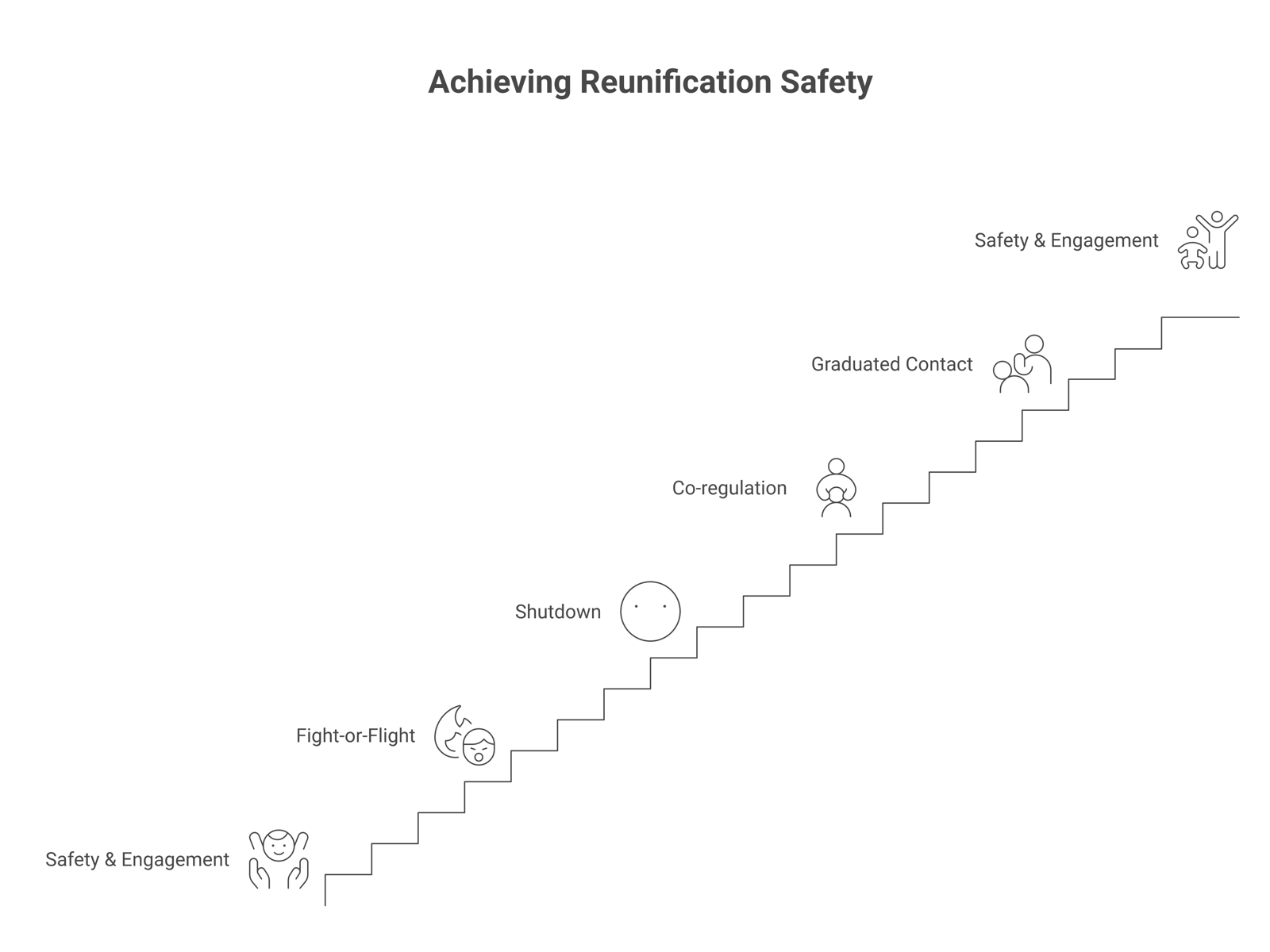
Safety and social engagement (ventral vagal)
At the top of the ladder sits the ventral vagal state, the physiology of safety and social engagement. Here the heart rate is settled, the face is expressive, the voice carries warmth, and the child can make eye contact, listen, and play. This is the only state in which genuine connection is possible. A child in ventral vagal can take in a parent’s bid for closeness, test it, and respond. Reunification work aims to create the conditions for this state, because everything the field hopes for depends on it.
Fight-or-flight (sympathetic)
When neuroception detects danger, the sympathetic branch mobilizes the body for fight or flight. In a reunification context this looks like a child who resists, argues, bolts from the room, or dissolves into panic. The behavior reads as defiance to an adult who expects compliance. The body reads it as survival. A child in this state is not refusing to bond out of stubbornness. The child’s physiology has classified the situation as a threat and shifted resources to escape or defense.
Shutdown (dorsal vagal)
When threat feels inescapable, the oldest branch of the system takes over: the dorsal vagal state of shutdown and collapse. A child here may go quiet, flat, and compliant. To an observer hoping for progress, this can look like success. It is not. Dorsal shutdown is the body conserving itself by withdrawing. The child may sit through a visit, answer in monosyllables, and even submit to a hug, yet remain entirely disconnected. Compliance produced by shutdown is the opposite of the connection reunification seeks.
Why forced reunification fails
The three-state map explains, at the level of physiology, why coercive reunification tends to backfire. Force is a threat cue. A child marched into a room, told to embrace a parent, and warned of consequences for resistance will neurocept danger. The body responds the only way it can, by climbing into fight-or-flight or dropping into shutdown. Neither state allows the warmth, curiosity, and trust that reconnection requires.
This is the heart of the polyvagal critique of coercive, forced-separation programs. Such programs often aim to break a child’s resistance quickly, sometimes by cutting contact with the preferred parent. From a polyvagal standpoint, breaking resistance is the wrong target. Resistance is a nervous-system state, not a position to be overpowered. Overpowering it does not produce a safe, engaged child. It produces a mobilized or collapsed one, and any apparent compliance is likely the hollow compliance of shutdown rather than the felt safety of social engagement.
There is a further problem. Threat states learned in a relationship tend to consolidate when the threat repeats. A child forced through distressing contact may come to associate the parent, the setting, and the process itself with danger, deepening the very rupture the intervention was meant to heal. The American Psychological Association’s guidance on divorce and child custody reflects the broader clinical consensus that high-conflict, coercive approaches carry real risk to children. The polyvagal model gives that caution a mechanism: connection cannot be commanded from a body that does not feel safe.
Co-regulation as the operating principle
If safety is the precondition for connection, the next question is how a frightened child reaches it. The polyvagal answer is co-regulation. Human nervous systems are not sealed units. They read and influence one another constantly through tone of voice, facial expression, pace, and posture. A calm, regulated adult nervous system can help settle a dysregulated child’s nervous system, the same way a soothing caregiver helps an infant downshift from distress.
Co-regulation is therefore the operating principle of the polyvagal reunification model, and it precedes self-regulation. A child cannot be lectured into calm or instructed to stop feeling threatened. The child borrows regulation from a steady adult first, and over time internalizes the capacity to self-regulate. This places a demand on every adult in the room, the clinician, the parents, and any coordinator, to manage their own state before expecting the child to manage theirs.
Bailey’s work offers a concrete illustration in a simple co-regulation script: “I hear you, how are the kids?” The phrase is small, but it does real autonomic work. It validates the speaker, signals listening rather than confrontation, and redirects attention toward the children. Used during charged exchanges between parents, a protective protocol like this lowers the temperature, keeps the adults out of fight-or-flight, and protects the child from absorbing the adults’ dysregulation. The practitioner-facing detail of working with the child directly belongs to counseling alienated children, but the underlying principle is the same: regulation flows from the adults outward.
Graduated, safety-first contact
Co-regulation sets the conditions. Graduated contact sets the pace. The polyvagal reunification model favors small, predictable, low-demand steps designed to keep the child within reach of the ventral vagal state, rather than large, high-pressure reunions that risk tipping the child into defense.
In practice this means contact that starts well below the child’s threat threshold and expands only as the child’s nervous system signals readiness. An early step might be a brief, structured, neutral-setting activity with no expectation of affection. The demand rises gradually, watching the child’s cues, and pulls back when the body shows signs of mobilization or shutdown. Predictability matters as much as size, because the unknown is itself a threat cue. A child who can anticipate what will happen, and trust that no one will force more than agreed, can stay regulated long enough for genuine moments of connection to occur.
This graduated, multi-phase shape is shared across the trauma-informed direction in the field, and the polyvagal model supplies the rationale for it. Each successful, safe contact is a small piece of evidence the child’s nervous system files under safe rather than dangerous, slowly rebuilding the neuroception that connection depends on. The wider trauma-treatment context appears in trauma therapy for parental alienation.
Where the model fits among other approaches
The polyvagal reunification model is one framework among several, and it is most useful when held that way. It does not replace family-systems thinking, which examines roles, triangulation, and the structural patterns a family enacts. It does not replace trauma treatment, which addresses the child’s history of distress directly. The polyvagal lens works alongside these, supplying the body-level account of why pacing and safety matter and giving clinicians a vocabulary for what they observe in the room. For the systems perspective, see family systems therapy for parental alienation, and for the hub of clinician resources, see the For Professionals section.
Honesty about the evidence base matters here. Polyvagal theory is influential and clinically generative, and elements of it are debated within the research community; it is not settled, fully validated neuroscience. The reunification-specific outcome literature is still developing, and the model is better described as evidence-emerging than evidence-established. Its strength is coherence with the broader, better-supported direction toward trauma-informed, gradual, safety-first work. The research indexed on PubMed and the case-and-commentary record in the Family Court Review are the right places to track that evidence as it matures. Clinicians weighing whether the broader category helps can also review does reunification therapy work.
The safety boundary
The model’s value depends on respecting one line without exception. A child’s threat response is information, and not all of it is about alienation. When a child braces against a parent who has genuinely harmed them, that response is protective and accurate. The nervous system is doing exactly what it evolved to do. In that situation, the goal of feeling safe with the parent is not the right goal, and treating the child’s fear as a problem to be co-regulated away would be a serious clinical error.
This is why a thorough, safety-first assessment precedes any reunification effort, and why family violence, abuse, and credible safety concerns change the entire picture. A protective threat response to a dangerous parent is not parental alienation, and the polyvagal model is not a tool for overriding it. The question of when the work should not proceed at all is covered in when reunification therapy is not recommended.
Frequently asked questions
What is the polyvagal reunification model?
It is an approach to family reunification that centers the child’s autonomic nervous system, drawing on Stephen Porges’s polyvagal theory and developed in reunification practice by Dr. Rebecca Bailey. It holds that reconnection requires a felt sense of safety, and it relies on co-regulation and graduated, paced contact rather than pressure. It is one framework among several, with a developing evidence base.
How does polyvagal theory apply to reunification?
Polyvagal theory describes three autonomic states: ventral vagal safety and social engagement, sympathetic fight-or-flight, and dorsal vagal shutdown. The body selects them through neuroception, an unconscious scan for safety or threat. Applied to reunification, only the ventral vagal state allows real connection, so the work aims to help the child reach and stay in that state.
Why does forced reunification fail?
Coercion is read by the body as a threat. A child who is forced into contact will neurocept danger and shift into fight-or-flight or shutdown, neither of which permits authentic connection. Any compliance produced this way tends to be the hollow compliance of shutdown, and repeated distressing contact can deepen the rupture by linking the parent with danger.
What is co-regulation in reunification therapy?
Co-regulation is the process by which a calm, regulated adult nervous system helps a dysregulated child’s nervous system settle. Because human bodies read and influence one another through voice, face, and pace, the adults must manage their own states first. Co-regulation precedes self-regulation, giving the child a borrowed steadiness before the child can find their own.
Is the polyvagal approach evidence-based?
It is grounded in established polyvagal theory and in clinical reunification work published in the Family Court Review, and it aligns with the better-supported trauma-informed, gradual direction. That said, polyvagal theory has debated elements, and the reunification-specific outcome literature is still developing. The honest description is evidence-emerging rather than fully validated, and it is one model among several.
What this page does not do
This page is not clinical or legal advice, and it does not direct treatment in any individual case. The ideas here belong in the hands of clinicians working within their training, scope, and supervision. The page does not present polyvagal theory as settled science, does not promise reunification outcomes, and does not endorse coercive or forced-separation programs. It presents the polyvagal reunification model as one useful, evidence-emerging lens among several.
For related clinician resources, see trauma therapy for parental alienation, family systems therapy for parental alienation, and counseling alienated children. The full For Professionals section is the hub.
Sources and further reading
- PubMed / National Center for Biotechnology Information. Polyvagal theory (Stephen Porges) and reunification research. pubmed.ncbi.nlm.nih.gov
- American Psychological Association. Divorce and child custody. apa.org/topics/divorce-child-custody
- Association of Family and Conciliation Courts. Family Court Review (home of Dr. Rebecca Bailey’s reunification work, 2016 and 2020). afccnet.org
If you or a child are in crisis
Free and confidential help is available right now.
- 988 Suicide and Crisis Lifeline. Call or text 988. 988lifeline.org
- Childhelp National Child Abuse Hotline. 1-800-422-4453. childhelp.org
- NAMI HelpLine. 1-800-950-6264. nami.org/help
Last reviewed: 2026-06-08. Author: Alex Buckles (PAC Founder). Reviewed for clinical accuracy by: the future expert review board.