

Pro se parental alienation means representing yourself in a case involving alienation concerns, without a lawyer. It is allowed in family court but carries real limits. Courts act on documented behaviors, not on the label “parental alienation,” so the realistic work is calm documentation, a child-focused stance, and knowing when to get counsel.
A note on safety
A child’s rejection of a parent is not always alienation. If the rejected parent has been abusive, neglectful, or genuinely dangerous, the child’s distancing is justifiable estrangement, not parental alienation, and it is a different legal and safety matter. If a child’s safety is at risk, contact local law enforcement or a domestic-violence resource first, and do not try to handle it alone.
This page is general US-national education. It is not legal advice, does not create an attorney-client relationship, and does not address any one state’s law, court rules, or filing procedures. State and county rules vary widely. Anyone representing themselves should consult a licensed family-law attorney in their own jurisdiction, even briefly, before acting.
What pro se means, and its real limits
Pro se is a Latin phrase that means “for oneself.” A pro se litigant is a person who handles their own case in court without a lawyer. Family courts allow it. The right to self-represent is well established, and the Cornell Legal Information Institute keeps a general reference on what it involves.
But allowed is not the same as easy. A self-represented parent takes on every job a lawyer would normally carry. So that includes learning the court’s procedures, meeting deadlines, organizing evidence, questioning witnesses, and presenting a clear account to a judge. None of this is simple, because the rules are not written for newcomers.
Why most parental alienation litigants are self-represented
Many parents in these cases have no choice. Custody litigation is expensive, so money usually runs out before the conflict does. One judicial discussion of parental alienation notes that most of these litigants are pro se, with no attorney, no guardian ad litem, and no custody evaluator, just a judge and two parents in a room. If the system worked only for parents who can afford full representation, it would write most of them out.
So self-representation is common, and it is often a practical necessity rather than a preference. That reality shapes everything on this page. The goal here is to be honest about what a self-represented parent can realistically do, and where the limits are real.
The limits you are taking on
A judge cannot coach a self-represented parent or fill the gaps in their case. Court staff can explain procedures but cannot give legal advice. The other parent may have a lawyer, which changes the balance in the room. And the emotional weight of the case can make it hard to stay organized and calm, which is exactly what a self-represented parent most needs to be.
None of that means a parent should give up. It means going in with clear eyes, a realistic plan, and a willingness to get help on the hard parts.
Why courts act on behaviors, not the label
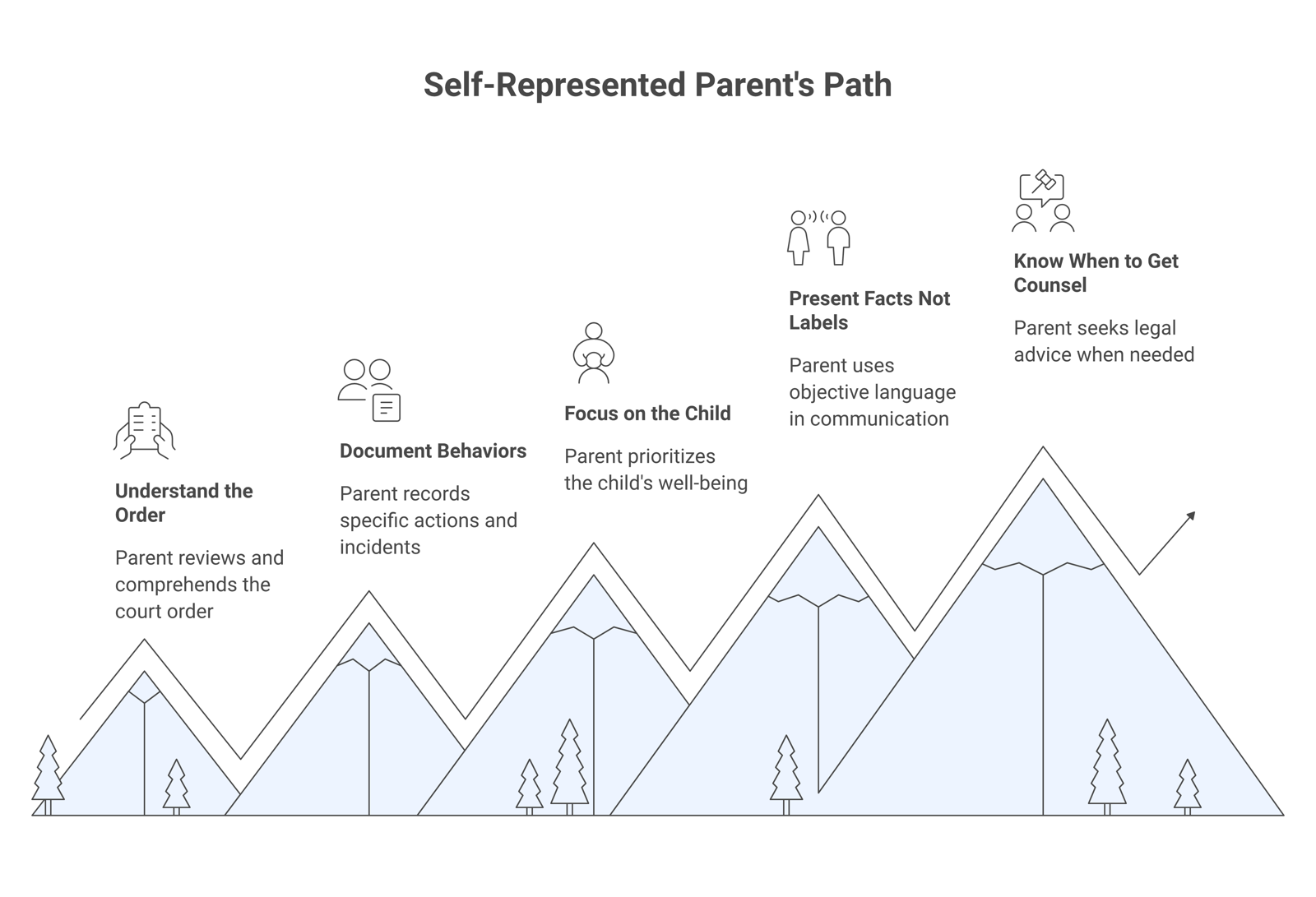
Here is the single most useful idea for a self-represented parent. Courts do not rule on the words “parental alienation.” Instead, they rule on facts. So a parent who walks in determined to prove a label, without a clear pattern of conduct behind it, tends to lose ground.
Parental alienation is a contested construct. It is debated among researchers and clinicians, it is not a formal diagnosis in the main diagnostic manuals, and courts treat it with care rather than as settled science. That is one reason the label alone does not carry a case.
A judicial framework described by attorney Ashish Joshi and Judge Jon Van Allsburg puts the point plainly. A court can recognize and respond to harmful conduct based on the behaviors themselves, without an expert first certifying a syndrome. As they describe it, “labels don’t give us any basis on which to make a ruling. It’s the facts that give us that ability.” Their guidance to litigants: do not arrive with a diagnosis like “narcissist” or “abuser” and no fact pattern. Talk about the specific behaviors instead. Describe the denied parenting time, the blocked calls, the put-downs the child repeats, and let the conduct speak.
This framing also keeps a self-represented parent honest, because not every case of a child pulling away is alienation. For example, a child may simply be aligned with one parent for a stretch of development, or may be reacting to something the rejected parent actually did. Researchers in the field stress that affinity and justified estrangement are different from alienation, and that courts should screen carefully for abuse before reaching any alienation conclusion. Leading with behaviors, rather than the label, keeps the focus where a court can actually use it.
Most people benefit from at least consulting an attorney
Even a parent who plans to proceed pro se usually gains from talking to a lawyer at least once. A single consultation can flag a procedural trap, clarify what evidence matters, and give a reality check on the case. That is different from full representation, and it costs far less.
Many attorneys now offer unbundled services, sometimes called limited-scope representation. Under that model, a lawyer helps with one defined task, such as reviewing documents or preparing a parent to testify, while the parent handles the rest. So it is a middle path between going fully alone and paying for a lawyer at every step. Then, to make a consultation count, it helps to arrive organized. The companion page on what to tell your lawyer about parental alienation walks through how to brief an attorney efficiently.
Cost is a real barrier, and no one should feel ashamed of representing themselves because money is tight. Free and low-cost help exists. The American Bar Association’s Section of Family Law publishes general consumer information, and LawHelp.org points readers to legal-aid programs and court self-help centers by location. For how to vet counsel when full or partial representation is possible, see how to choose a parental alienation lawyer.
Documenting behaviors and denied contact
Documentation is the core of the self-represented parent’s work. Because courts act on facts, a calm and organized record is the most valuable thing a parent can build. The aim is a clear account of what happened, when, and how it affected the child.
Good documentation is specific and dated. For example, it records concrete events: a denied exchange on a certain day, a phone call the child was not allowed to take, an event the parent was blocked from attending, a message that put down the other parent. A good record sticks to what can be shown, such as texts, emails, calendars, and a contemporaneous log, and avoids guessing at motives or piling on insults.
Tone matters as much as content. A record full of anger reads as a parent venting, not as evidence. A record that calmly states facts reads as credible. The discipline is to describe behavior and its effect on the child, not to attack the other parent’s character. The cross-silo guide on how to document parental alienation covers a method in depth, and the sibling page on how to prove parental alienation covers how that record connects to what a court weighs.
One more point. Documentation is not a license to surveil a child or the other parent in ways that cross legal or ethical lines. The goal is an honest record of what a parent already sees, kept steadily over time, not a covert operation.
Focus on the child’s welfare, not on winning
It is natural to think of a custody fight as something to win. But that instinct, understandable as it is, tends to hurt a self-represented parent. Courts are not trying to crown a winner. Instead, they are trying to serve the child.
Experienced litigators describe a serious parental alienation case as a matter of the child’s welfare and a documented pattern of harm, closer to a child-protection question than a contest between two adults. Robert Hoffman, a board-certified Texas family-law attorney, frames these cases around the child’s wellbeing rather than around scoring points. So the skills that win an ordinary argument are often the wrong skills here. Instead, what helps is steadiness, evidence, and a visible concern for the child.
There is a practical reason to drop the win frame too. When a parent only attacks the other side, listeners begin to attribute the negativity to the speaker. Psychologists call this spontaneous trait transference. A parent who does nothing but tear down their ex can end up looking like the bitter one. The steadier path is to name what the child needs, acknowledge that no situation is all black and white, and let the documented behaviors carry the concern. The paired page, the PA case is not a custody case, explains this litigation frame and its limits in more detail.
Courtroom conduct: passion, not anger
How a self-represented parent carries themselves in court can matter as much as the file. Judges are human, and a calm, organized, child-focused parent earns trust. A parent who comes across as angry or combative can lose ground even when the facts are on their side.
A useful distinction comes from Hoffman’s coaching: passion is good, anger is not. Caring deeply about a child is appropriate and even sympathetic. Being nervous is fine too. But lashing out, interrupting, or treating the courtroom as a place to vent is not. The aim is to present as mature, balanced, and centered, with clear knowledge of the child.
A few habits help in practice. Address the judge respectfully and follow the court’s instructions. Speak to behaviors and facts, not to character attacks. Admit the gray honestly, because a parent who can name a few of their own missteps reads as more credible than one who insists they are flawless. And keep social media clean. Public venting about the other parent, the judge, or the process has cost parents cases that the evidence otherwise supported.
The realistic role of evidence and experts
Evidence is what a court can act on, so a self-represented parent should build the strongest factual record they can. That record is usually documents and testimony: the dated log, the messages, the calendars, and the parent’s own clear account. The earlier framing applies here too. The record should show behaviors and their effect on the child, not assert a label.
Experts are a harder question for someone without a lawyer. A custody evaluation or expert witness can help in some cases, but it is expensive and not always available, and not every evaluator understands alienation dynamics. Still, the encouraging news for a pro se litigant is that a court can recognize harmful conduct from the behaviors alone, without first paying for an expert to certify a syndrome. That does not make expert input worthless. But it means a parent who cannot afford one is not automatically out of options. For how a record translates into proof, see how to prove parental alienation and the broader Court silo.
A note of realism: outcomes are never guaranteed. Courts vary, judges vary, and the strength of the record matters. This page describes how to prepare and present honestly. It does not and cannot promise a result.
When the stakes mean you should not go it alone
Self-representation has limits that are not about skill. Some cases are too serious, too fast-moving, or too dangerous to handle alone, and recognizing that is its own form of good judgment.
If there is any abuse or safety concern, get help. A child’s distancing that is rooted in real harm is not alienation, and a case that involves domestic violence, child abuse, or threats is not the place to test self-representation. Severe or complex cases, emergency motions, and situations where the other side has aggressive counsel are all signals to find a lawyer, a legal-aid program, or at least an unbundled-services arrangement. The honest move in those moments is to reach for help, not to push through alone. Specialists treat the most serious of these cases as child-protection matters, which is a reason to bring in trained help rather than carry them solo.
Frequently asked questions
What does pro se mean in a parental alienation case?
Pro se means representing yourself in court without a lawyer. In a parental alienation case, a self-represented parent handles their own documents, evidence, and presentation. It is allowed in family court, but it carries real limits, since the parent takes on every task a lawyer would normally do.
Can I prove parental alienation without a lawyer?
You can present documented behaviors and denied contact on your own, because courts act on facts rather than on the label. A judge can recognize harmful conduct from the behaviors themselves. Proving it well is harder alone, so most people benefit from at least consulting an attorney, and abuse concerns should always go to a professional.
Should I represent myself in a parental alienation case?
Self-representation is possible and often necessary when money is tight, but the stakes are high. At least a one-time consultation or an unbundled-services arrangement is usually worth it. If there is abuse, danger, or a fast-moving emergency, a parent should not go it alone.
How do I document parental alienation behaviors on my own?
Keep a calm, dated, factual record of specific behaviors and denied contact. Save texts, emails, and calendars. Describe what happened and how it affected the child, and avoid insults or guesses about motive. A tidy, credible record is more useful than an angry one.
How should I act in family court if I am self-represented?
Present as calm, organized, and focused on the child. Passion is fine; anger is not. Speak to behaviors and facts, follow the court’s instructions, admit the gray honestly, and keep social media free of venting about the case.
What this page does not do
This page is not legal advice. It does not name any one state’s rules as if they applied nationally, and it does not tell readers what to file or how to file it. Procedure varies by state and county, and those steps belong to a licensed attorney or a local court self-help center. The page also does not frame self-representation as a way to win. The honest uses of these tools are the calm, evidence-based, child-focused ones.
For the litigation frame and its limits, see the PA case is not a custody case. On documentation, see how to document parental alienation and how to prove parental alienation. To work with counsel, see what to tell your lawyer about parental alienation and how to choose a parental alienation lawyer. The full Court silo covers the rest.
Sources and further reading
- Cornell Legal Information Institute (Wex). Pro se. law.cornell.edu/wex/pro_se
- American Bar Association, Section of Family Law. americanbar.org/groups/family_law
- LawHelp.org. Legal aid and court self-help directory. lawhelp.org
- American Psychological Association. Divorce and child custody. apa.org/topics/divorce-child-custody
If you or your child are in crisis
Free and confidential help is available right now.
- 988 Suicide and Crisis Lifeline. Call or text 988. 988lifeline.org
- Childhelp National Child Abuse Hotline. 1-800-422-4453. childhelp.org
- NAMI HelpLine. 1-800-950-6264. nami.org/help
Last reviewed: 2026-06-07. Author: Alex Buckles (PAC Founder).