

Preparing to testify in a parental alienation case means learning to describe specific behaviors you saw and how they affected your child, in calm, factual terms. Stay within what you personally observed. Leave the label and any diagnosis to the court and to qualified experts. Credibility comes from honesty and specificity, not intensity.
A note on safety
A child’s rejection of a parent is not always alienation. If the rejected parent has been abusive, neglectful, or genuinely dangerous, the child’s distancing may be justifiable estrangement, not parental alienation, and it is a different legal and safety matter. Courts screen for abuse first. If a child’s safety is at risk, contact local law enforcement or a domestic-violence resource.
This page is general education, not legal advice. It does not create an attorney-client relationship and does not address any one court’s rules. Procedure varies by jurisdiction. Anyone preparing to testify should work with a licensed family-law attorney in their own area.
What makes testimony credible
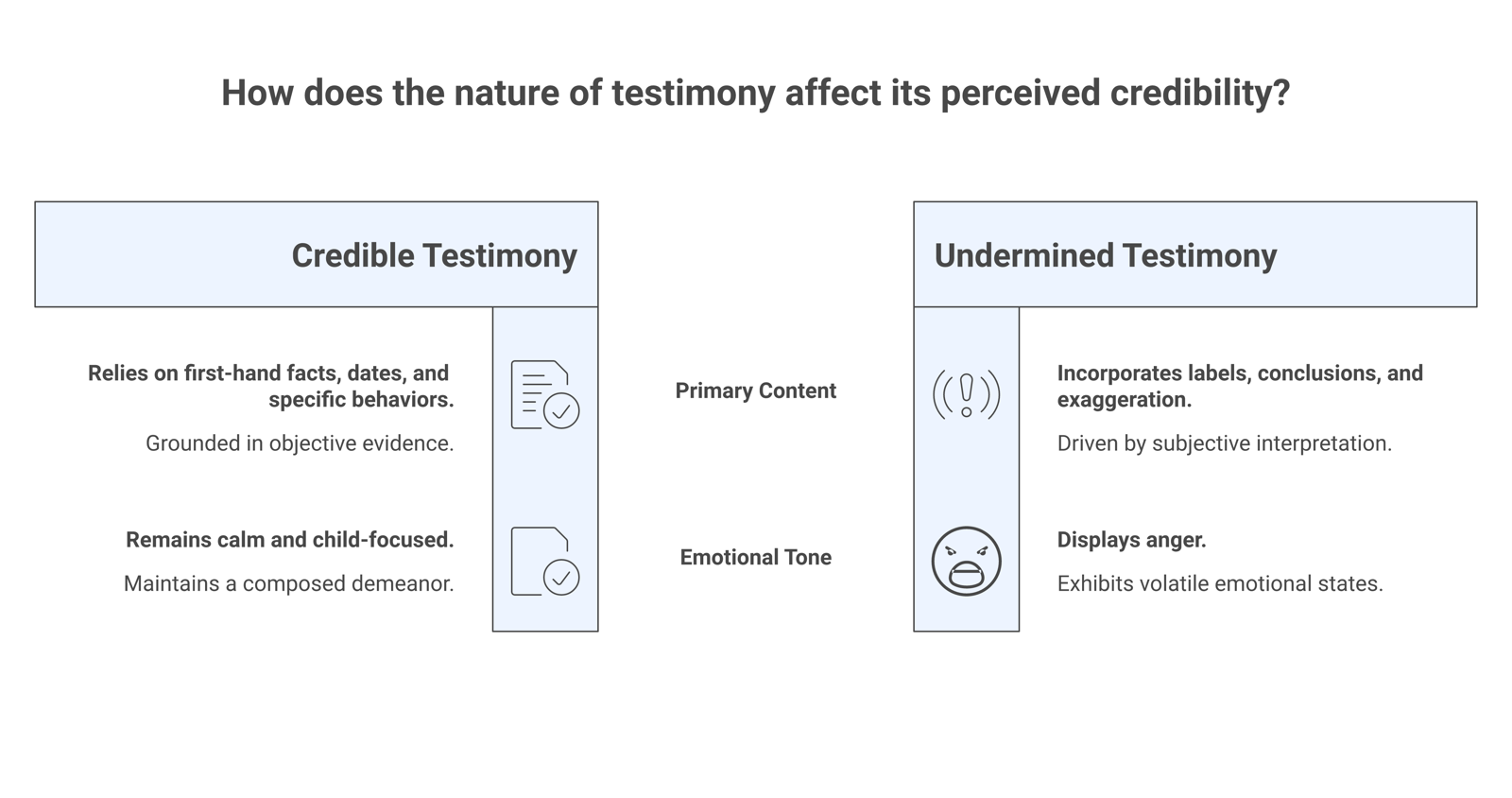
Credible testimony rests on a few simple things. You speak to what you personally saw and heard. You give dates and specific behaviors. You stay calm. And you keep your child, not your anger at the other parent, at the center of every answer. Judges and evaluators weigh witnesses the way most people weigh anyone: honesty and specificity build trust, while exaggeration and heat erode it.
What undermines testimony is the mirror image. Labels instead of facts. Conclusions instead of observations. Exaggeration instead of accuracy. Anger instead of measured concern. A parent who arrives ready to argue a theory, or to settle scores, often loses the very credibility the case depends on. The discipline below is not about performance. It is about telling the truth in a way the court can actually use.
Tell the truth and stay within what you saw
Honesty is the foundation, and it is also the strongest strategy. A witness who is caught stretching one fact loses trust on every other fact. So the goal is not to sound impressive. The goal is to be accurate, even when accuracy is less dramatic than the reader might wish.
Testimony from a parent is generally lay testimony. A lay witness speaks to personal knowledge: things you directly observed, not things you assume, heard secondhand, or pieced together. The Federal Rules of Evidence put this plainly. Under Rule 602 on personal knowledge, a witness may testify to a matter only if there is evidence they have personal knowledge of it. Most state courts apply an equivalent rule. So when you describe an exchange, describe the one you were standing in, in the words and actions you actually witnessed.
That boundary protects you. If you stay inside what you saw, cross-examination has far less to work with. If you stray into speculation about motives or events you did not witness, an opposing attorney can unravel it quickly.
Stick to facts and dates
Specific, documented behaviors carry weight that conclusions do not. “On March 3 the scheduled exchange did not happen, and my daughter later told me she was told I had canceled” is testimony a court can weigh. “The other parent is alienating the children” is a conclusion the court has to evaluate on its own, and it sounds like argument.
This is where good records earn their keep. Dates, times, missed exchanges, blocked calls, and the child’s own words, written down close to when they happened, let you testify with precision instead of memory alone. The work of building that record is covered in how to prove parental alienation and, in the foundational silo, in how to document parental alienation. On the stand, that record becomes the difference between a vivid, dated account and a vague impression.
Describe effects, too, but only the ones you observed. If your child stopped sleeping, said something specific, or refused a long-loved activity, say so factually. Avoid diagnosing the child or predicting the future.
Describe behaviors, not the label
One of the most useful things a testifying parent can understand is that courts act on behaviors, not on the term “parental alienation.” Litigators and judges who handle these cases say it directly. As one bench-and-bar framework puts it, “labels don’t give us any basis on which to make a ruling. It’s the facts that give us that ability.” Parents who arrive with the label but no fact pattern tend to lose. Parents who describe the specific conduct, and what it did to the child, give the court something it can act on.
There is a second reason to drop the label. Parental alienation is a contested construct. There is no parental alienation diagnosis in the standard diagnostic manuals, and a large practitioner survey found that professionals often over-believe how settled the science is, even though no validated measure of alienation exists. Serious scholars caution that a simple “it is all the other parent” story risks false conclusions when other factors are in play. None of that means a parent’s documented experience is not real. It means the credible move is to testify to the behaviors and their effect, and let the court, not the witness, decide what to call it. The page on working with a skeptical court goes deeper on why this approach holds up.
Stay calm and child-focused: passion, not anger
Veteran litigators draw a sharp line between passion and anger. Passion is welcome. You can pause, show sadness, and use words that carry real weight when you describe how a loss affected your child. Anger is different, and it tends to be the death knell on the stand. Fact-finders pull away from a witness who is loud, contemptuous, or out for revenge.
There is a related trap worth naming. Targeted parents often present, understandably, as angry, anxious, agitated, and afraid, while a charming opposing party presents as cool and calm. The point is not to fake serenity. The point is to consciously show up as steady, mature, and centered, and to keep the focus on the child’s wellbeing rather than on your grievance. Nervousness is fine, and it often reads as sympathetic. Bitterness does not. When a question invites you to attack the other parent, answer about the behavior and its effect on your child, then stop.
The limits of lay testimony and the expert’s role
It helps to know where your role ends. A parent testifies as a lay witness to personal knowledge. Opinions about whether a recognized phenomenon is present, and any diagnosis, belong to a qualified expert, not to a party in the case.
Experts themselves operate within careful limits. One forensic psychologist who has testified in dozens of these cases across many states describes several distinct expert roles, from court-appointed evaluator to retained witness. A key discipline he stresses is that an expert who has not personally interviewed the other parent and the children should avoid offering an explicit diagnosis, because the full picture is not in front of them. If trained experts hold back from labels they cannot support, a testifying parent has even more reason to stay with observed behaviors. For how experts are chosen and what they can and cannot do, see parental alienation expert witness.
Prepare with your attorney
Preparation is not scripting, and it is not coaching a story. It is honest rehearsal: going over truthful answers to likely questions so you can give them clearly and calmly under pressure. Your attorney can tell you what is relevant, what the court will and will not consider, and how to answer a hard cross-examination question without losing your footing.
The American Bar Association’s Section of Family Law offers general consumer information on family-court process. Use your own counsel for the specifics of your hearing. Bring your documentation in order, organized by date, so you can support what you say. And tell your attorney the whole truth, including the parts that are not flattering to you, because the page on what to tell your lawyer about parental alienation explains why surprises in the courtroom are far more damaging than a candid conversation beforehand.
What not to do
- Do not exaggerate. One inflated claim taints the credible ones.
- Do not speculate. If you did not see it, do not testify to it.
- Do not vent. The stand is not the place to release years of pain at the other parent.
- Do not coach the child or repeat coached statements as if they were spontaneous.
- Do not argue the science of parental alienation. That is contested terrain, and it is not a lay witness’s job.
- Do not answer a question you do not understand. Ask for it to be repeated or rephrased.
Each of these protects the same thing: a record the court can trust.
Managing your nerves
Nervousness is normal, and it does not hurt you the way anger does. A few honest habits help. Sleep and eat before the hearing. Slow your pace and pause before answering, which also gives your attorney room to object if needed. Listen to the whole question, answer only that question, and stop. If you do not know an answer, say you do not know. If you need a moment, it is acceptable to ask for one.
Long custody battles sometimes leave a parent feeling wrung out and flat. Reconnecting with calm, genuine feeling about your child, rather than rage at the other parent, is itself part of preparing. The aim is to walk in steady, tell the truth, and let the facts do the work.
Frequently asked questions
How do you testify in a parental alienation case?
You describe specific behaviors you personally observed and how they affected your child, in calm and factual terms, supported by dates and records. You stay within your own knowledge as a lay witness. You do not testify to a diagnosis or assert the label “parental alienation,” because courts act on documented behaviors and let the court decide what to call them.
Should you say “parental alienation” on the stand?
Generally no. Courts act on facts, not labels, and the construct is contested. It is more credible to describe the conduct, such as blocked contact or denigration you witnessed, and its effect on the child, and to let the court draw its own conclusion. Save argument about the term for your attorney’s role, not your testimony.
How do you stay calm while testifying?
Prepare truthful answers with your attorney, stick to facts and dates, and bring passion without anger. Slow down, listen to the full question, and answer only what is asked. Nervousness is normal and often reads as sympathetic; anger and contempt do not. Keeping your child, rather than the other parent, at the center helps you stay steady.
Can a parent testify as an expert on alienation?
No. A parent is a party and a lay witness who testifies to personal knowledge. Opinions on whether a recognized phenomenon is present, and any diagnosis, are the role of a qualified expert. Even retained experts who have not interviewed everyone involved avoid offering an explicit diagnosis.
What should you not do when testifying?
Do not exaggerate, speculate, vent, coach the child, or argue the science of the construct. Do not testify to things you did not see. Stay within what you actually observed, keep your answers specific and dated, and let your documentation support you.
What this page does not do
This page is not legal advice, and it is not witness coaching. It does not script answers, name any one court’s rules as if universal, or tell readers how to win. It does not treat parental alienation as settled science. The right use of this guidance is honest, specific, child-focused testimony that a court can rely on.
For the broader evidence work, see how to prove parental alienation and how to document parental alienation. For preparing with counsel, see what to tell your lawyer about parental alienation. For the expert’s role, see parental alienation expert witness. When the judge or evaluator seems doubtful, see working with a skeptical court. The full Court silo covers the rest.
Sources and further reading
- Cornell Legal Information Institute. Federal Rule of Evidence 602, Need for Personal Knowledge. law.cornell.edu/rules/fre/rule_602
- American Bar Association, Section of Family Law. americanbar.org/groups/family_law
- American Psychological Association. Divorce and child custody. apa.org/topics/divorce-child-custody
If you or your child are in crisis
Free and confidential help is available right now.
- 988 Suicide and Crisis Lifeline. Call or text 988. 988lifeline.org
- Childhelp National Child Abuse Hotline. 1-800-422-4453. childhelp.org
- NAMI HelpLine. 1-800-950-6264. nami.org/help
Last reviewed: 2026-06-07. Author: Parental Alienation Center (Organization). Editorial review: held to the PAC Editorial Standards (balance, primary-source citation, reader safety); an independent expert review board will be appointed.