

This page is general information, not legal or clinical advice. It does not create a professional relationship, and it does not address any one state’s law. Anyone weighing reunification therapy should consult a qualified clinician and, where a court is involved, a licensed family-law attorney in their own jurisdiction.
Does reunification therapy work? It depends on the model and how it is run. Voluntary, paced, emotionally safe approaches that screen for safety show the most promising results, while coercive, forced-separation programs rest on weaker evidence and can cause harm. The honest answer is conditional, and the research on both sides deserves a fair reading.
A note on safety
A child’s rejection of a parent is not always alienation. Where there is genuine abuse, reunification is contraindicated, and forcing contact can re-traumatize a child. Safety comes first. No evidence question in this article changes that boundary. If a child’s safety is at risk, contact local law enforcement or a domestic-violence resource before pursuing any reunification process.
Does reunification therapy work? The short answer
Reunification therapy is a structured effort to rebuild a damaged relationship between a child and a rejected parent. It ranges from gentle, weekly, voluntary sessions to intensive multi-day programs, and the question “does it work?” cannot be answered the same way for all of them. The format matters. The safety screen matters. The child’s readiness matters.
A flat yes or no would mislead. Proponents of certain intensive programs report high reconnection rates. Critics argue those numbers rest on weak study designs and that some approaches can do harm. Both claims can be partly true at once, because they often describe different models run in different ways.
The Association of Family and Conciliation Courts, a leading body for family-court professionals, urges that there be no single label and no one-size answer for parent-child contact problems, and that each family be assessed on its own facts. That caution is a good starting point. The AFCC treats these as individual clinical and legal questions, not as a settled technique with a guaranteed result. For the definition of the intervention itself, see what reunification therapy is, and for the court mechanics, see court-ordered reunification therapy.
What proponents report
The affirming case rests largely on outcome reports from intensive programs. The best-known is Family Bridges, described in the literature by psychologist Richard Warshak, who traces its methods to workshops originally developed for children recovered from parental abductions. Programs in the same lineage include Turning Points for Families, Overcoming Barriers, and Transitioning Families.
The reported figures are striking. In Warshak’s 2010 outcome study, the initial case series reported 22 of 23 children restoring the relationship. In his 2019 follow-up study of 83 severely alienated children placed with the rejected parent and enrolled in the four-day workshop, contact refusal dropped from 85 percent to 6 percent, and by various measures 75 to 96 percent were described as having overcome their alienation, as reported by participating parents and workshop leaders. Program developers describe these as psychoeducational interventions for moderate-to-severe cases where conventional weekly therapy has already failed, and they argue that leaving severe alienation untreated is itself harmful to the child.
Two things should be held in view at once. First, these are real reports from people who went through the programs, and they describe outcomes that matter to families. Second, the numbers are participant-reported and program-reported. They come from the programs that ran the work, often gathered shortly after it ended. That does not make them false. It does mean they carry the limits of any self-reported, self-collected outcome data, which the next section examines directly.
What critics say the numbers leave out
The critical pole focuses on how those outcomes were measured. The clearest statement comes from a 2019 review by Jean Mercer, which examined the leading reunification treatments and concluded that court-ordered separation from the preferred parent combined with intensive counseling “have not been shown to be effective, but are in fact potentially harmful.” Mercer’s companion work appears in the edited volume Challenging Parental Alienation.
The methodological complaints are specific. The outcome claims rest on designs with no control groups, so there is no comparison with families who received different help or none at all. Many studies are proponent-run, meaning the people reporting success also designed and delivered the treatment. The samples are selected rather than representative. Mercer argues that the core mechanism of some intensive models, forced separation from a child’s primary attachment figure, conflicts with attachment and developmental science, and that the programs meet the criteria for what researchers call potentially harmful treatments, citing the work of Lilienfeld and of Dallam and Silberg.
The evidence gap is broader than any single program. Even researchers who affirm parental alienation acknowledge that the field has produced no empirical longitudinal studies of long-term treatment outcomes. The same thinness applies across the board. There are no randomized controlled trials of reunification programs. Readers can survey the peer-reviewed literature themselves through PubMed. Proponents respond that randomized trials would be unethical and impractical for children in crisis, and that imperfect evidence is not the same as no evidence. That exchange is unresolved, which is part of the honest answer.
The pattern both sides can see
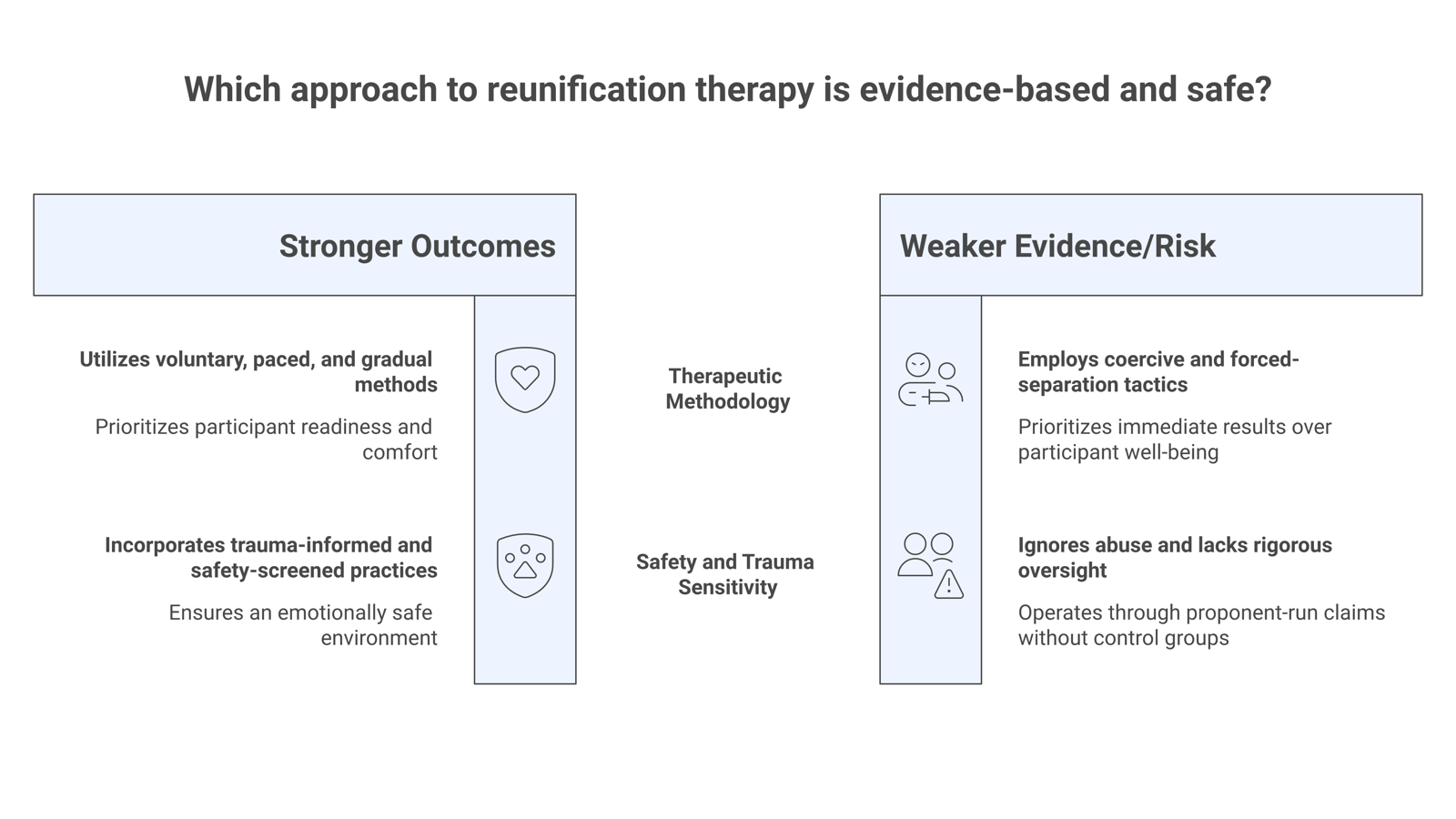
Underneath the dispute about numbers, a usable pattern emerges, and it is one that careful voices on both poles tend to accept. Approaches that are voluntary, paced to the child’s readiness, emotionally safe, and properly safety-screened tend to do better. Approaches that are coercive, that rely on forced separation, and that proceed without a real safety screen tend to do worse and carry more risk.
Experienced systemic practitioners describe reunification work for severe cases as structured, directive family therapy that follows a sequence rather than a single confrontation. A foundational set of principles, drawn from a 1991 court decision and revived by attorney Brian Ludmer, frames severe alienation as a matter of the child’s emotional safety, addressed through staged therapeutic work rather than through pressure alone. That framing fits the AFCC guidance to screen for safety on an ongoing basis and to refer families to proportional, accountable services.
The takeaway is not that one program is good and another is bad. It is that the same intervention can help or harm depending on whether it respects the child’s pace and safety. A model built around the child’s readiness has the better track record. A model built around overriding the child’s resistance carries the heavier evidentiary and ethical burden.
The abuse boundary
One line is not a matter of model or pacing. Where there is genuine abuse, reunification is contraindicated. A child who resists a parent because that parent has harmed them is not exhibiting alienation, and pressing that child back into contact can re-traumatize them.
This boundary is built into the critical literature and into emerging policy. Mercer’s central objection is that forcing a child away from a protective attachment figure conflicts with what is known about child development. At the policy level, the federal standard known as Kayden’s Law (Title XV of the Violence Against Women Act Reauthorization of 2022) encourages courts not to order reunification treatment without scientifically valid, generally accepted proof of its safety and effectiveness, precisely to protect children in cases where abuse is alleged. As of mid-2026, Colorado, California (Piqui’s Law), Pennsylvania, and Utah have adopted conforming state laws; the details are covered on the Kayden’s Law page. Clinicians who take a child-protection-first view, including practitioners in the Gottlieb tradition, treat any reconnection effort as protective work that must rule out danger first.
None of this is about denying a wronged parent a relationship. It is about sequencing. Safety is screened first, the child’s account is taken seriously, and reunification is pursued only when it is safe to do so. For a fuller treatment of the limits, see when reunification therapy is not recommended.
Where the field is heading
The direction of the field is toward gentler, more transparent models. Trauma-informed, gradual, multi-phase approaches that prepare the child, move at a tolerable pace, and keep safety central are gaining ground over single-event, high-pressure formats.
The push for better evidence will have to answer the critics on their strongest point. The recurring criticism of the intensive programs is that they report their own findings, so the design the critical pole has long asked for is evaluation by independent researchers with no stake in the outcome. As of mid-2026, no such independent evaluation has been published. Until one is, current outcome claims remain developer-reported, and whether independent results would confirm or temper them is an open question.
For families, the practical implication is to ask hard questions before starting. How does the model handle a child who is not ready? What is the safety screen? Who collects the outcome data, and how long does the work take? The page on how long reunification therapy takes covers the time dimension.
So, does it work? A balanced bottom line
The fair conclusion is the conditional one. Reunification therapy can help rebuild a damaged relationship, and many families report that it did. The strongest support is for voluntary, paced, emotionally safe, safety-screened work. The weakest evidence, and the clearest risk of harm, attaches to coercive, forced-separation programs and to any approach that proceeds where abuse has not been ruled out.
Anyone facing this decision is weighing a real but contested intervention. A qualified clinician can assess fit and safety, and where a court is involved, a licensed attorney can explain the local rules. For how judges tend to view these issues, see how judges view parental alienation, and use the Court silo as the hub.
Frequently asked questions
Does reunification therapy work?
Sometimes, and it depends heavily on the model and how it is run. Voluntary, paced, emotionally safe approaches that screen for safety show the most promising results. Coercive, forced-separation programs rest on weaker evidence and can cause harm. There is no single yes-or-no answer, and genuine abuse contraindicates reunification entirely.
What is the success rate of reunification therapy?
Some intensive programs report high rates. Family Bridges’ developer-affiliated studies report 22 of 23 restored relationships in the initial 2010 case series and, in a 2019 study of 83 children, a drop in contact refusal from 85 percent to 6 percent. Those figures are participant-reported and program-reported, gathered without control groups and from selected samples, so they should be read as encouraging reports rather than as proven, generalizable success rates.
Is reunification therapy effective or harmful?
It can be either. The same intervention can help when it is voluntary, paced, and safety-screened, and harm when it is coercive or applied where abuse exists. Critics argue that forced-separation programs can be potentially harmful and conflict with attachment science. The risk is highest when a child’s resistance is overridden rather than understood.
What makes reunification therapy more likely to succeed?
The factors that recur in the better-regarded work are voluntary participation, pacing to the child’s readiness, genuine emotional safety, a real safety screen for abuse, and a trauma-informed, gradual structure. Approaches that respect the child’s pace tend to outperform single-event, high-pressure formats.
Is reunification therapy evidence-based?
Partly, and the evidence base is thin and contested. There are no randomized controlled trials and no longitudinal studies of long-term outcomes. The strongest claims come from proponent-run programs without control groups. The field is now moving toward independent evaluation, but a reader should treat current outcome claims as preliminary rather than settled.
What this page does not do
This page is not legal or clinical advice. It does not endorse or condemn any single program, name any one state’s rules as if they applied everywhere, or promise that reunification therapy will work in a given case. It does not frame the process as a way to win against the other parent. Choices about reunification belong to qualified clinicians and, where a court is involved, to licensed attorneys working with the real facts.
For the contraindications, see when reunification therapy is not recommended. For the court mechanics, see court-ordered reunification therapy. For the definition, see what reunification therapy is. The full Court silo covers the rest.
For a structured, both-parents method a court can order, see New Ways for Families.
Sources and further reading
- American Psychological Association. Divorce and child custody. apa.org/topics/divorce-child-custody
- Association of Family and Conciliation Courts (AFCC). afccnet.org
- PubMed (National Library of Medicine). Reunification and parent-child contact-problem outcome research. pubmed.ncbi.nlm.nih.gov
- Warshak, R. A. (2010). Family Bridges: Using insights from social science to reconnect parents and alienated children. Family Court Review, 48(1), 48 to 80. https://doi.org/10.1111/j.1744-1617.2009.01288.x
- Warshak, R. A. (2019). Reclaiming parent-child relationships: Outcomes of Family Bridges with alienated children. Journal of Divorce & Remarriage, 60(8), 645 to 667.
- Mercer, J. (2019). Examining parental alienation treatments: Problems of principles and practices. Child and Adolescent Social Work Journal, 36(4), 351 to 363.
- Dallam, S., & Silberg, J. L. (2016). Recommended treatments for “parental alienation syndrome” (PAS) may cause children foreseeable and lasting psychological harm. Journal of Child Custody, 13(2-3), 134 to 143.
- Keeping Children Safe From Family Violence Act (Kayden’s Law), Title XV, Violence Against Women Act Reauthorization Act of 2022, Pub. L. 117-103, codified at 34 U.S.C. 10446(k).
If you or your child are in crisis
Free and confidential help is available right now.
- 988 Suicide and Crisis Lifeline. Call or text 988. 988lifeline.org
- Childhelp National Child Abuse Hotline. 1-800-422-4453. childhelp.org
- NAMI HelpLine. 1-800-950-6264. nami.org/help
Last reviewed: 2026-06-08. Author: Alex Buckles (PAC Founder). Editorial review: held to the PAC Editorial Standards (balance, primary-source citation, reader safety); an independent expert review board will be appointed.