
This page is general information, not legal or clinical advice. It does not diagnose any family and does not replace an evaluation by a licensed professional. Anyone worried about a child should consult a qualified clinician or attorney in their own area.
The attachment-based model of parental alienation explains a child’s rejection of a loving parent as a symptom, not a true feeling. It says the child’s bond with the favored parent has been distorted into role reversal, where the child manages the parent’s emotions. This page explains how that happens and where the idea is debated.
A note on safety
A child’s distance from a parent is not always alienation. When a child pulls away from a genuinely abusive or frightening parent, that child is protecting themselves, and that is healthy. The attachment-based model applies only when the rejected parent is safe and broadly normal. If a child’s safety is at risk, contact local law enforcement or a child-protection resource first.
What the attachment-based model of parental alienation says
The attachment-based model of parental alienation is a clinical reframe most linked to Dr. Craig Childress, a psychologist who set it out in his 2015 book. The central claim is simple to state. When a child suddenly rejects a parent they once loved, the rejection is read as a symptom of a damaged bond, not as the child’s own settled choice.
Most accounts of alienation focus on the favored parent’s actions, the bad-mouthing, the loyalty tests, the rewriting of memories. This model goes a layer deeper. It asks what has happened inside the attachment system itself, the part of a child that decides who is safe and who to turn to.
Childress describes three things he looks for together. First, the child shuts down the bond with the rejected parent for no good reason. Second, the child shows traits that mirror the favored parent rather than their own age. Third, the child holds a fixed, false belief about the rejected parent that does not fit the facts. One firm rule guards the whole model. The rejected parent must be safe and broadly normal, or the picture is something else. For the checklist that sits alongside this account, see the five-factor model of parental alienation. The broader Learn hub maps the rest.
How healthy attachment is supposed to work
To see what the model claims has gone wrong, it helps to start with what should go right. Attachment is the bond that forms between a young child and the adults who care for them. The classic research of John Bowlby and Mary Ainsworth showed that a child uses a trusted caregiver as a secure base, a safe place to return to when the world feels scary.
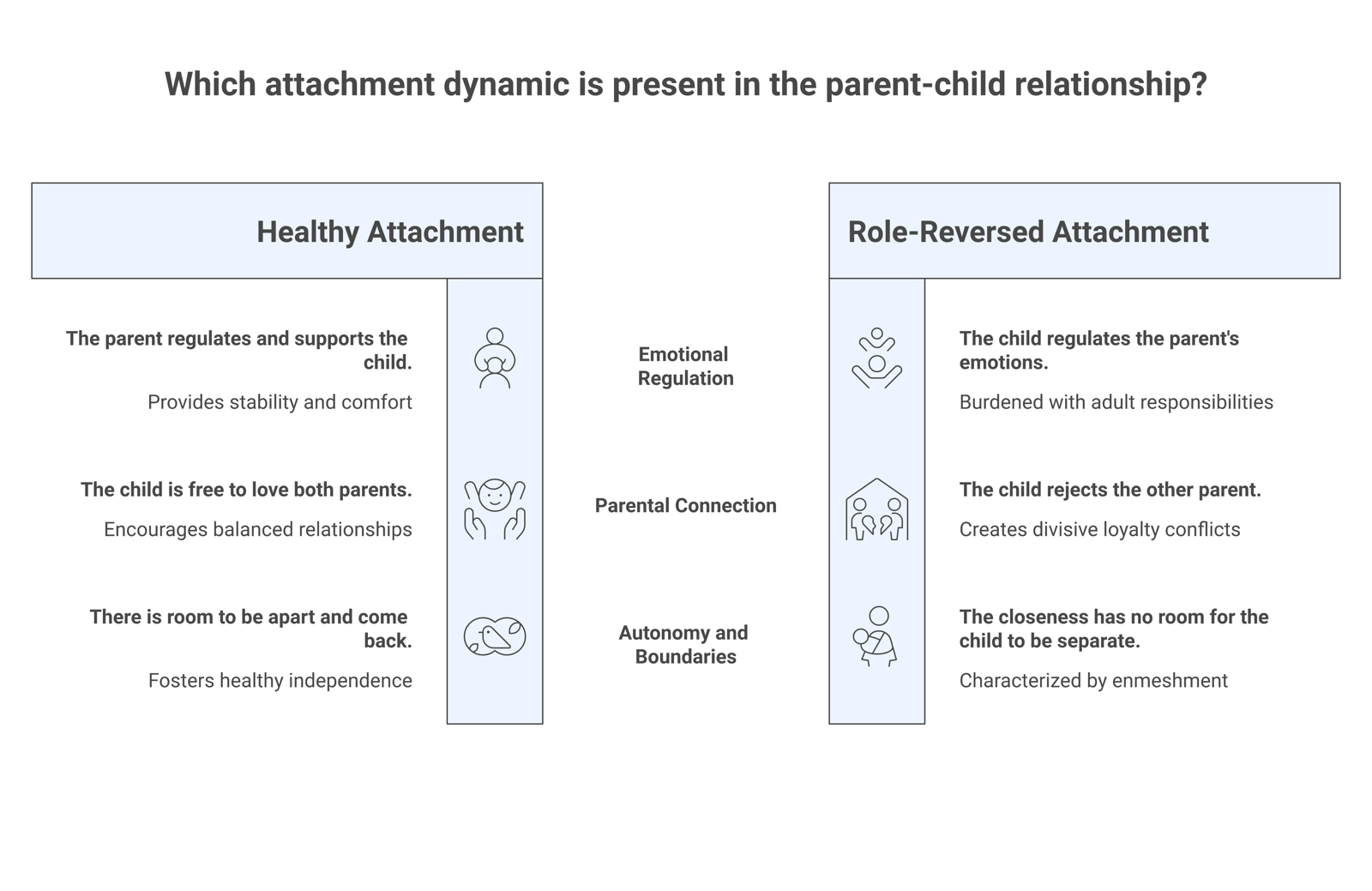
In a healthy bond, the parent does the calming. A toddler who falls and cries runs to a parent, and the parent’s calm voice settles the child’s racing heart. Over thousands of small moments like that, the child slowly learns to soothe themselves. Put another way, the parent’s steady nervous system teaches the child’s own to steady itself. The skill is built through use, much as a muscle grows when it is worked.
Healthy attachment also leaves room for more than one person. A child can love a mother and a father, a grandparent and a stepparent, without any of those bonds canceling out the others. Loving one parent never requires hating the next. The American Psychological Association offers general background on attachment and child development, and the research base is searchable through PubMed. The point to carry forward is the direction of care. In a healthy bond, the parent holds the child, not the other way around.
How the relationship gets inverted: role reversal
The model’s heart is what happens when that direction flips. Childress and others call it role reversal. Picture a parent who never learned to manage their own strong feelings, often because of their own painful past. That parent still needs someone to steady them. In a marriage, the spouse often plays that role quietly. After a divorce, the spouse is gone.
So the parent turns to the only person left, the child. The child becomes what one model calls a regulatory object, a living source of comfort the parent leans on to feel calm and safe. The child senses the parent’s need and rises to meet it, because children are wired to keep their caregivers close. A small person ends up carrying a grown person’s feelings.
Role reversal changes how the child sees the world. To keep the fragile parent steady, the child takes on that parent’s fears as if they were their own. When the favored parent feels hurt and angry at the other parent, the child starts to feel hurt and angry too. The rejection of the other parent is not really the child’s idea. It is the price of keeping the bond the child cannot afford to lose. Personality patterns matter here too, a thread picked up on the page about parental alienation and narcissism.
Why the bond looks “highly bonded” from the outside
Here is the part that fools almost everyone. A role-reversed bond does not look broken from across a room. It looks unusually close. The child and the favored parent seem to share everything, finish each other’s sentences, and present a united front. To a casual observer, that reads as a wonderful relationship.
Family therapist Salvador Minuchin gave this pattern a name decades ago. He called it enmeshment, a state where the normal line between parent and child has fallen away. In an enmeshed pair, there is little space, little privacy, and little room for the child to be a separate person with separate feelings. The closeness is real, but it is the wrong kind. It serves the parent’s needs more than the child’s growth. Childress uses a stark image for the same idea, describing the favored parent as feeding off the child’s own life force.
This is why so many adults miss what is happening. A teacher sees a devoted parent and a clingy, agreeable child and thinks nothing of it. A pediatrician notes a close family. Even a court evaluator can mistake tight enmeshment for a strong, secure bond and decide the child simply prefers one home. The model argues that the very thing that should raise concern, a bond too tight to let the child grow, gets praised instead. The behaviors that flow from this pattern appear on the page about parental alienation manipulation and in the eight behaviors of an alienated child.
How this differs from a child’s genuine attachment to a safe parent
None of this means that every child who favors one parent has been alienated. Children pull toward one parent for many ordinary reasons, and many of those reasons are healthy. The model draws a careful line, and that line protects children.
A genuine, secure attachment runs one way. The safe parent does the soothing, and the child is free to be a child. The child can be close to that parent and still love the other one. There is room to disagree, to be apart, and to come back. A role-reversed bond runs the other way. The child does the soothing, the closeness has no breathing room, and loving one parent seems to demand rejecting the other.
The most important line of all is the line around real harm. A child who keeps their distance from a parent who has hurt or scared them is not alienated. That child is reading danger correctly and staying safe, exactly as attachment is meant to work. Researchers who study these cases, including Shawn Wygant, warn that confusing protective distance with alienation causes serious mistakes. The attachment-based model agrees with that line in its own terms. It only applies when the rejected parent is safe and broadly normal. Where real abuse is present, the model does not fit, and the right path is a child-protection one. The American Psychological Association’s guidance on divorce and child custody frames these points for families.
Is the attachment-based model accepted?
The honest answer is that the model is influential but debated. It is fair to hold two facts at once. Attachment theory itself, the work of Bowlby and Ainsworth, is well established and widely taught. The attachment-based model of alienation is a specific newer application of those ideas, and it has not reached the same level of acceptance.
Supporters like the model because it shifts focus from a contested label to a process you can watch, and because it treats severe cases as a matter of the child’s safety. Critics raise real questions. Some doubt the diagnostic framing the model borrows from clinical manuals. Others want a stronger base of peer-reviewed evidence before the model guides big decisions about children. The fight over alienation language is older than this model, and it is covered on the page about parental alienation syndrome.
A fair reader can take the model as one useful lens among several, valuable for the questions it raises, and not as settled science. Clinicians who work from a systems view often pair it with other tools, an approach discussed in the resource on family systems therapy for parental alienation.
Frequently asked questions
What is the attachment-based model of parental alienation?
It is a clinical reframe, associated with Dr. Craig Childress, that explains a child’s rejection of a loving parent as a symptom of a damaged attachment rather than the child’s true wish. The model says the child’s bond with the favored parent has been inverted into role reversal. It applies only when the rejected parent is safe and broadly normal.
How does role reversal work in parental alienation?
Role reversal flips the normal direction of care. A parent who cannot manage their own emotions starts using the child to feel calm and steady, often after a divorce removes their adult support. The child absorbs the parent’s fears as their own and rejects the other parent to protect the bond. The result is a child carrying a grown person’s emotional needs.
Why does an alienated child seem so bonded to the favored parent?
Because a role-reversed bond looks like unusual closeness from the outside. The child and favored parent appear inseparable, which observers read as a strong relationship. Therapist Salvador Minuchin called this enmeshment, a collapse of the normal boundary between parent and child. The very tightness that should raise concern is often mistaken for healthy attachment.
Is the attachment-based model accepted?
It is influential but debated. The underlying attachment theory of Bowlby and Ainsworth is well established, but this specific application is newer and contested. Supporters value its focus on an observable process and the child’s safety. Critics want stronger peer-reviewed evidence and question its diagnostic framing. It is best treated as one useful lens, not as settled science.
How is this different from a child attaching to a safe parent?
With a safe parent, the parent soothes the child, and the child is free to love both parents. In role reversal, the child soothes the parent, and loving one parent seems to require rejecting the other. The clearest line is around real harm. A child who keeps distance from an abusive parent is protecting themselves, and that is not alienation.
What this page does not do
This page does not diagnose any reader’s family or any named person. The attachment-based model is a framework for understanding, not a verdict, and only a qualified professional who has met the family can assess a real situation. Nothing here presents the model as proven, and nothing here frames any idea as a way to win a case or pressure the other parent. The right use of this material is understanding, paired with sound professional help.
Readers who want the observable identification test can see the five-factor model of parental alienation. For the personality angle, the page on parental alienation and narcissism goes deeper. The older label this model reframes lives on the page about parental alienation syndrome. The full Learn hub covers the rest.
Sources and further reading
- American Psychological Association. Attachment and child development. apa.org
- American Psychological Association. Divorce and child custody. apa.org/topics/divorce-child-custody
- PubMed (National Library of Medicine). Attachment research. pubmed.ncbi.nlm.nih.gov
If you or your child are in crisis
Free and confidential help is available right now.
- 988 Suicide and Crisis Lifeline. Call or text 988. 988lifeline.org
- Childhelp National Child Abuse Hotline. 1-800-422-4453. childhelp.org
- NAMI HelpLine. 1-800-950-6264. nami.org/help
Last reviewed: 2026-06-08. Author: Alex Buckles (PAC Founder). Editorial review: held to the PAC Editorial Standards (balance, primary-source citation, reader safety); an independent expert review board will be appointed.