

A child rejecting one parent can stem from several different causes, not alienation alone. The rejection may reflect an attachment rupture, justified estrangement from real abuse, normal developmental or loyalty dynamics, or alienating influence. Reading the cause correctly matters, because each one points toward a very different and appropriate response.
A note on safety
When a child rejects a parent because of genuine abuse or neglect, that is justified estrangement, and it must never be reframed as alienation. A child stepping back from a parent who has harmed them is protecting themselves. If a child’s safety is at risk, contact local law enforcement or a domestic-violence resource first.
This page offers general information, not clinical advice. It does not diagnose any child or family and does not replace an assessment by a qualified clinician. A parent who is worried about a child should speak with a licensed mental-health professional who can review the specifics.
What it means when a child is rejecting one parent
A child rejecting one parent is a behavior, not a diagnosis. The same outward picture can grow from very different roots. A child who pulls away, goes quiet, cancels visits, or says hurtful things may be doing so for many reasons. Two families can look the same from the outside and have opposite stories beneath.
Psychologist Joshua Coleman, author of Rules of Estrangement, offers a helpful map. In his framing, estrangement is the broad term for any strained, distant, or cut-off bond between parent and child. Alienation is one part of that, not the whole. A child can grow distant for reasons that have nothing to do with one parent turning them against the other.
That distinction sets up the honest task of this page. Before a parent names what is happening, it helps to look at the full range of causes. The label comes last, after the facts. The sections below walk through the main pathways and then offer a careful way to tell them apart.
Rejection often begins as an attachment rupture, not defiance
A child who rejects a parent is often a child who feels rejected. Therapist Kathy Himlin, working with Lawrence Joss, frames the behavior this way in her account of why children reject a parent. The cold shoulder reads on the surface like defiance. Beneath that, it often works as an attachment rupture, a break in the felt sense of safety between child and parent.
This reframe changes what the behavior means. Defiance invites correction. An attachment rupture invites repair. When a parent reads hostility as an attack and responds in kind, the rupture usually widens. When the same parent reads it as a wound and stays steady and warm, the door stays open.
Time is the quiet factor here. Himlin notes that every stretch without safe contact tends to deepen the wound. The child reads the gap itself as proof of the rejection they fear. The contrast with foster care is sharp. Foster children often get prompt supervised visits, while family-law cases can let months or years pass with no contact at all. That gap can be fixed, and closing it early tends to help.
None of this means the cause is always alienation. The attachment-rupture lens fits many causes, including the ones that involve no outside influence at all. It simply reminds a parent that the child’s harsh surface is often hiding pain, not malice.
The range of reasons a child rejects a parent
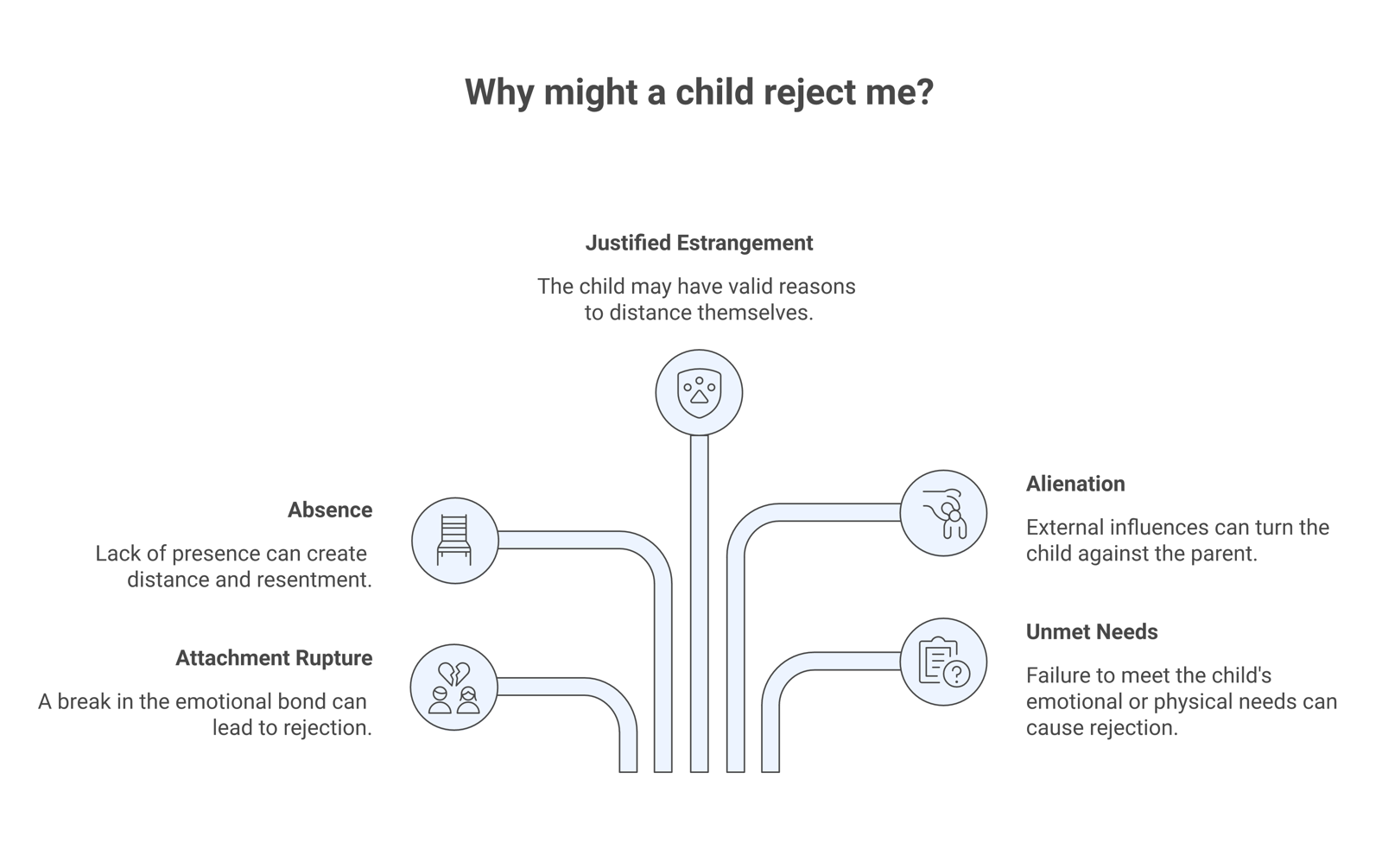
Several distinct paths lead to the same behavior. Ryan Thomas, who rejected his own father for decades before reconnecting, sorts the causes into three situations. His categories pair well with Coleman’s longer taxonomy, and together they cover most of what parents actually encounter.
Absence: a real gap in the relationship
Sometimes the rejection traces to a real gap. A parent’s long work hours, heavy travel, or emotional distance can leave a child with missed moments and real hurt. Thomas calls this the absence case. The pain is rooted in something that truly happened, not in a third party. Repair here starts with showing up, every time, without getting defensive, over a long stretch.
An incident or rupture event
Other times a single event breaks the trust. A divorce, a move, a broken promise, or a hard fight can land in a child as a betrayal. Thomas calls this the incident case. It is a rupture event, not a campaign. The child holds a story about that moment. The work is to learn the story and slowly offer a fuller one, not to argue the child out of their feelings.
Justified estrangement from abuse or neglect
In some families the child is stepping away from a parent who truly harmed them. Coleman names this path justifiable estrangement: the parent was abusive or neglectful and has not made amends. This is the caveat stated plainly at the top of this page. A child moving away from real harm is not being alienated. The child is protecting themselves, and that deserves respect, not correction. The honest line between this path and alienation is explained in the guide on estrangement versus alienation.
Developmental and loyalty dynamics
Normal growth and family pressure account for many cases too. A teenager reaching for independence may use distance as the only tool they have to pull away. Coleman calls this differentiation. He also names triangulation, where a partner or a relative forces a loyalty bind. Mental illness in a parent or child can add strain as well. These patterns are common, and they often ease as a child grows and the pressure lifts.
Alienation, or outside influence
The last path is alienation. Thomas calls it the influence case: someone has built a story against the targeted parent, run the narrative, and turned the child into a weapon. Here the parent is fighting not only the child’s anger but whoever is shaping it. Researchers Jennifer Harman, Edward Kruk, and Denise Hines argue that these alienating behaviors map onto coercive control and amount to a form of family violence. The term and its history are covered in the explainer on parental alienation syndrome.
How to tell the causes apart
Reading the cause is the hard part, and one research finding helps. Dr. Jennifer Harman draws on foster-care studies and attachment research to describe what she calls the attachment-abuse paradox. Badly abused children tend to play down the abuse, make excuses for the abuser, and still want to go back to them. Their bond survives the harm.
That pattern carries a surprising signal. Picture a child who was once close to a safe, loving parent. When that child suddenly turns on the parent with strong, fixed, all-or-nothing anger, the picture looks less like a response to abuse and more like a response to influence. Harman also points to reflexive support, where a child leaps to defend one parent the instant they sense any criticism, as a clue about who holds the controlling role.
This signal must be handled with care. It is a clue, not a verdict, and it should never be used to wave away a real abuse report. The safe approach is to take every safety worry seriously, gather facts, and bring in experts rather than to decide the answer in advance. Where real abuse exists, Harman’s guidance is to protect the child through proper channels while still speaking about the other parent with care. A child should never be told that a parent never loved them. The way rejection unfolds over time is mapped in the overview of the stages of parental alienation.
A sudden, sharp turn deserves its own close look. The case where a child’s warmth flips fast after a split is covered in the companion guide on what to do when a child suddenly hates a parent after divorce.
Why reading the cause correctly matters
Each cause points toward a different response, so a wrong reading tends to produce a wrong response. A child stepping back from real harm needs safety and support, not a push toward contact. A child reacting to absence needs steady presence over time. A child caught in a loyalty bind needs the pressure lowered, not raised. A child under steady influence needs a different kind of help again. The wrong label for any of these can deepen the rupture.
The hopeful part is that distance is rarely forever. Himlin notes that critical thinking comes fully online in adulthood. That is why many estranged bonds reopen years later, once the adult child can weigh the story for themselves. The American Psychological Association’s resources on divorce and child custody show how much a child’s adjustment depends on the adults around them staying steady.
Naming the cause is not a solo task. A parent who is unsure is better served by a clinician who can review the specifics than by settling the question alone under stress. The broader picture and the next steps live in the Learn library.
Frequently asked questions
Why is my child rejecting me?
A child can reject a parent for several reasons. It may be an attachment rupture that reads as defiance. It may be a reaction to a real gap or a painful event. It may be a normal push for independence or a loyalty bind. It may be justified estrangement from real harm, or alienation driven by outside influence. The cold surface often hides pain, not malice. Reading the cause, ideally with a clinician, is the first useful step.
Is a child rejecting one parent always alienation?
No. Alienation is one cause among several. Estrangement is the broad term for a strained or cut-off bond, and alienation is only one part of it. A child may pull away because of absence, a rupture event, a push for independence, a loyalty bind, or real abuse. Assuming alienation in every case risks missing the true cause and the right response.
What is the difference between estrangement and alienation?
Estrangement is any distant or cut-off bond between parent and child, whatever the cause. Alienation is the case where one parent turns a child against the other through influence. The key difference involves abuse. When a child pulls away from a parent who truly harmed them, that is justified estrangement, and it must never be relabeled as alienation.
Can a child reject a parent for no reason?
A child’s rejection almost always has a cause, even when it is hard to see. The cause may be a felt attachment rupture, a buried hurt, family pressure, a push for independence, or outside influence. The reason may not match what the child says out loud. A calm look at the history, often with expert help, usually reveals more than a first glance does.
How do you tell alienation from justified estrangement?
The key question is whether real harm occurred. Justified estrangement follows real abuse or neglect, and the child is protecting themselves. Research finds that abused children tend to cling to and excuse the abuser. So a sudden, strong, fixed rejection of a once safe and loving parent can point toward influence instead. That signal is a clue, not proof, and any abuse worry should be taken seriously and reviewed by experts.
What this page does not do
This page does not diagnose any child or family, and it does not decide which cause applies in a given case. It does not treat every instance of a child rejecting one parent as alienation, and it does not relabel abuse-driven estrangement as alienation. It offers no legal advice and frames none of this as a contest to win. The aim is understanding and a steady, child-centered response, worked out with qualified help. For the full library, see the Learn pillar.
The ambivalence marker
One clue helps separate coached rejection from a child’s justified pulling away. Alienation tends to show an all-good and all-bad split with almost no mixed feelings, while a child estranged by real harm usually keeps some ambivalence and proportion. Researchers describe this as a hallmark of alienation in Jaffe, Thakkar & Piron, Cogent Psychology (2017) and measure it with the Bernet et al., PARQ-Gap, Journal of Forensic Sciences (2020). The marker only raises a question, it never answers it, and it never overrides real evidence of harm. For the full comparison, see estrangement versus parental alienation.
Sources and further reading
- Harman, J. J., Kruk, E., & Hines, D. A. (2018). Parental alienating behaviors: An unacknowledged form of family violence. Psychological Bulletin, 144(12), 1275 to 1299. https://doi.org/10.1037/bul0000175
- American Psychological Association. Divorce and child custody. apa.org/topics/divorce-child-custody
If you or your child are in crisis
Free and confidential help is available right now.
- 988 Suicide and Crisis Lifeline. Call or text 988.
- Childhelp National Child Abuse Hotline. 1-800-422-4453.
- NAMI HelpLine. 1-800-950-6264.
Last reviewed: June 17, 2026. Author: Alex Buckles (PAC Founder).