

Going to family court can help or harm your child depending on the situation, how the case is conducted, and whether your child’s resistance reflects genuine alienation or a justified response to abuse. There is no guarantee either way. The honest answer is that it depends, and a child’s safety has to come first.
Read this first
A child’s resistance to a parent is not always alienation. If a child is pulling away from a parent who has been abusive, neglectful, or frightening, that distancing is a protective and justified response, not parental alienation, and pushing contact can cause real harm. If you have any concern that a child is unsafe with either parent, raise it with a professional and, where there is immediate danger, contact local emergency services or a domestic-violence resource before considering litigation.
This page is general educational information and emotional support. It is not legal advice and not clinical advice. It cannot tell you what to do in your situation. Decisions about court belong to you, working with a licensed family-law attorney and, where helpful, a qualified mental-health professional.
The honest answer: it depends, and abuse comes first
You deserve a straight answer rather than a sales pitch, so here it is. Court is a tool. In some situations it protects a child, and in others it deepens the harm. Which way it goes depends on the facts of your family, how the case is run, and one question that has to be answered before any other: is the child’s resistance a justified response to something that happened, or is it being driven by one parent’s behaviour?
That ordering is not optional. Before any court remedy that pushes contact or transfers a child, the child’s safety has to be screened. Where a child is reluctant because a parent was genuinely unsafe, the resistance is protective, and forcing contact can compound the injury. Where a child is being turned against a safe and loving parent through alienating behaviour, leaving that unaddressed has its own cost. The same courtroom can help one child and harm another. Holding both possibilities honestly is the only fair way to think about your decision.
What can make court protective for your child
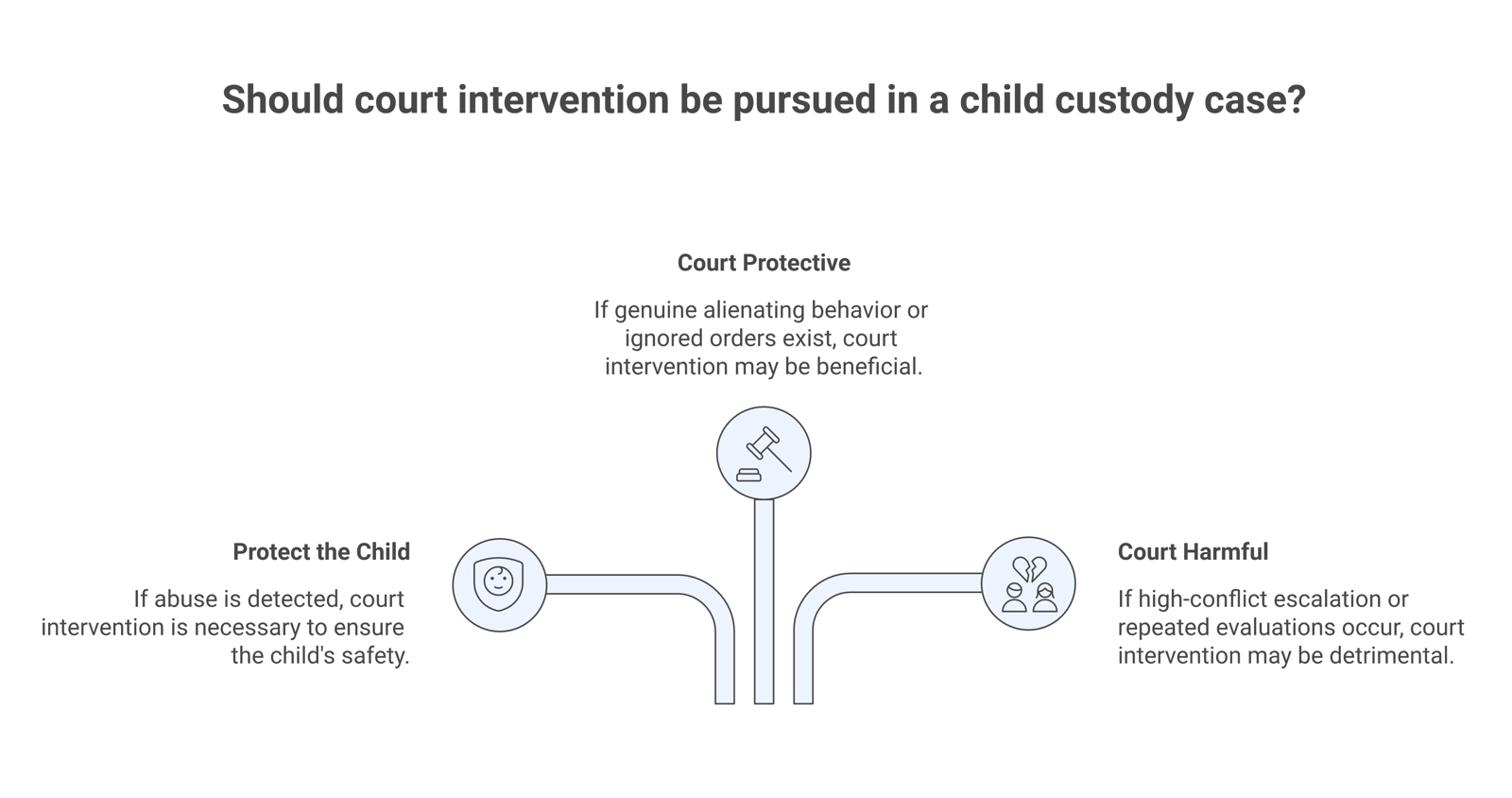
There are real situations where stepping back and doing nothing is the more harmful choice, and court becomes the protective one.
The clearest case is genuine alienating behaviour that is actively damaging a child. Research synthesized by Jennifer Harman and colleagues describes alienating behaviours as a form of family violence that can leave lasting harm when they go unchecked. If one parent is systematically undermining a child’s bond with a safe, loving parent, the harm is already happening, and an outside structure may be what interrupts it.
Court can also be protective when an existing order is being ignored. A parenting plan that exists only on paper protects no one. When a parent repeatedly blocks contact the court already ordered, an enforcement step can restore the relationship the order was meant to preserve. In these situations the question is not whether to disrupt a calm life, but whether to let an ongoing harm continue. A measured, well-prepared case, focused on documented behaviour rather than blame, is more likely to land well. The companion guidance on dealing with parental alienation and on what to do when your ex is keeping your child away covers the groundwork.
What can make court harmful for your child
The harms are just as real, and an honest page names them plainly rather than burying them.
High-conflict litigation can escalate. A custody fight can pull a child deeper into a loyalty bind, expose them to adult conflict they should never carry, and stretch over months or years of tension. Repeated psychological evaluations, interviews, and changes of plan are themselves stressful for a child, and the process can wear down both the child and the parents.
The most serious harm comes from getting the central question wrong. Where a child’s resistance is a justified response to a parent who was genuinely unsafe, a court remedy that forces contact or transfers the child can be damaging. Research by Joan Meier, published through the National Institute of Justice, found that when mothers alleged abuse, fathers’ cross-claims of alienation roughly doubled the mothers’ risk of losing custody, an effect that did not run the other way. That finding is a warning: the alienation label is sometimes used to override a real protective concern. If your child’s distancing is rooted in fear of a parent rather than in another parent’s coaching, the courtroom path that helps an alienated child can hurt yours. This is why the abuse screen comes first, every time.
The evidence on custody reversals is small, and honesty matters
In the most severe alienation cases, courts sometimes reverse custody, moving a child from the favored parent to the rejected one, often paired with a structured reunification program. Parents researching this step want to know whether it works, and they deserve an honest read of the evidence.
The honest read is that the follow-up evidence is thin. The published outcome reports come largely from the programs themselves and from small samples, not from large independent studies with comparison groups. Some clinicians report that children reconnect well after a reversal; critics point out that the evidence base lacks the rigor that would let anyone promise that result, and they raise safety concerns about forced transfers. Both points are fair. The takeaway for a worried parent is to treat custody reversal as a serious, contested intervention with a small evidence base, not a guaranteed fix. The page on what happens after custody reversal lays out what the small body of follow-up actually shows.
Keep your child out of the conflict, whatever you decide
Whatever you choose about court, the single most protective thing you can do costs nothing and is fully in your control: keep your child out of the adult conflict.
Children fare better in divorce and custody disputes when they are shielded from the details, not asked to choose sides, and not used as messengers between parents. Guidance from the American Psychological Association and the American Academy of Child and Adolescent Psychiatry points the same way: a child’s adjustment depends heavily on the level of conflict they are exposed to, more than on the legal outcome itself. You cannot control the other parent, but you can refuse to put your child in the middle. That choice protects them no matter how the case turns out.
Look after your own wellbeing too
You cannot pour from an empty cup, and a depleted parent is less able to make calm, child-centered decisions. Looking after yourself is not a luxury here; it is part of protecting your child.
The stress of a custody conflict is heavy, and many parents in this situation carry grief, anxiety, and exhaustion. Support helps. That can mean your own therapist, a support group of parents who understand the experience, and steady routines that keep you grounded through a long process. The page on coping with the grief of parental alienation speaks to that loss directly. A parent who is steadier is better placed to decide whether court is the right step and to weather it if it is.
How to think it through with a professional
This is a decision to make with help, not alone at midnight. Two kinds of professional can hold different parts of it.
A licensed family-law attorney in your area can tell you what the law actually allows in your situation, what a realistic outcome looks like, and what the process would ask of you and your child. A qualified mental-health professional can help you read your child’s resistance, separate justified rejection from alienation, and weigh the likely effect of litigation on a specific child. Bring them the real facts, ask them for the honest downside as well as the upside, and let the answer be “it depends” if that is the truth. For how courts tend to view these cases, see how do judges view parental alienation. The full Help hub collects the active-situation guidance, and the companion guide for journalists, covering parental alienation responsibly, shows how the same fairness standard applies when the topic reaches the public.
Frequently asked questions
Will going to court hurt my child?
It can help or harm a child, and there is no guarantee either way. Court can be protective when a child is genuinely being harmed by alienating behaviour or when an existing order is being ignored. It can be harmful when litigation escalates conflict, subjects a child to repeated evaluations, or forces contact where a child’s resistance is a justified response to abuse. A child’s safety has to be screened before any remedy that pushes contact.
Is family court bad for kids?
Not automatically, but it carries real risks. The biggest driver of harm to children in custody disputes is the level of conflict they are exposed to, not the legal outcome by itself. A high-conflict, drawn-out fight can deepen a child’s distress, while a measured case focused on documented behaviour and a child’s safety can be protective. Shielding a child from the adult conflict matters more than the venue.
When is going to court worth it for a child?
Court is more likely to help when a safe, loving parent is being cut off from a child through genuine alienating behaviour, or when a parent keeps breaking an order the court already made, and the harm of doing nothing is greater than the stress of the case. It is a decision to weigh with a licensed attorney and, where helpful, a mental-health professional, never a guaranteed win.
Does forcing a child to see a parent backfire?
It can, especially when the child’s resistance is a justified response to a parent who was genuinely unsafe. Forced contact or a forced transfer in that situation can deepen the harm. The evidence on custody reversals and reunification programs is small and contested, so they should be treated as serious interventions with a limited evidence base, not a sure fix. The abuse question must be answered first.
How do I protect my child during a custody case?
Keep the child out of the adult conflict. Do not ask them to choose sides, do not use them as a messenger, and shield them from the legal details. Keep routines steady, support the child’s relationship with both safe parents, and look after your own wellbeing so you can stay calm. A child’s adjustment depends heavily on the conflict they witness, which is one thing you can directly influence.
Where to go next
- For the full active-situation hub, see the Help pillar.
- For the broader playbook, see dealing with parental alienation.
- If contact is being blocked, see ex keeping child away.
- For the emotional side, see coping with the grief of parental alienation.
- For the court-side context, see what happens after custody reversal and how do judges view parental alienation.
- For the press-facing companion, see covering parental alienation responsibly.
Sources and further reading
- American Psychological Association. Divorce and child custody. apa.org/topics/divorce-child-custody
- American Academy of Child and Adolescent Psychiatry. aacap.org
- Harman, J. J., Kruk, E., and Hines, D. A. (2018). Parental alienating behaviors: An unacknowledged form of family violence. Psychological Bulletin, 144(12), 1275 to 1299. https://doi.org/10.1037/bul0000175
If you or your child are in crisis
Free and confidential help is available right now.
- 988 Suicide and Crisis Lifeline. Call or text 988. 988lifeline.org
- Childhelp National Child Abuse Hotline. 1-800-422-4453. childhelp.org
- NAMI HelpLine. 1-800-950-6264. nami.org/help
Last reviewed: 2026-06-07. Author: Alex Buckles (PAC Founder).