

This page is general information, not legal or clinical advice. It does not create a professional relationship and does not address any one state’s rules.
Alienated father help starts with the same steady steps that help any targeted parent: regulate yourself, keep a calm record, and build real support around you. You are not powerless and not alone. Fathers can and do reconnect with children who pulled away. Getting support early matters most, because isolation hits hard.
A note on abuse
A child pulling away is not always alienation. When a child distances because a parent has caused real harm, that is a protective response, and the priority is the child’s safety. This page is for fathers facing alienation, where the rejection is driven by another person’s influence rather than by abuse.
Alienated father help: you are not powerless
Alienated father help means practical support and a realistic path for a father whose child has turned away because of another person’s influence. The feeling of helplessness is common, and it is understandable. It is also, in most cases, not the full truth.
One thing worth saying plainly: alienation is not a gendered problem. Mothers alienate and fathers alienate. Fathers are alienated and mothers are alienated. This page speaks to fathers because many fathers describe a particular kind of isolation, a sense of being dismissed, told to keep paying support and wait, and quietly carrying shame that keeps them from asking for help. None of that means a father has no options. It means the options are easy to miss when you feel alone.
The reassuring part is that what helps a father is not mysterious. It is the same steady, well-documented, well-supported approach that helps any targeted parent. The rest of this page lays it out, names the myths that keep fathers stuck, and points to where the real support is.
Myths alienated fathers hear, and the reality
A few beliefs keep alienated fathers frozen, and they do their damage in private. Many fathers carry a “handle it yourself” script that turns the loss of a child into a secret, and the secret feeds the myths: each one sounds more plausible to a man who has stopped talking to anyone about what is happening. Naming them helps, because most do not hold up.
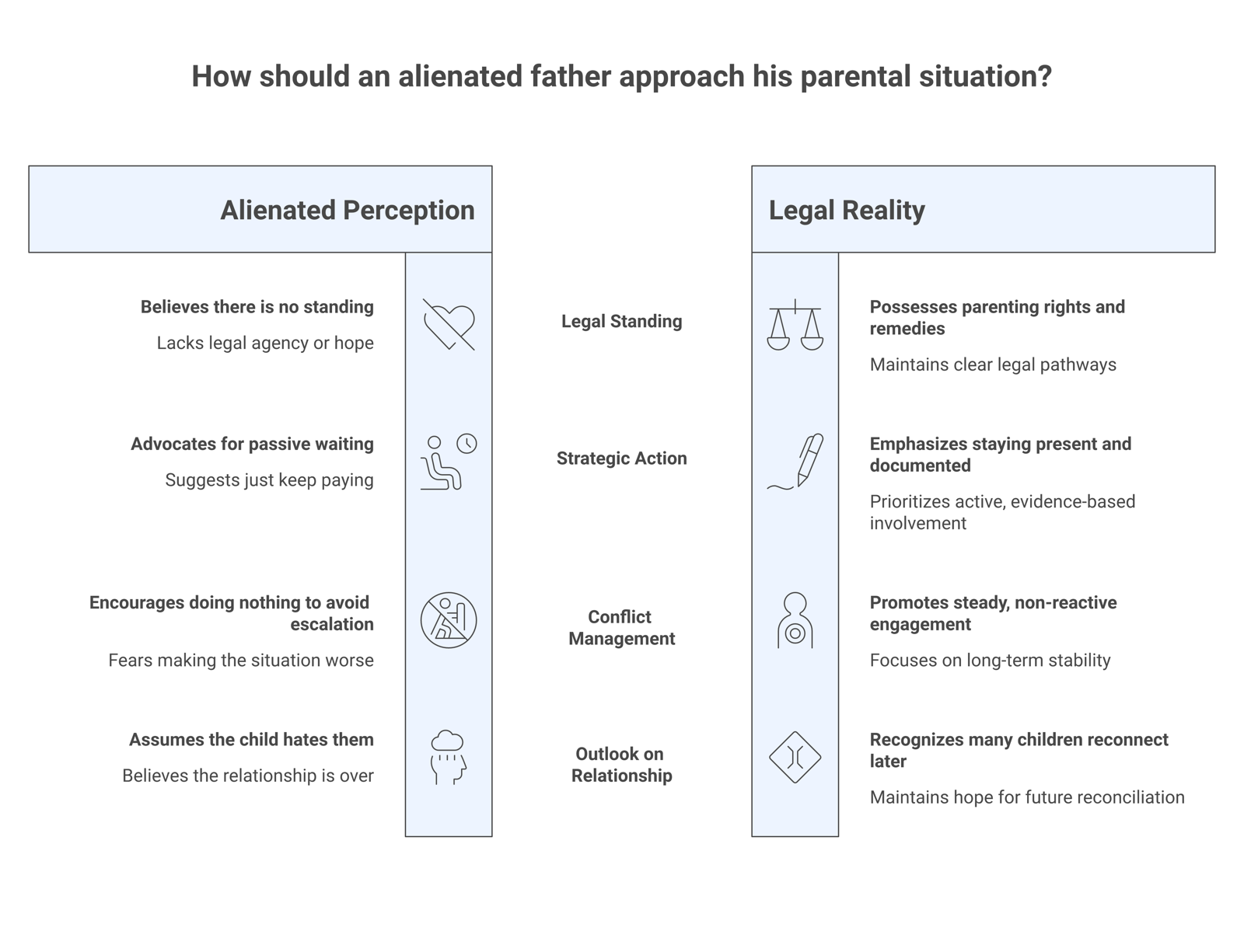
The first myth is that a father has no standing. In reality, fathers have parenting rights, and family courts have remedies when a parenting order is being broken. The law varies by place, so the specifics belong to a local attorney, but “I have no rights” is rarely accurate.
The second myth is that the job is just to keep paying support and wait it out. Paying support matters, and so does staying present in every way a court order allows. A father who quietly disappears, even out of pain, leaves a gap the alienation can fill. Staying present and keeping a record matters more than waiting.
The third myth is that any pushback makes it worse, so the safest thing is to do nothing. The goal is not silence and it is not a fight. It is steady, non-reactive engagement: showing up calmly, communicating in a business-like way, and not taking the bait. Doing nothing is not neutral; it reads as absence.
The fourth myth is the heaviest: my child hates me now, so it is over. Children who reject a parent under alienation often reconnect later, sometimes years later, when they are older and see more clearly. The door is not closed. Your job is to keep it open and be the steady parent your child can walk back to.
The steps that actually help
The playbook for a targeted father is the same evidence-grounded sequence that helps any targeted parent, and its canonical home is how to stop parental alienation: steady yourself first, keep a calm and behavior-anchored record, stay present without pressure, build real support, and bring in a family-law attorney when an order is being broken. This page does not repeat that sequence. Two parts of it land differently for fathers.
Support is the step fathers most often skip. The isolation that runs through this page makes the support step the one many fathers quietly delete from the list. A support group is usually the first thing that breaks the silence, therapy for alienated parents gives the strain somewhere to go, and some fathers add an advocate or coach for steady guidance; see what a parental alienation advocate does.
Presence reads louder than words. A father who quietly disappears, even out of pain, leaves a gap the alienation will fill with its own story. Short, warm, low-demand contact within whatever the order allows tells a child the door is open; the pace and tone are covered in how to reconnect with an alienated child. When the record matters, how to document parental alienation shows how to keep it calm and factual, and a parental alienation lawyer is the one who turns it into options where you live.
When the weight gets too heavy
Alienated fathers carry a particular kind of weight. The loss of a child, the shame that keeps it hidden, and the isolation that comes from feeling no one understands can press down hard. If you have felt that despair, you are not broken and you are not alone, and it is worth saying clearly that this pain can become dangerous if it is carried in silence.
Survivors and clinicians in this field repeat one message to targeted parents who are struggling: do not do anything to harm yourself, because your child will come looking for you one day. That is not pressure. It is hope grounded in what alienated children so often do when they grow up. If the weight is becoming too much, reach out now, to a person you trust or to the crisis line in the footer of this page. Staying here, steady and alive, is itself part of the path back.
A realistic word about outcomes
Hope and honesty belong together here. Many fathers reconnect with children who once turned away. At the same time, no one can promise a timeline or a result, and anyone who guarantees a custody outcome is not being straight with you.
Reading about alienation is a start, not a path. The forward work is staying regulated, keeping the door open, and using the right support over time, and none of it requires doing this alone, which is the trap this page exists to name. For the full sequence and the day-to-day, see how to stop parental alienation.
Frequently asked questions
What can an alienated father do?
More than the helpless feeling suggests. The full evidence-grounded sequence lives on how to stop parental alienation; the father-specific additions are refusing the isolation (a support group and a therapist before anything else) and refusing the quiet fade-out, because absence is the one thing the alienation cannot be allowed to narrate for you.
Do alienated fathers have legal rights?
Yes. Fathers have parenting rights, and family courts have remedies when a parenting order is being broken. The specifics vary by jurisdiction, which is why a licensed family-law attorney where you live, not a forum thread, is the person to ask. “I have no standing because I am the dad” is a myth, not a legal assessment.
My child says he hates me. Is it over?
No. Under alienation, a child’s stated hatred reflects the influence they live inside, not a permanent verdict. Children who rejected a father often reconnect in their late teens or adulthood, when distance gives them new eyes. Your job now is not to win the argument; it is to stay steady and keep a low-pressure door open.
Why do I feel so alone as an alienated father?
Because almost everything in the situation pushes a father toward silence: shame, the “handle it yourself” script, and advice that amounts to keep paying and wait. The isolation is common and treatable. A support group full of people who do not need convincing, plus a therapist who knows this terrain, are the fastest ways out of it.
Is parental alienation more common against fathers?
Alienation is not a gendered problem at its root: mothers and fathers both alienate, and both are targeted. What is arguably more father-specific is the isolation around it, which is why this page leans so hard on getting support early. The research picture on gender is covered at gender and parental alienation.
What this page does not do
This page does not argue that the system is rigged against fathers, and it does not coach tactics against the other parent. It does not promise a custody outcome, and it does not treat every child’s rejection as alienation. It is general information, not legal or clinical advice, and it does not address any one state’s rules. Decisions about your case belong to a licensed professional working with the real facts.
Sources and further reading
- American Psychological Association. Divorce and child custody. apa.org/topics/divorce-child-custody
- Association of Family and Conciliation Courts. afccnet.org
- 988 Suicide and Crisis Lifeline. 988lifeline.org
If you or your child are in crisis
You do not have to carry this alone. Free and confidential help is available right now.
- 988 Suicide and Crisis Lifeline. Call or text 988. 988lifeline.org
- Childhelp National Child Abuse Hotline. 1-800-422-4453. childhelp.org
- NAMI HelpLine. 1-800-950-6264. nami.org/help
Last reviewed: 2026-06-10. Author: Alex Buckles (PAC Founder). Editorial review: held to the PAC Editorial Standards (balance, primary-source citation, reader safety); an independent expert review board will be appointed.