

Can therapy help parental alienation? Yes, but only under the right conditions. Therapy can repair a damaged parent-child bond, yet ordinary counseling alone often fails when the alienating pressure continues and the child stays unprotected. The clinician must be trained for this dynamic, and protection has to come before reunification.
A note before you read
A child’s rejection of a parent is not always alienation. If the rejected parent has been abusive, neglectful, or genuinely dangerous, the child’s distance is justifiable estrangement, not parental alienation. Pushing a justifiably estranged child toward forced reunification can re-traumatize that child. Abuse-driven estrangement and alienation are clinically distinct and must never be treated the same way.
General information, not clinical advice. This page is educational. It does not diagnose any child, does not create a clinician-client relationship, and is not a substitute for care from a licensed professional who has met the family. Treatment decisions belong to a qualified clinician working with the real facts.
The short answer: yes, but with conditions
Therapy can help parental alienation, and sometimes it helps a great deal. The honest version of that answer carries conditions. Therapy tends to work when the child is protected from the alienating pressure, when the clinician is trained for this exact dynamic, and when everyone holds realistic expectations about time. Remove any one of those conditions and the same therapy can stall, or even make things worse.
Many parents picture therapy as a weekly appointment that slowly heals the rejection. That model fits ordinary family conflict. It rarely fits alienation. A child who spends one hour in a session, then returns to a home that keeps reshaping the story, arrives at the next session carrying the same load again. The hour cannot undo what the week reinstalls.
This page answers the direct question, “does therapy help,” with the caveats kept in plain view. For a fuller map of the treatment types and what each one does, see parental alienation therapy.
Why protection has to come first
The most important condition is protection. Therapy cannot treat alienation while the child is still being actively turned against the parent.
Clinical psychologist Craig Childress puts the rule in a memorable image. “You can’t fix a child in the middle of a battlefield and call it therapy,” he says. First you map the battlefield, disarm the traps, and make sure the child survives the tour. Only then can healing begin. Adult survivor and educator Maddie, who runs the Anti-Alienation Project, lived the alternative. She went through twenty years of individual therapy, reunification therapy with her father, and family therapy while still exposed to the alienating parent, and she reported that the work made the situation worse rather than better.
Family therapist Linda Gottlieb names the same sequence as protection first, reunification second. In her framework the child is protected from the alienating behavior until that parent gives it up, the same standard used in any other child-abuse case. Reunification with the targeted parent is the downstream goal, not the opening move. Reverse the order, forcing reunification while the alienating pressure runs unobstructed, and the result re-traumatizes the child and predicts failure. Gottlieb also stresses that standard talk therapy is not enough on its own. The work calls for trauma-informed therapy that helps the child reach their genuine, loving feelings again.
The reasoning rests on how serious the behavior is. Research by Jennifer Harman, Edward Kruk, and Denise Hines, published in Psychological Bulletin, maps alienating behaviors onto the recognized pattern of coercive control and treats them as a form of family violence. If the behavior is a form of abuse, then shielding the child comes first, exactly as it would with any other harm. Protection is not a punishment aimed at the other parent. It is a safety step for the child.
Which therapy fits which situation
“Therapy” is not one thing, and matching the wrong type to a case is a common way good intentions go sideways.
A useful map comes from the resist and refuse framework described by Zack and Randy Flood. A child’s refusal of a parent sits on a spectrum. At one end is estrangement, where the fear is based in real abuse or neglect. At the other end is alienation, where the refusal rests on a false story built by the other parent. Mixed and hybrid cases fall in between. The two ends call for opposite handling. Care for a genuinely frightened child moves at the child’s pace and respects the child’s voice, because that voice is grounded in reality. Care for an alienated child gently moves the child past a coached refusal. Use the wrong approach and you either re-traumatize a scared child or give in to a coached one. That risk is why a clear causation finding should come before reunification therapy, not after.
Severity matters too. Milder cases may respond to lighter-touch family work led by a trained clinician. Moderate and severe cases often need a structured, intensive reunification program paired with a protective break from the alienating parent. The full breakdown of these modalities lives on the parental alienation therapy page, and the wider sequence of steps appears in how to reverse parental alienation.
How the wrong therapist can make it worse
A warm, well-credentialed therapist with no specific alienation training is one of the most reliable ways to deepen a moderate or severe case. The reason is structural, not a matter of effort or kindness.
A generalist is trained to build trust by siding with a client’s stated feelings. With an alienated child, siding with the stated wish to reject the parent locks the rejection in place. A generalist may also accept the child’s absorbed account as plain fact and then work the wrong problem entirely. A therapist who insists on strict neutrality between the parents, in a case where one parent’s conduct meets the threshold for emotional abuse, cannot do the directive work the situation actually needs.
Several warning signs help a parent screen for fit. A clinician who promises a reunion or a firm timeline is overselling, because no honest clinician controls a child’s response. A clinician who wants to begin reunification while the child is still fully inside the alienating environment is skipping the protection step. The American Psychological Association keeps general guidance on divorce and child custody that helps parents understand the landscape, though it is not specific to alienation.
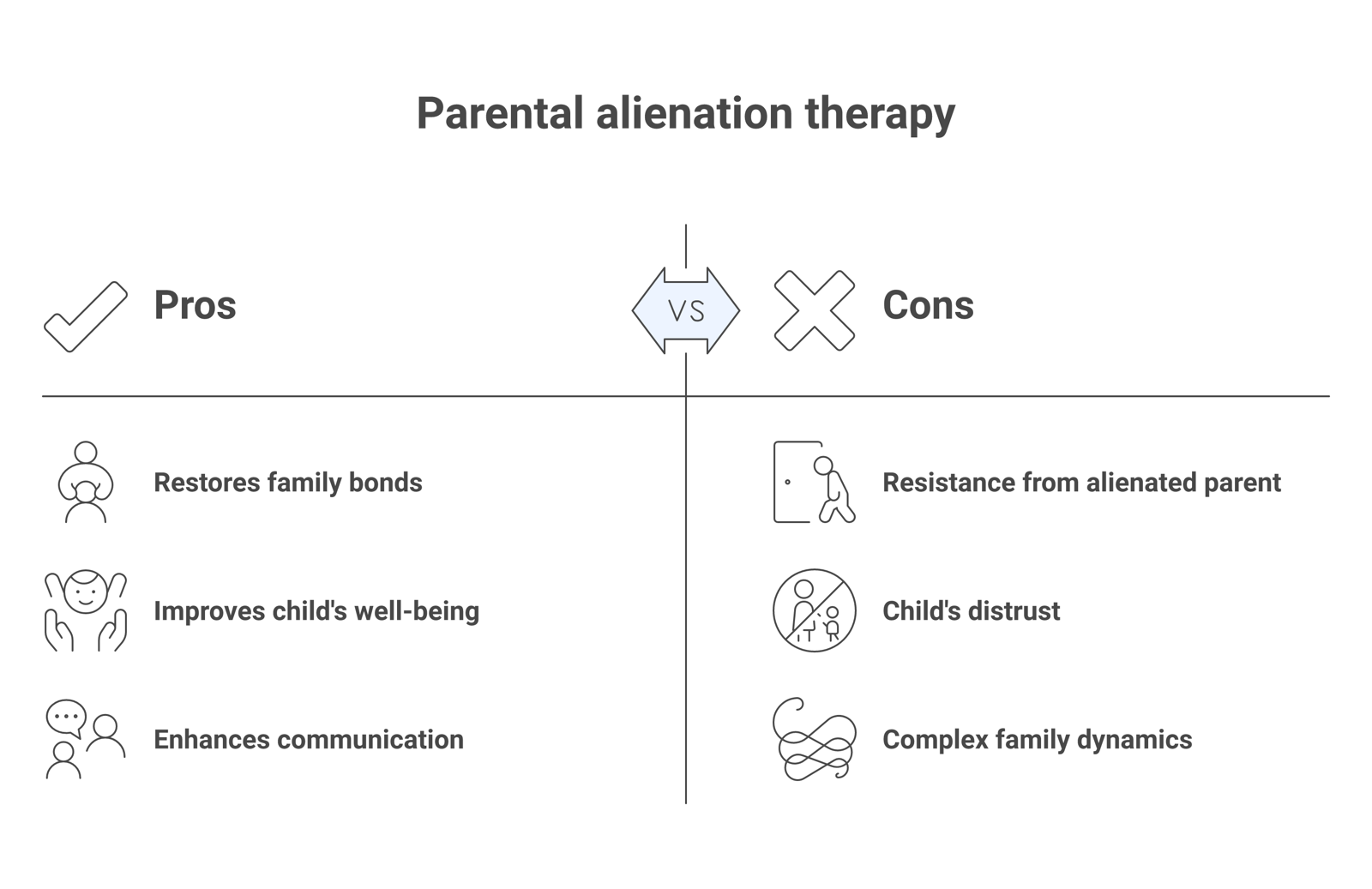
| When therapy helps | When therapy stalls or backfires | |
|---|---|---|
| Protection | Child shielded from the alienating pressure | Child stays fully exposed at home |
| Clinician | Trained in alienation and reunification | Warm generalist, no specific training |
| Therapy-to-case match | Type and approach fit the case and severity | Wrong approach for estrangement or alienation |
| Expectations | Realistic, patient, long-term | Promised reunion or fixed timeline |
What realistic expectations look like
Hope works best here when it stays honest. Therapy can do real things, and confusing what it can and cannot do sets a parent up for despair.
Cindy Hirsch, who leads a support network for alienated families, frames reconnection as a long arc rather than a quick repair. In her model nothing moves until the parent is grounded and steady, the quality she calls being a lighthouse parent, solid in any storm. Grief along the way is normal and non-linear, not a sign that something is wrong with the parent. The arc runs from alienation through reconnection and reattachment toward a stable relationship, and even after a child comes back it can take around three years to settle. Boundaries are part of that work, held as protection rather than punishment.
So a fair expectation looks like this. Under the right conditions, therapy can repair a damaged bond, give a child a safe place to question the absorbed story, change how a family functions, and keep the targeted parent steady through a long case. It cannot override a home that keeps reinstalling the rejection. It cannot work on a child who stays fully exposed to the pressure. It cannot guarantee a reunion, and it does not run on a fixed clock. Some cases shift in weeks, some take years, and some do not reverse. How long the reunification piece itself tends to take is covered in how long does reunification therapy take.
When therapy is not the right tool
One situation calls for a different response. When a child rejects a parent because that parent was genuinely abusive or neglectful, the distance is justifiable estrangement, not alienation. Pushing such a child toward “reunification” can re-traumatize the child and aims at the wrong goal. Telling alienation apart from estrangement is exactly why a careful assessment and a causation finding should come before any reunification plan. Therapy still has a role for a justifiably estranged child, though the goal becomes that child’s safety and healing, never a forced reunion. For how therapy fits inside the larger response, see parental alienation intervention and the broader Help library.
Frequently asked questions
Can therapy help parental alienation?
Yes, under specific conditions. Therapy can repair a damaged parent-child bond when the child is protected from the alienating pressure, when the clinician is trained in alienation specifically, and when expectations about time stay realistic. Ordinary counseling alone, with an untrained therapist and no protection, often stalls or makes a moderate to severe case worse. Protection comes first, and reunification follows.
Why does therapy alone often fail with parental alienation?
Because a weekly session cannot undo what the child’s environment reinstalls every day. A child who returns to a home that keeps reshaping the story carries that pressure straight back into the next appointment. Linda Gottlieb and Craig Childress both describe protection from the alienating behavior as the precondition for treatment. Without it, the therapy is working against a force it cannot match.
Can a regular family therapist treat parental alienation?
Often not well. A generalist trained to side with a client’s stated feelings can accept an alienated child’s rejection at face value and lock it in. Matching the wrong approach to the case can also re-traumatize a genuinely estranged child. The safer choice is a clinician with specific training and experience in alienation and reunification work, not a generalist learning on the case.
How long does therapy for parental alienation take?
There is no fixed clock. Some cases shift in weeks, others take years, and some do not reverse. Cindy Hirsch describes reconnection as a multi-year arc, with roughly three years to stabilize even after a child returns. Realistic expectations protect a parent from despair and keep the focus on steady, patient, long-term work rather than a fast fix.
Sources and further reading
- Childress, C. A., via Maddie (The Anti-Alienation Project). Protection-first doctrine and the battlefield metaphor: therapy cannot treat alienation while the child remains exposed.
- Gottlieb, L. Protection-first, reunification-second treatment sequence; trauma-informed therapy requirement.
- Hirsch, C. Stability-first reconnection, the lighthouse parent, and the multi-year reunification arc.
- Flood, Z., and Flood, R. Resist and refuse dynamics spectrum and the differential treatment paradigm.
- Harman, J. J., Kruk, E., & Hines, D. A. (2018). Parental alienating behaviors: An unacknowledged form of family violence. Psychological Bulletin, 144(12), 1275 to 1299. https://doi.org/10.1037/bul0000175
- American Psychological Association. Divorce and child custody. apa.org/topics/divorce-child-custody
If you or your child are in crisis
Free and confidential help is available right now.
- 988 Suicide and Crisis Lifeline. Call or text 988. 988lifeline.org
- Childhelp National Child Abuse Hotline. 1-800-422-4453. childhelp.org
- NAMI HelpLine. 1-800-950-6264. nami.org/help
Last reviewed: 2026-06-06. Author: Alex Buckles, Founder.