

A child repeating negative things about a parent can mean one of two things: a coached script borrowed from the other parent, or a genuine grievance worth hearing. Telling them apart matters. The calm response is the same start: listen for the feeling underneath, avoid counter-attacking, document what you see, and keep showing up.
A note on safety
A child’s complaint is not always coaching. If a child describes genuine abuse, neglect, or anything that makes them unsafe, that is never dismissed as parroting. A child who distances from a parent because of real harm is showing justifiable estrangement, not parental alienation. Take any abuse disclosure seriously, and report safety concerns to the proper authorities first.
This page is general education, not legal or clinical advice. It does not diagnose any child or any family. A licensed therapist or family-law professional can advise on a specific situation.
The short answer
Your child says something harsh, and the words do not sound like them. Maybe they use a phrase no eight-year-old would choose. Maybe they accuse you of something you know never happened. The first useful move is to slow down and notice which of two things you are seeing.
One possibility is coaching, where the child repeats a story shaped by the other parent. The other possibility is a real grievance, where the child is upset about something that actually happened. Researchers who study alienation point to eight behavioral signs that help separate the two, first described by Richard Gardner and now used in Dr. Amy Baker’s identification model. You do not need to label your child. You only need to respond in a way that keeps the door open.
Why a child repeats the other parent’s words
Repetition shapes a child’s brain. Bill Eddy, a clinician and attorney who studies high-conflict families, puts it plainly: neurons that fire together wire together. When a child hears “it is all your dad’s fault” over and over while feeling sad, the brain links the sadness to dad-blame. Children also copy what they see through mirror neurons, so the favored parent’s contempt gets rehearsed inside the child.
That is why borrowed words can feel so sincere. The child is often not lying in any ordinary sense. Clinician Zach Flood describes a loyalty contract, where the child internalizes one parent’s narrative as the price of staying close to them, then fills in gaps to make the story hold together. Psychologists call that gap-filling confabulation. The child believes what they are saying, so arguing with the facts rarely lands.
None of this is harmless. Researcher Jennifer Harman and colleagues, writing in the journal Psychological Bulletin, describe sustained alienating behavior as a form of coercive control and family violence. The point is not to panic. The point is to understand that the words are a symptom of pressure on the child, not a verdict on you.
Coached parroting versus a child’s genuine grievance
You can tell a lot from how the complaint behaves. The comparison below gathers the signals that tend to separate a coached script from a real concern. No single signal proves anything by itself. A pattern across several is more telling than one line on a hard day.
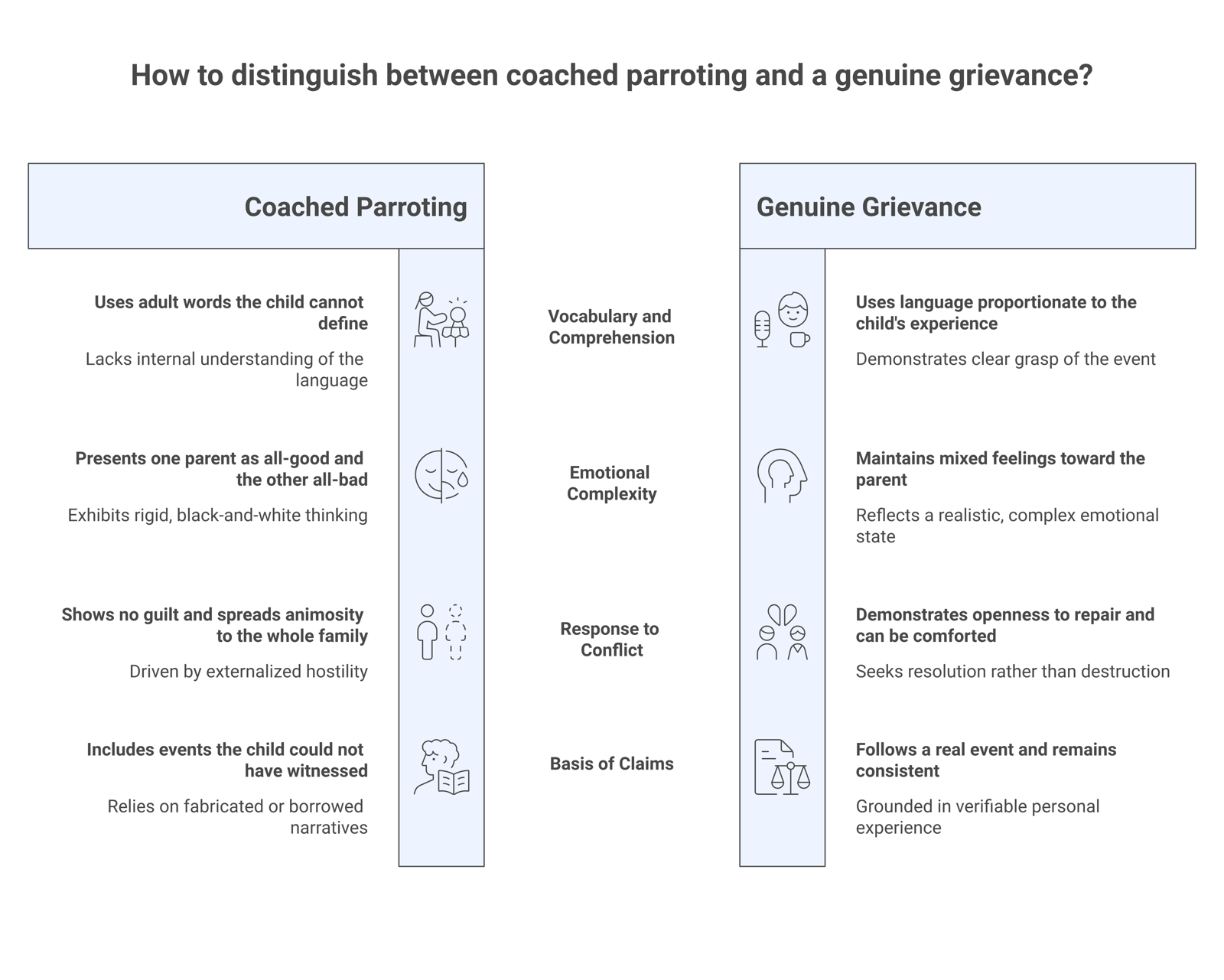
Signals that point to coaching
- The child uses adult words or legal phrases they cannot define.
- The story describes events the child could not have witnessed, or could not explain if asked.
- One parent is all-good and the other is all-bad, with no mixed feelings.
- The reasons are weak, absurd, or wildly out of proportion to the offense.
- The child shows no guilt about treating you cruelly.
- The animosity spreads to your whole side of the family, including people the child once loved.
- The child insists the views are entirely their own, that nobody influenced them.
Signals that point to a genuine grievance
- The complaint is specific and roughly proportionate to what happened.
- The child can describe the event in their own words.
- Mixed feelings remain, so love sits alongside the hurt.
- The feeling follows a real event you can identify.
- The child can be comforted and can move on.
- The grievance stays consistent whether or not the other parent is nearby.
- The child still wants things to be repaired, not erased.
A clean way to remember the difference comes from Eddy: “all human relationships are ambivalent and ambiguous.” Even children who have been badly hurt by a parent usually keep some mixed feelings. Pure, settled hatred with no nuance is the pattern that is taught. For a deeper look at recognition, see the signs your child is being manipulated by your ex guide, and for the line between the two paths, see parental alienation versus estrangement.
The “independent thinker” claim and borrowed scenarios
Two patterns show up so often they have names. Both came up in the search that brought many parents here.
The independent-thinker claim is when a child insists the negative view is entirely their own idea, that the other parent had nothing to do with it. Often they protest a little too much. One eight-year-old, quoted in the research literature, announced, “I have free will and I’ve decided I never want to see you again.” Real opinions do not usually arrive with a press release about how independently they were formed.
Borrowed scenarios are stories the child repeats using the favored parent’s words and details, sometimes about things the child never saw. Baker records a child who declared a serious accusation, then, asked what the key word meant, answered, “I don’t know but daddy did it and it’s wrong.” The child carried the sentence without carrying the meaning. That gap, between strong words and thin understanding, is one of the clearest tells.
How to respond in the moment
When the harsh words land, your nervous system wants to defend, explain, or fire back at your ex. Randy Flood offers a useful image: a riptide. Swimming straight at it exhausts you. The wiser move is to stay steady, get out of the current, and choose your direction. Here is what that looks like.
First, regulate yourself before you say anything. A slow breath buys you the half second you need. A calm parent is the most convincing evidence a child has that the scary story is not true.
Second, do not interrogate. “Are you sure? That never happened” puts the child on trial, and because they believe the story, it only digs in. A gentler question works better. Eddy suggests asking, “Where did you hear that? How often has that been said?” That invites the child to notice whether they observed something or were told it many times.
Third, do not counter-bash the other parent. Describe behavior, never label the person. “I was sad we missed our movie night” stays anchored to what happened. “Your mother is a liar” hands the other side fresh fuel and asks the child to choose. The same posture carries into every message you send, which the guide on how to communicate with a toxic ex covers in detail.
Fourth, validate the feeling without accepting the false story. You can say, “It sounds like you were really worried,” without agreeing that you did the thing. The child needs to feel heard. They do not need you to confirm a script.
Keep showing up, and document
Presence beats pressure. A child caught in the middle often feels guilt under the anger, even when the surface looks cold. Ryan Thomas, who was an alienated child himself, describes that hidden guilt as the reason a steady, low-pressure door matters so much. You are not chasing. You are remaining reachable.
So keep the rhythms small and reliable. Show up to the game. Send the goodnight text even when it goes unanswered. Save the rejected birthday gift in a box rather than reacting to the rejection. Over months, your steadiness becomes the counter-story.
Document at the same time, calmly and factually. Note the date, what was said, and what happened around it, in plain behavioral language. A record like this protects your memory and can help a professional see the pattern. It is most useful when it reads like an even log, not a case against your ex. The companion piece on what to do when an ex is keeping your child away walks through the same documentation habit for denied contact.
When to get professional help
Some of this you can hold on your own. Some of it you should not carry alone. A single rough comment after a hard week is not a crisis. A steady, escalating pattern of rehearsed hostility, especially with the all-good and all-bad thinking, is a reason to bring in skilled help.
Look for a therapist who understands alienation dynamics and high-conflict separation. Weekly talk therapy with the child alone often struggles here, because the child returns to the same pressure between sessions, so an experienced professional will think about the whole family system. Flood is blunt that home remedies rarely resolve alienation, and that building a team is part of the work. The broader dealing with parental alienation guide covers how those pieces fit together. If your child ever expresses thoughts of self-harm, treat it as urgent and use the crisis resources below.
Frequently asked questions
Why is my child repeating negative things about me?
It can be coaching or a genuine grievance. Coached parroting often uses adult words the child cannot define, describes events they could not have witnessed, and shows no mixed feelings about either parent. A real grievance is specific, proportionate, and keeps some love alongside the hurt. Looking at the pattern, rather than one comment, is what helps you tell the difference.
What are borrowed scenarios in parental alienation?
Borrowed scenarios are stories or accusations a child repeats using the favored parent’s words and details, sometimes about events the child did not see or cannot explain. They are one of the eight behavioral signs used in Baker’s identification model. The classic tell is a child stating something serious in adult language, then being unable to say what the words mean.
How do I respond when my child repeats lies about me?
Stay calm and do not interrogate or counter-bash the other parent. Validate the feeling underneath, then gently ask where the child heard it rather than denying it outright. Keep showing up, and write down the pattern in plain, factual language. If rehearsed hostility continues, involve a therapist who understands alienation.
Is my child being coached or telling the truth?
Look at the signals together. Coaching tends to bring adult language, absurd or out-of-proportion reasons, and all-good versus all-bad thinking. A genuine concern is consistent, specific, and leaves room for mixed feelings. Any disclosure of real abuse is taken seriously and is never dismissed as coaching.
Should I correct my child when they repeat something untrue?
Arguing or flatly denying usually backfires, because the child believes the story. A calmer move is to ask where they heard it and to let your everyday behavior show, over time, who you actually are. Persistent, scripted hostility is a reason to involve a qualified professional rather than to escalate at home.
What this page does not do
This page does not diagnose your child or your family. It does not tell you to dismiss a real complaint, and it never treats a genuine abuse disclosure as parroting. It does not coach you to interrogate your child or to attack the other parent. And it does not promise that a calm response will undo alienation, because outcomes depend on many things outside one parent’s control.
For the upstream pattern, see when your ex is turning the child against you. For denied contact, see ex keeping child away. The full Help silo covers the rest of the active-situation guidance.
Sources and further reading
- Harman, J. J., Kruk, E., & Hines, D. A. (2018). Parental alienating behaviors: An unacknowledged form of family violence. Psychological Bulletin, 144(12), 1275 to 1299. https://doi.org/10.1037/bul0000175
- American Psychological Association. Divorce and child custody. apa.org/topics/divorce-child-custody
- Baker, A. J. L. Four-factor model for identifying parental alienation (eight behavioral manifestations originally described by Richard Gardner). Referenced by name.
If you or your child are in crisis
Free and confidential help is available right now.
- 988 Suicide and Crisis Lifeline. Call or text 988. 988lifeline.org
- Childhelp National Child Abuse Hotline. 1-800-422-4453. childhelp.org
- NAMI HelpLine. 1-800-950-6264. nami.org/help
Last reviewed: 2026-06-07. Author: Alex Buckles (PAC Founder).