

This page is general information, not legal or clinical advice. It does not create a professional relationship and does not address any one state’s rules.
The best way to communicate with a high-conflict co-parent is to make every message brief, informative, friendly, and firm, keep the tone business-like and child-focused, move everything to one written channel, and stop responding to bait. The aim is lower conflict and a protected child, not winning the exchange.
A note on safety
High conflict is not the same as abuse. The methods here help with hostile or chaotic communication between two safe people. Where there is abuse, threats, or fear for your safety, these techniques are not a substitute for a safety plan, and you should reach out to the resources at the bottom of this page.
The best way to communicate with a high-conflict co-parent is a method
The best way to communicate with a high-conflict co-parent is to follow a repeatable method rather than searching for the right words in the heat of the moment. When messages keep blowing up, the problem is rarely a single bad sentence. It is the absence of a system. A method takes the pressure off you to perform under stress and gives you something to fall back on every time.
There is a reason tone matters more than you might expect. The high-conflict expert Bill Eddy, who studies how children absorb their parents’ emotions, points out that a child often carries the worst moment of an exchange forward as the whole truth. The tension in a message does not stay between the adults. It reaches the child. So a calmer message is not just easier on you; it protects your child from the leftover heat.
The method below has four parts: a structure for each message, a business-like tone, a single written channel, and the discipline to stop feeding conflict. None of it requires the other parent to change. That is the point. You control your half, and your half is enough to lower the temperature.
Use the BIFF structure: brief, informative, friendly, firm
The simplest tool for high-conflict messages is Bill Eddy’s BIFF method, developed at the High Conflict Institute. Every message you send can be brief, informative, friendly, and firm. Here is what each part means.
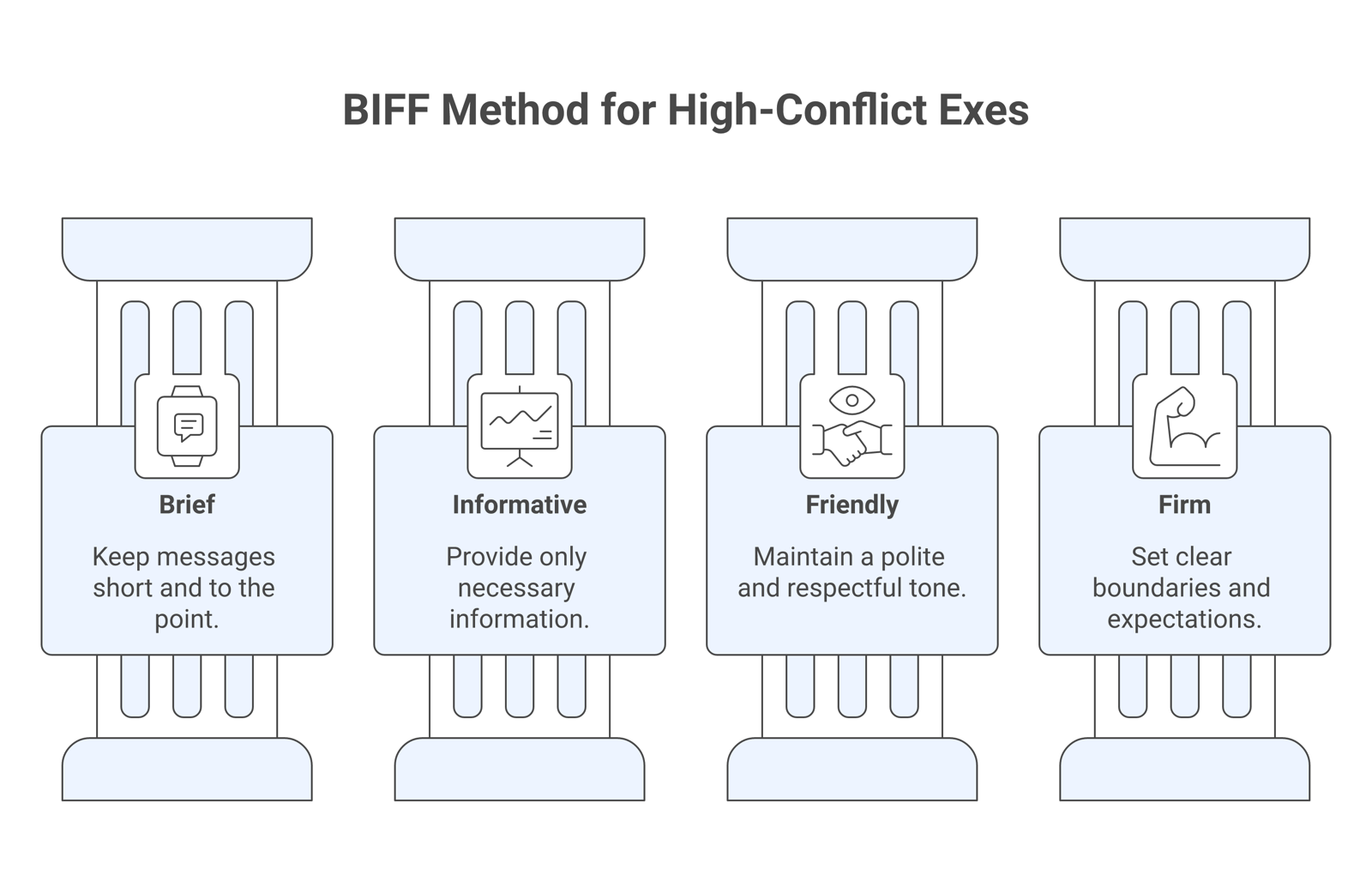
Brief
Keep it short. A few sentences, not a wall of text. Long messages invite long arguments and give the other parent more to react to. Leave out the history and the grievances. Address only what is in front of you.
Informative
Stick to facts and logistics. State the time, the place, the plan. Avoid opinions, accusations, and emotional language. A message that contains only information gives the other parent very little to fight with.
Friendly
Open and close with a neutral, civil line. Not warm, not cold. Something as plain as “Thanks for letting me know” or “Talk soon” keeps the tone from sliding into hostility. Friendly here means civil, not affectionate.
Firm
End the topic. Do not leave open hooks, questions, or invitations to keep arguing. A firm message closes the loop so the exchange does not spiral. If a decision is made, state it and stop.
Compare two messages about a swap. A reactive version reads: “You are always changing plans last minute and it is incredibly disrespectful to me and confusing for the kids, you need to stop.” A BIFF version reads: “Thanks for the heads-up. Saturday pickup at 10am works. See you then.” Same situation, far less fuel.
Keep it business-like and child-focused
The tone that works is the tone of a calm work email. Picture writing to a difficult colleague you cannot quit. You stay polite, you stay on task, and you do not take the bait, because the relationship has to keep functioning.
Bill Eddy offers a model for the steady tone in his work on co-parenting: “You don’t have to feel the same feelings as I do. You’re a separate person, entitled to your own emotions about things. I can take care of myself.” That posture, calm and self-possessed, is what you are aiming for in writing. You are not managing the other parent’s feelings, and you are not handing them yours to manage.
Keeping it business-like also protects the child directly. Children do best when the conflict between their parents stays low, as the American Psychological Association describes in its guidance on divorce and child wellbeing. Every message you keep cool is one less bit of tension your child has to absorb. For the broader cooperative approach, see healthy co-parenting strategies.
Move everything to one written channel
A structural change makes the method far easier: put all co-parenting communication in one written place. Pick a single channel, such as a co-parenting app or a dedicated email thread, and route everything through it. Stop negotiating by text, phone, and doorstep all at once.
Writing helps in three ways. It slows you down, so you answer with your thinking brain instead of your reflexes. It creates a calm, timestamped record, which matters if a court or a parenting coordinator ever needs to see the pattern. And it removes tone of voice, which is where a lot of spoken conflict ignites. The Association of Family and Conciliation Courts supports structured communication tools for exactly these reasons.
A clean written record is also useful if alienation is part of the picture. The page on how to document parental alienation explains how to keep that record in a way that informs rather than inflames. The same calm messages that lower conflict today double as a fair record later.
Stop responding to the bait
Not every message needs a reply, and not every line in a message deserves a response. High-conflict communication often contains hooks: a jab, an accusation, a demand for a reaction. The skill is to answer the part that concerns your child and let the rest go unanswered.
A simple habit helps here: pause before replying. Wait a few hours, or sleep on it, before answering anything that stings. The delay lets the urge to defend yourself fade so you can send the brief, factual version instead of the heated one. When a message is pure provocation with nothing about the child in it, the strongest reply is often a short acknowledgment or no reply at all. You are not being rude. You are refusing to feed a fight.
This is not about going silent or stonewalling on real parenting matters. Genuine logistics always get a calm, prompt answer. The disengagement is only from the bait, the parts designed to pull you into conflict that does nothing for your child.
When the method is not enough
A good method lowers conflict, but it does not cure everything. With a co-parent who has a difficult personality, the same method still helps, and you may also want the relationship-focused guidance on how to deal with a narcissistic co-parent and how to communicate with a toxic ex.
Sometimes the better structure is less contact, not better contact. If cooperation keeps failing, parallel parenting versus co-parenting explains a model that reduces direct interaction while still serving the child. And if the communication has crossed from difficult into relentless, the page on what is considered harassment by a co-parent helps you tell the difference. The goal throughout is the same: protect the child and protect your own steadiness, never win the exchange.
Frequently asked questions
What is the best way to communicate with a high-conflict co-parent?
Use a method. Make each message brief, informative, friendly, and firm. Keep the tone business-like and focused on the child. Move all communication to one written channel. And stop responding to provocations, answering only the parts that concern your child. The aim is lower conflict, not winning.
What is the BIFF method?
BIFF is a structure for high-conflict messages developed by Bill Eddy at the High Conflict Institute. It stands for brief, informative, friendly, and firm. A BIFF message is short, sticks to facts, opens and closes civilly, and closes the topic without leaving hooks for more argument.
Should I use a parenting app to communicate?
For many high-conflict situations, yes. A single written channel slows you down, removes tone of voice, and creates a calm, timestamped record. A dedicated co-parenting app or email thread keeps everything in one place, which lowers conflict and makes any future review easier.
Do I have to respond to every message from my co-parent?
No. Answer the parts that concern your child promptly and calmly, and let provocations go unanswered. Pausing before you reply, even sleeping on it, helps you send the brief, factual version instead of a heated one. Refusing to feed a fight is not rudeness.
How do I stay calm when my co-parent provokes me?
Treat each message like a work email, pause before replying, and lean on the BIFF structure so you are not improvising under stress. Remember that the tension in a message reaches your child, which gives you a reason to keep it cool. A therapist or support group can help you build that steadiness.
What this page does not do
This page does not coach manipulation or scoring points, and it does not promise the other parent will change. It does not give legal advice, and it does not treat genuine abuse or safety threats as ordinary high conflict. It is general information, not legal or clinical advice, and it does not address any one state’s rules.
Sources and further reading
- Bill Eddy, High Conflict Institute. The BIFF method for difficult communication. highconflictinstitute.com
- American Psychological Association. Divorce and child custody. apa.org/topics/divorce-child-custody
- Association of Family and Conciliation Courts. afccnet.org
If you or your child are in crisis
Free and confidential help is available right now.
- 988 Suicide and Crisis Lifeline. Call or text 988. 988lifeline.org
- Childhelp National Child Abuse Hotline. 1-800-422-4453. childhelp.org
- NAMI HelpLine. 1-800-950-6264. nami.org/help
Last reviewed: 2026-06-09. Author: Alex Buckles (PAC Founder). Editorial review: held to the PAC Editorial Standards (balance, primary-source citation, reader safety); an independent expert review board will be appointed.