
Is parental alienation admissible in court? It depends on the jurisdiction’s expert-evidence standard, Daubert or Frye, and on the specific testimony offered. Courts are split. Testimony about documented behaviors is treated more like ordinary evidence and is more often admitted. A formal “parental alienation syndrome” diagnosis faces the strongest reliability challenges, because no major diagnostic manual recognizes it.
A note on safety
A child’s rejection of a parent is not always alienation. If the rejected parent has been abusive, neglectful, or genuinely dangerous, the child’s distancing is justifiable estrangement, not parental alienation, and it is a different legal and safety matter. Courts must still screen for abuse before treating a case as alienation. If a child’s safety is at risk, contact local law enforcement or a domestic-violence resource first.
This page is general US-national education. It is not legal advice, does not create an attorney-client relationship, and does not address any one state’s evidence rules. Standards and rulings vary widely by jurisdiction. Anyone with a case should consult a licensed family-law attorney in their own state.
The short answer
There is no single national answer to whether parental alienation is admissible, because admissibility turns on two things. The first is the expert-evidence standard the court uses, which differs by jurisdiction. The second is what the testimony actually claims. A witness describing specific, documented behaviors is offering something close to ordinary evidence. A witness diagnosing a formal “syndrome” is offering an expert opinion that must clear a reliability test.
So courts split. Some admit testimony about alienating behaviors while excluding or limiting testimony that labels the situation a recognized syndrome. Others take a stricter or a looser view. As one judicial framework puts it, “labels don’t give us any basis on which to make a ruling. It’s the facts that give us that ability.” That sentence captures the practical pattern: the facts get in more easily than the label.
How courts decide what expert evidence gets in
Expert testimony is not automatically allowed. A court acts as a gatekeeper and decides whether a proposed expert opinion is reliable enough to reach the fact-finder. Two general standards govern that decision across the United States, and which one applies depends on the jurisdiction.
The Daubert standard
The Daubert standard governs expert testimony in federal court and in many states. It asks whether the expert’s methodology is reliable. Courts applying it look at factors such as whether the method can be and has been tested, whether it has been subjected to peer review and publication, the known or potential error rate, and whether it enjoys general acceptance in the relevant field. The Cornell Legal Information Institute keeps a general reference on the Daubert standard, and the rule it grew from is codified at Federal Rule of Evidence 702. Under Daubert, a method that cannot show reliable support is vulnerable to exclusion.
The Frye standard
The Frye standard is older and narrower. It asks a single main question: is the expert’s method generally accepted in the relevant scientific community? Some states still use a Frye test or a Frye-style variation rather than Daubert. Under Frye, a technique that the field has not generally accepted can be kept out, even if the expert believes it is sound. Because states differ on which standard they apply, the same parental alienation testimony can fare differently from one courtroom to another.
Why “parental alienation syndrome” draws the strongest challenges
The phrase “parental alienation syndrome” describes a proposed clinical pattern in which a child rejects one parent because of the other parent’s conduct. The trouble, for admissibility, is recognition. No major diagnostic manual lists it as a formal disorder. It does not appear as a diagnosis in the DSM-5-TR, the American Psychiatric Association’s manual, and it is not a coded diagnosis in the World Health Organization’s ICD-11. The American Psychological Association has not endorsed it as a syndrome either, and its general resources on divorce and child custody reflect that careful posture.
That lack of formal recognition gives opposing counsel a ready reliability challenge. Critics make the argument forcefully. The scholar Jean Mercer has long contended that parental alienation syndrome lacks the validation a court should require before treating it as science. The legal scholar Joan Meier, whose 2020 study for the National Institute of Justice examined how family courts handle abuse and alienation claims, raised a further concern: that alienation cross-claims can be used to discount a parent’s abuse allegations. These critiques are serious, and a court applying Daubert or Frye may well exclude testimony that presents alienation as a diagnosable syndrome. A reader weighing this should treat the construct as genuinely contested, not settled.
Syndrome claims versus behaviors-not-labels testimony
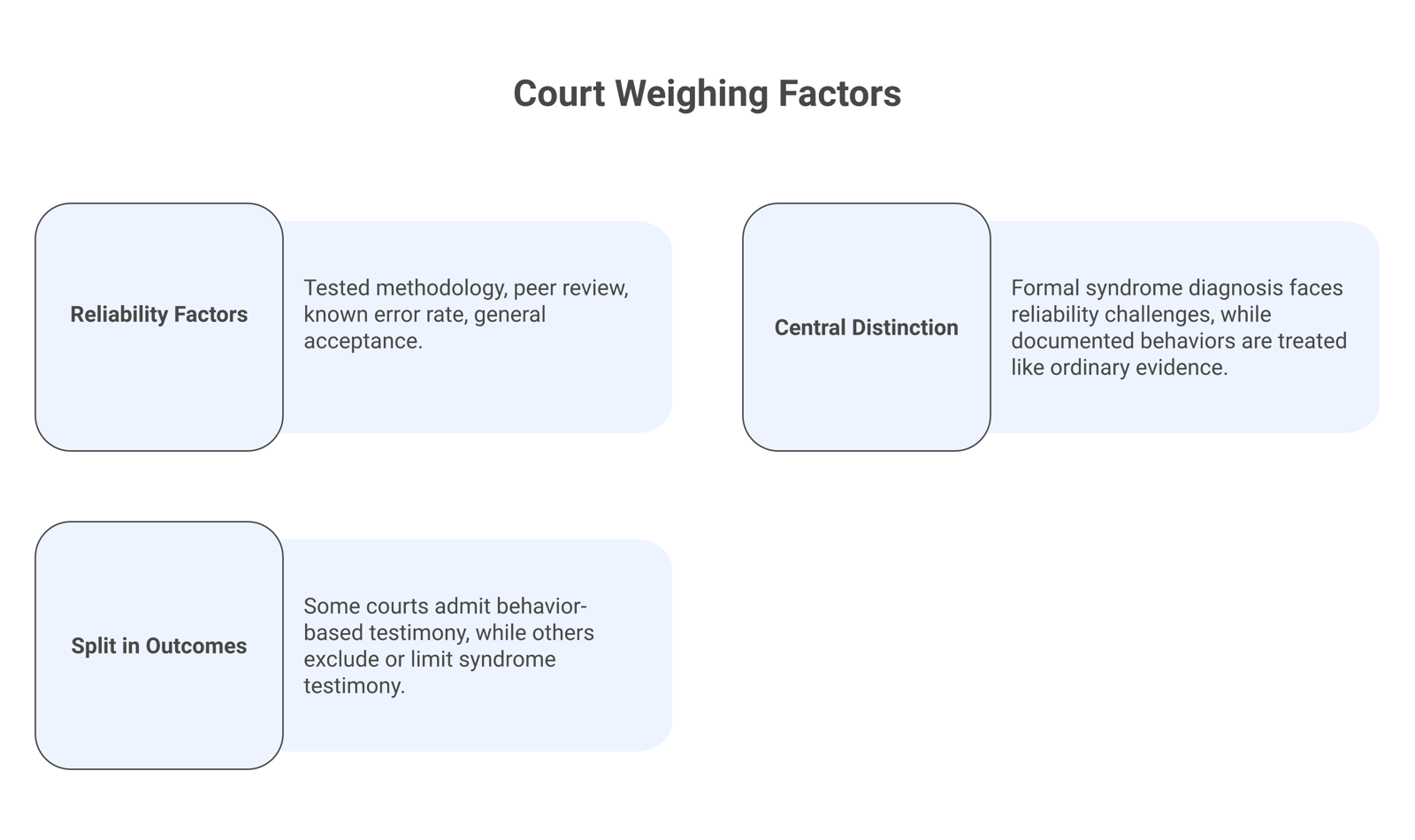
Here is the distinction that explains most of the split. There is a difference between testifying that a child “has parental alienation syndrome” and testifying that one parent repeatedly denied exchanges, deleted the other parent’s messages, scheduled activities during the other parent’s time, and coached the child to refuse contact. The first is a contested diagnostic label. The second is a description of documented conduct.
Courts have long evaluated bad behavior without requiring it to be a recognized syndrome. As litigator Ashish Joshi and Judge Jon Van Allsburg frame it, much of what gets called parental alienation is, at bottom, conduct a court can assess on the facts. In one 2020 trial, a behavior-based, multi-factor model survived a Daubert challenge and the testimony was admitted. Documentation does the work here. The evidence a parent gathers, texts, emails, calendars, and a record of denied parenting time, is the kind of proof courts handle routinely. Testimony that stays close to those facts tends to be treated more like ordinary evidence than like a novel scientific claim.
The role of a qualified expert
When an expert does testify, who they are and how carefully they speak matters a great deal. A qualified mental-health professional can help a court understand patterns without overstepping what the evidence supports. Forensic practice describes several distinct ways an expert can appear in these cases, from a court-appointed evaluator who interviews everyone to a retained expert who has reviewed only the records.
That last distinction carries an admissibility lesson. An expert who has not interviewed the alienating parent or the children should be cautious about offering a firm diagnosis, because the data to support one are absent. Testimony that respects that limit, explaining general principles and connecting them to documented facts without claiming a diagnosis the expert cannot support, is more defensible than testimony that reaches for a label. Readers researching how testimony is deployed can see the parental alienation expert witness page.
The genuine split in authority
Both lines of authority are real, and an honest page presents both. On the admission side, courts have allowed testimony about documented alienating behaviors and, in some instances, behavior-based multi-factor models that survived a reliability challenge. The reasoning is that obstructing a child’s relationship with the other parent is conduct a court can evaluate on the facts, the way it evaluates other parental conduct.
On the exclusion side, courts have kept out or sharply limited testimony framed as a “parental alienation syndrome” diagnosis, reasoning that the construct lacks the recognition and validation a reliability standard demands. The Meier study’s concern, that alienation claims can be used to deflect attention from abuse, gives some courts additional reason for caution. Neither line has erased the other. The result is a field where outcomes depend on the jurisdiction, the standard, the specific testimony, and the strength of the record. For how judges tend to approach these claims, see how judges view parental alienation, and the broader Court silo maps the rest.
What this means for a parent
The practical takeaway is calm and modest. No one should assume that testimony about parental alienation will automatically come in, and no one should assume it will automatically be excluded. The distinction that matters most is between a contested diagnostic label and documented behavior. Evidence that stays grounded in specific, recorded conduct sits on firmer ground than a claim that rests on a syndrome the manuals do not recognize.
What gets in, and how, is a question for a licensed attorney who knows the evidence rules in the relevant jurisdiction. The reliability debate itself is covered in more depth on the cross-silo is parental alienation junk science page, which weighs the scientific arguments on both sides.
Frequently asked questions
Is parental alienation admissible in court?
It depends on the jurisdiction’s expert-evidence standard, Daubert or Frye, and on the specific testimony. Courts are split. Testimony describing documented behaviors is treated more like ordinary evidence and is more often admitted. A formal “parental alienation syndrome” diagnosis faces the strongest reliability challenges, because no major diagnostic manual recognizes it. An attorney in the relevant state can explain how the local rules apply.
Is parental alienation syndrome admissible as evidence?
It faces the strongest challenges of any form of this testimony. Because the DSM-5-TR and the ICD-11 do not recognize a parental alienation syndrome, opposing counsel can argue under Daubert or Frye that it is unreliable. Some courts exclude syndrome testimony while still allowing testimony about specific, documented behaviors.
What is the Daubert standard?
The Daubert standard is a test US courts use to decide whether expert testimony is reliable enough to admit. It considers whether the method can be tested, whether it has been peer reviewed, its error rate, and whether it is generally accepted. It governs federal court and many state courts, and it is tied to Federal Rule of Evidence 702.
What is the Frye standard?
The Frye standard is an older test that asks whether the expert’s method is generally accepted in the relevant scientific community. Some states still use Frye or a Frye-style rule instead of Daubert. Because states differ, the same parental alienation testimony can be treated differently from one jurisdiction to another.
Is parental alienation junk science?
That is contested, not settled. Critics argue that parental alienation syndrome lacks formal diagnostic recognition and reliable validation, and that alienation claims can be used to discount abuse. Others argue that specific alienating behaviors are observable and can be documented like any other conduct. Courts treat the diagnostic label and the documented behaviors differently.
What this page does not do
This page is not legal advice. It does not name any one state’s evidence rulings as if they applied nationally. It does not tell readers how to get evidence admitted or how to challenge an expert. Those choices belong to a licensed attorney working with the real facts and the local rules. And the page does not take a side in the underlying scientific debate. It treats parental alienation as a contested construct, presents the admission and the exclusion lines fairly, and keeps the abuse-versus-alienation distinction explicit.
For the documentation behind behaviors testimony, see how to prove parental alienation. For how experts appear, see parental alienation expert witness. For the bench’s perspective, see how judges view parental alienation. The reliability debate lives at is parental alienation junk science, and a related enforcement question is covered at can police enforce parenting time.
Sources and further reading
- Cornell Legal Information Institute (Wex). Daubert standard. law.cornell.edu/wex/daubert_standard
- Cornell Legal Information Institute. Federal Rule of Evidence 702. law.cornell.edu/rules/fre/rule_702
- American Psychological Association. Divorce and child custody. apa.org/topics/divorce-child-custody
- Meier, J. S. (2020). U.S. child custody outcomes in cases involving parental alienation and abuse allegations (National Institute of Justice study). ojp.gov
If you or your child are in crisis
Free and confidential help is available right now.
- 988 Suicide and Crisis Lifeline. Call or text 988. 988lifeline.org
- Childhelp National Child Abuse Hotline. 1-800-422-4453. childhelp.org
- NAMI HelpLine. 1-800-950-6264. nami.org/help
Last reviewed: 2026-06-07. Author: Alex Buckles (PAC Founder).