

What is reunification therapy? It is a structured, often court-ordered counseling process that aims to repair a damaged or broken relationship between a child and a parent the child resists or refuses to see. A trained therapist works with the family. Outcomes vary, and the child’s safety always comes first.
A note on safety
A child’s rejection of a parent is not always alienation. Where a child is refusing contact because of genuine abuse or neglect, the goal is safety and the child’s own pace, not forced reunification. Abuse-driven estrangement is not alienation, and coercive reunification of a child who has truly been harmed is itself harmful.
This page is general education, not clinical or legal advice. It does not create a therapeutic or attorney-client relationship and does not address any one family’s situation. Anyone considering reunification therapy should consult a licensed clinician and, where a court is involved, a licensed family-law attorney.
What is reunification therapy?
Reunification therapy is a specialized form of family counseling. Its purpose is to rebuild the bond between a child and a parent the child has come to resist, fear, or reject. The work usually follows a high-conflict divorce or custody dispute. A family court often orders it as part of a parenting plan.
A child can pull away from a parent for many reasons. Reunification therapy is built for one specific pattern. It targets cases where a child rejects a safe, loving parent in a way that looks out of proportion to anything that parent has done. Psychologist Richard Warshak describes this as a child rejecting a parent “for no apparent good reason.” The therapy tries to restore the child’s access to their own honest feelings.
The label covers a wide range of programs. Some are gentle and slow. Others are intensive and tightly structured. They share one aim, which is a safe, working relationship between the child and the rejected parent. None can force a child to feel love on command. Good programs do not try.
What the therapy is trying to do
The goal is repair, not punishment. A skilled therapist works to lower the child’s anxiety and to ease the loyalty pressure the child feels. Many children in these cases believe they must choose one parent and reject the other. The therapy gives the child permission to care about both.
Reunification work also treats the parents as active patients, not bystanders. Psychologist Douglas Darnall built a cognitive-behavioral model around this idea. His approach separates adult grievances from parenting issues. A dispute about money or an affair is not the child’s business. Decisions about school, health, and schedules are. The therapist flags adult conflict that leaks onto the child. Both parents are asked to reconcile around a few hard realities, such as the fact that the law favors a child knowing both parents and that litigation harms children.
Who takes part
A reunification case usually involves four roles. The child sits at the center. The rejected parent, sometimes called the targeted parent, takes part in joint sessions. The favored parent is often asked to support the work, or at least not to undermine it. A specially trained therapist runs the process.
Not every counselor is equipped for this. Psychologist Mark Mosk argues that ordinary family therapy often backfires in these cases. He frames competent reunification as careful engineering rather than open-ended talk. His model rests on five pillars. The therapist should be impartial and forensically informed. A written protocol should be set in advance. The court should support cooperation and accountability. Communication should be managed with care. Goals should be measurable, with regular reports back to the court.
The main models and intensity levels
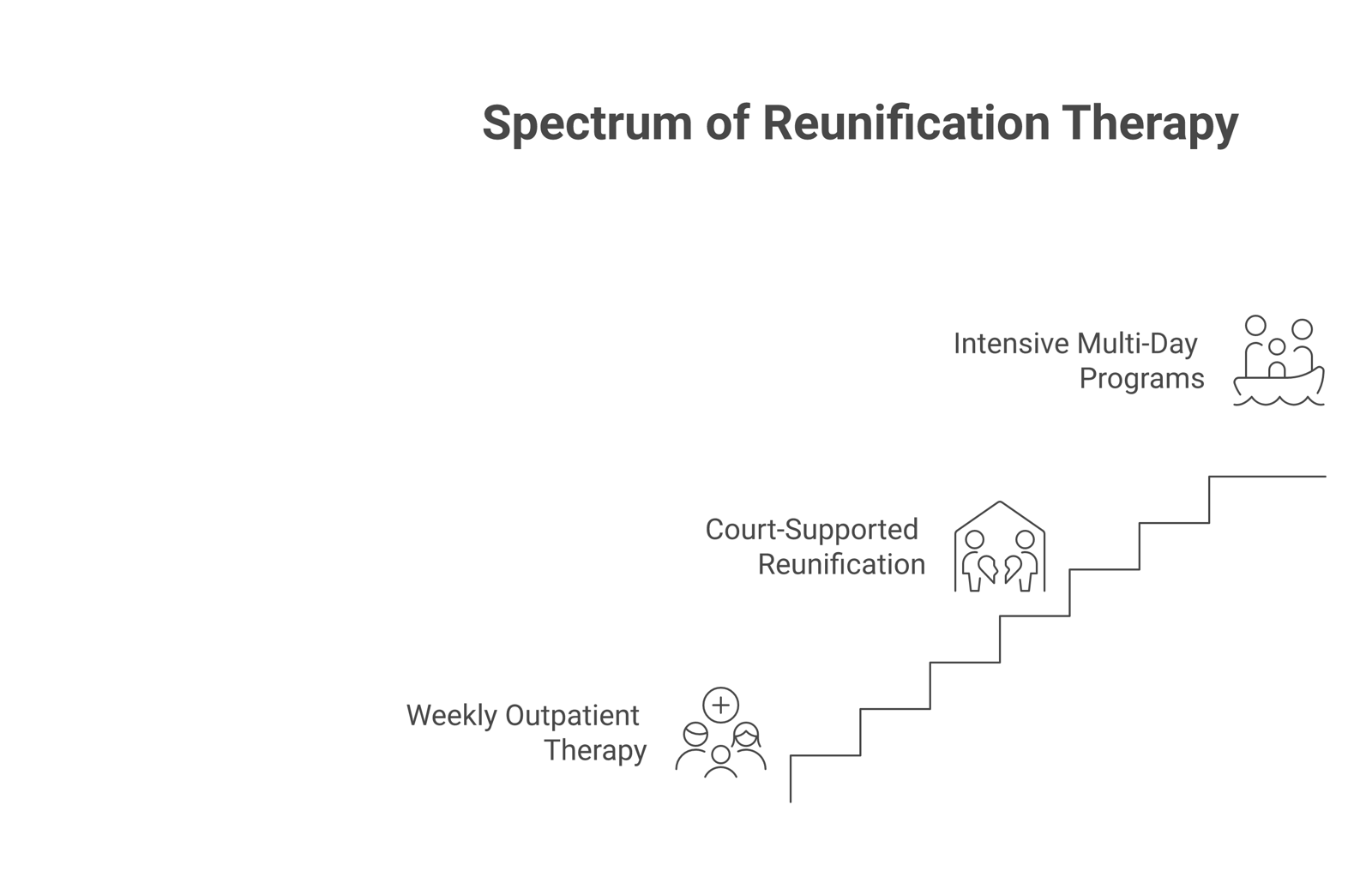
Reunification therapy is not one method. It runs along a spectrum of intensity. The right level depends on how entrenched the rejection has become. Mosk describes three rough stages. Early alienation shows up as subtle, easy-to-miss behavior. Middle alienation forms a clear pattern. Late alienation hardens into outright refusal and lasting estrangement. The deeper the stage, the more structure a case tends to need.
Outpatient family therapy
The lightest version looks like regular counseling. The family meets a therapist on a weekly or biweekly schedule. Sessions happen in an office, over weeks or months. This level suits milder cases caught early. It leans on education, communication skills, and the slow rebuilding of trust. For many families it is enough.
Structured, court-supported reunification
Moderate cases often need more scaffolding. Here the therapy follows a written protocol with clear goals and court oversight. Richard Warshak describes a graduated path he calls a reunification ladder. Contact with the rejected parent is maintained where it is safe. The court, not the child, owns the decision that contact will happen. Parent education and family therapy follow. This approach takes the weight off the child’s shoulders.
Intensive multi-day programs
The most entrenched cases are sometimes referred to intensive programs. These run over several days rather than weekly sessions. Psychologist Lynn Steinberg runs a four-day model of this kind. Programs such as Family Bridges, developed in work associated with Warshak, follow a similar psychoeducational design. They are not punishment camps, though critics have used that label. They teach children about influence, memory, and pressure, then rebuild the relationship in a focused block of time. A period of follow-up usually comes after the intensive days.
How long reunification therapy takes
There is no single answer. A mild outpatient case may settle in a few months. An intensive program runs over days, then adds months of follow-up. Severe cases can take far longer. Many clinicians describe reunification as a multi-year arc rather than a quick fix. One stability-first model suggests a relationship can take around three years to fully settle after contact resumes. Timing depends on the depth of the rupture, the cooperation of both parents, and the child’s age. For a fuller breakdown, see how long does reunification therapy take.
Protection and safety come first
Reunification is never the first priority when a child is unsafe. Clinicians who work in this field are clear about the sequence. Family therapist Linda Gottlieb teaches a protection-first, reunification-second rule. Once a court finds that a child is being harmed, the first job is to protect the child. Rebuilding the other relationship is the second job. Reversing that order tends to re-traumatize the child and predicts failure.
Some experts go further. Adult survivors and clinicians point out that therapy cannot fix a harmful family pattern while the harm continues. If a child stays fully inside the environment that caused the problem, talk therapy alone rarely helps. Protection has to come before repair. This is one reason careful screening should precede any intensive work.
The honest controversy
Reunification therapy is genuinely contested, and a balanced guide has to say so. Supporters point to programs that report strong results, with most children re-establishing a relationship. Critics raise real concerns. Some intensive programs have been accused of coercion, of overriding a child’s stated wishes, and of resting on thin independent evidence. Professional bodies such as the Association of Family and Conciliation Courts have worked to set guidelines precisely because quality varies so widely.
Two points hold the controversy together. First, outcomes vary, and no responsible provider promises success. Second, a child’s safety and a child’s voice matter throughout. A program that ignores genuine fear or forces contact at any cost is not following best practice. Researchers Jennifer Harman, Edward Kruk, and Denise Hines argue that alienating behaviors themselves can amount to a form of family violence, which is why courts treat these cases with care. Readers facing a court process can learn more through court-ordered reunification therapy, and those mapping the larger path can read how to reverse parental alienation.
When reunification is not the goal
The whole picture changes when a child’s fear is grounded in real harm. A child who avoids a parent because of genuine abuse or neglect is showing justified estrangement, not alienation. Those are different situations with different answers. In that case the goal is safety and the child’s own pace, never forced contact. Coercive reunification of a child who has truly been hurt causes more damage. A careful assessment, not an assumption, decides which situation a family is in.
Reunification therapy, used well, is one tool among several. It cannot substitute for safety, and it cannot manufacture feelings. What it can do is give a child room to rebuild a bond that conflict and pressure had frozen. For a gentler, parent-led starting point, see how to reconnect with an alienated child. For the broader basics, visit the Learn center.
Frequently asked questions
What is reunification therapy in simple terms?
It is counseling that helps a child and a rejected parent rebuild their relationship. A trained therapist guides the process, often after a high-conflict divorce. Courts frequently order it. The aim is a safe, working bond, not forced affection, and the child’s safety comes first.
Is reunification therapy always court-ordered?
No, but it often is. Some families enter it voluntarily. In many parental alienation cases a family court includes it in the parenting plan and supervises progress. Court involvement can help by taking the decision off the child’s shoulders, though it does not guarantee any particular result.
Does reunification therapy work?
Outcomes vary. Some programs report that most children re-establish a relationship, while critics note that evidence quality differs across providers. Success depends on the depth of the rupture, the cooperation of both parents, and the child’s safety. No ethical provider promises a guaranteed outcome.
What if the child is refusing because of real abuse?
Then reunification is not the goal. A child who avoids a parent because of genuine abuse or neglect is showing justified estrangement, not alienation. The priority becomes safety and the child’s own pace. Forcing contact in that situation is harmful and is not best practice.
An honest note on the evidence
An honest page also reports the disagreement among clinicians. Some experienced practitioners, including Steven Miller and Linda Gottlieb, argue that coercive or one-sided reunification approaches rest on weaker evidence than their promoters suggest, and that traditional therapy can be a poor fit for severe alienation. Read that as contested clinical opinion, not settled fact. Outcomes vary by model and by case, the strongest support is for paced, safety-screened, voluntary approaches, and genuine abuse must always be screened for before any reunification step.
Sources and further reading
- American Psychological Association. Divorce and child custody. apa.org/topics/divorce-child-custody
- Harman, J. J., Kruk, E., & Hines, D. A. (2018). Parental alienating behaviors: An unacknowledged form of family violence. Psychological Bulletin, 144(12), 1275 to 1299. https://doi.org/10.1037/bul0000175
- Association of Family and Conciliation Courts. afccnet.org
If you or your child are in crisis
Free and confidential help is available right now.
- 988 Suicide and Crisis Lifeline. Call or text 988. 988lifeline.org
- Childhelp National Child Abuse Hotline. 1-800-422-4453. childhelp.org
- NAMI HelpLine. 1-800-950-6264. nami.org/help
Last reviewed: June 17, 2026. Author: Alex Buckles (PAC Founder).