

The stages of parental alienation describe a severity gradient: mild, moderate, and severe. Mild is subtle resistance a child drops quickly during contact. Moderate adds independent criticism and borrowed stories. Severe is complete rejection that spreads to extended family. Psychiatrist Richard Gardner introduced this three-level model, and progression is driven by specific mechanisms, not time alone.
A note before you read
This gradient describes parental alienation only. If a child resists a parent because that parent was abusive, neglectful, or genuinely dangerous, the child’s distancing is justifiable estrangement, not alienation, at any level. Abuse-driven estrangement is clinically distinct and is never placed on this severity scale. This site treats that line as non-negotiable.
What “stages of parental alienation” means
The phrase points to a severity scale, not a fixed timeline. Most clinicians describe parental alienation in three levels: mild, moderate, and severe. Each level names how far the child has moved from a normal relationship with the rejected parent, and how the child justifies that distance.
Richard Gardner introduced this three-level classification in his work on parental alienation syndrome, starting with his 1985 paper and expanding it in later editions. The vocabulary has held up. Contemporary researchers still sort cases into mild, moderate, and severe, and they have sharpened the markers for each.
One distinction keeps the gradient clean. The behaviors that one parent uses are the cause. The stages describe what shows up in the child as a result. For the terminology behind that split, see parental alienation syndrome. The sections below walk each level in turn.
Mild parental alienation
Mild alienation is the first and most reversible level. The child shows some resistance to the targeted parent, but the resistance is shallow. The child may repeat a complaint borrowed from the other parent, then warm up within minutes once contact begins. The negative talk reflects the alienating parent’s words rather than the child’s own settled view.
A common marker of mild alienation is timing. The resistance often spikes right before a custody exchange, then fades. A child might protest the visit at the front door, then enjoy the afternoon without trouble. That pattern signals that the child still has a working relationship underneath the surface complaint.
At this level the child has not internalized the rejection. The bond is intact. Researchers note that mild cases respond well to early, calm intervention, because the child is reflecting pressure rather than acting on a hardened belief. Recognizing the behaviors early is the goal here, and the signs page catalogs what to watch for.
Moderate parental alienation
Moderate alienation is a clear step up. The child no longer just parrots the other parent. The child now criticizes the targeted parent independently, in their own words, and resists contact more firmly. The negative view has started to take root.
Two markers separate moderate from mild. First, lack of ambivalence: the targeted parent is described as all bad and the favored parent as all good, with no middle ground. Second, borrowed scenarios: the child reports events that did not happen to them, or could not have happened, repeated as if they were real memories.
Those false memories rarely appear by accident. Clinical psychologist Richard Warshak, in his book Divorce Poison, describes how an alienating parent can rewrite a child’s memory of the other parent. He calls the mechanism the misinformation effect: a real event, false information inserted afterward, then repetition until the distortion holds. A court-ordered vacation becomes “the time Mommy kidnapped you.” The child even adds details on later retellings. Even at this stage, researchers report that intervention can still reach the child.
Severe parental alienation
Severe alienation is the most serious level and the hardest to reverse. The child rejects the targeted parent completely. The targeted parent is seen as evil, dangerous, or unreliable, and the child refuses contact outright.
What sets severe apart is the spread. The animosity no longer stays with one parent. It reaches the rejected parent’s extended family: grandparents, cousins, aunts, and uncles. It can reach the parent’s friends and even supportive teachers. Researcher Joshua Marsden, presenting work from Colorado State University, describes severe cases where the hostility extends to nearly everyone connected to the targeted parent, and where a sibling who refuses to join the rejection becomes an outsider in their own home.
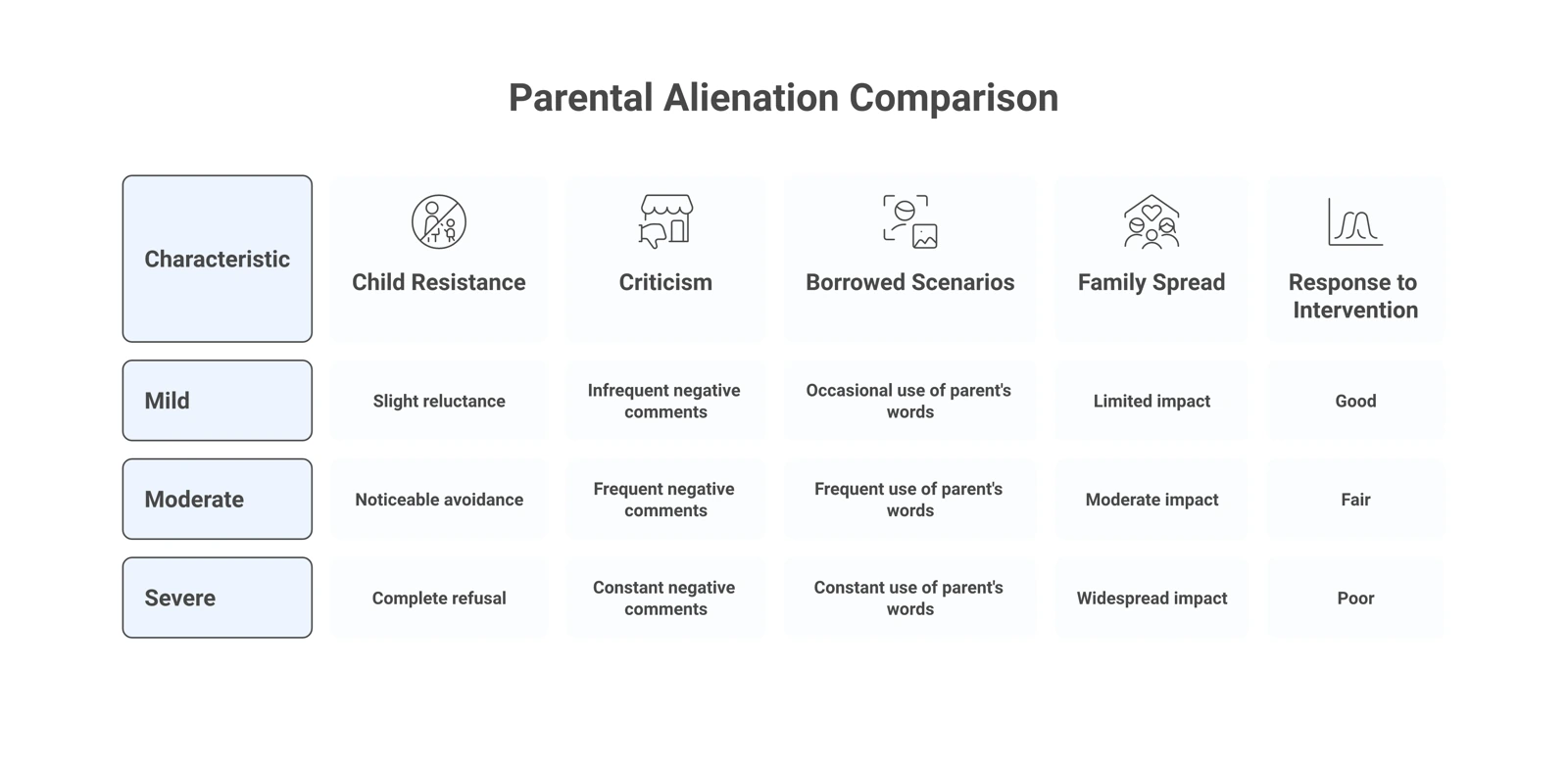
| Mild | Moderate | Severe | |
|---|---|---|---|
| Child’s resistance | Subtle, drops during contact | Firmer, sustained | Total refusal of contact |
| Source of criticism | Parrots the other parent | Independent, in own words | Fixed belief, sees parent as dangerous |
| Borrowed scenarios | Rare | Common | Entrenched |
| Spread to extended family | None | Limited | Wide (relatives, friends, teachers) |
| Response to intervention | Strong | Still effective | Difficult, specialized work needed |
The scope of severe alienation is not small. Marsden’s research places roughly four million United States children in the moderate-to-severe range, a figure he compares to the prevalence of autism. At this level the harm has already taken hold, and reaching the child takes specialized work. The lasting consequences of severe-end cases are covered on long-term effects of parental alienation.
How parental alienation escalates
A case does not climb the gradient because time passes. It climbs because of specific pressure. Two mechanisms appear again and again in the literature.
Rewriting the child’s reality
The first mechanism is the steady rewriting of the child’s reality. Warshak compares it to old propaganda methods: to turn a child against a once-loved parent, the alienating parent corrupts the record reaching back in time. The tactics include exaggeration (a tickle fight retold as an attack), outright invention, and withholding. Withholding is the most insidious. When cards, calls, and gifts are intercepted, the child sees no sign of the rejected parent’s love, feels abandoned, and drifts further away. Researcher Jennifer Harman’s 2018 review in Psychological Bulletin maps these behaviors onto coercive control and classifies them as a form of family violence.
Why cases worsen after divorce
The second mechanism is what happens after the divorce is final. A common belief holds that once the court rules, the alienation stops. In many cases it does the opposite. Two patterns drive that. In the first, the alienating parent got what they wanted in court, concludes the pressure worked, and pushes for more. In the second, the alienating parent did not get what they wanted, concludes they did not push the child hard enough, and escalates to make the arrangement fail in practice. In both patterns the child becomes the instrument. The aim is to make the child so upset that they refuse contact on their own. For steps to take as pressure rises, see how to stop parental alienation.
Keeping the gradient honest: is it alienation at all?
The severity scale only applies if the case is alienation in the first place. A child’s rejection of a parent has several possible causes, and not all of them are alienation. Before placing a case anywhere on the gradient, the case has to clear an identification test.
The most widely used test is the four-factor model from developmental psychologist Amy J. L. Baker. All four factors must be present:
- A prior positive relationship between the child and the now-rejected parent.
- Absence of genuine abuse or neglect by the rejected parent.
- The favored parent has used multiple alienating strategies.
- The child shows the behavioral signs of alienation, such as a campaign of denigration and lack of ambivalence.
The second factor is the bright line. Baker’s repeated finding is that even children who have been genuinely abused usually do not vehemently reject the abusive parent. They want repair, not severance. So a child’s total rejection, paired with substantiated abuse, points toward justifiable estrangement rather than alienation. Psychologist Joshua Coleman places alienation inside a wider estrangement landscape that also includes abuse-driven cut-offs, triangulation, mental illness, and other pathways. The gradient on this page covers the alienation pathway only.
Why stage matters for intervention
Stage matters because it shapes what is still possible. Mild and moderate cases generally respond to intervention, since the child’s underlying bond is bruised but not severed. Severe cases are harder, because the rejection has hardened into the child’s own stated belief.
That pattern argues for acting early rather than waiting. Forensic researcher Shawn Wygant’s work makes the case directly: a protective response should follow exposure to harmful behaviors, not wait for the child’s symptoms to reach the severe end. Once a case is severe, options narrow and specialized intervention is usually required. None of this guarantees a particular legal or clinical outcome, and no stage label by itself decides a case. The practical point is simpler: the earlier a real pattern is recognized, the more room there is to help the child.
Frequently asked questions
What are the stages of parental alienation?
The field describes a severity gradient with three levels. Mild is subtle resistance the child drops quickly during contact. Moderate adds independent criticism and borrowed scenarios that the child repeats as real memories. Severe is complete rejection in which the targeted parent is seen as dangerous and the animosity spreads to extended family.
Does parental alienation get worse over time?
It can, but not because of time alone. Cases escalate through specific mechanisms, including the steady rewriting of the child’s memory and the post-divorce patterns in which an alienating parent either pushes harder after winning in court or doubles down after losing.
What is the difference between mild and severe parental alienation?
Mild alienation is brief resistance the child sheds once contact begins, with the bond still intact underneath. Severe alienation is total, fixed rejection in which the child refuses contact, views the targeted parent as dangerous, and extends hostility to the parent’s relatives and friends.
Who created the mild, moderate, severe model?
Psychiatrist Richard Gardner introduced the three-level severity classification in his work on parental alienation syndrome, beginning with his 1985 paper. Contemporary researchers have refined the markers for each level but kept the three-level structure.
Can mild parental alienation be reversed?
Mild and moderate cases generally respond to early, calm intervention, because the child is reflecting pressure rather than acting on a hardened belief. Severe cases are harder to reach, which is why early recognition matters.
Where to go next
- For the broader concept and current definitions, read the Learn pillar.
- For the terminology behind the severity model, see parental alienation syndrome.
- For the behaviors that drive each stage, see signs.
- For what to do as a case escalates, see how to stop parental alienation.
Citations
- Gardner, R. A. (1985). Recent trends in divorce and custody litigation. Academy Forum, 29(2), 3 to 7.
- Gardner, R. A. (1998). The Parental Alienation Syndrome (2nd ed.). Creative Therapeutics.
- Baker, A. J. L. (2007). Adult Children of Parental Alienation Syndrome: Breaking the Ties That Bind. W. W. Norton. PubMed
- Warshak, R. A. (2010). Divorce Poison: How to Protect Your Family from Bad-mouthing and Brainwashing. Harper.
- Harman, J. J., Kruk, E., & Hines, D. A. (2018). Parental alienating behaviors: An unacknowledged form of family violence. Psychological Bulletin, 144(12), 1275 to 1299. https://doi.org/10.1037/bul0000175
- Marsden, J., et al. (2025 conference presentation, PASG). Inter-sibling alienation and operational severity definitions. Parental Alienation Study Group conference proceedings.
- American Psychological Association. (n.d.). Divorce and child custody. apa.org/topics/divorce-child-custody
- Coleman, J. (2021). Rules of Estrangement: Why Adult Children Cut Ties and How to Heal the Conflict. Harmony.
If you or your child are in crisis
Free and confidential help is available right now.
- 988 Suicide and Crisis Lifeline. Call or text 988. 988lifeline.org
- Childhelp National Child Abuse Hotline. 1-800-422-4453. childhelp.org
- NAMI HelpLine. 1-800-950-6264. nami.org/help
Last reviewed: 2026-06-05. Author: Alex Buckles (PAC Founder).