
Is there a parental alienation diagnosis? Parental alienation is not a standalone diagnosis in the DSM-5 or the ICD. No manual lists it as a disorder. Experts disagree about whether it should be. Clinicians instead describe the harm using coded constructs like child psychological abuse and relational problems.
A note on safety
The diagnosis debate must never be used to dismiss a child’s justified estrangement from an abusive parent. When a child pulls away from a parent who has been abusive, neglectful, or frightening, that distancing is a reasonable response, not parental alienation. A child’s safety always comes first. If a child is in danger, contact local emergency services or a child-abuse hotline before anything else.
This page offers general information, not clinical advice. It does not diagnose any individual, and it cannot replace an evaluation by a qualified professional. Anyone worried about a child or a family relationship should speak with a licensed clinician.
Is parental alienation a diagnosis?
A parental alienation diagnosis does not exist as a formal category. Clinicians name mental health conditions using two manuals. One is the DSM-5, published by the American Psychiatric Association. The other is the ICD, maintained by the World Health Organization. Neither book lists parental alienation as a disorder, a syndrome, or a billable diagnosis.
This surprises many people. The term appears in courtrooms, news stories, and therapy offices. It sounds official. A clinician still cannot open either manual and find it. There is no diagnostic code that reads “parental alienation.”
The absence of a label does not settle the deeper question. A pattern can be real and harmful without sitting in a manual as its own category. Researchers have documented serious harm to children caught in these dynamics. The argument is about naming and classification, not about whether children get hurt. The rest of this page from the Learn library explains what a diagnosis means, why the term is missing, and what clinicians write down instead.
What a diagnosis means in the DSM-5 and the ICD
A formal diagnosis is a defined category with stated criteria. A clinician checks a person’s symptoms against that list. When enough criteria are met, the condition can be named, coded, and billed. The two manuals exist to make this process consistent across providers and countries.
The DSM-5 is the reference most United States mental health professionals use. The American Psychiatric Association reviews proposals, weighs the evidence, and decides what enters each edition. Inclusion requires a clear definition and a body of research that supports it as a distinct condition.
The ICD plays a similar role worldwide. It codes diseases and health conditions for record-keeping, research, and insurance. Both manuals are revised over years, not months. Getting a new category accepted is slow and demanding by design.
Both manuals also contain entries that are not mental disorders. These describe situations that may bring a person into care, such as relationship problems and abuse. That distinction matters here, because it is where the harm behind parental alienation usually gets recorded.
Why parental alienation is not in the manuals
Supporters of recognition have tried to add it. During the development of the DSM-5, a group of researchers proposed including parental alienation as a disorder or relational problem. The proposal was reviewed and was not accepted. The committee concluded that the evidence and the definition were not settled enough for a standalone category.
The reasons given track a long-running scientific debate. Some reviewers felt the concept lacked a single agreed definition. Others worried it could be misapplied in custody disputes. The decision did not declare parental alienation fake. It declined to certify it as a formal diagnostic category at that time.
This history connects to an older idea called parental alienation syndrome, proposed in the 1980s and widely criticized. The label and the science around it have shifted since then. Readers who want that fuller backstory can see parental alienation syndrome, which traces the construct and the controversy over its name.
The debate over whether it should be a diagnosis
The field does not speak with one voice. Law professor Nicholas Bala, a longtime judicial educator, maps the disagreement into three broad camps. His framework is a useful way to stay balanced, because each camp argues in good faith from different evidence.
The first camp is the traditional research group, associated with the Parental Alienation Study Group. It treats parental alienation as a definable child problem and continues to press for formal recognition in the manuals. This camp points to diagnostic models and measurement tools developed over decades.
The second camp is critical and reform-minded. It argues that parental alienation is unscientific and that the label can be misused, especially to discount real abuse claims. Voices in this camp have driven legislative pushback in several countries. They warn that a diagnosis could do more harm than good.
The third camp sits in the middle. Clinicians and researchers such as Janet Johnston, Joan Kelly, and Bala himself treat alienation as one concept among several, including affinity, alignment, and justified estrangement. This group sees most cases as multifactorial. It resists a single test and favors case-by-case judgment. The honest summary is that no consensus exists, which is precisely why no manual has adopted the term.
How clinicians describe it instead
When a clinician believes a child is being harmed, they still need language that a manual recognizes. So they reach for coded constructs that already exist. The most relevant one is child psychological abuse, which both major manuals address as a condition that may be a focus of clinical attention.
Psychologist Craig Childress is one prominent advocate for this approach. In his attachment-based model, a child who rejects a previously loved parent without legitimate cause, paired with specific family features, may meet the standard for child psychological abuse rather than any “alienation” label. Childress and colleagues point to the DSM-5 child psychological abuse designation, referenced in his work as code V995.51. The clinical reviewer of record should confirm the exact current code and its crosswalk before publication.
Other coded options describe the relationship rather than abuse. Manuals include parent-child relational problem codes and entries for a child affected by family distress or disruption. These do not name a villain. They record that a relationship is impaired and that the child is being affected by it.
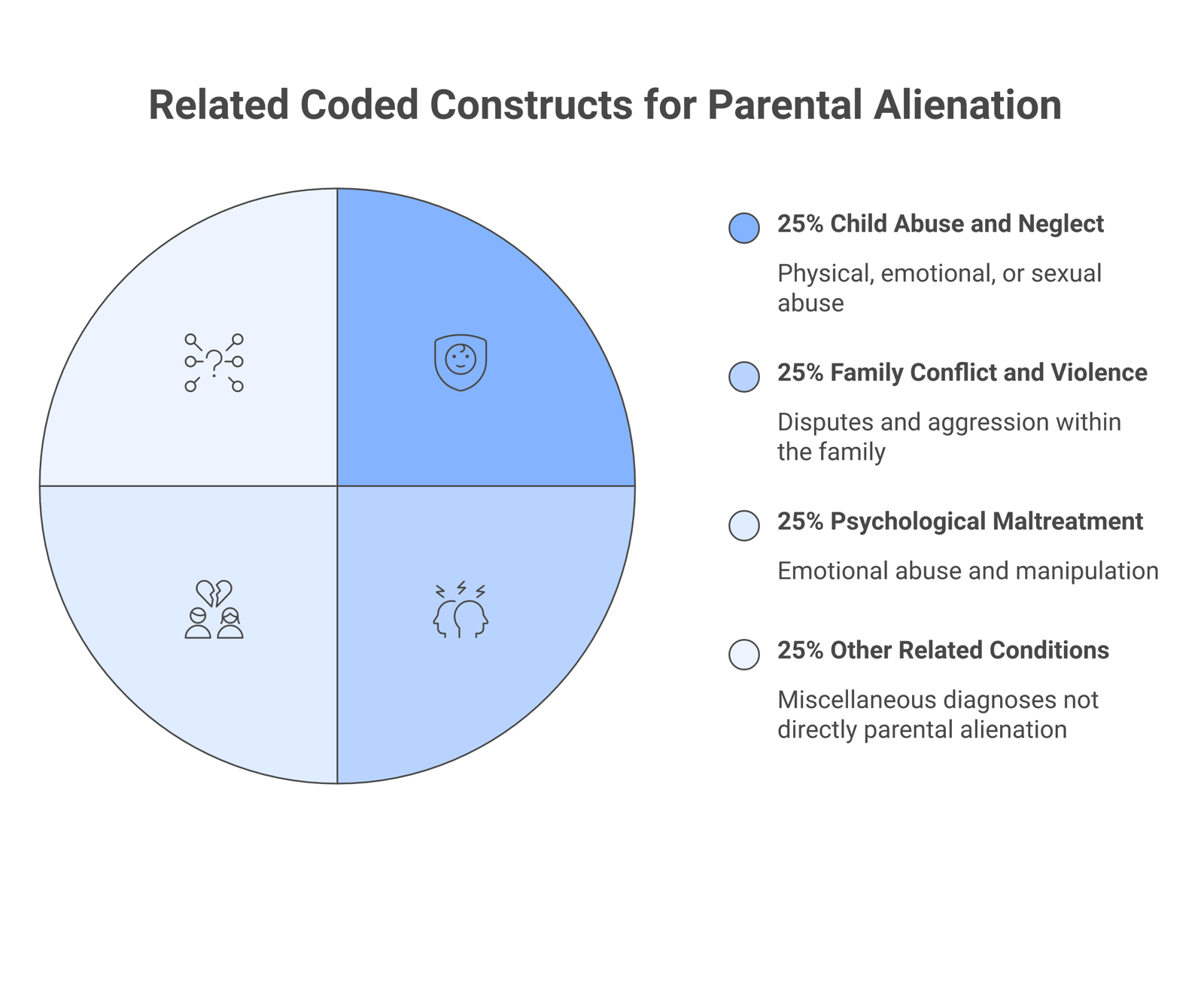
None of these codes is a perfect fit. Each captures part of the picture. A clinician chooses based on the specific facts of the family in front of them. The harm itself is well documented. Researchers Jennifer Harman, Edward Kruk, and Denise Hines describe parental alienating behaviors as a recognized pattern of coercive control. The behavior can be named in the research even where a single diagnostic label is not. For the broader harm framing, see parental alienation emotional abuse.
Why some experts prefer clinical language over the label
Some practitioners argue that the missing diagnosis is not a problem to solve but a prompt to use better words. Childress goes further than most. He calls “parental alienation,” “resist-refuse dynamic,” and “parent-child contact problem” euphemisms that hide child abuse from a court’s view. His position is that professionals should use the recognized child psychological abuse language instead.
A similar argument comes from the legal side. Robert Hoffman, a board-certified Texas family-law attorney, frames these matters as clinical, medical, and child-abuse cases rather than ordinary custody fights. In his view, precise clinical language built on recognized constructs is more defensible than a contested label. He treats the case like a medical case, not a name-calling contest.
There is a counterargument, and it deserves equal weight. Critics note that swapping in “child psychological abuse” presumes a conclusion that has not been proven in a given case. They caution against any framing that could be used to win an argument rather than to help a child. The balanced takeaway is simple. Clinical language can be more rigorous, and it can also be misused, so it calls for care. Clinicians who want a structured approach can review identifying parental alienation.
Diagnosis versus a child’s justified estrangement
The diagnosis question carries a real risk. A label, or the search for one, can be turned against a child who has good reason to keep distance. This is the most important caution on the page.
Careful models build in a safeguard. In Childress’s framework, the rejected parent must be assessed as broadly normal-range before alienation is even considered. If that parent has been abusive or neglectful, the clinical picture is entirely different. The child’s distancing is then justified estrangement, a healthy and protective response, not a disorder to be corrected.
This is why responsible clinicians resist quick labels. A child pulling away may be alienated. That same behavior may instead be a sane reaction to a parent who caused harm. The two look similar from the outside and require very different responses. Telling them apart is slow, evidence-based work, and it is never a reason to override a child’s safety. The way the pattern can build over time is covered in stages of parental alienation.
Frequently asked questions
Is parental alienation a diagnosis in the DSM-5?
No. Parental alienation is not a standalone diagnosis in the DSM-5. A proposal to include it during the manual’s development was reviewed and was not accepted, because reviewers found the definition and evidence were not settled enough for a distinct category. Clinicians who see harm use other recognized constructs, such as child psychological abuse, instead.
Is parental alienation in the ICD?
No. The ICD, maintained by the World Health Organization, does not list parental alienation as a disease or disorder. The manual does include related codes for caregiver-child relationship problems and for children affected by family distress. Those codes describe an impaired relationship, which is not the same as recognizing parental alienation as its own diagnosis.
What diagnosis do clinicians use for parental alienation?
There is no “parental alienation” code, so clinicians use constructs that already exist. When the facts fit, they may document child psychological abuse, a parent-child relational problem, or a child affected by family disruption. The choice depends on the specific family and on a careful assessment, not on the label alone.
Will parental alienation ever be added to the DSM?
It is genuinely uncertain and openly debated. One camp of researchers continues to push for recognition and points to diagnostic models and measurement tools. Another camp argues the concept is not scientifically settled and could be misused. A third treats it as one factor among several. No consensus exists, so no near-term change is assured.
Does not having a diagnosis mean parental alienation is not real?
No. A pattern can be real and damaging without being a named diagnostic category. The harm to children is documented in the research literature, including work describing parental alienating behaviors as a form of coercive control. The debate is about how to classify and name the harm, not about whether children are affected by it.
Sources and further reading
- American Psychiatric Association. DSM. psychiatry.org/psychiatrists/practice/dsm
- American Psychological Association. Divorce and child custody. apa.org/topics/divorce-child-custody
- Harman, J. J., Kruk, E., & Hines, D. A. (2018). Parental alienating behaviors: An unacknowledged form of family violence. Psychological Bulletin, 144(12), 1275 to 1299. https://doi.org/10.1037/bul0000175
- American Psychiatric Association. Diagnostic and Statistical Manual of Mental Disorders, Fifth Edition (DSM-5). Cited by name as the standard United States diagnostic manual.
- World Health Organization. International Classification of Diseases (ICD). Cited by name as the standard international diagnostic manual.
If you or your child are in crisis
Free and confidential help is available right now.
- 988 Suicide and Crisis Lifeline. Call or text 988. 988lifeline.org
- Childhelp National Child Abuse Hotline. 1-800-422-4453. childhelp.org
- NAMI HelpLine. 1-800-950-6264. nami.org/help
Last reviewed: 2026-06-06. Author: Alex Buckles (PAC Founder).