

This page is general information, not legal advice. It does not create an attorney-client relationship, and it does not address any one state’s mediation rules. Anyone heading into custody mediation should consult a licensed family-law attorney in their own jurisdiction.
What not to say in child custody mediation comes down to one idea. The words that hurt a parent most are the ones that sound vengeful, vague, or all about the parent rather than the child. Calm, factual, child-focused language lands far better. Here is what to avoid and what to say instead.
A note on safety
This guide is about tone and word choice, not about hiding real concerns. Genuine safety worries should be raised clearly and with the right people: a lawyer, the mediator, or local authorities. Where there has been abuse or coercive control, mediation may not be appropriate at all, and a parent should say so plainly rather than soften it.
What not to say in child custody mediation, in one sentence
A mediator is a neutral helper. Their job is to guide two parents toward a workable plan for the child, not to decide who is right. That single fact changes what good language sounds like in the room. The Cornell Legal Information Institute explains mediation as a voluntary, structured negotiation, not a trial.
So the words that backfire are the ones that treat mediation like a battle. Labels, threats, put-downs, and self-pity all signal conflict, and conflict is the very thing the process is trying to lower. Calm, specific, child-centered words signal a parent the other side can work with. Preparation helps a great deal here, which is why it pairs with how to prepare for child custody mediation.
Avoid labels and diagnoses (“narcissist,” “alienator”)
Many parents walk in ready to name what the other parent is. “He is a narcissist.” “She is an alienator.” These words feel true and they feel powerful. They also give a neutral almost nothing to work with.
Courts and neutrals respond to documented facts, not to diagnostic labels. One judicial standard, described by Joshi and Judge Van Allsburg, puts it plainly: labels do not give a decision-maker any basis to act, while facts do. A diagnosis is a conclusion. A mediator cannot verify it, cannot act on it, and may quietly read it as a sign the speaker is more focused on the fight than the child.
The fix is to swap the label for the behavior behind it. Instead of “he is a narcissist,” try “the last three exchanges started forty minutes late, and I have the dates.” Instead of “she is alienating the kids,” try “our daughter has missed two scheduled calls this month.” Specific, dated, neutral. For the deeper version of this point, see how to deal with a narcissistic co-parent. If a real diagnosis or pattern matters to a legal strategy, that belongs with a lawyer, covered in what to tell your lawyer about parental alienation.
Avoid threats, ultimatums, and badmouthing
Threats and ultimatums rarely move a mediation forward. “I will take you back to court.” “You will never see them again.” “Agree to this or else.” Each line reads as the conflict the mediator is trying to reduce, and each one tends to harden the other parent rather than soften them.
Badmouthing has the same effect. A running list of the other parent’s faults may feel like building a case. To a neutral, it often reads as a parent who cannot separate their own anger from the child’s needs. Stress makes this harder. A useful frame describes the four A’s of a parent under pressure: angry, anxious, agitated, and afraid. Any of the four can leak into a voice and read badly, even when the underlying point is fair.
The reframe is to describe the issue, not attack the person. Rather than “you are impossible to deal with,” try “scheduling has been hard, and a shared calendar might help.” Rather than a threat, state a need and a proposal. Keeping that calm tone under provocation is its own skill, explored in how to communicate with a toxic ex.
Avoid making it about you instead of the child
Mediation about a child is, in the end, about the child. Language that keeps circling back to the parent tends to land flat. “I deserve more time.” “It is not fair to me.” “I am the one who sacrificed.” These may all be true, and they still miss what a neutral is weighing.
The center of gravity should be the child’s wellbeing, not the parent’s grievance. A simple test helps before speaking: does this sentence describe what the child needs, or what the parent wants? Both can be real, but the first one carries more weight in the room.
So the reframe anchors each point to the child. Instead of “I deserve weeknights,” try “our son does homework better at my place on school nights, and here is why.” Instead of “it is not fair to me,” try “the current schedule means he changes homes mid-week, and a steadier routine would help him.” The American Psychological Association’s guidance on divorce and child custody underscores how much a child-centered focus matters to their adjustment.
Avoid lying, exaggerating, or dragging in old grievances
Exaggeration is tempting and costly. Saying the other parent “never” shows up, when the records show they usually do, hands the other side an easy correction and quietly damages a parent’s credibility. Once a neutral catches one stretch, every later point gets weighed more skeptically.
Old grievances do similar harm. The affair, the money fights, the wedding ten years ago: these may still sting, and they pull the conversation away from the only question that matters now, which is what works for the child going forward. Mediation is not the place to settle the marriage.
Honesty and restraint protect a parent more than any clever line. Sticking to what is accurate, recent, and relevant keeps the focus where it belongs. It also matters because words in a custody process can resurface later, a point covered in what can be used against you in child custody.
What to say instead, and how to stay calm
Good mediation language shares a few traits. It is specific and dated rather than sweeping. It describes behavior rather than character. It anchors to the child rather than the parent. It proposes rather than demands. And it stays brief, because short and calm is easier to hear than long and heated.
Staying calm under pressure is a practice, not a personality trait. One helpful frame is “I over E,” intellect over emotion: when feelings spike, let the thinking part lead the response. That can mean pausing before answering, taking a slow breath, asking for a short break, or simply repeating the proposal rather than rising to a jab. None of this means suppressing real feeling. It means choosing words that serve the child instead of the moment.
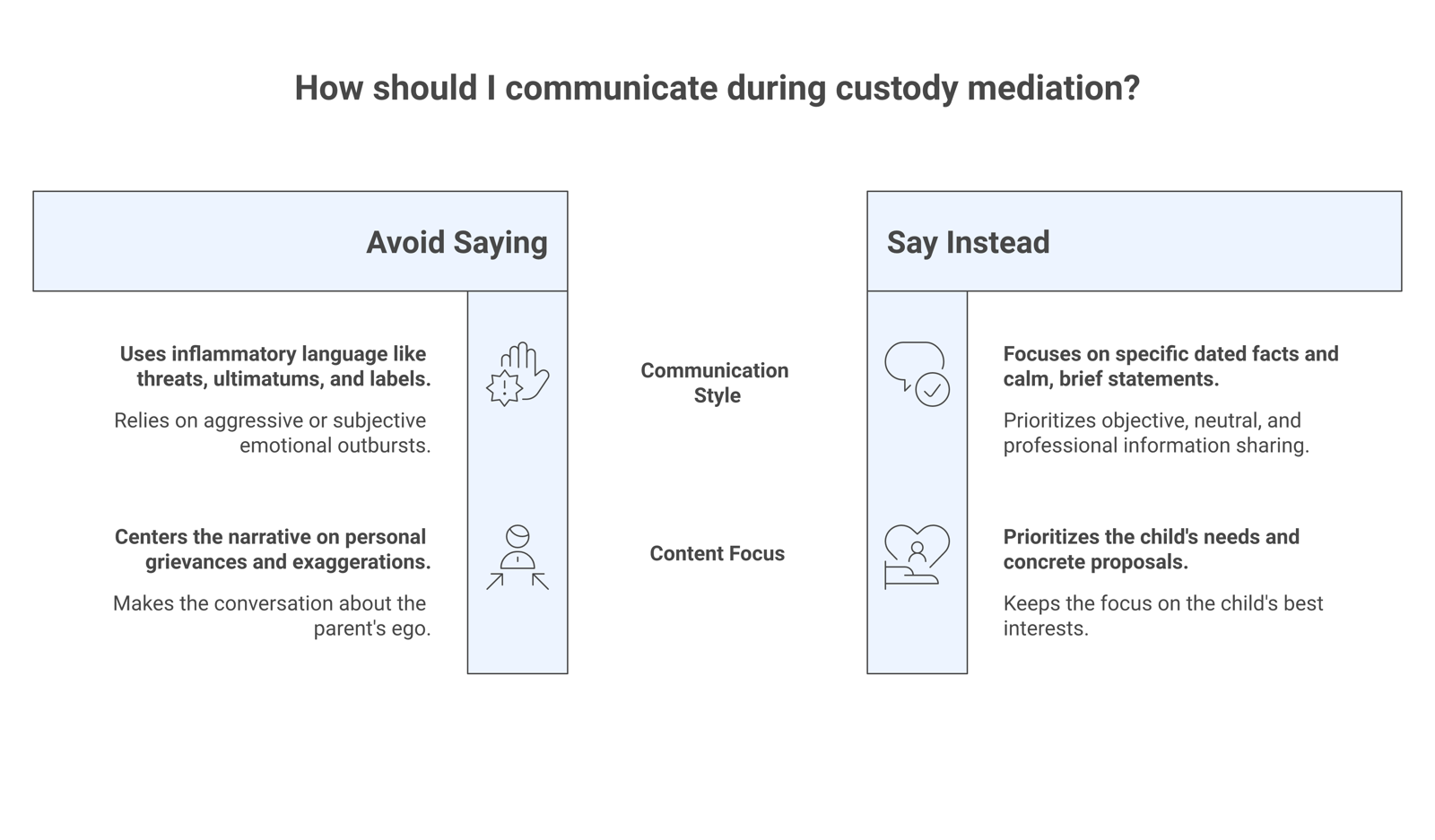
A little rehearsal goes a long way. Writing out the two or three points that matter, in calm and factual language, makes them easier to reach for when stress is high. The companion page on how to prepare for child custody mediation covers that groundwork, and the Help section gathers the rest.
When a real safety concern is in the room
None of this means swallowing genuine fear. A parent who believes a child is unsafe should say so clearly and to the right people, not bury it under polite phrasing. The advice to avoid labels is about persuasion in a negotiation, not about silencing real alarm.
Where there has been abuse or coercive control, mediation may not be appropriate at all, and many programs screen for exactly that. The Association of Family and Conciliation Courts publishes family resources on how mediation is meant to work and when other paths fit better. A safety concern belongs with a lawyer, the mediator, or local authorities, stated plainly, and what to tell your lawyer about parental alienation covers where those concerns land.
Frequently asked questions
What should you not say in child custody mediation?
Avoid labels and diagnoses like “narcissist” or “alienator,” threats and ultimatums, badmouthing the other parent, self-centered framing such as “I deserve,” exaggeration, and unrelated old grievances. Each one signals conflict or weakens credibility. Calm, dated, child-focused statements work far better with a neutral mediator.
What hurts your case in mediation?
Language that sounds vengeful, vague, or all about the parent tends to hurt most, as does anything a neutral can disprove. Exaggerating, attacking the other parent’s character, or reopening old marital fights pulls focus off the child and chips away at credibility. Specific, accurate, child-centered points hold up better.
Should you call your ex a narcissist in mediation?
No. A diagnosis is a conclusion a mediator cannot verify and may read as a sign of focus on the fight rather than the child. Describe the specific behavior instead, with dates, such as repeated late exchanges or missed calls. If a clinical pattern matters legally, raise it with a lawyer.
How do you stay calm in custody mediation?
Prepare the few points that matter in calm, factual language ahead of time. In the room, slow down, let intellect lead emotion, and pause or ask for a break when feelings spike. Anchoring each answer to the child, rather than to the other parent, makes a steady tone easier to keep.
What should you say instead?
Say specific, dated facts rather than labels, describe the child’s needs rather than your own grievances, and propose rather than demand. Keep it brief and calm. For example, “our daughter does better with a steady weeknight routine, and here is what I propose” lands far better than a complaint about the other parent.
What this page does not do
This page is not legal advice, and it does not address any one state’s mediation rules, which vary. It also does not coach a parent to manipulate the mediator or to “win” against the other parent, because mediation is not a contest. The aim is calm, honest, child-centered language and a workable plan, not a verbal victory.
For getting ready, see how to prepare for child custody mediation. For staying steady with a difficult co-parent, see how to communicate with a toxic ex. For what can resurface later, see what can be used against you in child custody. The full Help section covers the rest.
Sources and further reading
- American Psychological Association. Divorce and child custody. apa.org/topics/divorce-child-custody
- Association of Family and Conciliation Courts. Resources for families. afccnet.org
- Cornell Legal Information Institute (Wex). Mediation. law.cornell.edu/wex/mediation
If you or your child are in crisis
Free and confidential help is available right now.
- 988 Suicide and Crisis Lifeline. Call or text 988. 988lifeline.org
- Childhelp National Child Abuse Hotline. 1-800-422-4453. childhelp.org
- NAMI HelpLine. 1-800-950-6264. nami.org/help
Last reviewed: 2026-06-08. Author: Alex Buckles (PAC Founder). Editorial review: held to the PAC Editorial Standards (balance, primary-source citation, reader safety); an independent expert review board will be appointed.