

Parallel parenting vs co-parenting comes down to one thing: conflict. Co-parenting asks two parents to cooperate, talk often, and make joint decisions. Parallel parenting keeps high-conflict or controlling exes disengaged, each running their own home with business-only contact. When tension runs high, parallel parenting often protects a child better than forced cooperation.
A note on safety
Where abuse or coercive control is present, parallel parenting or supervised arrangements protect a child’s safety, and that comes first. A child who pulls away from a parent who has been abusive or frightening is showing justifiable estrangement, not alienation. Those are different situations with different responses. If anyone’s safety is at risk, contact local emergency services or a domestic-violence resource first.
This is general information, not clinical or legal advice. Every family is different. A licensed family therapist or a family-law attorney in the reader’s own area can give guidance for a specific situation.
Parallel parenting vs co-parenting: the short answer
Both models share one goal: raising a child well across two homes. The difference is how much the two parents interact along the way.
Co-parenting is the cooperative model. Parents communicate freely, coordinate routines, and reach decisions together. They act as a loose team, even though they live apart.
Parallel parenting is the disengaged model. Each parent runs their own household with little direct contact. Communication stays brief, written, and limited to logistics. Day-to-day choices happen independently in each home.
The deciding factor is not which label sounds better. It is the conflict level between the parents, and the safety of everyone involved. Low conflict points toward co-parenting. High conflict points toward parallel parenting.
What co-parenting means
Co-parenting describes two separated parents who work together on the practical job of raising their child. They share major decisions about school, health, and activities. They keep each other informed, stay flexible when plans shift, and try to present a united front.
This model asks a lot of both parents. It needs steady communication, basic respect, and reliability. It works best when neither parent uses the child to get at the other, and when conversations can stay calm.
When those conditions hold, co-parenting offers real benefits. The child sees cooperation modeled by the two adults they love most. Schedules flex around real life. Big decisions get made with both viewpoints in the room. The American Psychological Association notes that shielding children from ongoing parental conflict supports their adjustment after a separation, which is exactly what healthy co-parenting aims to do. Parents who want help building these skills can explore co-parenting counseling.
Co-parenting strains, though, when conflict stays high. Constant contact with a hostile or controlling ex can pull the child straight into the middle. At that point, more communication does not help. It can make things worse.
What parallel parenting means
Parallel parenting describes two parents who raise their child mostly independently. Each parent has full authority during their own time. Contact between the adults is minimal, formal, and focused only on essential logistics.
The structure has a few clear features. Communication moves to writing, often through a co-parenting app or email, so there is a record and time to think. The schedule is fixed and detailed, which removes the need to negotiate. Exchanges happen at neutral, low-contact spots, such as a school or a public place. Each parent handles routines, rules, and minor decisions in their own home without consulting the other.
Parallel parenting is not estrangement, and it is not a way to punish the other parent. It is structured distance. The point is to lower the friction that hurts the child, while both parents stay fully involved in the child’s life.
The conflict spectrum: where each approach fits
A useful way to choose between the two models is to picture a spectrum of conflict between two homes. After a separation, a child lives across two household systems, and the research on children’s post-divorce adjustment points to ongoing conflict between those homes, more than the separation itself, as the main source of stress. The American Psychological Association’s guidance on divorce makes the same point: shielding children from parental conflict is what supports their adjustment.
Along that spectrum, parenting styles line up by conflict level. Co-parenting sits at the cooperative end. Parallel parenting sits in the middle, as a structured way to lower contact when cooperation keeps failing. Beyond that lies sustained hostility, where a family needs more outside support, such as counseling or court structure, and at the far end sits abuse, where safety planning replaces parenting models.
Seen this way, parallel parenting is not a downgrade. It is the structure that fits the middle of the spectrum, where direct cooperation backfires but each parent still parents safely. The goal at every point is the same: keep the child out of the adults’ conflict. Conflict that drags on can also harden over time, which is part of how the stages of parental alienation unfold.
When parallel parenting protects the child better
Here is the honest part. In high-conflict or coercive-control situations, forced cooperation can keep harming the child. Pushing two parents to communicate constantly, when one of them weaponizes that contact, simply gives the conflict more room to grow.
Research backs the concern. Dr. Jennifer Harman and colleagues argue that parental alienating behaviors map onto coercive control and amount to a recognized form of family violence. When one parent uses contact to harass, control, or undermine the other, every required interaction becomes a chance to do that. A child caught in those exchanges absorbs the stress. In that setting, disengagement is protective, not cold.
Parallel parenting answers this by closing off the openings. Fixed schedules remove the negotiations a controlling ex can hijack. Written, business-only messages limit the surface for manipulation. Neutral exchanges cut down on confrontations in front of the child. The child still has both parents, with far less exposure to the conflict between them.
One caution matters here. A calm surface does not prove a healthy situation. Ryan Thomas, an adult survivor of alienation who now coaches targeted parents, points out from lived experience that alienation can be stealthy in amicable, low-conflict separations, delivered with a sad tone rather than an angry one. So choosing parallel parenting does not mean dropping attention to how the child is doing. It means lowering conflict while staying alert to the child’s wellbeing. Parents who notice a child turning against them without cause can read more about dealing with parental alienation and how to stop parental alienation.
Parallel parenting vs co-parenting at a glance
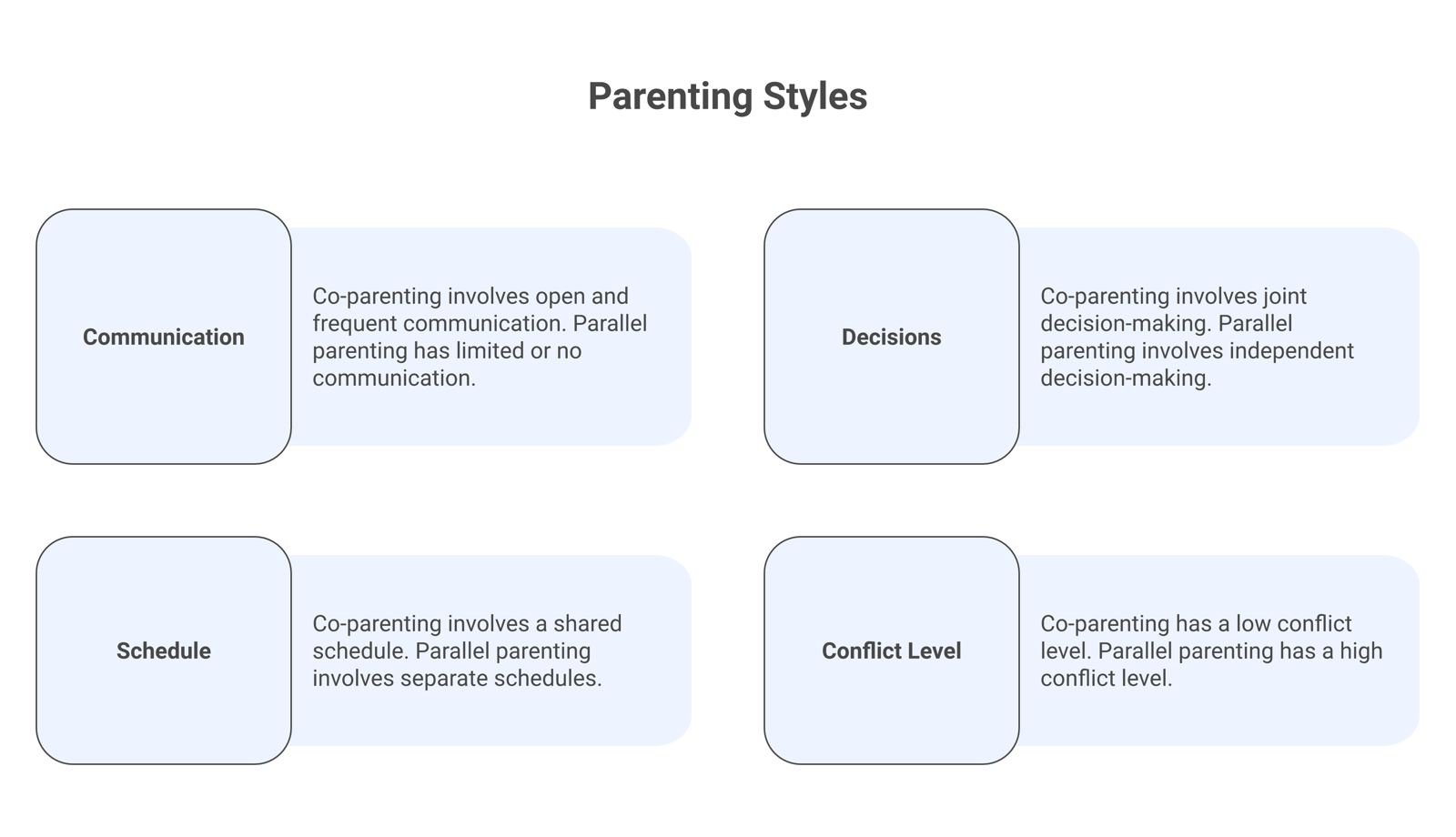
| Dimension | Co-parenting | Parallel parenting |
|---|---|---|
| Communication | Frequent, flexible, direct | Minimal, written, logistics only |
| Decisions | Made jointly | Made independently in each home |
| Schedule | Flexible, adjusted as needed | Fixed and detailed |
| Exchanges | Relaxed, often face to face | Neutral, low-contact locations |
| Conflict level it suits | Low | High |
| Child’s exposure to conflict | Low when cooperation holds | Lowered by design |
| Best fit | Respectful, reliable co-parents | High-conflict or controlling situations |
How to set up parallel parenting
A parallel parenting plan works because it spells everything out in advance. The more detail the plan holds, the fewer disputes the parents have to manage in real time.
A few practices anchor most plans. Put the schedule in writing, down to exchange times, holidays, and vacation rules, so nothing needs renegotiating. Keep communication to a written channel, and limit it to essential information about the child. Choose neutral exchange points that avoid direct contact. Let each parent handle their own household rules, routines, and minor decisions without seeking approval from the other.
One rule protects the child above all: keep the child out of the messenger role. Children should never carry messages, money, or schedule changes between homes, and they should never be asked to pick a side. Parents who want a fuller checklist can review guidance on protecting children during divorce.
Can parallel parenting become co-parenting later?
Sometimes, yes. Parallel parenting is not always permanent. If conflict cools over months or years, and both parents stay focused on the child, families can add cooperation back in slowly.
That shift cannot be forced. It depends on genuine change, especially where control or alienation was part of the picture. For many families, a stable parallel arrangement is the healthiest long-term setup, and that is a fine outcome. The measure of success is not how friendly the parents are. It is whether the child grows up shielded from their conflict.
Frequently asked questions
What is the difference between parallel parenting and co-parenting?
Co-parenting relies on cooperation, with parents communicating often and making decisions together. Parallel parenting keeps the parents disengaged, with each running their own home and contact limited to written logistics. The main difference is how much the two parents interact.
Is parallel parenting better than co-parenting?
Neither is universally better. Co-parenting suits low-conflict situations where parents communicate respectfully. Parallel parenting suits high-conflict or controlling situations, where it often protects the child better by lowering their exposure to conflict. The right choice depends on the conflict level and safety.
When should you use parallel parenting?
Parallel parenting fits when conflict stays high, when communication keeps breaking down, or when one parent uses contact to control or undermine the other. In those cases, structured distance reduces how much the child is caught in the middle.
Can parallel parenting turn into co-parenting?
It can, though it is not guaranteed. If conflict drops over time and both parents stay child-focused, a family can move toward more cooperation step by step. Where coercive control or alienation was present, that shift depends on real, lasting change.
Is parallel parenting bad for children?
No. Lowering a child’s exposure to ongoing parental conflict supports their wellbeing. The structure of the arrangement matters less than keeping the child out of the conflict. A low-contact plan that shields the child is a healthy choice.
Sources and further reading
- American Psychological Association. Divorce and child custody. apa.org/topics/divorce-child-custody
- Harman, J. J., Kruk, E., & Hines, D. A. (2018). Parental alienating behaviors: An unacknowledged form of family violence. Psychological Bulletin, 144(12), 1275 to 1299. https://doi.org/10.1037/bul0000175
More guides for parents in active situations are collected in the Help center.
If you or your child are in crisis
Free and confidential help is available right now.
- 988 Suicide and Crisis Lifeline. Call or text 988. 988lifeline.org
- Childhelp National Child Abuse Hotline. 1-800-422-4453. childhelp.org
- NAMI HelpLine. 1-800-950-6264. nami.org/help
Last reviewed: 2026-06-06. Author: Alex Buckles, Founder.