

A parental alienation custody evaluation is a structured forensic assessment that places a child’s rejection of a parent inside a multifactor differential. The evaluator weighs alienation against justified estrangement, realistic preference, and hybrid cases, screening first for abuse and coercive control, then grounding any opinion in collateral evidence and recognized practice standards.
The differential comes first
The evaluator’s first duty is the differential. Justified estrangement from an abusive or neglectful parent must never be misclassified as alienation. Screening for abuse, neglect, and coercive control comes before any alienation hypothesis, and a substantiated safety concern triggers reporting obligations that supersede every framework on this page.
This page offers general professional information, not clinical, forensic, or legal advice. It is not a substitute for the evaluator’s own judgment and applicable practice standards. A defensible parental alienation custody evaluation requires direct, court-authorized assessment by a qualified evaluator working within recognized guidelines.
What a parental alienation custody evaluation is
A parental alienation custody evaluation is a forensic methodology, not a label applied to a high-conflict file. The task is to explain, with documented evidence, why a child rejects a parent and what arrangement serves that child. Alienation is one candidate explanation among several, and the evaluation exists to test it against the alternatives rather than to confirm it.
This methodology lens separates the present page from clinical identification work. A treating clinician who recognizes a behavioral pattern is doing identification, covered in identifying parental alienation. A court-appointed evaluator builds a record across both parents, the child, and collateral sources, then offers the court a reasoned, standards-anchored opinion. The roles are distinct, and conflating them weakens both.
Two recognized practice standards frame the work. The APA Guidelines for Child Custody Evaluations in Family Law Proceedings set the profession’s expectations for scope, multiple data sources, and impartiality. The Association of Family and Conciliation Courts publishes model standards that many jurisdictions adopt. Neither standard names a parental alienation protocol, yet both require the structured, multi-source, hypothesis-testing posture that a defensible alienation analysis depends on. Anchoring the evaluation to those guidelines is what makes the resulting opinion durable under scrutiny. The broader role map sits in the For Professionals hub.
Screen for abuse and coercive control first
Screening for maltreatment is the opening move, not a later checkbox. Before an evaluator entertains an alienation hypothesis, the file must rule in or rule out genuine abuse, neglect, and coercive control toward the child or the rejected parent. A child who pulls away from a parent who has frightened or harmed them is showing justified estrangement, which is a protective response and a different matter entirely.
The taxonomy clarifies the stakes. Dr. Joshua Coleman frames estrangement as the umbrella category for any strained or severed parent-child relationship, with alienation as one subset and justifiable estrangement, traceable to real abuse or neglect, as a separate pathway. The evaluator’s job is to identify the pathway, because the right recommendation depends entirely on which one the family is on.
Coercive control deserves specific attention because it can run in either direction and can be missed. Researchers Jennifer Harman, Edward Kruk, and Denise Hines argue in Psychological Bulletin that parental alienating behaviors map onto recognized patterns of coercive control and family violence, which means the screening must look for control as well as overt violence. Forensic investigators add a caution evaluators should hold consciously: a small, articulate, highly educated presenting parent is rarely suspected of being the controlling party, and that bias must be overridden so the same investigation runs regardless of how a parent presents. Screening first protects the child, protects the rejected parent, and protects the evaluation from its most damaging error.
The screening runs in both directions because alienation claims and intimate-partner-violence claims frequently co-occur in the same files, and researchers in the Harman line frame alienating behaviors themselves as a form of family violence, so the practical rule is to screen for each whenever the other is alleged. One boundary stays firm. A documented finding of physical or sexual abuse reclassifies the case as estrangement, not alienation, which keeps the protective reading in front.
The multifactor differential
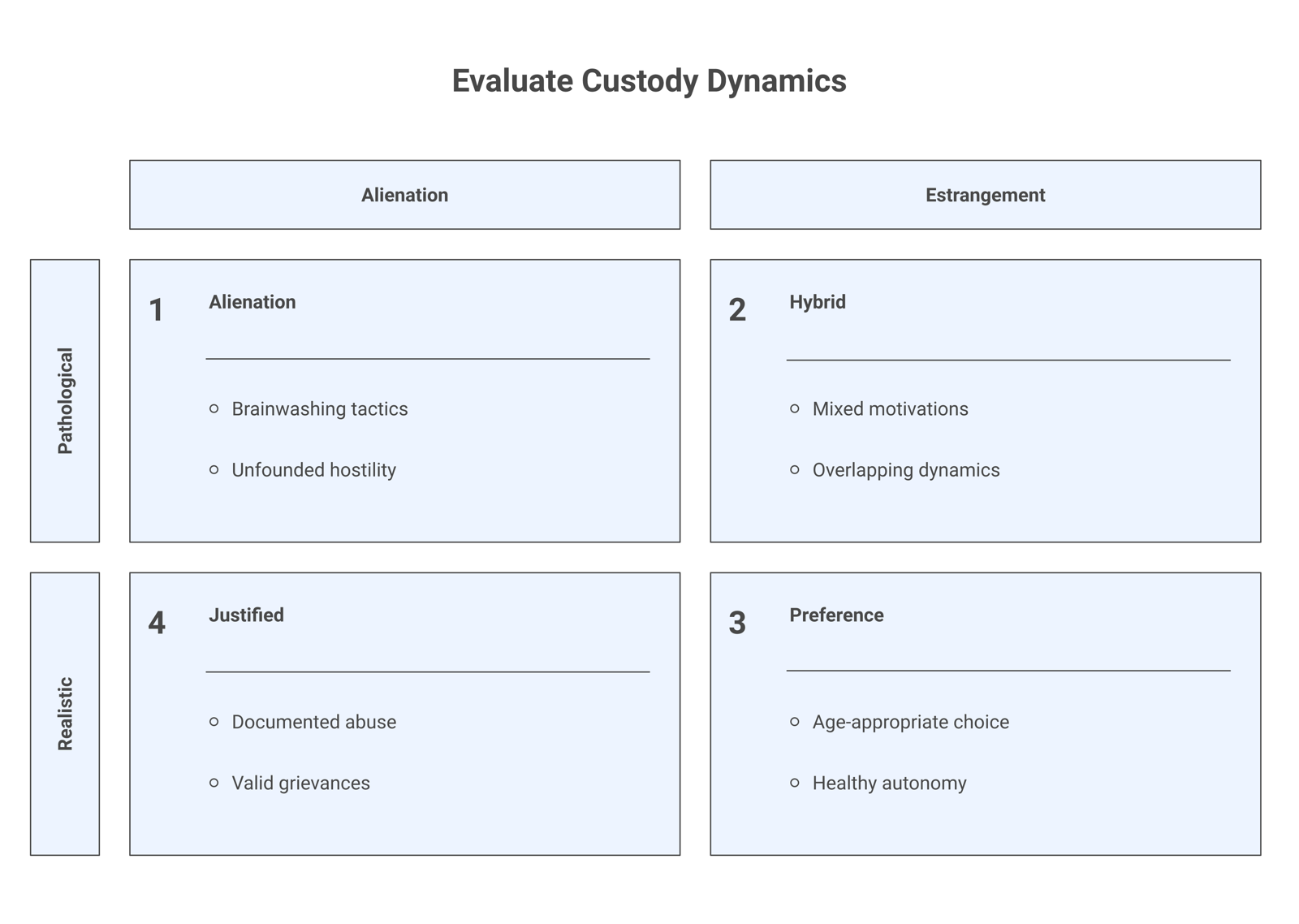
The core of the evaluation is a differential with four live branches. Each branch explains a child’s rejection of a parent, and the evidence pattern, not the louder parent, decides which branch fits. A defensible report names the branches considered and states why the evidence favors one over the others.
Alienation
Alienation describes a child who rejects a previously loved parent without proportionate cause, after sustained influence from the favored parent, in the absence of bona fide maltreatment. Dr. Amy Baker’s four-factor structure operationalizes this branch: a prior positive relationship, the absence of substantiated abuse or neglect by the rejected parent, multiple alienating strategies by the favored parent, and recognizable behavioral manifestations in the child. All four factors must be present for the branch to hold, per Baker’s 2020 validation study. The field’s Five-Factor Model (Bernet and Greenhill, 2022) is the same four factors with the child’s contact refusal added as factor one: factor one establishes that there is a problem to explain, and the remaining factors distinguish alienation from justified estrangement.
Justified estrangement
Justified estrangement describes a child whose distancing traces to a parent’s real abuse, neglect, or frightening conduct. Baker’s own research underscores why this branch is easy to misread: even children who have been harmed by a parent often seek repair rather than total severance, so complete and contemptuous rejection in a substantiated-abuse case still warrants careful reading. The protective reading is the default whenever maltreatment is established.
Realistic preference
Realistic preference describes a child whose stated preference responds proportionately to a genuine parenting deficit that falls short of abuse. A parent who is chronically disengaged, rigid, or emotionally unavailable can generate a reasonable preference for the other home. The signal here is proportionality. The child’s account tracks observable parenting behavior and carries the mixed feelings that real relationships produce.
Hybrid presentations
Hybrid presentations are common and demand the most discipline. Many families show some alienating conduct by one parent alongside some real deficit in the other. Forensic researcher Shawn Wygant’s conference-stage work on the parental alienation child-abuse model, presented at the Parental Alienation Study Group conference in October 2025 and not yet published in a peer-reviewed journal, warns against the type-II error of failing to recognize alienation when it is present, while the evaluator must equally avoid inflating ordinary parenting friction into alienation. The discipline is to weight each contribution separately rather than collapsing the case into a comfortable “both parents are difficult” verdict that resolves nothing for the child.
Structured assessment approaches
Structure is what distinguishes a defensible evaluation from a clinical impression. A single session, a single instrument, or a single informant cannot support an alienation opinion. The evaluation gathers data from multiple sources and tests each hypothesis against all of them.
Baker’s four-factor model supplies a workable spine because every factor is observable and tied to evidence. The first factor, a prior positive relationship, draws on pre-separation history, photographs, school records, and third-party accounts. Establishing the second factor, the absence of bona fide maltreatment, relies on the abuse screening already described. For the third factor, multiple alienating strategies, the evaluator points to the seventeen replicated strategies Baker derived from adult survivors, from badmouthing to forcing the child to choose. A fourth factor, behavioral manifestations in the child, draws on the eight recognized signs, including a campaign of denigration and the spread of animosity to extended family.
A second structured lens adds attachment language. Dr. Craig Childress names three indicators: suppression of the child’s attachment system toward a rejected parent assessed as broadly normal-range, either personality-disorder features in the favored parent or phobic anxiety in the child, and a fixed false belief about the rejected parent’s inadequacy. The normal-range precondition matters because it routes the evaluator back to the abuse screening before the attachment reading is allowed to stand. A status caveat is required here: Childress’s attachment-based model is an influential minority position that remains contested even within the field that accepts parental alienation, and neither courts nor mainstream guidelines (including the PASG mainstream, the APA, and the AFCC) have adopted it. An evaluator who borrows its vocabulary should label it as Childress’s model, not as field consensus, and should never present his “three definitive indicators” as a validated diagnostic test.
An evaluator fluent in more than one structured framework is harder to discredit than one committed to a single model, provided each framework is presented with its actual standing. Baker organizes the behavioral evidence, and Childress supplies a contested attachment vocabulary. Both demand the multi-source posture that the APA guidelines and AFCC standards already require.
Standardized and objective instruments
Objective instruments add measured data to clinical observation, yet no instrument decides a case on its own. Each one functions as a trigger for further inquiry, never as a verdict, and every score is integrated with the rest of the file before any opinion forms.
The Parental Acceptance-Rejection Questionnaire (PARQ), developed by Dr. Ronald Rohner, is a validated 60-item self-report measuring a child’s perceived acceptance or rejection by each parent. Dr. William Bernet’s PARQ-Gap work shows it can surface the “splitting” seen in severely alienated children. Careful evaluators read items aloud without intonation, test siblings separately, and treat extreme scores as prompts for follow-up rather than proof of preference.
A further instrument names specific alienating behaviors. The Baker Strategy Questionnaire (BSQ), built by Dr. Amy Baker and validated across multiple studies, measures the favored parent’s use of the alienating strategies and is free to use. Because it scores observable conduct, it serves as an input to the differential, not a conclusion.
The loss-of-ambivalence indicator
One behavioral indicator carries unusual weight in the differential. Bill Eddy frames it cleanly: “All human relationships are ambivalent and ambiguous.” Real relationships hold mixed feelings, and even children harmed by a parent retain some affection alongside their fear. Ambivalence is the ordinary texture of attachment.
When a child presents as wholly positive toward one parent and wholly negative toward the other, across multiple contacts, with no acknowledgment of any prior good memory, that pattern is not authentic relational experience. The split is the signal. A defensible note records it specifically: the child described the favored parent in unambiguously positive terms and the rejected parent in unambiguously negative terms across several contacts, with no mixed feeling expressed in either direction.
The indicator has limits the evaluator must respect. Loss of ambivalence is necessary but not sufficient, because it points toward influence without proving its source, and it must be read alongside the abuse screening rather than instead of it. A traumatized child can also present with flattened ambivalence under some conditions. Treating one indicator as a verdict is the kind of shortcut that collapses under cross-examination. The signal earns its weight only inside the full differential, a point developed in the identification sibling page.
Vetting a child’s statements
A child’s account is evidence only to the extent it was reliably elicited. Applied memory science gives the evaluator a vocabulary for judging that reliability. Dr. Gary Wells’s distinction between estimator and system variables organizes the question. Estimator variables, such as the child’s age, stress, and elapsed time, sit beyond anyone’s control. System variables, such as the interview method and the feedback given, are controllable and can either protect or contaminate the account.
The interview method is the lever the evaluator can pull. The Cognitive Interview, developed by Fisher and Geiselman, uses rapport, uninterrupted free recall, and context reinstatement to yield more accurate detail without loss of accuracy. For children, the NICHD protocol opens with rapport, invites open-ended recall, suggests nothing, and permits the child to say “I don’t know.” Contamination runs the other way: a single changed verb shifted estimates in Loftus’s research, and confirming feedback inflates false confidence. Children are especially suggestible, so a statement produced by leading or repeated questioning carries less weight than one offered spontaneously.
Collateral and case-file investigation discipline
Collateral investigation is where many evaluations are won or lost. The child’s account and each parent’s narrative are inputs, not conclusions, and the evaluator’s discipline in testing them against documentary evidence is what gives the opinion its spine. Forensic case-investigation practice offers a transferable protocol.
Check the correspondence trail between the parties. Email and message exchanges usually contain accusations running both directions, and the pattern and contemporaneous tone often reveal who was doing what at the time, which is more reliable than either party’s later reconstruction. Canvass both extended families. Asking each side what they actually witnessed often surfaces concrete, corroborated observations that neither parent volunteered.
Verify the provenance of every claimed evidence item. Cases have been documented in which a parent presented injury photographs copied from the internet as images of the child, so the protocol is to reverse-image-search claimed-injury photos before accepting them. Observe behavior in multidisciplinary settings: a parent’s conduct in a professionals’ meeting is itself data, best cross-checked with the other professionals present. This discipline is what turns a stack of allegations into a record an attorney can use, the subject of evidence for parental alienation cases and the documentation work in how to prove parental alienation.
How the evaluator’s role shapes the opinion
The opinion an evaluator can defensibly offer depends on the role the evaluator occupies. Forensic practice maps four distinct ways a mental-health professional appears in a parental alienation case, and each carries different reach and different limits.
The court-appointed custody evaluator has the most comprehensive view, with access to both parents, the children, and collateral sources, and is least vulnerable to bias attacks because no party retained the role. A blind consultant educates the court on general principles without examining the family, connecting general science to case facts through hypothetical questions. The behind-the-scenes consultant trains an attorney and never testifies. A retained expert reviews the timeline, pleadings, recordings, and messages and addresses both general principles and a case-specific narrative.
The role sets a hard boundary on the conclusion. The rule for the retained expert is direct: when one parent and the children have not been interviewed, offering a clear diagnosis should be avoided. Only the comprehensive court-appointed posture supports an individualized opinion about a specific family, and even then the opinion is offered within the differential rather than as a fixed diagnosis. Stating the boundary in the report is a strength, not a weakness, and it shapes what the court can do with the finding, addressed in how courts handle parental alienation.
The limits of the science
Honesty about limits is part of a defensible evaluation. Parental alienation is not a standalone diagnosis in the DSM-5. Wygant’s conference-stage model situates severe cases within the established DSM-5 standard for child psychological abuse rather than within a freestanding syndrome, which keeps the analysis tethered to recognized nosology instead of to contested labels. An evaluator who claims a diagnosis the manual does not contain invites avoidable challenge.
The appropriate output is probabilistic, not certain. The evaluator describes a behavioral pattern, weighs it across the four-branch differential, and offers a reasoned opinion about the most likely explanation and the arrangement that serves the child. Findings should be framed as the weight of evidence favoring one branch, never as proof. Admissibility scrutiny under the prevailing evidentiary standards rewards this restraint, because an opinion grounded in multiple data sources and stated within its limits survives where an overclaimed diagnosis does not. The science supports a careful differential. It does not support certainty, and a report that promises certainty misrepresents the method.
Frequently asked questions
How is parental alienation assessed in a custody evaluation?
Through a structured forensic differential. The evaluator screens first for abuse and coercive control, then weighs alienation against justified estrangement, realistic preference, and hybrid presentations using data from both parents, the child, and collateral sources. The opinion is anchored to recognized custody-evaluation guidelines and offered probabilistically rather than as a fixed diagnosis.
What is the difference between parental alienation and estrangement in an evaluation?
Estrangement is the umbrella term for any strained or severed parent-child relationship. Justified estrangement traces to genuine abuse or neglect by the rejected parent and is a protective response. Alienation traces to a favored parent’s influence in the absence of substantiated maltreatment. The differential turns on establishing or excluding maltreatment first.
What is the loss-of-ambivalence indicator?
It is the observation that authentic relationships carry mixed feelings. A child who presents as wholly positive toward one parent and wholly negative toward the other, across multiple contacts and with no acknowledged good memory, shows a pattern authentic relationships do not produce. It is one indicator, necessary but not sufficient, and it must be read alongside abuse screening.
Can a custody evaluator diagnose parental alienation?
Parental alienation is not a standalone DSM diagnosis. A court-appointed evaluator with comprehensive access can describe a behavioral pattern and offer a probabilistic opinion within the differential. An expert who has not interviewed all parties should avoid offering a definitive diagnosis, and every opinion should be stated within its evidentiary limits.
Which standardized instruments are used to assess parental alienation?
No instrument decides a case alone. Evaluators may use the Parental Acceptance-Rejection Questionnaire (PARQ) to measure a child’s perceived acceptance or rejection by each parent and the Baker Strategy Questionnaire (BSQ) to measure a favored parent’s alienating behaviors. Extreme scores are triggers for further inquiry, integrated with all other data, never standalone proof.
What guidelines govern a parental alienation custody evaluation?
No guideline names a parental alienation protocol. The APA Guidelines for Child Custody Evaluations in Family Law Proceedings and the AFCC model standards set the expectations for scope, multiple data sources, impartiality, and stating the limits of one’s conclusions. A defensible alienation analysis is built inside those general standards.
Sources and further reading
- American Psychological Association. Guidelines for Child Custody Evaluations in Family Law Proceedings. apa.org/practice/guidelines/child-custody
- Association of Family and Conciliation Courts (AFCC). afccnet.org
- Harman, J. J., Kruk, E., & Hines, D. A. (2018). Parental alienating behaviors: An unacknowledged form of family violence. Psychological Bulletin, 144(12), 1275 to 1299. https://doi.org/10.1037/bul0000175
- Rohner, R. P. Parental Acceptance-Rejection Questionnaire (PARQ). Ronald and Nancy Rohner Center for the Study of Interpersonal Acceptance and Rejection, University of Connecticut. csiar.uconn.edu
- Baker, A. J. L. (2020). Reliability and validity of the four-factor model of parental alienation. Journal of Family Therapy, 42(1), 100 to 118. https://doi.org/10.1111/1467-6427.12253
- Bernet, W., & Greenhill, L. L. (2022). The Five-Factor Model for the diagnosis of parental alienation. Journal of the American Academy of Child and Adolescent Psychiatry, 61(5), 591 to 594. https://doi.org/10.1016/j.jaac.2021.11.026
- Childress, C. (2015). An Attachment-Based Model of Parental Alienation: Foundations. Oaksong Press. (An influential minority model, contested within the field and not adopted in mainstream guidelines.)
If you or a family you work with is in crisis
Free and confidential help is available right now.
- 988 Suicide and Crisis Lifeline. Call or text 988. 988lifeline.org
- Childhelp National Child Abuse Hotline. 1-800-422-4453. childhelp.org
- NAMI HelpLine. 1-800-950-6264. nami.org/help
Last reviewed: 2026-06-06. Author: Alex Buckles (PAC Founder).