

This page is general information for professionals, not legal advice. It does not create an attorney-client relationship, and it does not address any one state’s law. Modification standards vary by jurisdiction. Attorneys should rely on the controlling statute and case law in their own forum.
Parental alienation custody modification turns on proof, not the label. Alienation can support a modification when the record documents substantial, ongoing harm to the child and the proposed change serves the child’s best interests. Courts act on proven behaviors and child impact. This explains the analysis, the evidence, the remedies, and the outcomes.
A note on safety
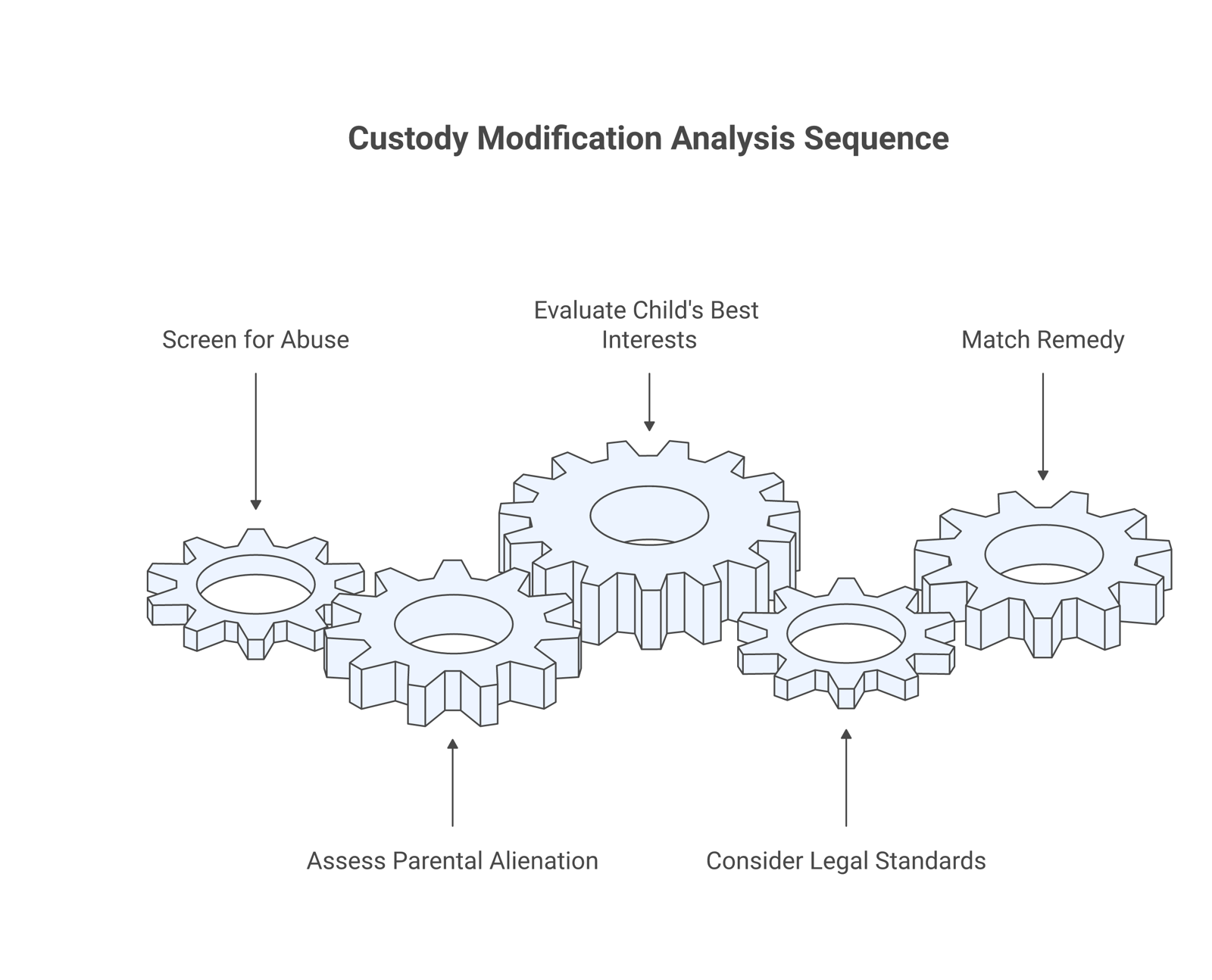
Alienation and genuine abuse can look similar from the outside, and hybrid cases are common. A modification motion built on an alienation theory must first screen for genuine abuse and for a child’s protective resistance. An alienation framing must never be used to override a parent who is genuinely protecting a child. When a child’s safety is at risk, that concern comes first.
Can parental alienation support a custody modification?
Yes. A documented pattern of alienating behavior, and the harm it does to the child, can support a change to a custody or parenting-time order. What it cannot do is support a modification on its own as a label. A motion that asks a court to act because the other parent “is an alienator” gives the bench nothing to weigh. A motion that shows specific behaviors, the child’s deteriorating relationship with a once-loved parent, and the resulting harm gives the court a factual basis to act.
That distinction is grounded in the case record itself. A database of US trial and appellate decisions from 1985 to 2018, assembled in the work of Lorandos and described in Joshi’s “Goal 1,” shows that courts across jurisdictions have modified custody, ordered intervention, and sanctioned conduct in alienation cases. The point of that database is not that alienation guarantees a modification. It is that alienation is judicially cognizable when it is proven, and that the body of decisions deserves Daubert-grade seriousness rather than dismissal. The neutral starting point for the doctrine is the law of child custody maintained by the Cornell Legal Information Institute, which frames every custody question around the child.
The analysis that follows is general. The threshold a moving party must clear, and the factors a court weighs, vary by jurisdiction, and counsel should map this frame onto the controlling standard in the forum.
The two-part modification analysis
Most US jurisdictions analyze a custody modification in two steps. A court asks whether there has been a substantial change in circumstances since the existing order, and if so, whether the proposed change serves the child’s best interests. The labels and the exact threshold differ by state, but the two-part shape is widely shared.
A substantial, ongoing change
The first step screens out relitigation. A court will not reopen a settled custody arrangement over an isolated grievance or a single missed exchange. The moving party has to show something substantial that has developed since the last order. In an alienation case, that change is rarely one event. It is a pattern that has hardened over time: a child who once had a warm relationship with a parent now refusing contact, parroting an adult’s grievances, showing fear or contempt that is disproportionate to any real experience with the rejected parent, and a favored parent who actively encourages or permits that rejection.
The record has to document both halves, the behavior and the change in the child. A court is far more persuaded by a documented trajectory, the relationship before and the relationship now, than by a snapshot. The behavior is the cause the court can act on; the child’s deterioration is the harm that makes the change substantial rather than cosmetic.
The child’s best interests
If the moving party clears the threshold, the court turns to the child’s best interests. This is where the alienation’s impact on the child is weighed against the disruption that any change will cause. Courts are conservative about disruption, and rightly so. A modification has to leave the child better off, not merely punish the disfavored conduct. That means the record must connect the alienating behavior to concrete harm: the loss of a parental relationship, distorted reality-testing, anxiety, or a developmental cost the child is bearing now and will carry forward. The best interests of the child standard is the lens for the entire second step, and it is the reason a modification stands or falls on child impact rather than on adult blame.
Framing alienation as child protection, not a label
The most common drafting error in these motions is leading with the diagnosis. Courts do not modify custody because an expert used the words “parental alienation.” They modify because the proven facts show harm to a child. As one judicial framing of the behaviors-not-labels standard puts it, labels do not give a court a basis on which to rule; the facts do. Joshi and Judge Van Allsburg have both pressed this point: the work of the case is documenting behavior and impact, not winning a battle over a syndrome.
The case law reflects this. In Martin v. Martin, the Michigan Court of Appeals upheld a finding of parental alienation without requiring proof of any “syndrome,” resting the decision on the documented conduct and its effect on the child. Counsel who internalize that approach build the record around what happened and what it did, and let the clinical vocabulary stay in the expert’s lane.
There is a deeper reason to frame the case this way. A genuine, severe alienation finding is, in substance, a child-protection finding. The Wygant model treats severe alienation as a form of psychological child abuse, and clinicians such as Gottlieb have made the same point: the harm to the child is the injury the system exists to address. That reframing carries a practical consequence for pace. A routine custody dispute can proceed at a routine pace. A severe-alienation case, properly understood, is a matter of a child’s ongoing psychological harm, and the analysis should be approached at a child-protection pace rather than a leisurely one. The principle that Ludmer drew from the Gomery decision captures the stakes: faced with credible evidence of severe alienation, the court cannot remain indifferent. None of this lowers the burden of proof. It locates the case correctly, so the urgency matches the harm once the harm is actually proven. For how benches receive these claims in practice, see how courts handle parental alienation.
The evidentiary foundation for a modification
A modification built on alienation lives or dies on its record. Three disciplines distinguish a motion that persuades from one that collapses.
First, document behaviors and child impact, not conclusions. The record should show what the favored parent did and said, when, and how the child changed in response. Messages, third-party observations, school and counseling records, and a timeline that contrasts the relationship before and after are the raw material. The mechanics of assembling that record are covered in building a parental alienation case file, and the categories of admissible proof are covered in evidence for parental alienation cases.
Second, handle experts with discipline. Hoffman’s two-expert approach, bracketing the question with more than one qualified opinion, guards against the single-expert vulnerability that opposing counsel will exploit. Equally important is obtaining the complete expert file, every note, draft, and underlying datum, rather than the polished report alone. The complete file is where the methodology either holds up or falls apart, and a modification that rests on an evaluation should be prepared to defend, or to challenge, that evaluation on its full record. The APA guidelines for child custody evaluations describe the standards a sound evaluation is expected to meet.
Third, treat the body of decisions as foundation, not anecdote. The Lorandos database of US decisions gives counsel a reasoned-from-the-record basis for the proposition that courts act on proven alienation, which is useful both in framing the motion and in meeting any argument that alienation is not a legitimate consideration. The strategic choices about how to deploy all of this at trial belong to litigating parental alienation.
The range of remedies
A modification is not a single switch. Courts have a graduated menu, and the remedy should match the documented harm rather than the moving party’s frustration. Most cases resolve well short of the most drastic option.
The least disruptive remedies come first. Court-ordered therapy and structured reunification work aim to repair the parent-child relationship while leaving the custodial arrangement intact. Specific, enforceable parenting-time provisions can replace vague ones, removing the ambiguity that alienating behavior exploits. Make-up time, clear exchange protocols, and communication rules address the conduct directly.
Where those measures fail or the harm is more entrenched, courts can adjust the parenting-time balance, appoint a parenting coordinator, or order intensive structured intervention. At the far end, and only in severe documented cases, a court can reverse custody, placing the child with the rejected parent and limiting or structuring the favored parent’s contact. The American Bar Association’s Section of Family Law publishes general professional information on the enforcement and modification tools available across this range. The empirical and clinical consensus, voiced by researchers in the middle camp such as Johnston, Kelly, Fidler, and Bala, is that most alienation cases are best served by something short of reversal, and that the drastic remedy is reserved for the cases that genuinely require it.
Custody reversal and what follow-up research shows
Custody reversal is the remedy attorneys ask about most and understand least. The honest position is that reversal is rare, fact-dependent, and reserved for severe cases, and that the follow-up evidence on the cases where it has been ordered is more encouraging than the surrounding controversy suggests.
Long-term follow-up research associated with Birnbaum and Bala (2024) tracked children after a custody change in alienation cases. The follow-up found that, contrary to the fear that uprooting a child from the favored parent would traumatize them, the children were generally doing well and tended to validate the change once the dust settled. A notable pattern emerged on the other side: many of the formerly favored, alienating parents disengaged or dropped out of the children’s lives after the reversal, which itself spoke to the quality of the prior attachment that the alienation campaign had presented as unbreakable.
That research should be cited with care and without overreach. It does not establish that reversal works in every case, that it is appropriate as a first resort, or that it should be sought aggressively. It establishes a narrower and more useful proposition: when a court correctly identifies a severe case and orders a well-supported change, the outcome for the child can be good, and the prediction of catastrophic harm to the child is not borne out by the follow-up data. The same researchers who report these outcomes also caution that most cases do not reach reversal and should not. Reversal is the rare endpoint of the analysis, not its goal.
The DV and abuse boundary
Every modification theory built on alienation has to clear an abuse screen before it goes anywhere. The reason is that a child’s resistance to a parent has more than one cause. It can be the product of an alienation campaign. It can also be a rational, protective response to genuine mistreatment. The two can even coexist in the same family, which is why hybrid cases are common and why a careful evaluator distinguishes alienation from justified estrangement rather than assuming the former.
The professional duty here runs both ways. Counsel for a parent seeking modification on an alienation theory should screen the facts honestly for any indication that the child’s resistance is protective, because a motion that ignores genuine abuse is not only wrong but fragile. Counsel defending a protective parent should be alert to an alienation theory being used to reframe legitimate safety concerns as manipulation. An alienation framing must never become a mechanism for overriding a parent who is genuinely protecting a child. The screening discipline described in the APA guidelines for child custody evaluations exists precisely to keep these two pictures apart. For the consumer-facing treatment of how judges weigh these competing accounts, see how judges view parental alienation.
Frequently asked questions
Can parental alienation change a custody order?
Yes, when it is documented as a substantial, ongoing harm to the child and the proposed change serves the child’s best interests. A court does not modify custody because of the label “alienation.” It modifies because the proven behaviors and their effect on the child meet the modification standard. The motion has to show conduct and child impact, not a diagnosis.
What is the standard for custody modification based on alienation?
Most US jurisdictions apply a two-part analysis: first, whether there has been a substantial change in circumstances since the existing order, and second, whether the proposed change serves the child’s best interests. The exact threshold and the best-interests factors vary by jurisdiction, so counsel should apply the controlling standard in their own forum. Alienation is relevant to both parts when it is proven through behavior and harm.
Do courts reverse custody for parental alienation?
Sometimes, in severe and well-documented cases. Custody reversal sits at the far end of a graduated remedy range that begins with therapy, reunification work, and parenting-time adjustments. The clinical and empirical consensus is that most alienation cases are best served by remedies short of reversal, and that reversal is reserved for the cases that genuinely require it.
What evidence supports a custody modification for alienation?
Documented behaviors and demonstrable child impact, supported by qualified expert opinion handled with discipline. That means a timeline contrasting the relationship before and after, messages and third-party records, more than one expert where possible, and the complete expert file rather than the polished report alone. The body of US decisions confirms that courts act on proven alienation, not on the label.
How often does custody reversal work?
Long-term follow-up research on cases where custody was changed found the children generally doing well and validating the change, and found that many formerly favored alienating parents disengaged afterward. That evidence is encouraging for the severe cases where reversal is correctly ordered, but it does not make reversal common or appropriate as a first resort. Reversal remains the rare endpoint of the analysis.
What this page does not do
This page is not legal advice, and it does not tell any attorney how to win a modification. It does not present any one state’s modification statute or best-interests factors as universal, and it does not promise that a documented alienation case will result in a modification or a reversal. The decision to file, and the framing of any motion, belongs to counsel working with the controlling law and the real facts. The page also does not treat alienation as a weapon. The legitimate use of a modification motion is the documented, child-centered one, screened for genuine abuse and aimed at the child’s interests rather than at the other parent.
For the wider professional picture, see how courts handle parental alienation, litigating parental alienation, and the For Professionals hub. For the consumer-facing custody overview, see parental alienation and child custody.
Sources and further reading
- Cornell Legal Information Institute (Wex). Child custody. law.cornell.edu/wex/child_custody
- American Bar Association, Section of Family Law. americanbar.org/groups/family_law
- American Psychological Association. Guidelines for child custody evaluations in family law proceedings. apa.org/practice/guidelines/child-custody
If you or your child are in crisis
Free and confidential help is available right now.
- 988 Suicide and Crisis Lifeline. Call or text 988. 988lifeline.org
- Childhelp National Child Abuse Hotline. 1-800-422-4453. childhelp.org
- NAMI HelpLine. 1-800-950-6264. nami.org/help
Last reviewed: 2026-06-08. Author: Alex Buckles (PAC Founder). Reviewer: the future expert review board.