

What happens after a custody reversal? In real alienation cases, a small follow-up and years of clinical work hint that many children settle and heal over time. Early distress is normal. Yet where a child’s fear is earned by abuse, a forced move can deepen harm. A reversal is a grave child-safety step, not a tactic.
A serious caveat before anything else
A child’s resistance is not always alienation. The rejected parent may have been abusive, neglectful, or frightening. If so, the child’s distancing is justified estrangement, not alienation, and moving the child to that parent harms the child. A custody reversal is one of the most drastic steps a court can take. It is a child-safety decision, never a way to win a custody fight. A failed treatment or a bad transfer is not proof of alienation. If a child’s safety is at risk, call local law enforcement or a domestic-violence resource first.
This page is general US-national education. It is not legal advice. It does not create an attorney-client relationship and does not address any one state’s law. State laws vary widely. Anyone facing a custody-reversal question should consult a licensed family-law attorney in their own state.
The short answer
A custody reversal moves a child from the parent the child has sided with to the parent the child has rejected. Courts order it only in rare, severe cases. First, careful review must point to real alienation rather than justified estrangement. Second, lighter steps must have failed. So the honest answer has two halves, and both matter.
In true alienation cases, the small data and the clinical record suggest a pattern. The child’s loud early protest often fades. Then a real bond with the rejected parent can return. But in cases where the child was reacting to abuse, the same forced move can retraumatize the child. Instead of help, it can cut off a parent who kept the child safe. The evidence is thin on both sides. So this page reports what is known, names the limits, and avoids promises.
What a small follow-up study suggests
The clearest evidence here is also one of the smallest studies in the field, so read it with that in mind. Social work researcher Rachel Birnbaum and legal scholar Nicholas Bala published a 2024 retrospective of 67 reported Ontario cases with a judicial finding of alienation, and located and interviewed nineteen people, including six children, years after the orders. All six children were doing well as young adults and had a good relationship with the previously rejected parent. All six said the judge had been right to force the change, even though they fought it hard at the time. None, however, still had a relationship with the previously favored parent, a real cost the study itself acknowledges.
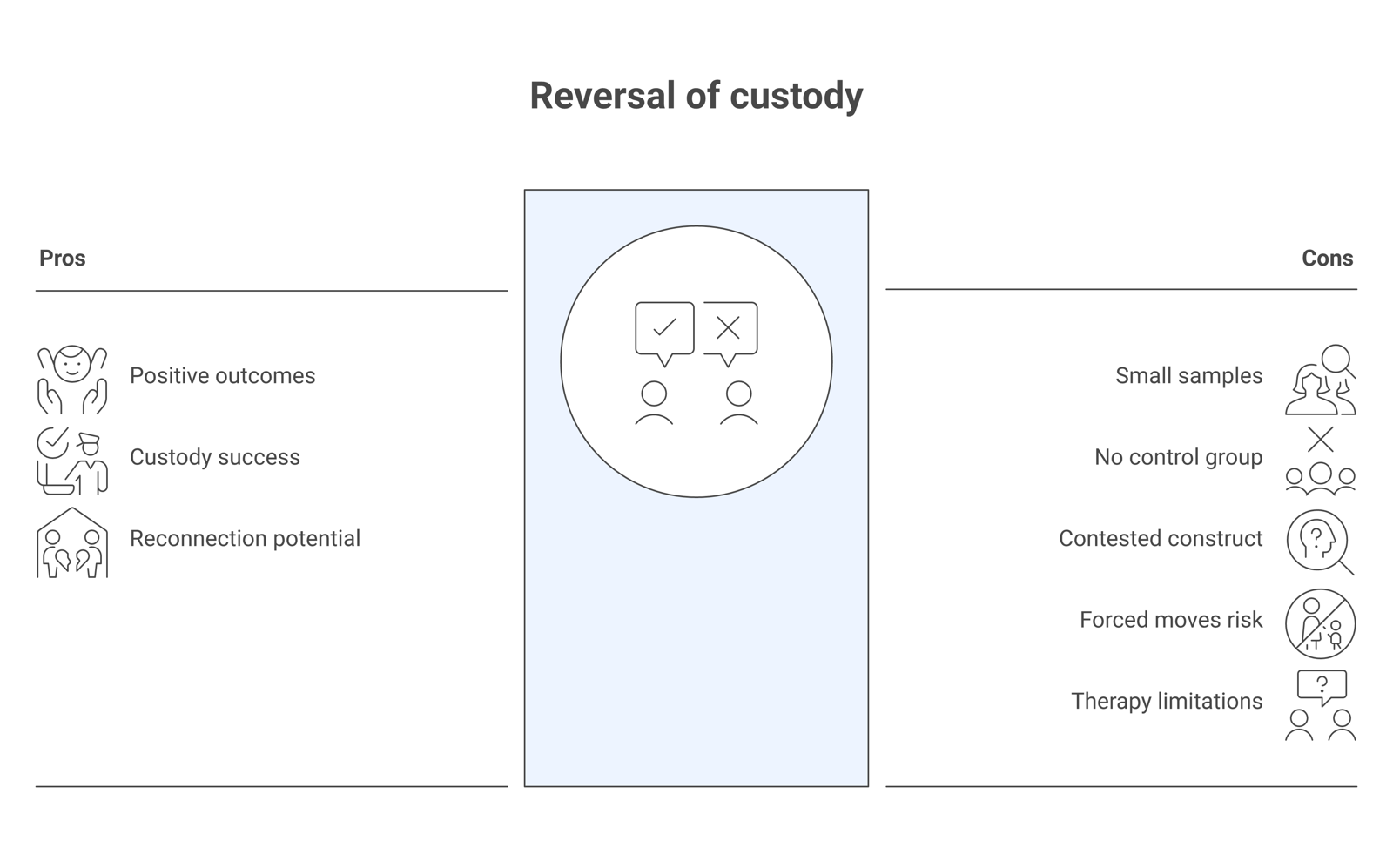
That result is striking, and it is easy to over-read. Six children is a tiny, non-random sample, because it came from a much larger pool of cases where reversal was tried. The children who could be found may differ from those who could not. There was no comparison group of similar children who stayed put. The study cannot say what will happen in any one case. Bala himself sits in the centrist camp, which treats alienation as one explanation among several, not a default. So treat this as a hopeful signal, not a guarantee. It is not a reason to seek a reversal lightly.
One related point is worth naming, because families ask about it often. In many of these cases, the once-favored parent slowly dropped out of the child’s life after losing custody. No court ordered that exit. It happened because the parent gave up after the ruling. The targeted parents in the study, by contrast, supported the child’s contact with the other parent. That pattern is part of why the field treats a reversal as a child-welfare step, not a punishment.
When conventional therapy was not enough
A second, older data point leans the same way, but it carries its own heavy caveats. In a 1994 case series in the Journal of Divorce and Remarriage, John Dunne and Marsha Hedrick reviewed sixteen families. Each fit Richard Gardner’s parental alienation syndrome criteria. In the three cases where the court ordered a change of custody, the change worked. So the children’s bond with the rejected parent improved. In the thirteen cases handled with ordinary therapy, most showed no gain, and a couple grew worse.
The authors did not turn this into a rule. They warned plainly that spotting alienation does not by itself justify a custody change. They even doubted whether the syndrome deserved to be called a syndrome at all. The sample was small, non-random, drawn from severe cases, and decades old. The underlying idea is still contested. Read with care, the study hints at one thing: in the hardest cases, talk therapy alone often does little, while a change of home sometimes does more. It does not say a reversal is a first move or a safe default.
The centrist clinical books land in much the same place. In their Oxford University Press book Children Who Resist Postseparation Parental Contact, Barbara Jo Fidler, Nicholas Bala, and Michael Saini review the research. They find that ordinary counseling often fails in moderate and severe alienation. They reserve stronger steps for carefully chosen cases, after a full review. Their work is widely cited because it sits between the two camps and refuses to oversell any single answer.
The clinical expectation: distress can give way to recovery
Clinicians who work these cases describe a familiar arc when a move is truly warranted. At first the child often protests hard. There can be anger, tears, threats to run, and cries that the move is unfair. Specialists read this early distress as the surface of the alienation, not proof that the move is wrong. The same script was rehearsed before the move. Over days and weeks, in the cases that go well, the pressure eases. Then the child returns to normal life. The child also tests whether the rejected parent is really safe. Often the feared parent turns out to be nothing like the monster the child was told to expect.
This is the expectation, not the promise. It holds in real alienation, where the fear was built up and the bond underneath was real. It does not hold where the fear was earned. From the outside, the two cases can look the same. An alienated child and a truly frightened child can act alike. That is why review before a reversal has to be strict. It is also why honest clinicians refuse to read distress as proof. Recovery is likely in the right cases, but it is not promised in any case.
The serious counter-concern: forced transfers can harm
The hopeful picture above is real. It is not the whole picture, though, and it would be dishonest to stop there. A large body of criticism warns that forced moves and intensive reunification can themselves harm children. The risk is highest when the child’s resistance was justified. Psychologist Jean Mercer reviewed the treatment evidence. She argues that programs built on forced separation from a child’s main attachment figure have not been shown to be safe, or even to work. They also clash with what child development research knows about attachment. On this view, reading a child’s terror as mere alienation can put a child in danger.
News reporting has put faces to that concern. ProPublica documented the case of two Utah siblings, Ty and Brynlee Larson. State authorities had confirmed their father’s sexual abuse in 2018. In 2023 a judge still found the mother to be alienating. Then the judge let police move the children to the father. The order did not mention the earlier abuse findings. The same report cites research by Joan Meier, funded by the Department of Justice. It found that a mother alleging abuse was about twice as likely to lose custody when the father claimed alienation. The report also notes who has declined the parental alienation label: the American Psychological Association and the DSM-5, the World Health Organization, and the National Council of Juvenile and Family Court Judges. A 2023 United Nations report called it a pseudo-concept.
Policy has moved in response to these concerns. The federal Keeping Children Safe From Family Violence Act, known as Kayden’s Law and enacted as Title XV of the Violence Against Women Act Reauthorization of 2022, offers states grant incentives to limit court-ordered reunification treatment, tighten expert-qualification standards, and train judges on family violence. As of mid-2026, Colorado (2023), California (SB 331, Piqui’s Law, 2023), Pennsylvania (Act 8 of 2024), and Utah (Om’s Law, 2024) had adopted conforming laws. A family facing a reversal order paired with reunification treatment should know whether their state has adopted these limits; see Kayden’s Law for the details.
These are not fringe objections, and a fair resource has to hold them fully. The lesson is not that custody reversal is always wrong. Instead, a reversal carries real danger when the review is sloppy. The danger grows when abuse evidence is ignored. It grows again when the alienation label is used to override a child’s real fear. The cost of a wrong reversal is paid by the child.
When a reversal is and is not appropriate
Put both sides together, and the responsible reading is narrow. A custody reversal may fit when an independent, qualified review finds real, severe alienation. First, abuse and neglect must have been carefully ruled out. Second, lighter steps must have failed. Third, the receiving parent must be safe and must support the child’s other relationships. Even then it is a serious step. So it belongs to a court acting on a full record, not to one parent acting on a hunch.
A reversal does not fit as a first response, a threat, or leverage in talks. It does not fit where a child’s resistance tracks documented abuse. Nor does it fit where the abuse evidence was never truly weighed. And it does not fit where the only support for the alienation claim is the rejected parent’s own account. The deciding question is never which parent is angrier or more convincing. The question is what a careful, abuse-aware review shows about why this child is resisting this parent. For how courts weigh these calls, see parental alienation and child custody and can a parent lose custody for alienating a child.
What the first weeks can look like
Families facing a court-ordered change often ask what daily life looks like right after. The honest answer is that it varies. The plan matters as much as the order. Courts that order a reversal often pair it with support. That can mean an intensive workshop, ongoing therapy, or a short limit on contact with the once-favored parent while the new bond steadies. Those reunification supports are themselves contested. The same safety questions apply to them. They are covered in court-ordered reunification therapy and what is reunification therapy.
Children usually need time before anything feels normal. Early weeks can bring testing, withdrawal, and grief for the home that was left, but there are small moments of reconnection too. A good plan expects all of that. So it builds in clinical support. Then it keeps watching for any sign that the child’s first resistance was protective after all. The point of the watching is simple. A reversal is justified only while it is serving the child. A court that ordered one has to stay ready to revisit it if the evidence shifts. Real outcomes range widely. That is why this site keeps both clinical success stories and clinical failure stories side by side, rather than telling only the hopeful half.
Frequently asked questions
What happens to a child after a custody reversal in an alienation case?
In real alienation cases, clinical work and a small follow-up suggest the child’s loud early protest often eases over weeks and months. A real bond with the rejected parent can return. Early distress is normal and expected. Outcomes vary, the evidence is thin, and nothing is promised. But where the child’s resistance was justified by abuse, a forced move can instead deepen harm.
Does the Birnbaum and Bala follow-up study prove custody reversal works?
No. The Birnbaum and Bala follow-up interviewed only six children, years after a reversal. All six were doing well and agreed with the decision in hindsight. That is a hopeful signal. But it is also a tiny, non-random sample with no comparison group, drawn from a much larger pool of 67 cases. So it cannot predict any one outcome, and it is not a reason to seek a reversal lightly.
Can a court-ordered custody transfer traumatize a child?
Yes, it can, and this is a serious, documented concern. Critics such as Jean Mercer argue that forced moves and intensive reunification have not been shown to be safe. ProPublica has reported cases where children were moved to a parent despite confirmed abuse. A transfer carries real danger when the review is poor. It is dangerous when a child’s resistance was a justified response to abuse.
When is a custody reversal not appropriate?
A reversal does not fit as a first move, a threat, or bargaining leverage. It does not fit where a child’s resistance tracks documented abuse. Nor does it fit where abuse evidence was never truly weighed. And it does not fit where the only support for the claim is the rejected parent’s own account. It belongs to a court acting on a full, abuse-aware record after lighter steps have failed.
What happens to the alienating parent after a reversal?
In the cases Birnbaum and Bala followed, many once-favored parents slowly withdrew from the child’s life after losing custody. Usually no court ordered that. They disengaged after the ruling. That is one observed pattern, not a certainty. A good plan usually supports the child’s continued, safe contact with both parents, rather than cutting either one off.
What this page does not do
This page does not tell any reader to seek a custody reversal. It does not promise an outcome. The page does not diagnose alienation in any family. Nor does it treat distress as proof of alienation. And it does not frame a reversal as a way to win or to punish an ex. The right use of this information is simple. Understand a grave decision honestly, including its real risks. Bring careful questions to qualified professionals and to a licensed attorney working from the actual facts.
For how courts approach these cases, see parental alienation and child custody and can a parent lose custody for alienating a child. For the reunification supports that often follow a transfer, see court-ordered reunification therapy, what is reunification therapy, and the program explainer at family bridges and reunification programs. The full Court silo covers the rest.
Sources and further reading
- Fidler, B. J., Bala, N., and Saini, M. A. (2012). Children Who Resist Postseparation Parental Contact: A Differential Approach for Legal and Mental Health Professionals. Oxford University Press. global.oup.com
- Birnbaum, R., and Bala, N. (2024). A retrospective study of outcomes of custody reversal in parental alienation cases. University of New Brunswick Law Journal, 75, 62 to 95. journals.lib.unb.ca
- Dunne, J., and Hedrick, M. (1994). The parental alienation syndrome: An analysis of sixteen selected cases. Journal of Divorce and Remarriage, 21(3 to 4), 21 to 38. https://doi.org/10.1300/J087v21n03_02
- Dreyfus, H. (2023). Parental alienation and its use in family court. ProPublica. propublica.org
- Mercer, J. (2019). Examining parental alienation treatments: Problems of principles and practices. Child and Adolescent Social Work Journal, 36(4), 351 to 363. https://doi.org/10.1007/s10560-019-00625-8
- American Psychological Association. Divorce and child custody. apa.org/topics/divorce-child-custody
- Keeping Children Safe From Family Violence Act (Kayden’s Law), Title XV, Violence Against Women Act Reauthorization Act of 2022, Pub. L. 117-103, codified at 34 U.S.C. 10446(k).
If you or your child are in crisis
Free and confidential help is available right now.
- 988 Suicide and Crisis Lifeline. Call or text 988. 988lifeline.org
- Childhelp National Child Abuse Hotline. 1-800-422-4453. childhelp.org
- NAMI HelpLine. 1-800-950-6264. nami.org/help
Last reviewed: 2026-06-07. Author: Alex Buckles (PAC Founder).