

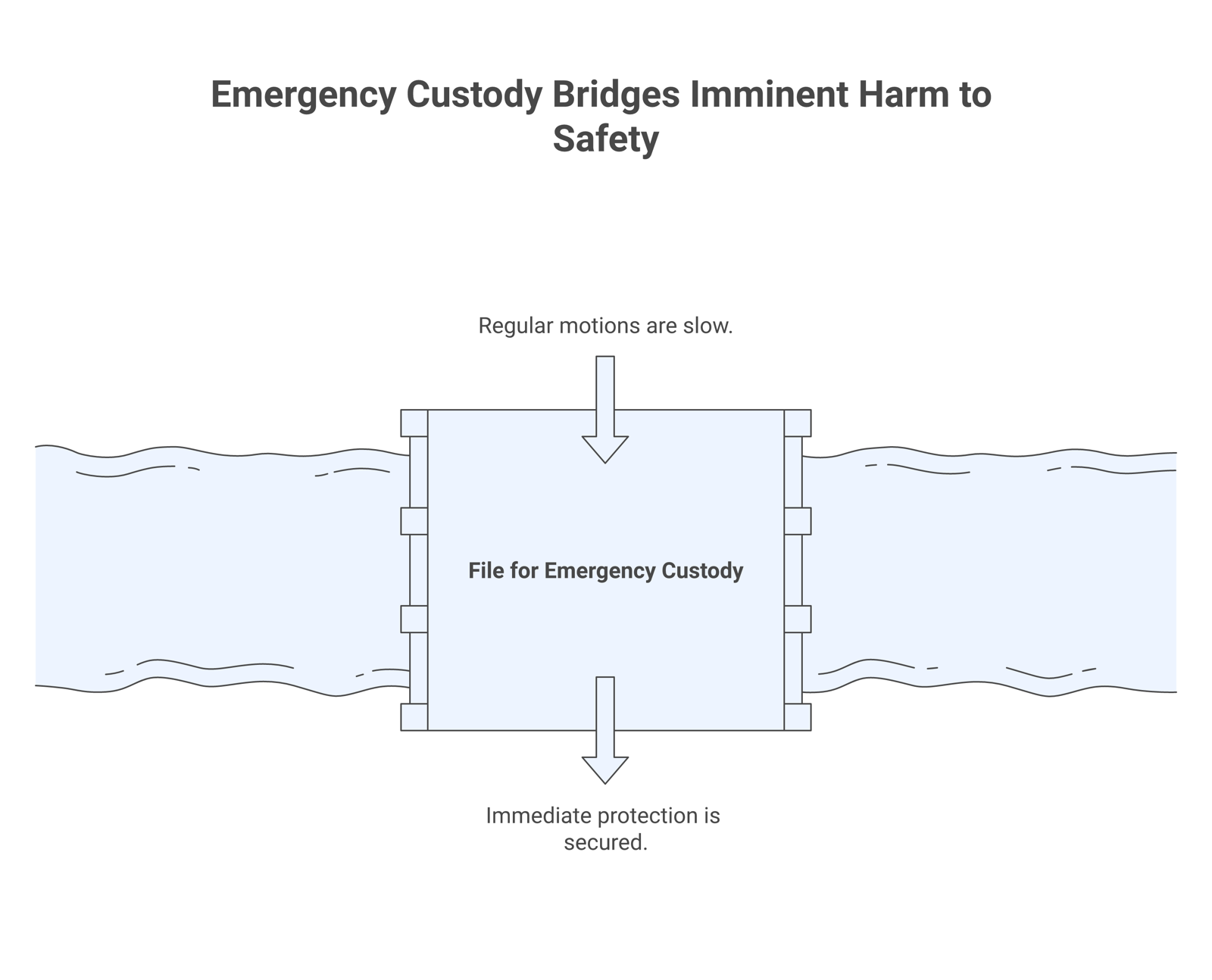
Emergency custody for parental alienation usually requires an immediate risk of serious harm or abduction, not alienation by itself. Courts reserve emergency and ex parte orders for genuine danger. Most alienation is slower, and it is handled through ordinary motions rather than emergency relief. The bar for an emergency order is high, and for good reason.
A note on safety
Genuine danger and abduction risk are real grounds for emergency relief. A parent who pulls a child back from a credible threat, or who acts because the other parent may flee with the child, is protecting the child, not committing alienation. If a child’s safety is at risk right now, contact local law enforcement or a crisis resource first.
This page is general information, not legal advice. It does not create an attorney-client relationship and does not address any one state’s law, where emergency and ex parte standards vary widely. In a true emergency, consult a licensed family-law attorney immediately.
What emergency custody in parental alienation cases means
Emergency custody refers to a fast, often temporary order that a court can issue to protect a child right away. Some courts call this an ex parte order, which means a judge can act on one parent’s request before the other parent has been heard. These orders exist for a narrow purpose. They are meant to stop imminent harm while the slower, normal process catches up.
In a parental alienation case, parents sometimes hope an emergency order will force an immediate change because the other parent is turning the child against them. That hope often meets a hard rule. Courts grant emergency relief for danger that cannot wait, not for conduct that is harmful but gradual. Alienating behavior is serious, yet most of it unfolds over months. The ordinary motion process, not the emergency docket, is built to handle that.
The high bar: imminent risk, not the label
Two questions decide most emergency requests. Is there a real risk of serious harm? Is that risk immediate? When the answer to both is yes, an emergency order may fit. When either answer is no, the request usually belongs in the regular process.
Courts also focus on facts, not labels. Litigator Ashish Joshi and Judge Jon Van Allsburg describe a behaviors-not-labels standard, in which a court acts on documented conduct rather than on a diagnosis or a buzzword. As Van Allsburg puts it, “labels don’t give us any basis on which to make a ruling. It’s the facts that give us that ability.” The word “emergency” works the same way. Calling a situation an emergency does not make it one. The specific facts, the risk and its timing, decide whether the high bar is met.
Why alienation alone usually is not an emergency
Most alienation is a slow pattern. A child grows more distant. Messages go unanswered. Visits get harder to arrange. Each incident is painful, and together they cause real damage, but no single one is a life-threatening crisis. That pattern calls for a careful record and a regular motion, not an emergency filing.
There is a practical reason too. Emergency orders are temporary and limited. A judge who grants one still schedules a full hearing soon after, where both parents present evidence. A parent who rushes an alienation claim onto the emergency docket may get a quick denial and little else. The same facts, organized and presented through the normal process, often carry far more weight.
This is why specialists treat most alienation cases as evidence projects, not emergencies. The work is documentation, expert input where the budget allows, and a clear request the court can grant. Readers can see how that record gets built in how to document parental alienation.
When it genuinely is an emergency: abduction and danger
Some situations truly do justify emergency relief. The clearest are an imminent risk that a child will be taken away and a credible threat of serious harm. These are the real triggers, and they differ in kind from ordinary alienation. A parent facing one of them should seek legal help right away.
Abduction risk
Parental child abduction sits at the severe end of the spectrum. The US Supreme Court has recognized that family abduction is a form of child abuse, with potentially devastating effects on a child’s wellbeing. Advocates such as Jeffery Morehouse, whose own son was taken abroad, work to treat these cases as crimes and child protection, not ordinary custody disputes.
Courts look at concrete warning signs when they weigh abduction risk. A parent who has threatened to flee, who has weak ties to the country, who suddenly obtains passports or closes accounts or quits a job, or who has a history of violence may present a genuine emergency. When abduction across borders is a live concern, the federal and Hague Convention framework comes into play, and the US State Department’s Office of Children’s Issues is the official channel. Parents can start with the State Department’s overview of international parental child abduction.
Genuine danger to the child
A credible threat of serious harm is the other real trigger. Physical abuse, sexual abuse, severe neglect, or a parent’s dangerous instability can each support emergency action. This is also where the safety caveat matters most. A parent who pulls a child back from a real threat is protecting the child, not alienating. The law treats a genuine protective response and an unfounded one very differently, and an honest record is what separates them. The American Psychological Association describes how a child’s wellbeing sits at the center of these decisions.
Severe alienation and the child-protection lens
Severe alienation can shade toward a child-protection concern, and that can change how some courts respond. Drawing on principles from a 1991 decision by Justice Gomery, Canadian attorney Brian Ledmer argues that a child’s complete rejection of a loving parent is rare and signals that something artificial is at work. In that view, severe cases deserve a child-protection level of attention, because, as the decision put it, a court “cannot remain indifferent to the danger to a child’s future emotional stability.”
This does not convert every alienation claim into an emergency. It means that severity and risk, shown through evidence, are what move a case toward faster intervention. A severe pattern with documented harm is treated more urgently than a mild one. The label “severe” does not do that work by itself. The proof does. How alienation can affect custody decisions is covered in parental alienation and child custody.
A caution: emergency motions can be misused
Emergency and ex parte tools deserve respect, and they can also be abused. Because an ex parte order can move fast and be granted before the other parent speaks, it is sometimes filed on thin facts to gain an advantage. A parent might dress up an ordinary dispute as an emergency, or repeat the tactic to harass. Courts notice this. A filing that does not hold up can damage the filer’s credibility for the rest of the case.
The honest standard cuts both ways. The same behaviors-not-labels rule that protects a child from a hidden danger also protects a parent from a manufactured one. A court that looks past the word “emergency” to the actual facts is doing exactly what it should. Anyone considering an emergency motion should be candid with counsel about whether the facts really clear the bar.
What usually works instead: ordinary motions
For the large majority of alienation problems, the regular family-court process is the right path, and it has real tools. A motion to enforce an existing order addresses denied parenting time. A motion to modify custody addresses a lasting, documented change in the child’s circumstances. Either route can include a request for therapy or other intervention. None of these is an emergency filing, and that is not a weakness. It is the process working as designed.
These ordinary motions reward preparation. A clear timeline, saved messages, missed-exchange records, and where possible a professional assessment carry more weight than urgency. The American Bar Association’s Section of Family Law publishes general consumer information on how these motions work. The order types a court can issue are explained in types of parental alienation court orders, and whether the conduct is unlawful at all is covered in is parental alienation illegal. For the wider map of legal options, see the Court resource hub.
Frequently asked questions
Can you get emergency custody for parental alienation?
Usually not on alienation alone. Emergency and ex parte custody orders generally require an immediate risk of serious harm or abduction. Slow, gradual alienation rarely meets that bar. Most alienation is handled through a motion to enforce an existing order or a motion to modify custody, built on a careful record. A licensed family-law attorney in the relevant state can say whether the specific facts could support emergency relief.
What counts as an emergency in a custody case?
An emergency generally means a real and immediate risk that a child will be seriously harmed or taken away. Both parts matter: the harm must be serious, and the risk must be immediate. A painful but gradual situation usually does not qualify. Courts decide based on the documented facts, not on how urgent a filing sounds.
Is parental alienation enough for an ex parte order?
By itself, rarely. An ex parte order lets a judge act before the other parent is heard, so it is reserved for danger that cannot wait. Severe cases need documented risk, not the label “alienation.” A parent who believes the facts rise to that level should consult an attorney quickly rather than filing on their own.
What should a parent do if they fear the child will be abducted?
Treat it as urgent. Contact a licensed family-law attorney immediately, and contact local law enforcement if a child is about to be taken. For international risk, the US State Department’s Office of Children’s Issues is the official channel, and warning signs such as threats to flee or sudden passport activity should be raised with counsel at once.
How is most parental alienation handled if not as an emergency?
Through the ordinary process. The two common tools are a motion to enforce a parenting-plan order and a motion to modify custody, each supported by a documented record over time. Whether a court might shift custody in response to alienating conduct is discussed in can a parent lose custody for alienating a child.
What this page does not do
This page is not legal advice. It does not name any one state’s emergency or ex parte standard as if it applied everywhere, and it does not tell a reader what to file or when. Those choices belong to a licensed attorney working with the real facts. The page also does not frame an emergency motion as a weapon. The right uses of emergency relief are the careful, fact-based ones, focused on a child who is genuinely at risk.
For order types, see types of parental alienation court orders. For how alienation can affect custody, see parental alienation and child custody. For documentation, see how to document parental alienation. The full Court resource hub covers the rest.
Sources and further reading
- American Bar Association, Section of Family Law. americanbar.org/groups/family_law
- US Department of State. International Parental Child Abduction. travel.state.gov
- American Psychological Association. Divorce and child custody. apa.org/topics/divorce-child-custody
If you or your child are in crisis
Free and confidential help is available right now.
- 988 Suicide and Crisis Lifeline. Call or text 988.
- Childhelp National Child Abuse Hotline. 1-800-422-4453.
- NAMI HelpLine. 1-800-950-6264.
Last reviewed: 2026-06-06. Author: Alex Buckles (PAC Founder).