

Last reviewed: 2026-06-17. Author: Parental Alienation Center Editorial Team.
Parental Alienation Anonymous is a free, peer-run 12-step fellowship for people affected by parental alienation. It is modeled on Al-Anon, the program for families of alcoholics. As the founders put it, it is “not a place to get our kids back, it is a place to recover a relationship with ourselves.” So it is peer support, not therapy, not reunification, and not legal help.
A note on safety, read this first
Sometimes a child pulls away because a parent was abusive, neglectful, or frightening. That distancing is justified estrangement, and the child is protecting themselves. This page is about peer support for parents who believe they have lost a child to alienation. It never asks anyone to relabel real harm. If anyone in the family is in danger right now, contact 988 or the Childhelp hotline at 1-800-422-4453 first.
This page offers general information, not clinical or legal advice. A peer-support fellowship is not a substitute for therapy or for an attorney. Anyone facing alienation should also work with a qualified clinician and, where the law is involved, a licensed attorney.
What Parental Alienation Anonymous is
Parental Alienation Anonymous, often shortened to PA-A, is a free fellowship of people who share their experience, strength, and hope around parental alienation. Meetings are peer-led, which means another affected parent or grandparent runs them, not a clinician. The program is worldwide and runs online, so a parent in one country can sit in a meeting with parents in another. You can read the program’s own description on the Parental Alienation Anonymous site.
The fellowship grew out of lived experience, not out of a clinic or a law office. Lawrence Joss, who helped start it, calls it free, imperfect, and taught by doing. Members show both what to do and what not to do. So one person shares a reach-out to a child that went well. Then the next person shares one that blew up. Both stories teach.
Because it costs nothing, there is no membership fee, no upsell, and no product. The only thing asked of a member is a desire to recover their own footing while alienation continues.
How a 12-step fellowship works
A 12-step fellowship works by giving people a shared set of steps and a room full of others walking them. The steps move a person from feeling powerless over another person’s choices toward steady, daily practices they actually control. First a member admits what they cannot control. Then they take an honest inventory of their own part and their own patterns. After that, they keep making small, repeatable changes, one day at a time.
The structure matters because alienation pulls a parent into a loop of waiting and reacting. Every text, every missed exchange, every cold message can hijack the day. The steps interrupt that loop. They move attention from the alienating parent’s behavior, which a member cannot change, back to the member’s own recovery, which they can.
PA-A adapts the wording of the steps to the alienation experience. You can read the program’s own list on its twelve steps page. The list below sums up the arc so you can see the shape first.
- Admit you are powerless over the alienation and that your life has become unmanageable.
- Come to believe a power greater than yourself can restore steadiness.
- Decide to turn your will and your recovery over to that understanding.
- Make a searching and honest inventory of yourself.
- Admit to yourself and one other person the exact nature of your patterns.
- Become ready to let go of the defects that keep you stuck.
- Humbly ask for those shortcomings to be removed.
- List the people your reactions have harmed, including yourself.
- Make amends where doing so would not cause more harm.
- Continue to take personal inventory and admit when you are wrong.
- Seek, through reflection, conscious contact with your understanding of a higher power.
- Carry this message to other alienated parents and practice these principles daily.
Notice that not one step is about the child returning. That is the point. Step one, in the program’s framing, is to accept what you cannot control without giving up your own work, so that you stay grounded if and when the child does come back.
The Al-Anon model it adapts
The Al-Anon model is built for people who love someone they cannot control. Al-Anon Family Groups began in 1951 for the families and friends of alcoholics. Its core insight is that you cannot recover another person, but you can recover yourself, whether or not the other person ever changes. You can read about the model on the Al-Anon Family Groups site.
PA-A borrows that blueprint and points it at alienation. The parallel is close. An alienated parent, like an Al-Anon member, is bound to someone whose choices are causing pain and is outside their control. Both programs answer the same trap with the same move. Instead of trying harder to change the other person, you build a life and a self that hold steady regardless.
This lineage also explains the tone of PA-A. It is calm, not combative. It is about acceptance and daily action, not about strategy or winning. That is a deliberate contrast with the advocacy spaces that name the wound but cannot close it.
Recovery is not reunification, and not treatment
Recovery, reunification, and clinical treatment are three different things, and PA-A is only one of them. Confusing them is one reason so many parents stay stuck. The diagram below lays the three side by side.
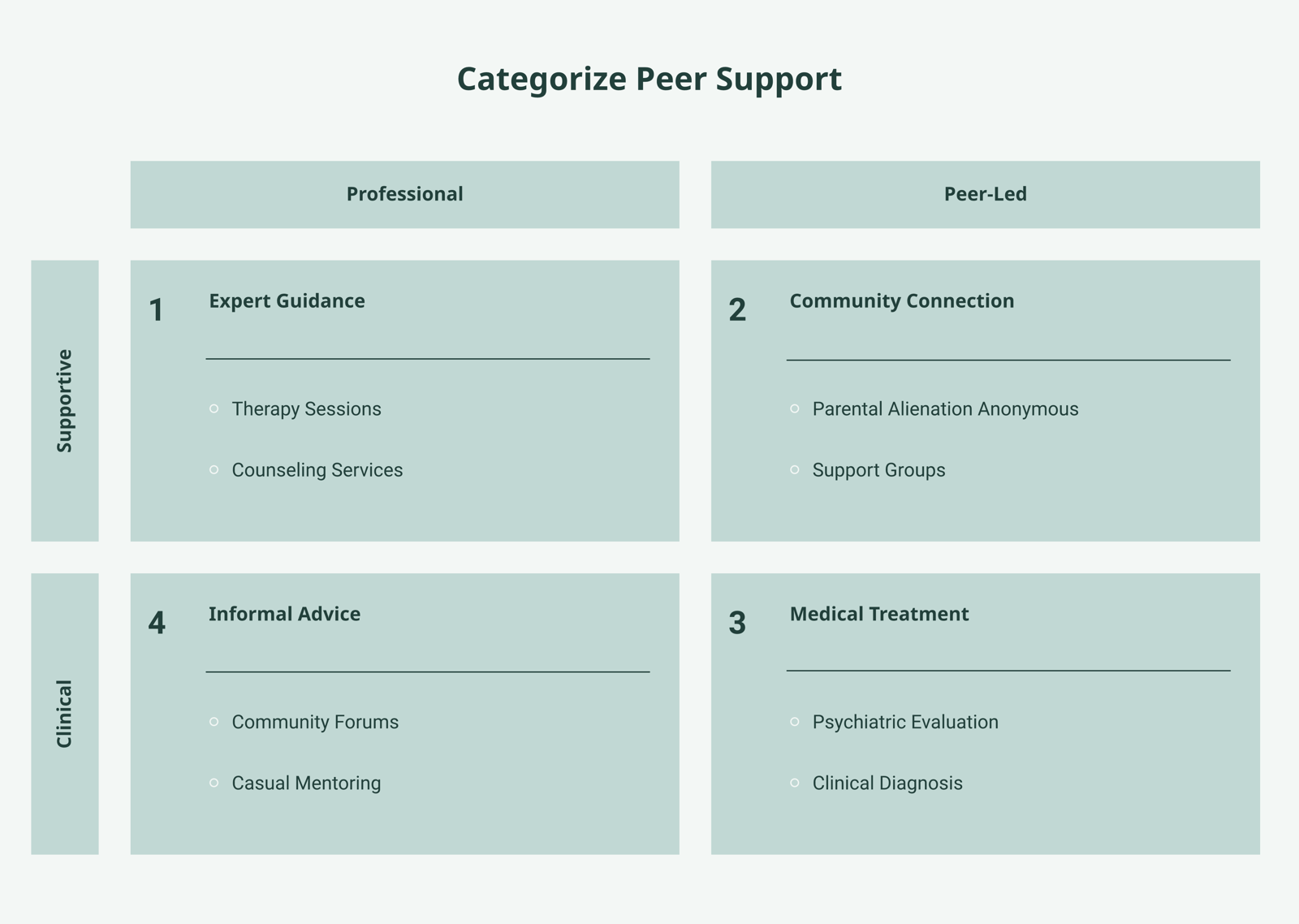
Dorcy Pruter draws the sharpest version of this line. Advocacy and validation name the wound, she says, and that work is sacred and necessary. Recovery, by contrast, closes it. The two are sequential, not in competition. Her warning is blunt and worth sitting with. “Validation feels like progress because it feels better than being gaslit, but validation is not transformation. Feeling seen is not being free.”
PA-A lives in the recovery column, with one careful caveat. It is peer recovery, not clinical treatment. A fellowship can steady your nervous system, give you community, and keep you from white-knuckling alone. Yet it does not deliver a diagnosis, a treatment plan, or a therapist’s office. A structured clinical recovery plan across physical, intellectual, emotional, and spiritual work is the kind of care a licensed professional provides. A peer fellowship complements that care. It does not replace it.
Reunification is different again. It is the relationship-repair work, often guided by a clinician, that aims at a reunion that holds. PA-A does not promise a reunion and does not run reunification therapy. If reunification is your question, see our page on reunification therapy and talk to a qualified professional.
Who it helps, and what to expect
PA-A helps the affected adult more than it changes the case. It is built for alienated and targeted parents, for grandparents cut off from grandchildren, and for other family members carrying the same grief. The shared thread is loving someone whose contact you cannot command.
Members learn a few habits that the corpus describes well. One is the intent-versus-impact habit: you may mean love, but a reach-out lands on the other person’s nerves, so you weigh the likely impact before you act. Another is the both-realities reframe: your truth and the child’s truth can each be real at once, so trying to win that argument tends to backfire. A third is the simplest and the hardest. “Recovery is for me, not for them,” as Lawrence Joss puts it. You become the steadiest version of yourself whether or not the child comes back.
What you should not expect is a method to bring a child home fast. No honest program offers that, and PA-A does not pretend to. What it offers instead is a place to stop drowning, so that you can think, parent, and live while the larger situation stays uncertain.
If you want help finding professional care alongside a fellowship, see finding a therapist and our support for targeted parents page. For the bigger picture of healing and reconnection, start at the Recover hub.
How to find a meeting
You find a PA-A meeting through the program’s own website, because schedules change. Meeting days, times, and formats are set by the fellowship, not by this resource, so the current list always lives on the official site. Visit Parental Alienation Anonymous for the up-to-date schedule and joining details.
Before your first meeting, it helps to know that you can simply listen. You are never required to share, and you can join anonymously. Many parents come to one meeting expecting nothing and stay because, for the first time, the people in the room already understand.
Frequently asked questions
Is Parental Alienation Anonymous free?
Yes. PA-A is a free, peer-run fellowship. There are no fees, no products, and no upsell. It is funded and run by affected members in the Al-Anon tradition.
Is it therapy?
No. It is peer support, not clinical treatment. A fellowship can steady and support you, but it does not provide diagnosis or a treatment plan. Use it alongside, not instead of, care from a licensed clinician.
Will it help me get my child back?
That is not its purpose. The program is, in its own words, “not a place to get our kids back, it is a place to recover a relationship with ourselves.” It helps you stay grounded, which can matter if and when reconnection becomes possible.
Do I have to be religious to join?
No. The steps refer to a higher power as each person understands it. Members include people of every faith and people of none, and the program does not require any particular belief.
Can grandparents and other family members attend?
Yes. PA-A welcomes alienated and targeted parents, grandparents, and other family members affected by alienation. The common thread is loving someone whose contact you cannot control.
If you are in crisis
If you are struggling to cope, please reach out now. Support is free and available around the clock.
- 988 Suicide and Crisis Lifeline, call or text 988, 988lifeline.org
- Childhelp National Child Abuse Hotline, 1-800-422-4453, childhelp.org/hotline
- NAMI HelpLine, 1-800-950-6264, nami.org/help