

This page is general information about one court case. It is not legal advice. Laws and outcomes vary by state and by the facts of each case. For advice about a specific situation, consult a licensed family-law attorney in your jurisdiction.
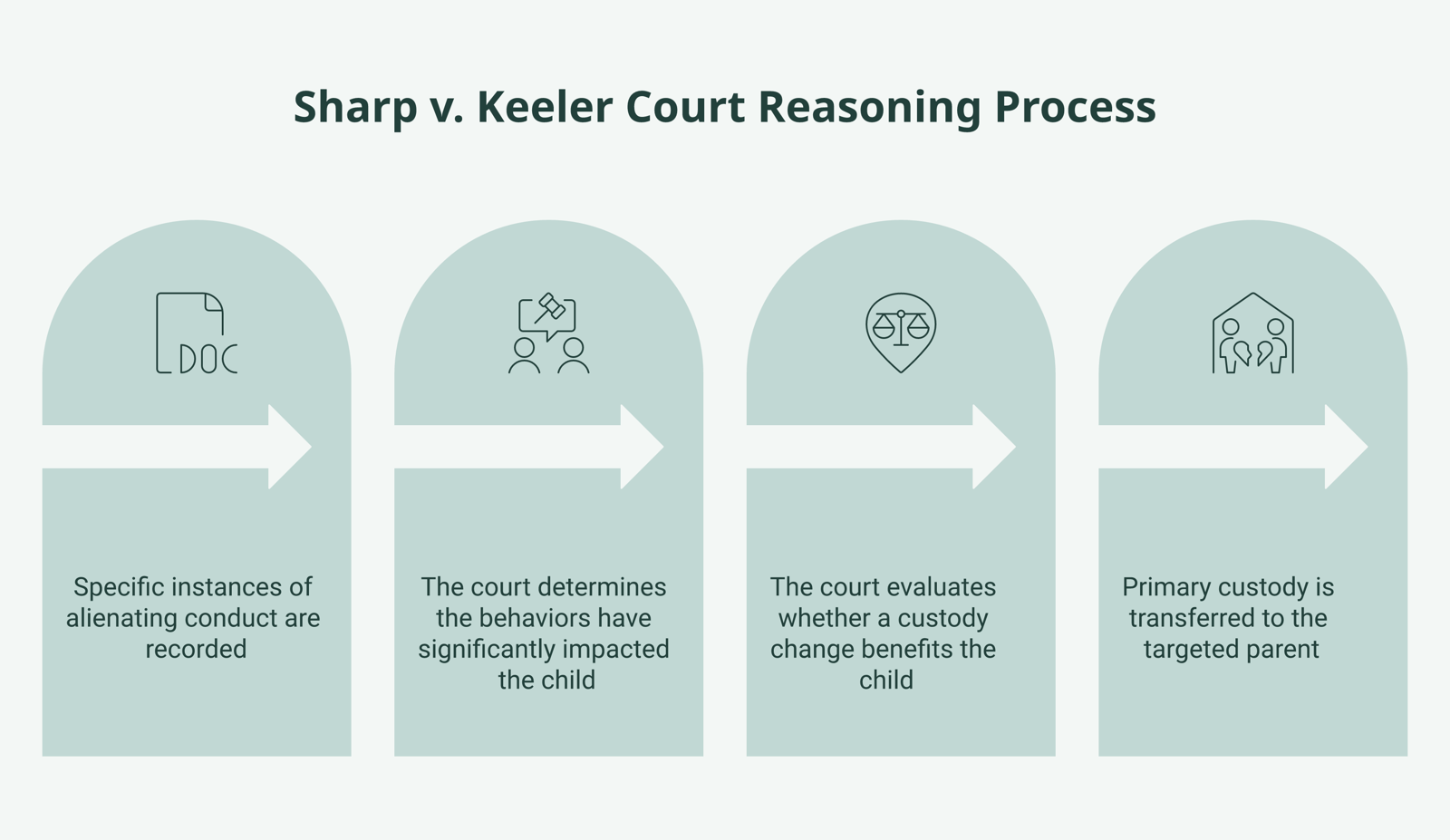
In Sharp v. Keeler (2007), the Arkansas Court of Appeals treated a custodial mother’s dated, sustained interference with the child’s bond with the father as a material change of circumstances. Because that change was found to harm the child, and because a custody change served the child’s best interest, the court moved primary custody to the father. The outcome was tied to its specific facts. It is not a rule that alienation always changes custody.
Before anything else: abuse is not alienation
A child who pulls away from a parent because that parent is genuinely abusive is not being alienated. Instead, that child is responding to real harm, and so protecting that child is the priority. Parental alienation describes a different situation, where a child rejects a safe, loving parent without a good reason, often while echoing the other parent’s hostility. Because the stakes are high, courts and clinicians take this distinction seriously, and so does this page. Researchers who study alienation, including Dr. Richard Warshak, warn that both false claims of alienation and false claims of abuse occur. So an honest analysis first checks whether the rejection is one-sided, extreme, lasting, and unwarranted. Sharp v. Keeler is presented here as one documented legal outcome, not as a template for accusing the other parent.
The short answer
Can a dated, proven pattern of alienating behavior support a change of custody? In at least one published appellate case, yes. In Sharp v. Keeler, 99 Ark. App. 42, 256 S.W.3d 528 (Ark. Ct. App. 2007), the court agreed that a custodial parent’s conduct toward the other parent and the child amounted to a material change of circumstances. That conduct, paired with the child’s best interest, supported moving primary custody to the father. The holding rests on the record in that case. It does not promise the same result anywhere else.
What happened in Sharp v. Keeler
The case involved a father seeking to change custody after a pattern of interference by the mother. Notably, the record before the trial court described concrete, dated conduct rather than a single dispute. The documented behaviors included:
- refusing to use the father’s surname for the child
- withholding the child’s medical information
- denying scheduled visitation
- framing the father to the child as little more than a babysitter
- a fabricated emergency-room episode
Each item was specific. Just as important, each tied back to a duty the custody order or ordinary co-parenting expected of a custodial parent.
Then the trial court found that this sustained pattern operated to the detriment of the child. That finding is the hinge of the case. Importantly, the court did not change custody because the mother was disliked. Nor did it act because the father used the word “alienation.” Rather, it acted because a dated course of conduct was harming the child’s bond with a parent the court viewed as fit.
The legal test the court applied
Arkansas, like most states, does not let a parent reopen custody at will. So, to modify an existing custody order, a parent generally must clear a two-part test. First, the parent must show a material change of circumstances since the last order. Second, the parent must show that a change of custody serves the best interest of the child. You can read the Arkansas custody-modification standard through the official Arkansas Judiciary and the Arkansas Code. Both prongs matter, because a material change alone is not enough, while a bare best-interest argument cannot bypass the change-in-circumstances requirement.
Why the alienating pattern counted as a material change
So the court treated the mother’s proven conduct as the material change. The reasoning is straightforward once the facts are laid out. A custody order assumes each parent will support the child’s relationship with the other parent. But when one parent instead builds a steady record of blocking contact, hiding information, and reshaping the child’s view, the situation the original order rested on has shifted. Because the court found that shift harmful to the child, it satisfied the first prong. Then the best-interest analysis carried the rest of the way, since restoring the child’s access to a fit parent served the child.
What the appellate court left in place and what it changed
On appeal, the Arkansas Court of Appeals largely affirmed the trial court. First, it upheld the custody change. But it did reverse one piece: a condition that had placed limits on the mother’s visitation. So the appellate ruling is not a clean sweep in one direction. Instead, the court endorsed the custody transfer while trimming a restriction it found unsupported. That detail matters for accuracy. The case is a custody change upheld on appeal and a partial reversal on a visitation condition, not a total loss for the other parent.
Why the documented record mattered
The lesson legal observers draw from Sharp v. Keeler is about evidence, not labels. For example, the father did not prevail because he asserted alienation. Instead, he prevailed because he presented a behavior-by-behavior record tied to specific provisions and dates. So a judge could weigh a dated log of denied visits, withheld records, and specific incidents. By contrast, a judge has far less to work with when handed a general complaint that the other parent is “turning the kids against me.”
A separate court case makes the same point from a different angle. In Hanson v. Spolnik, an Indiana appellate case, the alienating parent’s own recorded words helped establish what she knew and intended, because communications themselves are evidence. Yet that case also involved abuse allegations that were not substantiated, which is exactly why the abuse-versus-alienation boundary has to stay in view. The shared thread across both cases is concrete documentation, weighed by a court, not adjectives.
What the case does and does not mean for other parents
Sharp v. Keeler shows that a court can treat a proven alienating pattern as a material change of circumstances. It does not show that a court must, or that any particular parent will see the same result. Several limits are worth stating plainly.
- It is one state. Arkansas appellate law binds Arkansas courts. Other states apply their own modification standards, even where the two-part structure looks similar.
- It is fact-bound. The outcome followed a specific, dated record found harmful to a specific child. Different facts produce different results.
- It is not a tactic. Reading the case as a script for accusing the other parent misreads it. The court responded to dated conduct and the child’s welfare, not to an accusation.
- It does not override the abuse boundary. A child’s reasonable rejection of an abusive parent is not alienation, and courts are alert to that distinction.
So the honest takeaway is modest and useful. Courts sometimes treat sustained, documented interference as a real change that justifies revisiting custody. But whether they do turns on the record, the jurisdiction, and the child’s best interest.
Frequently asked questions
Can parental alienation change custody?
Sometimes. In Sharp v. Keeler (2007), an Arkansas appellate court treated documented alienating conduct as a material change of circumstances that, with the child’s best interest, supported a custody transfer. Outcomes depend on the facts, the evidence, and the state.
Is parental alienation a material change of circumstances?
It can be, in the right facts. In Sharp v. Keeler the court found a custodial parent’s documented pattern of interference harmful to the child, which satisfied the material-change prong of Arkansas’s modification test. A label alone does not satisfy that test; a documented pattern found to harm the child can.
What did Sharp v. Keeler decide?
The Arkansas Court of Appeals affirmed a change of primary custody to the father after the mother’s documented interference was treated as a material change of circumstances. The court reversed one visitation restriction while leaving the custody change in place.
Does documenting a pattern help in court?
A dated, specific record gives a court something concrete to weigh. In Sharp v. Keeler the father’s case rested on dated behaviors tied to specific order terms, not on the word “alienation.” A record is about giving a court facts it can check, not about gaining an edge over the other parent.
Is the 2008 Sharp v. Keeler case the same thing?
No. A later appeal between the same parties exists at 103 Ark. App. 233 (2008). The alienation-as-material-change holding discussed here comes from the 2007 opinion at 256 S.W.3d 528. The two should not be merged.
Related reading
If you want the underlying construct, start with what parental alienation is in Learn. Then, to recognize the behaviors a court might weigh, see the patterns described in Signs. When you are ready to prepare a clear record, see how to document a pattern for court and how courts evaluate alienation evidence in Court.
Sources
- Sharp v. Keeler, 99 Ark. App. 42, 256 S.W.3d 528 (Ark. Ct. App. 2007). Published opinion, cited for the alienation-as-material-change holding and the partial reversal of the visitation condition.
- Arkansas custody-modification standard (material change of circumstances and best interest of the child), via the official Arkansas Judiciary and the Arkansas Code.