

Parental alienation legal failure stories show family courts failing in two opposite directions. In one, an alienation label overrides substantiated abuse and removes a child from a protective parent. In the other, courts ignore genuine alienation and leave orders unenforced. Both are misclassification. Each harms children. The pattern deserves scrutiny.
A note on safety and balance
A court finding of alienation is not proof that alienation occurred. When a state authority has already substantiated abuse, that finding must not be overridden by an alienation label. At the same time, genuine parental alienation is real and can be a form of emotional abuse, and it is sometimes wrongly ignored. Both truths hold at once. If a child’s safety is at risk, contact local law enforcement or a domestic-violence resource first.
This page is general education, not legal advice. It does not create an attorney-client relationship and does not address any one state’s law. State laws vary. The cases described here illustrate patterns; none should be read as a ruling on any reader’s situation. Anyone in or near litigation should consult a qualified attorney in their own jurisdiction.
The two ways courts get parental alienation wrong
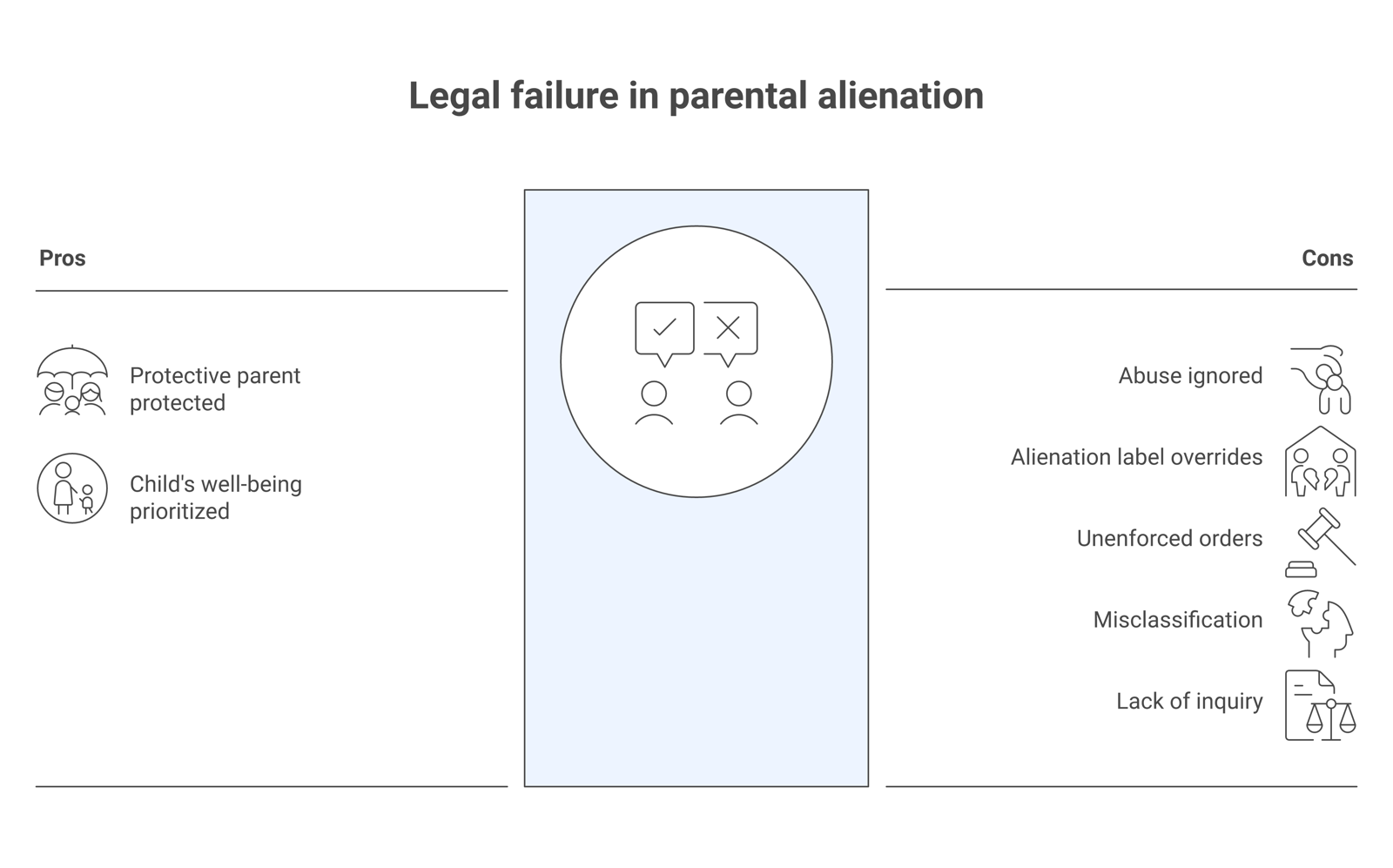
A legal failure in a parental alienation case is not a single thing. Courts get these cases wrong in two opposite directions, and the two failures are mirror images of each other.
The first failure runs against protective parents. A parent reports abuse, the other parent answers that the first parent is alienating the child, and the court treats the abuse report itself as evidence of alienation. Where that happens, a child can be moved toward the very person the child fears. The second failure runs the other way. A court recognizes that one parent is genuinely turning a child against the other, enters an order to fix it, and then does nothing when that order is ignored.
These are not competing claims about which problem is real. Both problems are real. Abuse and alienation can each occur, and research shows they can even occur in the same family, so the task for a court is to tell them apart with care. The harm documented on this page is misclassification, not the existence of either abuse or alienation. For the cases where courts get it right, see the companion legal success stories.
Failure one: an alienation label overriding substantiated abuse
The most thoroughly documented failure of this kind comes from investigative journalism, not from a marketing page or an anonymous account. In August 2023 the newsroom ProPublica, reporting by Hannah Dreyfus, published a detailed examination of how the parental alienation label is used in family court.
The Larson case
The reporting followed two Utah siblings, Ty and Brynlee Larson, who later chose to share their identities publicly. State authorities had substantiated their father’s sexual abuse in 2018. Despite that prior finding, a judge in 2023 concluded that the mother was alienating the children and authorized police to move them to the father. According to ProPublica, the order moving the children did not mention the earlier abuse findings at all. The siblings resisted the transfer and spoke about it on social media, and the case drew enough attention that Utah lawmakers later called for a reexamination of court-ordered reunification practices. You can read the full ProPublica investigation for the complete account.
This is the clearest documented example of the first failure direction. A finding the state had already made, that a child was abused, was set aside in favor of a finding that the protective parent was alienating. The label did the work that the evidence should have done.
Why a finding of alienation is not proof of alienation
The Larson case illustrates a principle that holds far beyond Utah. A judge writing “alienation” in an order does not establish that alienation happened. It establishes that one decision-maker, on one record, reached that conclusion, sometimes without weighing a prior abuse finding at all. A child who resists a parent may be alienated, or may be responding to something the child has good reason to fear. Telling those apart is the whole job, and a label skips it. This is why the boundary between justified estrangement and parental alienation matters in every case, a boundary explored further in child custody and emotional abuse.
What the data shows, and what it does not settle
A single case, however well documented, cannot establish a pattern. The question of how often the first failure happens has been studied directly, and the evidence is genuinely contested.
The Meier finding
The most cited study is by Joan Meier and colleagues, published in 2020 and funded by the National Institute of Justice through George Washington University. The researchers coded thousands of US custody opinions. They reported that when mothers alleged abuse and fathers responded with a cross-claim of alienation, the mothers’ rate of losing custody roughly doubled, rising from about 26 percent to about 50 percent. A father’s alienation cross-claim also made courts substantially more likely to disbelieve a mother’s child-abuse claim. The effect was gender-specific rather than symmetric. You can find the study through the National Institute of Justice.
The counter-study and the limits of both
That finding is not the end of the argument. In the same year, Jennifer Harman and Demosthenes Lorandos published a study of 967 appellate cases, pre-registered and coded by reviewers who were blind to the hypotheses. They reported little evidence that alienation claims were widely misused to override abuse, and found no evidence that children were placed with actively abusive parents. Their work is framed directly as a rebuttal to Meier.
Each study has limits worth naming. Meier and colleagues acknowledged that their sample over-represents published appellate opinions, which can skew the picture, and they were careful to say their data cannot prove that any individual ruling was wrong. Harman and Lorandos are leading figures on the side that affirms parental alienation as a construct, so their framing is not neutral either. The honest summary is that this is a live, unresolved empirical dispute, and neither pole should be presented as settled. The broader question of the construct’s scientific standing is covered in is parental alienation real.
The protective-parent critique
A body of advocacy and policy work argues that the first failure is not an occasional accident but a systemic risk. This pole deserves a fair hearing, and its evidence weight deserves an honest label.
The Safe and Together Institute, led by David Mandel, publishes practitioner guidance arguing that parental alienation is often used to reframe a protective parent as a manipulator after that parent reports abuse or coercive control. The Institute cites the Meier doubling and proposes that practitioners pivot to examining the pattern of the alleged abuser rather than the resistance of the child. This is advocacy opinion rather than new data, and it promotes the author’s own model and training, so it should be read as a strong statement of one position.
At the international level, the UN Special Rapporteur on violence against women and girls, Reem Alsalem, issued a thematic report in 2023, catalogued as A/HRC/53/36, that calls parental alienation a “pseudo-concept” and recommends that states legislate to prohibit its use in family courts. That report carries real weight as a statement of concern, and it is important to be precise about what it is. It is one appointed rapporteur’s thematic report, not a binding position of a UN body, and it is contested by groups that affirm the construct. Readers weighing the false-allegation question can also see parental alienation and false allegations.
Failure two: courts ignoring genuine alienation
The mirror-image failure is just as real, even though its public evidence base is weaker and must be labeled as such. Here a court accepts that a parent is genuinely undermining a child’s relationship with the other parent, or enters an order meant to protect that relationship, and then the system fails to follow through.
Unenforced orders
In this failure mode a parent may hold a valid parenting-time order, a reunification-therapy order, or a finding of alienating conduct, and watch it go unenforced month after month. Exchanges are missed, calls are blocked, therapy is obstructed, and the court does not act. For the targeted parent and the child, an order that is never enforced can be worse than no order at all, because it signals that the conduct carries no consequence.
The weaker evidence base, named honestly
The documentation for this second failure is thinner than for the first, and saying so is part of being honest. A frequently shared example is a 2018 Psychology Today post by the psychologist Susan Heitler titled “Two Classic Cases of Courts Failing Alienated Parents.” That post is built on two reader-submitted letters, not on adjudicated cases, and the facts in it cannot be verified. It belongs in the low-evidence tier.
A more balanced legal-industry treatment comes from the Weinberger Law Group, which has written about parental alienation accusations being raised as a counter-weapon. That piece is marketing content from a law firm, with no named cases, so it too sits low on the evidence scale. It is useful for a different reason. It states the both-and position plainly, acknowledging that alienation is real and harmful and also misusable, and it urges courts to ask why a child resists before reaching a finding. The harm that follows when treatment is imposed without that care is examined in clinical failure stories.
Holding the both-and line
The two failure directions can make it tempting to pick a side and decide that alienation is either a weapon or a fact. Neither simplification survives contact with the evidence.
Research on the overlap between parental alienation and intimate-partner violence, associated with Amanda Sharples and colleagues, examined cases where a court found alienation and looked at who in the case had a substantiated abuse record. In their data, when substantiated abuse existed, it was more often attached to the alienating parent than to the targeted parent, and unsubstantiated abuse allegations were more often aimed at the targeted parent. That work sits on the affirming side of the field, so it is one input rather than the final word, and it should be read next to the critical pole rather than instead of it.
The point that survives from all sides is the both-and. Abuse and alienation can each be real. They can even appear in the same family at the same time. A child can be both genuinely frightened of one parent and genuinely turned against the other, which is exactly why a court cannot let one label foreclose the other inquiry. Treating these as a single either-or question is what produces failures in both directions.
How to read these stories: evidence weight
Not every story carries the same weight, and a careful reader should sort them before drawing conclusions. The table below labels the main anchors on this page by how well documented they are.
| Story or source | What it shows | Evidence weight |
|---|---|---|
| ProPublica, Larson (2023) | A substantiated-abuse finding overridden by an alienation finding | High: named subjects, documented investigative reporting |
| Meier and colleagues (2020) | Abuse-alleging mothers’ custody-loss rate roughly doubled by alienation cross-claims | Peer-reviewed, federally funded national analysis, with an acknowledged appellate-sampling limit |
| Harman and Lorandos (2020) | Little misuse found across 967 appellate cases | Rigorous design, but authors are leading affirming figures |
| UN Special Rapporteur, A/HRC/53/36 (2023) | Calls the construct a “pseudo-concept”; urges prohibition | One rapporteur’s thematic report, not a binding UN position |
| Safe and Together Institute | Argues the label is used to reframe protective parents | Advocacy opinion, no new data |
| Heitler, Psychology Today (2018) | Two accounts of unenforced orders | Low: unverifiable reader letters |
| Weinberger Law Group | Both-and framing of weaponization | Low: marketing content, no named cases |
The lesson is not that low-weight stories are worthless. It is that a documented, named case carries more for a court and a reader than an anonymous letter, and that a contested study must be cited with its counter-study attached.
What the failures have in common
The two failure directions look like opposites, yet they share a single root. In both, the court does not ask carefully enough why this particular child resists this particular parent.
When that question is skipped in one direction, a child who is reacting to real harm gets relabeled as alienated, and the protective parent is treated as the problem. When it is skipped in the other direction, a child who is genuinely being turned against a parent gets left in place because the court never names the alienating conduct or never enforces the order against it. The same missing step, a patient and evidence-led inquiry into the cause of the resistance, drives both errors. That inquiry is a clinical and forensic skill, addressed for professionals in differential diagnosis of contact refusal and for the bench in how judges view parental alienation.
Frequently asked questions
Can a court use parental alienation against a protective parent?
It can happen. The ProPublica investigation documented a Utah case in which a judge found the mother alienating and authorized moving the children to a father whose abuse the state had already substantiated, with the transfer order not mentioning those prior findings. A court finding of alienation is not proof that alienation occurred, and a prior, substantiated abuse finding should not be set aside by a label.
Does parental alienation get used to override abuse claims?
The evidence is contested. A peer-reviewed, federally funded study by Meier and colleagues found that when mothers alleged abuse, fathers’ alienation cross-claims roughly doubled the mothers’ custody-loss rate. A separate study by Harman and Lorandos, examining 967 appellate cases, reported little misuse and no placements with actively abusive parents. This remains a live, unresolved dispute, and neither result should be treated as the last word.
Do courts ever ignore real parental alienation?
Yes, and this is the mirror-image failure. Some parents hold valid orders or findings that go unenforced for long stretches, while exchanges are missed and therapy is obstructed. The public documentation here is weaker, often advocacy writing or unverifiable accounts rather than named cases, but the failure is real and harms children just as the first one does.
Is parental alienation real if courts sometimes misuse it?
Misuse of a label does not make the underlying harm fake. Genuine parental alienation exists, can amount to emotional abuse, and is sometimes wrongly ignored by the system. The harm described on this page is misclassification in either direction, not the existence of alienation, and the evidence that abuse and alienation can co-occur is exactly why courts must distinguish them with care.
What do these legal failures have in common?
Both stem from a court not asking carefully enough why a specific child resists a specific parent. Skip that question in one direction and a frightened child is relabeled as alienated. Skip it in the other and a genuinely alienated child is left without protection. A patient, evidence-led inquiry into the cause of the resistance is what separates a sound finding from a harmful one.
What this page does not do
This page does not declare parental alienation either fake or universally valid, and it takes no side in the construct dispute. It does not tell any reader that their own case is a failure of one type or the other. No single case here is offered as proof of a nationwide pattern, and contested research is labeled as contested. The page also does not frame either failure direction as a tactical opening to exploit, and it cites no state law as if it were universal. For the cases where the system worked, see the legal success stories; for treatment outcomes, see the clinical success stories and clinical failure stories.
Sources and further reading
- ProPublica (Hannah Dreyfus). Parental alienation and its use in family court (Aug 19, 2023). propublica.org/article/parental-alienation-and-its-use-in-family-court
- Meier, J. S., Dickson, S., O’Sullivan, C., Rosen, L., & Hayes, J. (2020). U.S. child custody outcomes in cases involving parental alienation and abuse allegations. Journal of Social Welfare and Family Law, 42(1), 92 to 105. National Institute of Justice. nij.ojp.gov
- Harman, J. J., & Lorandos, D. (2020). Allegations of family violence in court: How parental alienation affects judicial outcomes. Psychology, Public Policy, and Law. (Peer-reviewed counter-study to Meier 2020.)
- UN Special Rapporteur on violence against women and girls, Reem Alsalem. Custody, violence against women and violence against children. Report A/HRC/53/36 (2023).
- Safe and Together Institute (David Mandel). Practitioner guidance on parental alienation and coercive control.
If you or your child are in crisis
Free and confidential help is available right now.
- 988 Suicide and Crisis Lifeline. Call or text 988. 988lifeline.org
- Childhelp National Child Abuse Hotline. 1-800-422-4453. childhelp.org
- NAMI HelpLine. 1-800-950-6264. nami.org/help
Last reviewed: 2026-06-07. Author: Alex Buckles (PAC Founder). Editorial review: held to the PAC Editorial Standards (balance, primary-source citation, reader safety); an independent expert review board will be appointed.