

Parental alienation legal success stories share a pattern: a court screens out abuse, finds that one parent actively undermined the child’s bond, orders a proportionate remedy, and the child does better over time. These wins are real but harder to document than failures, and a finding of alienation is never automatic.
A safety note, first
When a child pulls away from a parent who genuinely harmed them, that is a safety response, not alienation. It must never be recast as a false claim. A court finding of alienation is also not proof that alienation occurred; courts can get it wrong in both directions. If a child may be unsafe, contact local police or a child-protection agency before anything else.
This page is general education. It is not legal advice, and it does not assess any one family. Anyone facing these questions in a real case should consult a licensed attorney in their own jurisdiction.
What a parental alienation legal success story actually looks like
A parental alienation legal success story is a case where a court rules out abuse, finds a documented pattern of one parent undermining the child’s relationship with the other, orders a remedy matched to the severity, and the child’s wellbeing improves afterward. Notice what is missing from that sentence. There is no mention of one parent beating the other in court.
The distinction matters because the popular version of a “win” is a custody fight won. That framing is wrong for this topic, and it is part of why these cases are so often misunderstood. So a genuine success here is measured by the child’s outcome, not by which adult prevailed.
Courts that handle these cases well tend to work from behavior, not from labels. Litigators Ashish Joshi and Judge Jon Van Allsburg describe this as a “behaviors, not labels” standard. A parent who arrives in court insisting the other parent is a narcissist or an abuser, but who brings no fact pattern, tends to lose. In contrast, a parent who can show specific conduct, such as blocked parenting time, repeated denigration, and interference with contact, gives the court something it can actually rule on. As Van Allsburg puts it, labels do not give a court a basis on which to make a ruling; facts do.
The result that earns the word “success” is proportionate. Most recognized alienation does not end in a custody reversal. The most common judicial response is more time for the rejected parent plus community-based family counseling, with reversal reserved for severe, entrenched cases. For more on how judges actually approach these disputes, see how judges view parental alienation.
In re Miller: the principle that alienating conduct can cost custody
The most frequently cited American statement of the underlying principle comes from New Hampshire. In In the Matter of Miller and Todd, 161 N.H. 630 (2011), the state Supreme Court restated a widely held rule: conduct by one parent that tends to alienate a child’s affection from the other parent can be so harmful to the child that it becomes grounds to deny or change custody. You can read the opinion summary on FindLaw.
Here is the nuance that most summaries leave out, and it is the most important teaching point on this page. In that very case, the father argued that the mother had alienated the children through repeated sexual-abuse accusations, and the court did not award him custody. Instead, parenting responsibility stayed with the mother. The case even involved a court-commissioned parental-alienation evaluation by a psychologist. So the principle was affirmed while the alienation claimant still did not prevail.
That outcome teaches something the marketing version of these stories hides. A label does not win. Saying the word alienation, even citing a real precedent, does not deliver custody. The court still weighs whether alienation is actually established and what serves the child. Read honestly, Miller is both a success story for the principle and a caution against assuming an alienation claim prevails.
One more limit deserves a clear flag. Miller is New Hampshire precedent. It is one state’s articulation of a principle that many courts share, not a national rule, and family law varies by jurisdiction. So treat it as a window into how courts reason, not as the law where you live. For the broader question of when custody can change, see can a parent lose custody for alienating a child.
Proving alienation without an expert, and why that cuts both ways
Many parents in these cases have no lawyer, no guardian ad litem, and no money for a custody evaluator. Judge Van Allsburg has argued that courts can find alienation without expert testimony, by marshalling a credible, fact-based narrative of behavior from lay witnesses. For a parent who cannot afford an evaluation, that route can be the difference between being heard and being written out of the system entirely.
The same low bar cuts the other way, though, and the honest version of this page has to say so. Lowering the threshold to lay “storytelling” also makes it easier to misclassify justified estrangement as alienation. For example, a child who avoids a parent for a real reason can be described in alienation language by a persuasive narrator. So the tool that helps a genuine case can harm a protective parent or a real victim in the wrong hands.
Proving alienation and proving it correctly are not the same task, though. The skill is not just assembling a story; it is ruling out the alternatives first. The same discipline that protects a falsely accused parent also protects a truly frightened child, because both depend on following the evidence rather than the most confident voice in the room. For the careful version of documentation, see how to prove parental alienation.
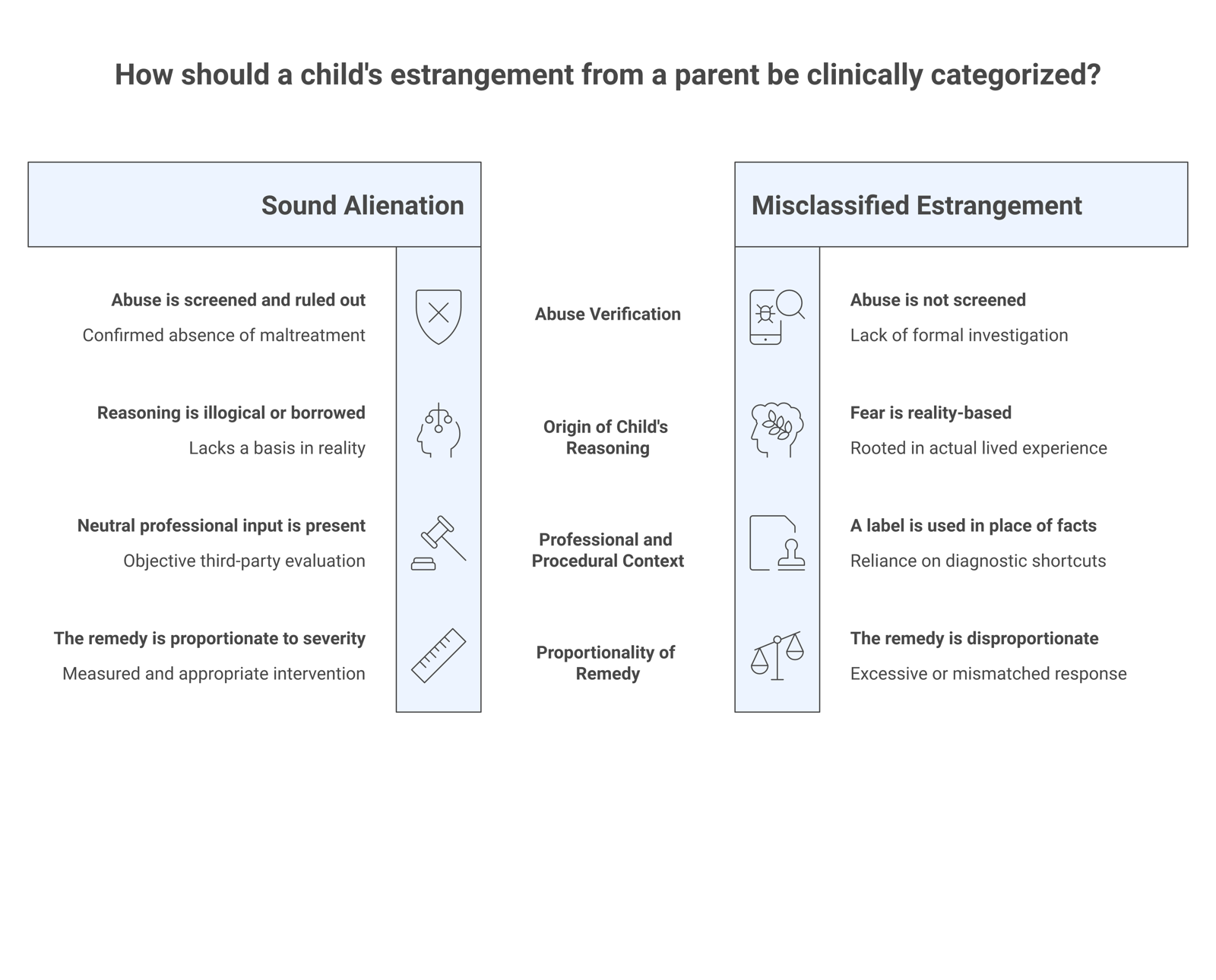
What separates a sound alienation finding from a misclassification
The difference between a sound finding and a misclassification comes down to a short list of gates. None of them is a checklist a parent can run at home, and all of them belong to trained, neutral professionals working with the full record. Still, knowing the gates helps a reader judge whether a court got it right.
- Abuse is screened and ruled out. After all, real, proven abuse takes a case out of the alienation category entirely. Amy Baker’s widely used model builds this in: one of its factors is the absence of real abuse or neglect by the rejected parent. Ruling out abuse is the first step, not an afterthought.
- There is a documented pattern of interference, not a single bad moment. For example, think blocked parenting time, written denigration, and sustained efforts to disrupt contact, shown across time rather than asserted once.
- The child’s reasoning is illogical or borrowed rather than reality-based. A child with a genuine grievance can usually describe it in concrete, age-appropriate terms. In contrast, a child caught in alienation often offers reasons that are absolute, scripted, or out of proportion to anything that happened.
- Neutral professional input is present. A finding grounded in an independent evaluator or a court-appointed professional is far stronger than one built on one parent’s narrative alone.
- The remedy is proportionate to severity. A measured order that adds contact and counseling for a moderate case, and reserves removal for a severe and entrenched one, signals a court weighing the child’s interest rather than punishing a parent.
A law-firm analysis from the Weinberger group frames the inverse usefully: the red flags of misuse include a claim that arises only after the other parent reports abuse, and a court that finds alienation without first asking why a child resists. The same source notes that genuine alienation tends to come with documented interference and no legitimate safety basis. The research literature urges the same caution. Reviewing sixteen cases in 1994, forensic evaluators Dunne and Hedrick found that custody change worked in the cases where it was ordered, yet they warned plainly that identifying alienation alone does not justify a custody change. You can read their analysis via its journal listing. For the two-directional risk in more depth, see parental alienation false allegations.
The empirical signal and the dispute it is caught in
Readers often want a number. How often do courts actually get this right? The honest answer is that the data are partial, contested, and pointed in opposite directions by serious scholars. So two studies anchor the dispute, and presenting only one of them would be dishonest.
On the affirming side, Harman and Lorandos published a 2020 study of 967 appellate case reports. It was pre-registered, and the cases were coded by reviewers blind to the hypotheses, which makes its method strong. The study reported that alienation arguments were not widely misused to override abuse, that alienating parents generally received less parenting time, and that almost no children were placed with actively abusive parents. Read on its own, that is a portrait of a system mostly working.
The method is strong, yet the authors are not neutral observers; they are leading figures in the pro-alienation field, and one is a practicing alienation litigator. Still, that does not make the findings wrong. It does mean the study should be read as one well-built pole of an argument, not as the final word.
On the contesting side sits the 2020 study led by Joan Meier and funded by the National Institute of Justice, which you can find through the NIJ library. Analyzing thousands of court opinions, Meier and colleagues found that when mothers alleged a father’s abuse, the father’s cross-claim of alienation roughly doubled the mother’s risk of losing custody, an effect that was gender-specific rather than symmetric. Critics of that study note that it over-represents published appellate opinions, which can skew the picture. Meier in turn concedes the data cannot prove any single ruling was wrong.
So the strongest empirical success signal is genuinely contested by the strongest empirical failure signal, and neither pole is settled. The fair takeaway is narrow. Courts sometimes recognize real alienation and act well, and courts sometimes get alienation wrong in ways that endanger children. Both are on the record, and no single statistic resolves a particular family’s case.
What follow-up research suggests after a remedy
Suppose a court does order a remedy in a severe case. What happens to the child years later? That is the question most targeted parents and adult survivors actually ask, and the research literature has one small but striking follow-up.
Researcher Rachel Birnbaum and law professor Nicholas Bala published a retrospective follow-up in 2024 in the University of New Brunswick Law Journal. They reviewed 67 reported Ontario alienation cases from 2010 to 2022, almost half of which ended in custody reversal, and they located and interviewed six of the children years later, along with 13 parents. All six children had a good relationship with the formerly rejected parent and were doing well. More notable still, all six said the judge had been right to force the change, even though they had fought it bitterly at the time. The finding also has a hard edge that hopeful readers should not skip: none of the six had any relationship with the formerly favored parent. In these families, the reconnection the court ordered came at the price of the other bond, and an honest account has to hold both facts together.
Read this result with its limits in plain view. Six children out of 67 cases is a tiny, self-selected sample, and the families who agree to a follow-up interview are not a cross-section of all alienation disputes. So the finding cannot tell you how often reversals end well. What it offers instead is a credible, if narrow, answer to the fear that a court-ordered change must traumatize a child for good. In these six lives, it did not, and the children later endorsed the decision. For how treatment can support such an outcome, see clinical success stories.
The success-factor profile, and what it is not
Advocacy and coaching materials sometimes circulate a profile of parents who “succeeded” against alienation. One well-known version, from Jayne Major’s Breakthrough Parenting work, describes such parents as those who completed parenting-skills training, never retaliated against the other parent, persisted over years, funded the legal fight, retained experienced counsel, and communicated carefully with evaluators.
That profile is worth reading, with one honest label attached. It is prescriptive coaching advice, not documented case data. The profile tells you what a particular advocate believes correlates with better outcomes, drawn from a syndrome framing that not all clinicians accept. Notably, it does not report verified results from named, adjudicated cases. So treat the profile as a reasonable set of behaviors to consider, not as proof that following them produces a win. The behaviors it describes, especially refusing to retaliate and staying child-focused, are echoed in clinical guidance, which is part of why they are worth weighing.
Where these wins can go wrong
Balance is not a courtesy on this topic; it is a requirement, because the same alienation argument that rescues a genuine case can be weaponized against a protective parent. Any honest account of legal success has to hold the failure mode in view at the same time.
Still, the Meier data above is one signal of that risk. The clearest single documented case is the ProPublica investigation of the Larson siblings in Utah, which you can read in full at ProPublica. State authorities had substantiated the father’s sexual abuse in 2018. In 2023, a judge nonetheless found the mother to be alienating and authorized police to move the children to the father, in an order that did not mention the earlier abuse findings. So the children resisted. That is not an alienation success story; it is an alienation finding used to override a substantiated abuse finding, and it shows how much damage a misclassification can do.
So hold the boundary clearly. Estrangement caused by genuine abuse is not alienation, and a child who avoids an abuser is not an alienated child. A court finding of alienation is not, by itself, proof that alienation happened. For the full set of cases where the system fails, including this one, see legal failure stories. The success stories on this page are only meaningful when read alongside those failures.
How to weigh these stories: the evidence ladder
Because this field is contested, the kind of evidence behind a story matters as much as the story itself. A simple ladder helps. At the top sit documented case law and news-verified accounts, where names, dates, and records can be checked. Below that sit peer-reviewed case series, which are systematic but often small and selective. Below that sit anonymized clinical vignettes. At the bottom sit illustrative or composite stories, which teach a model but report no actual outcome.
Then apply the ladder to the anchors on this page. In re Miller is documented case law. The Meier and Harman and Lorandos studies are peer-reviewed, with the caveats noted above. Dunne and Hedrick is a small, dated, contested case series. The widely shared UK reunification vignettes published by Karen Woodall sit at the bottom rung: they are heavily disguised, with no verifiable names, dates, or citations. Such vignettes can illustrate that reunion is possible, but they are illustrative, not documented outcomes, and this page does not present them as proof.
Reading this way protects you from two traps: dismissing a real principle because one telling was hyped, and believing a hopeful anecdote because it was vivid. For the parallel caution on the treatment side, see clinical failure stories.
Frequently asked questions
Can a parent lose custody for parental alienation?
Yes, in principle, and courts have done it. For example, decisions such as In re Miller in New Hampshire restate the rule that alienating conduct can be grounds to change custody. A label alone does not achieve this, though. A court still has to find that alienation is genuinely established, rule out abuse, and decide that a change serves the child. Most recognized cases end in added contact and counseling rather than a full reversal.
Do you need an expert to prove parental alienation in court?
Not always. Some judges hold that alienation can be found from behavior evidence and lay testimony, without a formal expert diagnosis, which matters for parents who cannot afford an evaluation. That lower bar carries a real risk, however: it makes misclassifying justified estrangement as alienation easier. Strong cases still rest on a documented pattern of conduct and, where possible, neutral professional input.
What happens to the child after a custody reversal?
The honest answer is that good, long-term data are scarce. One small retrospective follow-up (Birnbaum and Bala, 2024) interviewed six children years after court-ordered reversals and found all six doing well with the formerly rejected parent; all six said the judge had been right to force the change, and none remained in contact with the formerly favored parent. Six children is a tiny, self-selected sample, so it cannot tell you how often reversals end this way. It does push back on the fear that a court-ordered change must permanently harm a child.
Are parental alienation claims usually believed by courts?
It is contested. One strong study, by Harman and Lorandos, found little misuse and few children placed with abusive parents. Another strong study, by Meier and colleagues, found that a father’s alienation cross-claim roughly doubled an abuse-alleging mother’s odds of losing custody. Both are peer-reviewed, both have limits, and they point in opposite directions. No single number settles whether claims are believed too often or too rarely.
Is a court finding of parental alienation proof that it happened?
No. A finding is a legal conclusion reached on the evidence presented, and courts can be wrong in either direction. For example, they can miss real alienation, and they can label a protective parent or a real victim as an alienator. The Larson case in Utah, where a judge found alienation despite a prior substantiated abuse finding, shows why a finding should be read critically rather than treated as settled fact.
Sources and further reading
- In the Matter of Miller and Todd, 161 N.H. 630 (2011). FindLaw. caselaw.findlaw.com
- Meier, J. S., Dickson, S., O’Sullivan, C., Rosen, L., and Hayes, J. (2020). U.S. child custody outcomes in cases involving parental alienation and abuse allegations. National Institute of Justice. nij.ojp.gov
- Dunne, J., and Hedrick, M. (1994). The Parental Alienation Syndrome: An Analysis of Sixteen Selected Cases. Journal of Divorce and Remarriage, 21(3-4), 21 to 38. doi.org/10.1300/J087v21n03_02
- Dreyfus, H. (2023). Parental Alienation: A Disputed Theory With Big Implications. ProPublica. propublica.org
- Harman, J. J., and Lorandos, D. (2020). Allegations of family violence in court: How parental alienation affects judicial outcomes. Psychology, Public Policy, and Law. (Peer-reviewed counter-study to Meier 2020.)
- Birnbaum, R., and Bala, N. (2024). A retrospective study of outcomes of custody reversal in parental alienation cases. University of New Brunswick Law Journal, 75. Open access: journals.lib.unb.ca
If you or your child are in crisis
Free and confidential help is available right now.
- 988 Suicide and Crisis Lifeline. Call or text 988. 988lifeline.org
- Childhelp National Child Abuse Hotline. 1-800-422-4453. childhelp.org
- NAMI HelpLine. 1-800-950-6264. nami.org/help
Last reviewed: 2026-06-07. Editorial review: held to the PAC Editorial Standards (balance, primary-source citation, reader safety); an independent expert review board will be appointed. Author: Alex Buckles (PAC Founder).