

Parental alienation clinical success stories share one pattern: treatment works best when the pieces line up. Offending-parent therapy, reunification therapy, and court backing, applied after abuse is screened out, can restore a damaged relationship. Outcomes vary, much of the published evidence is illustrative rather than measured, and coercive programs can themselves cause harm.
Screen for abuse first
A child who pulls away from a parent who has been abusive, neglectful, or frightening is showing justified estrangement, not alienation. Reunification is not the remedy for abuse-driven estrangement. Screen for abuse and coercive control before any reunification work begins. Where abuse is founded, the protective logic runs the other way, and the success stories on this page do not apply.
This page is general education, not clinical advice, and not a substitute for a licensed clinician. It does not diagnose or plan treatment for any specific family. It describes what the published literature reports, including how strong or weak that evidence is.
What a clinical success story actually looks like
A clinical success in parental alienation is a case where treatment helps a child rebuild a damaged relationship with a rejected parent, after genuine abuse has been ruled out, and without coercing or harming the child. The published examples share a shape. Offending-parent therapy addresses the behavior that drove the rejection. Reunification therapy rebuilds the child’s bond with the rejected parent. Court backing holds the plan in place. No single piece tends to work on its own.
Most of these stories are not measured outcomes, and the honest reading depends on knowing which is which. Some are illustrative composites built to teach a model. Others are anonymized vignettes from practice. A few are small case series. Read each one for what it is. The label on the evidence matters as much as the happy ending.
That honesty is the point of this page. The science here is young and contested. Professional bodies that work in this space, such as the Association of Family and Conciliation Courts, stress careful screening and a response matched to the actual problem rather than a one-size cure. A success story that skips the screening step is not a model worth copying.
The graduated, abuse-screened model the literature points to
When clinicians describe what works, they describe a graduated model, not a single cure. Richard Warshak, writing for the American Academy of Matrimonial Lawyers in 2015, frames alienation on a continuum from mild to severe and matches the intensity of the response to the severity of the case. Mild cases may need only parent education. Counseling can help some moderate cases. Warshak cautions that ordinary counseling often makes things worse in moderate to severe cases, a caution he draws from the work of Fidler and Bala.
A second source points the same direction. Friedlander and Walters describe a Multi-Modal Family Intervention, often shortened to MMFI, in the journal Family Court Review. Their core point is that most contact refusal is not pure alienation. Most cases are hybrid, with several causes running at once. An intervention aimed only at alienation will run into trouble and can cause harm. Their model treats the whole family, needs the favored parent to take part, and needs court authority to hold.
A 2017 systematic review by Templer and colleagues, published in the Journal of Family Therapy, gathered the best available practice recommendations. The review found broad agreement on a handful of principles: screen carefully, match the response to severity, involve the whole family, and pair therapy with court authority. It was also candid about the evidence base. The review rested on only ten heterogeneous studies, and none of them were randomized controlled trials.
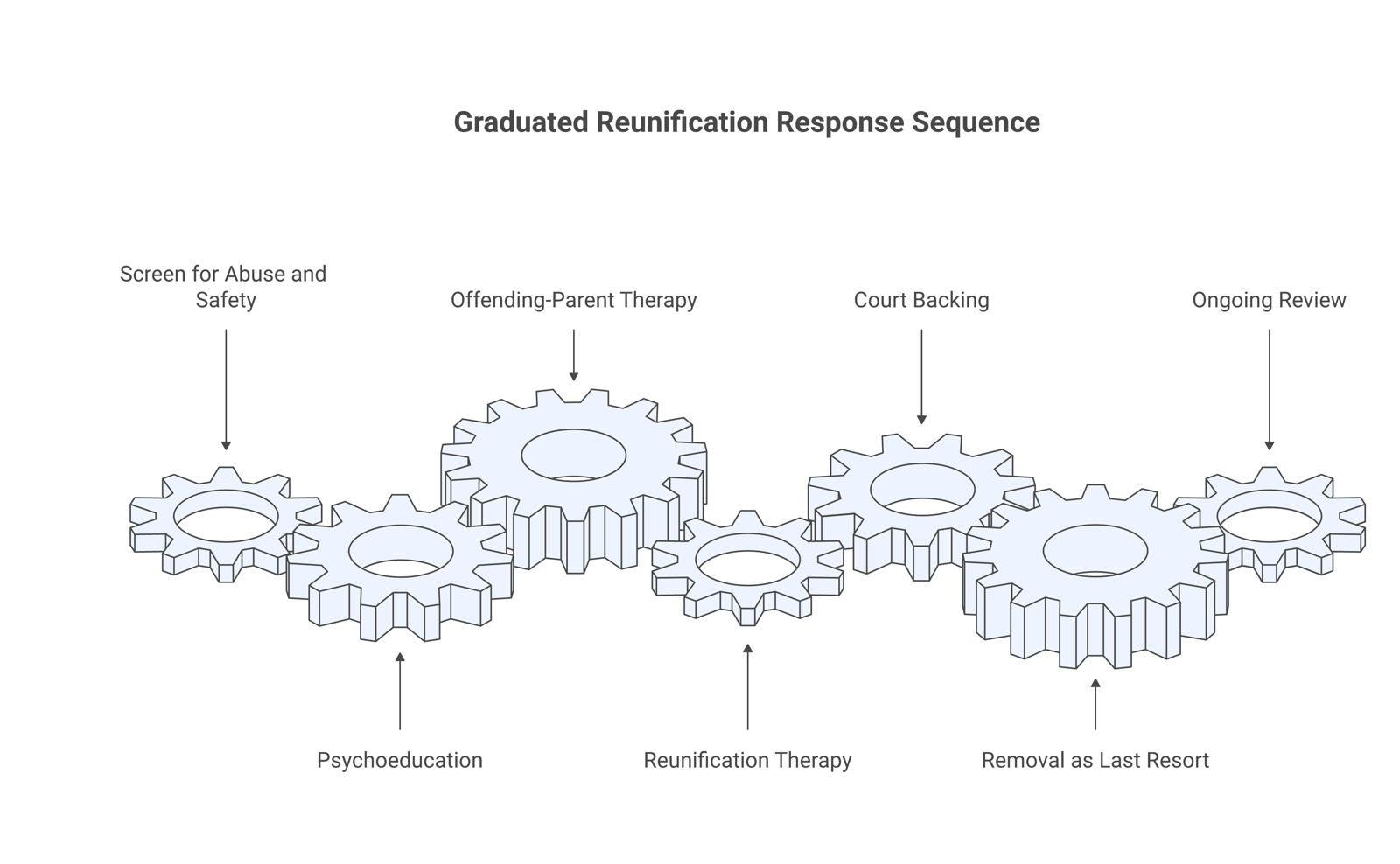
The thread running through all three sources is that therapy and court authority work together, not apart. Standard therapy without court backing tends to lose traction in serious cases. For the method itself, see what reunification therapy is and how it works when a court orders reunification therapy.
“Helen and Steve”: an illustrative model, not a documented result
One of the most cited clinical narratives is a family the authors call Helen and Steve. It appears in Social Work Today, in an article co-authored by William Bernet. The story is explicitly a fictional composite. It was built to illustrate a tiered model, not to report an actual outcome. That distinction matters, and this page keeps it visible.
In the composite, a mother’s abuse claim was ruled not indicated, and a fourteen-year-old daughter was severely alienated. The illustrated model is graduated. Mild cases get psychoeducation. Moderate to severe cases get offending-parent therapy plus reunification therapy, with court-ordered removal held in reserve as a possible step. In the story, the daughter was removed to her father. After about ten months of dual-track therapy, the relationship was restored, and the parents agreed to a fifty-fifty schedule.
Read this as a teaching illustration. It shows how the pieces are meant to fit together. It is not evidence that they fit for a real family, because Helen and Steve are not a real family. Presenting a composite as a documented win would mislead the very parents this page is meant to help.
Woodall’s stories of hope: vignettes, clearly labeled
Karen Woodall, a practitioner in the United Kingdom, has published a set of reunification vignettes under the heading “stories of hope.” In one, two children alienated from their mother for five years reconnected after a court reversed where they lived and used a short foster-care bridge. In another, an eight-year-old’s fear reaction eased after about a year of exposure therapy. A third describes three teenagers reunifying with a parent out of court over nine months.
These accounts are encouraging, and they are also anonymized and heavily disguised. No names, dates, or citations can be checked. Woodall writes from a strongly affirming stance. Treat the vignettes as illustrations of what some practitioners report, not as measured results. They belong on a success page only with that label firmly attached.
Dunne and Hedrick: when a custody change worked
The closest thing to documented clinical evidence in this set is a 1994 case series by Dunne and Hedrick, two Seattle evaluators, published in the Journal of Divorce and Remarriage. They reviewed sixteen families that met the criteria for what was then called parental alienation syndrome. In the three cases where the court ordered a custody change, the change worked. Across the thirteen cases handled with conventional therapy alone, the alienation mostly did not shift. Eleven showed no improvement, and two grew worse.
This is the finding quoted most often by both sides of the debate. The authors themselves were careful. They warned that identifying alienation does not by itself justify a custody change. They also questioned whether the syndrome deserved to be called a distinct syndrome at all.
The caveats are serious and worth stating plainly. The sample was small and not random. There was no control group. The cases were selected at the severe end of the spectrum. The study is now decades old, and the underlying construct remains contested. So the result is suggestive, not conclusive. You can read the original report through its published record.
Contested claimed successes: read them with the caveats attached
Some of the loudest success claims come from intensive reunification programs, and they call for the most caution. Linda Gottlieb’s Turning Points for Families promotes a four-day intensive that pairs the child with the rejected parent and separates the child from the alienating parent for a period afterward. Program literature cites a 96.4 percent success rate. That figure is the program’s own internal number. It is self-reported, it has not been independently verified, and it should never be cited without that caveat.
A 2023 ABC7NY investigation shows why the caution is warranted. A Florida judge found that a mother, Barb Jones, was alienating, and the family was ordered into the Turning Points program. The father, David Jones, calls the program effective. His daughter, Arianna Jones, calls that period the hardest time of her life, and says you do not combat parental alienation with more parental alienation. A separate participant describes lasting trauma. One investigation, one program, two opposite experiences. That contrast is the honest picture, and it is why a claimed success rate cannot settle the question by itself.
Why the safety critique belongs inside every success story
The success stories on this page are incomplete without the critique that runs against them. Jean Mercer, in a 2019 review, argues that court-ordered reunification treatments have not been shown to be effective and may in fact be harmful. Her central concern is the mechanism. Programs that force separation from a child’s primary attachment figure run against attachment and developmental science. Mercer and Drew expand the argument in a 2022 edited volume, which gathers professionals who question both the evidence and the ethics of coercive practice.
Supporters answer that randomized trials are hard to run for ethical and practical reasons, and that untreated severe alienation is itself harmful. Both points can hold at the same time. The evidence base is thin, and coercion carries real risk. A clinical success worth the name improves a child’s life without trading one harm for another. The other half of this story, the cases where treatment entrenches the rejection or the program itself hurts the child, lives on the clinical failure stories page, the explicit counterweight to this one.
What separates a success from a harm
- Genuine abuse is screened out first, so justified estrangement is never treated as alienation.
- The response is graduated, with intensity matched to the severity of the case.
- The favored parent does their own work in offending-parent therapy, rather than the child carrying the whole load.
- Court backing supports the plan, so the work does not lose traction between sessions.
- The child is not coerced, and a stalled plan can be changed.
- Progress is measured honestly, not asserted with an unverified success rate.
None of these features guarantees an outcome. Results vary by family, by severity, and by the quality of the team. The American Psychological Association’s overview of divorce and child custody frames these decisions around the child’s best interest, which is the right anchor here. For the clinical mechanics, see family systems therapy for parental alienation and trauma therapy for parental alienation. For a parent’s first steps, see how to reconnect with an alienated child.
The legal side of these outcomes runs on a parallel track. Courts can recognize alienation and apply a proportionate remedy, or they can misread the situation and cause harm. Both patterns are covered in legal success stories and legal failure stories.
Frequently asked questions
Do parental alienation clinical success stories prove reunification therapy works?
No. Most published success stories are illustrative composites or anonymized vignettes, not measured outcomes. They show how clinicians believe the pieces fit together. They do not prove the approach works for any specific family. The strongest piece of evidence in this set, a 1994 case series, is small, uncontrolled, and decades old. The science is genuinely young and contested.
What is the most documented clinical success in parental alienation?
The Dunne and Hedrick 1994 case series is the closest to documented evidence. Custody change worked in the three cases where a court ordered it, while conventional therapy alone did not shift the alienation in the other cases. The sample was small and non-random, there was no control group, and the cases were severe, so the finding is suggestive rather than conclusive.
Is the 96.4 percent success rate for reunification programs real?
That number is a program’s own internal figure, not an independently verified result. It has not been confirmed by outside researchers, and the same program that cites it has also drawn serious harm allegations from participants. Treat the figure as a marketing claim, and never repeat it without that caveat.
Can reunification therapy harm a child?
Yes, it can. Critics including Jean Mercer argue that coercive, court-ordered programs that force separation from a child’s primary attachment figure can be harmful and lack a solid evidence base. The risk is real. That is why screening for abuse, matching the response to severity, and avoiding coercion are central to any responsible approach.
What has to be true before reunification is even appropriate?
Genuine abuse, neglect, and coercive control have to be screened out first. A child’s rejection of a parent who was actually frightening or harmful is justified estrangement, and reunification is not the answer to it. Reunification work is appropriate only when abuse has been ruled out and the rejection is being driven by alienating behavior rather than real danger.
What this page does not do
This page is not clinical advice, and it does not diagnose or plan treatment for any family. It does not promise that a damaged relationship can be repaired quickly, or at all. It never frames a “get your child back fast” pitch, because that framing misleads parents and can put children at risk. And it does not present illustrative or composite stories as documented results, because the difference between an illustration and an outcome is the whole point.
Contested constructs, including parental alienation syndrome, are presented here as contested. Where the evidence is thin, the page says so. For the failure side of the same picture, see clinical failure stories.
Sources and further reading
- Dunne, J., & Hedrick, M. (1994). The parental alienation syndrome: An analysis of sixteen selected cases. Journal of Divorce & Remarriage, 21(3 to 4), 21 to 38. https://doi.org/10.1300/J087v21n03_02
- Warshak, R. A. (2015). Parental alienation: Overview, management, intervention, and practice tips. Journal of the American Academy of Matrimonial Lawyers, 28, 181.
- Friedlander, S., & Walters, M. G. (2010). When a child rejects a parent: Tailoring the intervention to fit the problem (the Multi-Modal Family Intervention). Family Court Review, 48, 98.
- Templer, K., Matthewson, M., Haines, J., & Cox, G. (2017). Recommendations for best practice in response to parental alienation: Findings from a systematic review. Journal of Family Therapy, 39(1), 103 to 122.
- Mercer, J. (2019). Examining parental alienation treatments: Problems of principles and practices. Child and Adolescent Social Work Journal, 36(4); and Mercer, J., & Drew, M. (Eds.). (2022). Challenging Parental Alienation. Routledge.
- American Psychological Association. Divorce and child custody. apa.org/topics/divorce-child-custody
- Association of Family and Conciliation Courts (AFCC). afccnet.org
If you or your child are in crisis
Free and confidential help is available right now.
- 988 Suicide and Crisis Lifeline. Call or text 988. 988lifeline.org
- Childhelp National Child Abuse Hotline. 1-800-422-4453. childhelp.org
- NAMI HelpLine. 1-800-950-6264. nami.org/help
Last reviewed: 2026-06-07. Author: Alex Buckles (PAC Founder).