

Parental alienation clinical failure stories show that treatment fails in describable ways, not at random. Ordinary therapy without court backing can entrench the problem. Coercive reunification can itself harm a child. And a hybrid or abuse case mislabeled as alienation gets the wrong treatment. The failure is usually a mismatch, not proof that help is impossible.
Screen for abuse first
A child’s resistance can be a protective response to real harm. Where a child’s refusal is justified by abuse or neglect, reunification pressure is the wrong response and can deepen the injury. A treatment that fails is not proof the child was alienated. If a child’s safety is at risk, contact local law enforcement or a child-protection resource first.
This page is general education, not clinical or legal advice. It does not diagnose any family, and it does not replace assessment by a licensed clinician. Parental alienation remains a contested construct, and the cases below are described with their evidence weight labeled honestly.
What parental alienation clinical failure stories reveal
A clinical failure in parental alienation is a case where treatment does not repair the parent-child relationship, or actively makes things worse, usually because the treatment did not match the family’s real problem. The pattern matters more than any single story. When you read enough accounts, the same few failure modes keep appearing.
Two truths sit underneath this page, and both have to be held at once. Genuine parental alienation exists, and it harms children; Harman, Kruk, and Hines (2018) argue in Psychological Bulletin that alienating behaviors amount to an unacknowledged form of family violence. Good treatment also exists, and it can restore a relationship that looked lost. The companion page on clinical success stories of parental alienation tells that side in full. This page is the honest counterweight. It looks at where help breaks down, so that families and clinicians can spot a mismatch before it does damage.
The lesson is not that all reunification is bad, and it is not that nothing works. The lesson is narrower and more useful. Treatment fails when it is aimed at the wrong target, applied without safeguards, or forced on a child whose resistance was justified all along. So if you can name the failure mode, you can often avoid it.
The three ways treatment tends to fail
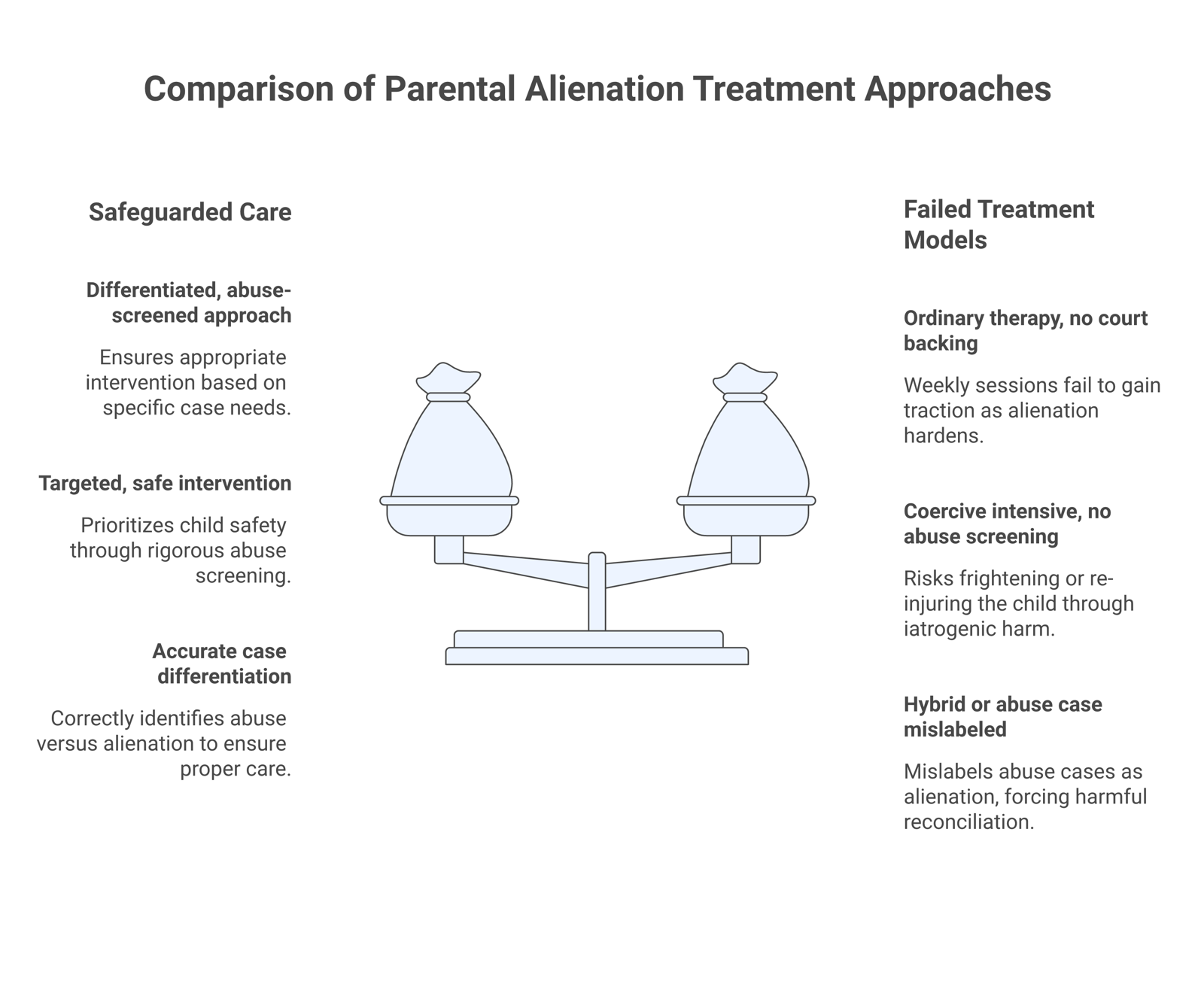
Across the documented and clinical accounts, three failure modes recur. One is ordinary therapy that runs without court backing, so it never gains traction and the alienation hardens. A second is a coercive, intensive program applied without careful abuse screening, which can frighten or re-injure a child. A third is a hybrid or abuse case that gets labeled as alienation-only, so the child receives the wrong treatment entirely.
Each of these is a mismatch, because the treatment never fits the family’s real problem. Set against them is a single safeguarded alternative: care that is differentiated to the family’s actual dynamic, screened for abuse first, supported by the court where severity requires it, and reviewed as it goes. The sections below walk each failure mode in turn, then return to what the safeguarded version looks like.
When ordinary therapy entrenches alienation
The most common clinical failure is quiet. Nothing dramatic happens. A child is sent to weekly individual counseling, the sessions continue for months, but the rejection of the targeted parent does not budge. Sometimes it even deepens.
Practitioners who work these cases have a structural explanation. Brian Ludmer, a Canadian attorney with decades of parental alienation practice, draws on a 1991 Quebec decision by Justice John Gomery to argue that alienation is a relational problem. So treating the child alone, without the rejected parent in the room, is built to fail. The therapeutic alliance that helps in ordinary individual therapy can work against a directive family process, because a clinician who mainly wants the child to like them will avoid the hard, structured work the case needs. This practitioner view is clinical opinion, not controlled research, and it should be read that way.
There is real caution required here. Ludmer’s circle treats failed conventional therapy as a near-diagnostic sign of alienation. But that inference is risky. A therapy that did not work can mean many things, and one of them is that the original alienation theory was wrong. A failed treatment is evidence of a failed treatment. It is not, by itself, proof that a child was alienated.
The oldest case series in this area illustrates both the failure and its limits. In 1994, Seattle forensic evaluators Dunne and Hedrick published an analysis of sixteen families selected because they met Richard Gardner’s criteria for the contested construct then called parental alienation syndrome. Of the cases handled with conventional interventions rather than a custody change, most showed no improvement and a couple grew worse. The authors were careful: they cautioned that identifying alienation alone does not justify changing custody, and they questioned whether the syndrome deserved to be called a distinct syndrome at all. The study is genuinely informative, yet its evidence weight is modest. It covered a small, non-random, severe-end sample, used no control group, dates to 1994, and rests on a construct that remains disputed.
For the clinical reasoning that separates entrenched alienation from other causes of refusal, see the guide to the differential diagnosis of contact refusal.
When coercive reunification can itself harm
The opposite failure is loud. Instead of doing too little, the system does too much, too fast, and to the wrong child. Court-ordered intensive reunification can become coercive, and coercion can injure.
The clearest documented account is the 2023 ProPublica investigation into court-ordered reunification practices. It followed two Utah siblings, Ty and Brynlee Larson, whose father’s sexual abuse had been substantiated by state authorities in 2018. In 2023 a judge nonetheless found their mother to be alienating. The judge authorized police to move the children to the father, and the order did not mention the earlier abuse findings. The children resisted publicly and used social media to tell their own story. Utah lawmakers later called for the state to reexamine court-ordered reunification. The same reporting documented intensive reunification programs that can cost families roughly fifteen thousand dollars for about four days. Because the children chose to publish their own identities, their case is named here with care and without sensationalism.
Scholars have raised the safety question directly. Psychologist Jean Mercer, in a 2019 review and in the 2022 edited volume Challenging Parental Alienation co-edited with Margaret Drew, argues that the evidence base for parental alienation treatments is thin and that coercive reunification practices carry a real risk of harm. Proponents push back. They report high reconnection rates and argue that untreated severe alienation is itself damaging, and that the absence of randomized trials reflects ethics and practicality rather than failure. Both positions belong on the page. The honest summary is that the strongest claims on each side run ahead of the controlled evidence.
One investigation captures the whole tension in a single family. A 2023 ABC7NY report on a Florida case followed the Jones family through an intensive reunification program. The targeted father called the program effective. His daughter, by contrast, described that year as the hardest time of her life, and put the harm bluntly: you do not combat parental alienation with more parental alienation. A separate young person in the same report described lasting trauma. The lesson is not that the program never helps. The lesson is that the same intervention can read as success to one participant and as harm to another, which is exactly why screening and review matter so much. For how courts structure these orders, see court-ordered reunification therapy, and for the treatment itself, see what reunification therapy is.
When an abuse or hybrid case is mislabeled as alienation
The third failure is the most consequential, because it puts a child in the wrong treatment from the start. A child can resist a parent for many reasons. Real abuse, anxiety, a developmental preference, enmeshment with one parent, and genuine alienation can each produce a child who refuses to visit. When a clinician sees only alienation, the child who needed protection or a different kind of help instead gets pressure to reconcile.
The clinical literature has a name for the better approach. Writing in Family Court Review, Friedlander and Walters set out a Multi-Modal Family Intervention that tailors the response to the actual driver of the child’s resistance. Their work builds on an earlier reformulation by Kelly and Johnston. That model reframed the question from a single cause to a range of causes. Their central point is plain: an alienation-only frame applied to a hybrid case, or to a case where the child’s fear is well founded, can be iatrogenic, meaning the treatment itself becomes a source of harm. These are expert, case-informed sources, and the authors say outright that controlled outcome studies of these interventions do not yet exist, so the differentiation principle is clinically grounded rather than trial-proven.
This is where the abuse boundary has to stay bright. Where a child’s resistance is justified by abuse, reunification pressure is not a neutral mistake. It can return a child toward danger and teach that child that disclosure does not protect them. A treatment failure of this kind is never evidence that the child was alienated. It is evidence that the wrong question was asked. The trauma-informed alternative is covered in trauma therapy in parental alienation cases.
What good treatment looks like
Naming these failures is only half the work. The other half is keeping the failures from collapsing into despair, because that conclusion is not supported either. Parental alienation is real, it harms children, and there are families whose relationships were restored by careful treatment. Readers weighing whether the phenomenon itself is genuine can start with is parental alienation real, and the recovery side is documented in the clinical success stories of parental alienation.
Good treatment is the mirror image of the three failure modes. It begins with an abuse screen, so a protective refusal is never mistaken for alienation. The work is matched to the family, so the help fits the real driver of the child’s resistance rather than a presumed one. Court support follows where severity demands structure, so the plan has traction instead of stalling. And it is reviewed as it proceeds, so a plan that is not working, or that is harming the child, can be changed before damage sets in. None of this guarantees a reunion, but it does load the odds toward help rather than harm.
The systemic failures that surround treatment matter too. When courts misread the evidence, the clinical plan rarely survives it. Those patterns are traced in the legal failure stories of parental alienation, and the cases where the court got it right are in the legal success stories of parental alienation.
How strong is the evidence on this page
Honest labeling is part of the point, so here is the ledger in plain terms. The ProPublica Larson reporting is high-confidence: named subjects, court documents, and confirmed agency findings. The ABC7NY Jones report rates medium to high: named subjects and court records, though the outcomes are reported rather than measured. By contrast, the Dunne and Hedrick case series is moderate at best, given its small non-random sample, missing control group, age, and contested construct. The Mercer reviews and the Friedlander and Walters intervention work are scholarly and clinically grounded, but they are critiques and frameworks, not randomized outcome trials.
That mixed picture is the truthful state of the field. The American Psychological Association’s general resource on divorce and child custody reflects the same caution. Strong conclusions about what cures or harms a resisting child run ahead of the controlled evidence in every direction. The safe reading is the modest one: match the treatment to the family, screen for abuse first, and review as you go.
Frequently asked questions
Why does parental alienation therapy sometimes fail?
It usually fails for one of three reasons. Ordinary individual therapy can run without court backing and never gain traction, so the alienation hardens. A coercive, intensive program can be applied without careful abuse screening and frighten or retraumatize the child. Or a hybrid or abuse case can be labeled as alienation-only, so the child receives the wrong treatment. Each is a mismatch between the treatment and the family’s real problem.
Can reunification therapy harm a child?
It can, when it is coercive and applied without safeguards. Documented reporting describes children who experienced court-ordered intensive reunification as frightening or traumatic, including cases where a child’s earlier abuse findings were set aside. Critics argue the evidence base is thin and the risk of harm is real, while proponents report high reconnection rates. The dispute is unresolved, which is itself a reason to screen for abuse and review treatment as it proceeds.
Does a failed therapy prove a child was alienated?
No. A treatment that did not work is evidence of a failed treatment, nothing more. One real possibility is that the original alienation theory was wrong and the child’s resistance had a different cause, including justified estrangement from a parent who harmed them. Reading failed therapy as proof of alienation is a known error that can push a child toward the wrong intervention.
What is the difference between alienation and a justified estrangement in treatment?
Alienation describes a child’s rejection that is driven by manipulation rather than the rejected parent’s behavior. Justified estrangement describes a child’s distancing that is a reasonable response to real abuse, neglect, or frightening conduct. The treatments are opposite. Pressure to reconcile may help an alienated child, but the same pressure on an estranged child can return them toward danger, so screening for abuse comes first.
Does treatment failure mean parental alienation cannot be helped?
No. Genuine alienation is real and harmful, and some families restore their relationships through careful, differentiated, court-supported treatment. Failure stories point to mismatch and missing safeguards, not to a dead end. The companion clinical success stories page documents cases where treatment held.
What this page does not do
This page does not diagnose any child or family. It does not tell readers which treatment to pursue or refuse, and it does not promise any outcome. Decisions about a specific child belong to that child’s clinicians, evaluators, and, where relevant, the court, working from a direct assessment. The page also does not treat parental alienation as a settled scientific fact or as junk science. Instead, it presents a contested construct as contested, labels each story’s evidence weight, and keeps the abuse boundary bright throughout.
For related reading, see the clinical success stories of parental alienation, the legal failure stories of parental alienation, the legal success stories of parental alienation, and the clinician guide to the differential diagnosis of contact refusal.
Sources and further reading
- ProPublica. Parental alienation and its use in family court. propublica.org/article/parental-alienation-and-its-use-in-family-court
- Dunne, J., and Hedrick, M. (1994). The parental alienation syndrome: An analysis of sixteen selected cases. Journal of Divorce and Remarriage, 21(3-4), 21 to 38. https://doi.org/10.1300/J087v21n03_02
- Mercer, J. (2019). Examining parental alienation treatments: Problems of principles and practices. Child and Adolescent Social Work Journal, 36(4), 351 to 363. (Review of treatment safety and effectiveness.)
- Mercer, J., and Drew, M. (eds.) (2022). Challenging Parental Alienation: New Directions for Professionals and Parents. Routledge.
- Friedlander, S., and Walters, M. G. (2010). When a child rejects a parent: Tailoring the intervention to fit the problem. Family Court Review, 48(1), 98 to 111. (The Multi-Modal Family Intervention.)
- Harman, J. J., Kruk, E., & Hines, D. A. (2018). Parental alienating behaviors: An unacknowledged form of family violence. Psychological Bulletin, 144(12), 1275 to 1299. https://doi.org/10.1037/bul0000175
- American Psychological Association. Divorce and child custody. apa.org/topics/divorce-child-custody
If you or your child are in crisis
Free and confidential help is available right now.
- 988 Suicide and Crisis Lifeline. Call or text 988. 988lifeline.org
- Childhelp National Child Abuse Hotline. 1-800-422-4453. childhelp.org
- NAMI HelpLine. 1-800-950-6264. nami.org/help
Last reviewed: 2026-06-07. Author: Alex Buckles (PAC Founder). Editorial review: held to the PAC Editorial Standards (balance, primary-source citation, reader safety); an independent expert review board will be appointed.