
If your child has turned away, you are likely asking whether the love is gone. Often it is not. A child’s outward rejection or compliance under intense loyalty pressure does not prove the underlying attachment has vanished. This is an honest reframe to help you stay steady, not a guarantee about your particular child.
A note on safety
This reframe assumes a child’s rejection is driven by alienating behavior, not by the reader’s own abuse or neglect. If a child is distancing because a parent has been harmful, that is justifiable estrangement, and the honest path is accountability and change, not technique. A reader unsure which applies should work with a qualified professional.
This page is general education, not clinical advice. It offers a way to understand a child’s behavior and to look after yourself. It cannot assess any specific family or replace care from a licensed professional.
The short answer
When a child suddenly goes cold, refuses contact, or repeats harsh lines that do not sound like them, a parent’s first fear is that the love is simply gone. In many alienation situations, it is not. Outward behavior under pressure is not the same as inward feeling.
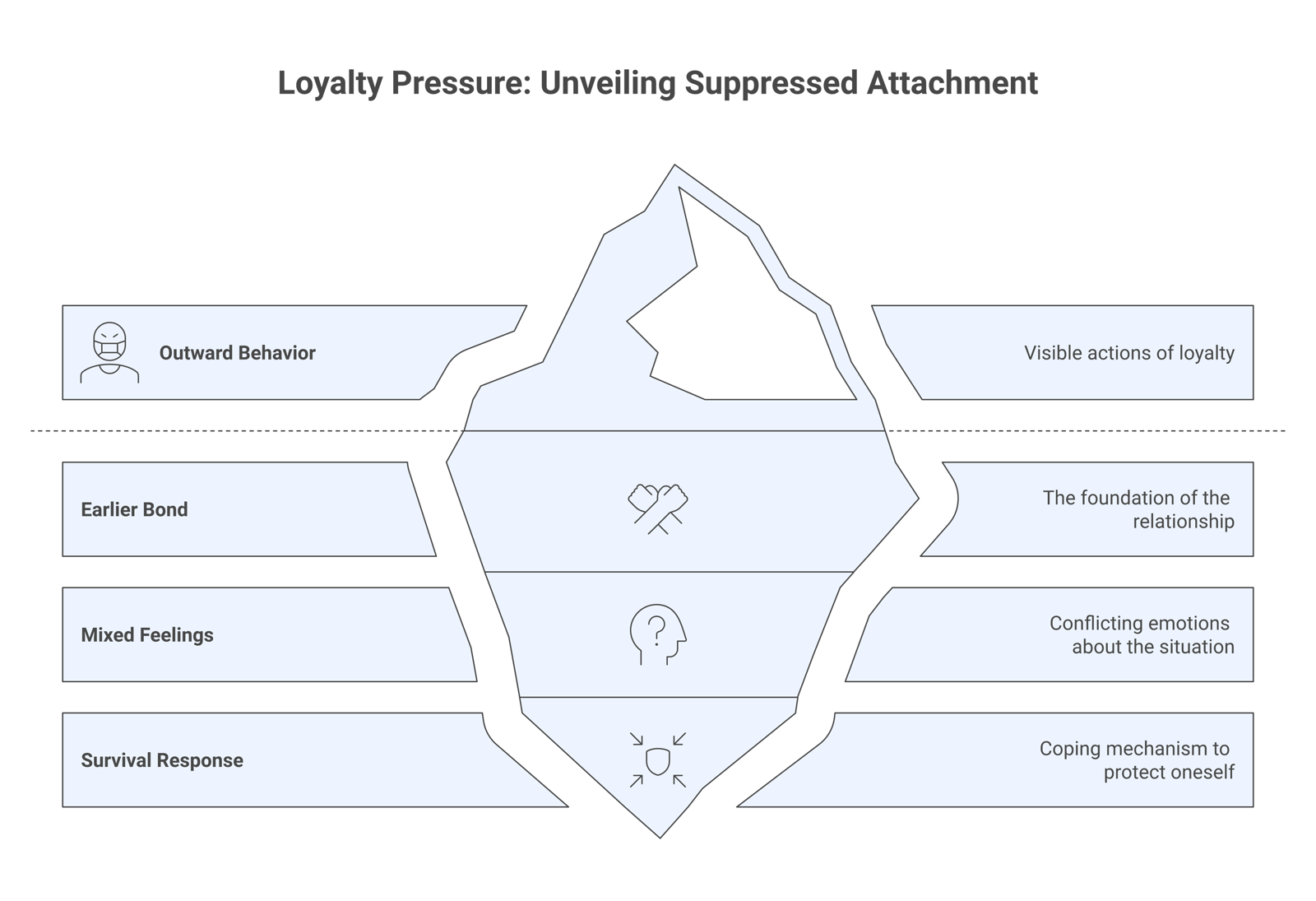
A child caught between two parents can comply with the more powerful one while still carrying an attachment to the other underneath. Coaches who work with alienated families describe this as compliance that hides, rather than erases, the bond. That does not mean the love is guaranteed to be intact in any one case. It means rejection on its own is weak evidence that feeling has ended. Hold this as a reframe that helps you stay steady, not as a promise.
Rejection as a survival response, not a verdict
One way to understand a child’s rejection is through survival. Ginger Gentile, who founded a coaching practice for alienated families and directed the documentary “Erasing Family,” frames a child’s love as bound up with survival rather than free choice. Treat this as one practitioner’s framework, not settled science, but it is a useful lens.
The logic runs like this. A young child cannot survive without a caregiver’s support. When the more powerful parent signals, openly or quietly, that love and security depend on rejecting the other parent, the child faces an impossible choice. Going against the parent they depend on feels, to a child’s nervous system, like a threat to survival. So the child complies. That compliance is not a moral failure and not a true change of heart. It is a frightened child doing what keeps them safe in the home they cannot leave. Understanding it this way can lift some of the self-blame a rejected parent carries, and it can keep you from reading every cold word as final.
The loyalty bind that produces compliance
Beneath the survival response sits a bind. Clinician Zach Flood, drawing on the family-systems work of Salvador Minuchin, describes an implicit loyalty contract between the favored parent and the child. In exchange for love, security, and a stable sense of identity, the child is expected to take on the favored parent’s view of the other parent and repeat it on demand.
This deal is rarely spoken aloud. It becomes the price of attachment in an enmeshed home, where the boundary between the favored parent’s feelings and the child’s own feelings blurs. A child inside that bind may say things that are not true, or that the rejected parent knows never happened, and sincerely believe them. The child is not lying so much as filling in a story they are required to hold. Seeing the bind helps explain why a sweet child can produce cutting words. The words are the contract talking. For more on how this pressure builds, see why your child sides with the alienating parent.
Why it is scarier to blame the parent than yourself
There is a reason the child’s anger so often lands on the rejected parent rather than the one applying the pressure. The physician Gabor Mate, whose trauma work Gentile draws on, captures it in a hard truth: for a child, it is safer to blame yourself than to recognize the parent you depend on as unhealthy.
A child who admitted that the parent they live with was harming them would have nowhere to stand. So the mind protects itself. The child reassigns the pain, often onto the parent who is safer to be angry at, the one who will not retaliate, the one whose love does not seem conditional. This is why a rejected parent, the steady one, can become the target of feelings that belong elsewhere. It is painful, and it is not a measure of how much you are loved. It is a child managing an unbearable position the only way a child can.
The honest limits of this reframe
A reframe that sustains you must also stay honest, or it stops helping. Three limits matter.
First, this is not proof about your specific child. It is a way of reading a pattern that is common in alienation, not a guarantee that any one child’s love is intact or that they will return. Second, the harm is real. A 2022 study by Verhaar, Matthewson, and Bentley followed adults who had been alienated as children and documented genuine, lasting effects on mental health. Reassurance for the parent does not erase the cost to the child. Third, and most important, none of this is a license to dismiss a child’s real grievances. Sometimes a child’s distancing is a justified response to a parent’s own behavior. Where that is the case, the work is honest accountability and change, not technique, and a qualified professional can help tell the two situations apart.
What a steady parent can do
Understanding the bind is only half of it. The other half is conduct, because the way a rejected parent carries themselves matters more than any single message.
Stay steady and regulated
Children, the coaching frameworks suggest, find it easier to move toward a parent who is steady than one who seems to be falling apart. This is not a judgment on grieving parents, who have every reason to grieve. It is a reason to get support for yourself so your child meets a calm, regulated presence rather than a frightened or angry one. Working on your own steadiness is described in becoming the anchor.
Keep the door open without pressure
Keep reaching out in low-key, low-pressure ways, even when there is no reply. Birthday messages, a short note, a small gift kept aside. Many parents save the letters and presents a child cannot yet accept, as a record that the love never stopped. The posture that helps is some version of “I am here whenever you are ready, on your terms.” That keeps the door open without backing the child into a corner. The work of slowly rebuilding is covered in reconnection as rebuilding trust and in how to reconnect with an alienated child.
Do not retaliate or interrogate
Two moves tend to backfire. Retaliating, by badmouthing the other parent back, deepens the loyalty bind the child is already trapped in. Interrogating, by pressing the child to explain or recant, raises the pressure they are buckling under. Steadiness means resisting both, however justified the urge feels.
Look after yourself
Looking after your own wellbeing is part of the work, not a distraction from it and not selfishness. Sleep, support, therapy, and time with people who know you keep you whole for the long timeline these situations often take. Active preparation and self-care are worth doing for their own sake, whatever any single child decides.
Do alienated children come back?
Parents understandably want to know whether the door stays open. The honest answer is that outcomes vary and no return is guaranteed. What can be said is that the door is often not permanently closed.
In the 2022 Verhaar study, most of the adults who had been alienated as children had reunified with the rejected parent at some point in their lives. That is not a promise about timing or about any one family, and some relationships are not rebuilt. It does suggest that a child’s rejection in the present is not always the last word. The most useful stance is patient steadiness: keep yourself well, keep the door open, and let the outcome stay open too. For the long view from the child’s side of this experience, see adult children of parental alienation, and the wider Recover silo collects related resources.
Frequently asked questions
Does my alienated child still love me?
Outward rejection or compliance under intense loyalty pressure does not prove the underlying attachment is gone. Rejection is often a survival response to an impossible bind rather than a true loss of love. This is an honest reframe meant to help you stay steady, not a guarantee about your specific child, and it is never a reason to dismiss a child’s real grievances. Where a child’s distancing is justified by a parent’s own harmful behavior, the situation is different.
Why does my child act like they hate me?
Under heavy loyalty pressure a child may take on the favored parent’s view and repeat it as the price of staying safe and attached in that home. The behavior can be survival in an enmeshed system rather than a true change of feeling, and anger often lands on the safer parent. It can also, in some cases, reflect a genuine grievance, which deserves to be taken seriously rather than explained away.
What should I do if my child rejects me?
Stay steady, keep the door open, and avoid retaliating or interrogating. Reach out in low-pressure ways and save unanswered letters and gifts as a record of steady love. Look after your own wellbeing, which is part of the work rather than selfishness. Seek professional support for yourself, and use the crisis resources below if you are struggling badly.
Do alienated children come back?
Outcomes vary and no return is guaranteed. In one 2022 study of adults alienated as children, most had reunified with the rejected parent at some point, which shows the door is often not permanently closed. Timing and outcome differ for everyone, so the steadier approach is to stay well and stay open rather than to count on a specific result.
Is my child’s rejection my fault?
Where the rejection is driven by alienating behavior, it is not a verdict on the rejected parent, and the anger often reflects the bind the child is in rather than the parent’s worth. Where a child is distancing because of a parent’s own abuse or neglect, that is a different situation, and the path forward is honest accountability and change. A qualified professional can help tell the two apart.
Sources and further reading
- Verhaar, S., Matthewson, M., & Bentley, C. (2022). The Impact of Parental Alienating Behaviours on the Mental Health of Adults Alienated in Childhood. Children, 9(4):475. https://doi.org/10.3390/children9040475
- American Psychological Association. Parenting and parent-child relationships. apa.org/topics/parenting
- Gentile, G. Reversing Parental Alienation Coaching, and the documentary Erasing Family (2020). Cited by name for the survival and loyalty-bind framing (a coaching framework, not peer-reviewed research).
- Mate, G. On trauma and self-blame in children. Cited by name for the principle that it is safer for a child to blame themselves than the parent they depend on.
If you are struggling, help is available
Free and confidential help is available right now.
- 988 Suicide and Crisis Lifeline. Call or text 988. 988lifeline.org
- Childhelp National Child Abuse Hotline. 1-800-422-4453. childhelp.org
- NAMI HelpLine. 1-800-950-6264. nami.org/help
Last reviewed: 2026-06-07. Author: Alex Buckles (PAC Founder). Editorial review: held to the PAC Editorial Standards (balance, primary-source citation, reader safety); an independent expert review board will be appointed.