

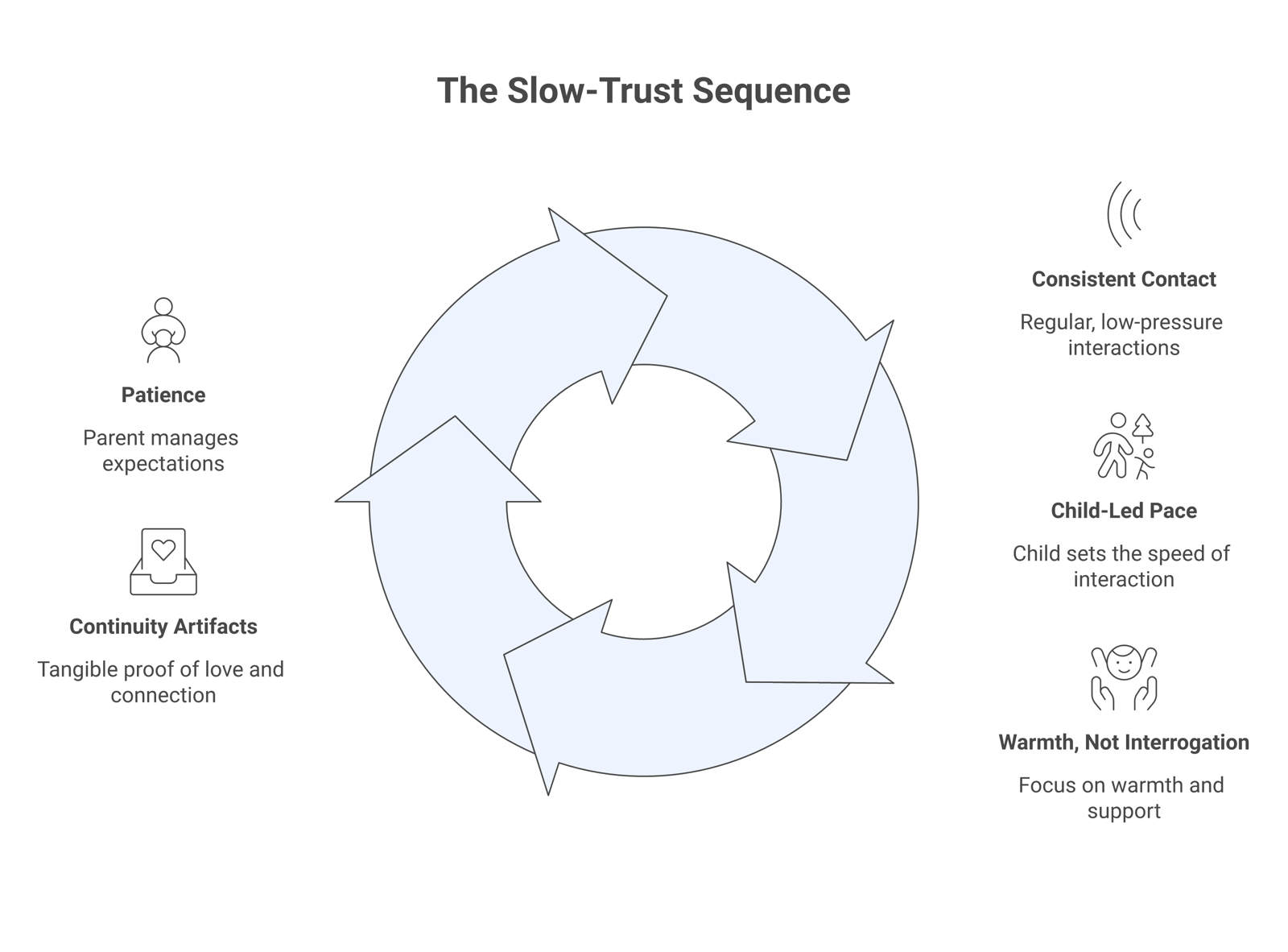
Reconnection with an alienated child works best as a slow rebuilding of trust at the child’s pace. Consistency matters more than frequency, warmth matters more than explaining yourself, and patience over months or years is the real work. Reunion is a process, not a single event, and some children take a long time.
A note on safety
These recovery pages address a child’s rejection that is driven by alienating behavior, not by a parent’s own abuse or neglect. Where a child’s distancing is a justified response to real harm, the honest path is accountability and change, not reconnection technique. A reader who is unsure which situation applies should work with a qualified professional.
This page is general education, not clinical advice. It does not diagnose any family, and it does not replace care from a licensed professional.
Reconnection is trust rebuilt, not a single reunion
Many parents picture reconnection as a doorway: one good conversation, one tearful hug, and the relationship is restored. Trust does not work that way, especially trust that has been worn down over years. A child who has pulled away needs evidence, gathered slowly, that the parent is safe, steady, and not going to push. So reconnection is better understood as rebuilding, brick by brick, than as a single grand reunion.
Some coaches describe this pace with the phrase “reconnection is like dating.” Used as a metaphor, and as one practitioner’s framing rather than settled science, it captures something useful. You would not propose on a first date. You would show up, be pleasant, take no for an answer, and let the other person set the speed. Reconnection asks for the same patience, the same lack of pressure, and the same willingness to let the child lead.
What the reunification research shows about pace
The honest picture of pace comes from research, not hope. A 2023 qualitative study published in Frontiers in Psychology by Leesa Van Niekerk and colleagues interviewed adult alienated children and targeted parents about how voluntary reunification actually unfolds. Their central finding is sobering and freeing at once. Voluntary reunification is a process that takes time, can span years or even decades, and often includes periods of connection followed by renewed distance.
That finding reframes what success looks like. A reconnection that moves in fits and starts is not a failed reconnection. It is the normal shape of the thing. Trust in attachment relationships is rebuilt through repeated, reliable experiences of safety, not through one breakthrough. Knowing this protects a parent from reading every quiet stretch as the end. The page on why an alienated child’s love is not gone explores the hope underneath this, and what reunification therapy is covers the clinical version of the same work.
Consistency over frequency
A parent’s most reliable signal is steady presence over time. The clinical psychologist Sue Cornbluth teaches a cadence of consistency over frequency: a warm, low-key message on a regular rhythm, roughly once a week for older children, does far more than a flood of contact. Daily messages tend to read as smothering, which is a common complaint children make about reconnecting parents.
One case Cornbluth describes captures the power of patience. A mother sent her son a short “thinking of you, have a good weekend” text every Friday for two and a half years, with no reply at all. One Friday, the answer came back: “Today I am wishing you a happy weekend too.” That single thread of consistency was the only signal that survived the silence, and the reconnection began there. The point is not the wait. The point is that reliability, repeated, is what a wary child eventually learns to trust.
Keep contact low-pressure and child-led
A child who has been alienated has often felt powerless for a long time. Handing some control back is part of how trust returns. Cornbluth suggests ending outreach with a line that puts the child in charge, something like, “I am open to doing this however works for you, at whatever pace feels right.” That stance tells the child that contact will not be forced on them, which paradoxically makes contact feel safer to accept.
Letting the child lead also means accepting their speed without protest. If a message goes unanswered, the next one stays just as warm and just as unpressured. If the child offers a small opening, the parent meets it without rushing to make up for lost time. The practical mechanics of pacing and first contact are covered further in how to reconnect with an alienated child.
No interrogation, no guilt, no corrective narrative
Three moves quietly sabotage reconnection, even when a parent means well. One is interrogation: a string of questions about the other home, about why the child stayed away, about what they have been told. Another is guilt: reminders of how much the parent has suffered, however true. A third is the corrective narrative, the urge to explain “what really happened.”
The recovery framework known as both-realities, developed in the Parental Alienation Anonymous community, offers the alternative. The child’s version of events and the parent’s version can both exist without either side having to win. Arriving to re-litigate the past confirms the very story that drove the child away. Cornbluth adds a small but telling rule: do not lead with “I love you and I miss you,” because the child already knows the parent loves them, and what they need first is to feel that their experience is heard. When ruptures happen along the way, and they will, the page on rupture and repair in reconnection explains how small breaks are normal and repairable.
Keep messages warm and brief
When the right words are hard to find, shorter is safer. A warm, brief message carries less weight for a child to manage and less room for an accidental misstep. “Saw a hawk today and thought of you. Hope your week is good.” That kind of note asks for nothing, demands no reply, and simply keeps a small, friendly light on. Warmth communicates more than explanation ever will, and brevity keeps the door open rather than crowding it.
Save rejected letters and gifts as continuity of love
Not every gesture will land while the alienation holds. Cards may go unopened, gifts may come back, letters may never be acknowledged. Rather than stopping, many parents keep these in a box, dated and saved. They become a record of steady love across the silence, something a child can one day receive all at once: proof that the parent never stopped showing up. The artifacts are continuity made visible, evidence that whatever the child was told, the love was real and constant.
Manage your own expectations between contacts
The hardest work often happens between messages, in the parent’s own mind. Hope spikes after a small reply, then crashes when the next one does not come. A nervous system worn down by long stress can even read a hopeful surprise as a threat, which is why a breakthrough can leave a parent shaky rather than purely glad. Steadying yourself between contacts is part of the work, not a distraction from it. The companion page on becoming the anchor covers how to build that steadiness, and the full Recover section holds the rest of the healing material. If the waiting ever brings thoughts of self-harm, please use the crisis resources at the foot of this page right away.
Frequently asked questions
How do you rebuild trust with an alienated child?
Rebuild trust slowly, through consistent, low-pressure, child-led contact rather than one big reunion. Keep messages warm and brief, avoid interrogation and guilt, and let the child set the pace. Trust returns through repeated experiences of safety over time, so steadiness and patience matter more than any single conversation.
How long does it take to reconnect with an alienated child?
There is no fixed timeline. A 2023 study in Frontiers in Psychology found that voluntary reunification is a process that can span years or even decades and often includes periods of connection followed by distance. Some children reconnect sooner, some take much longer, and some do not return. Honest hope holds room for all of these.
Should you keep contacting a child who does not respond?
Usually a steady, gentle rhythm of warm, no-pressure contact is more helpful than stopping, as long as it respects any clear boundary the child has set and never becomes smothering. Consistency over time is often the only signal that survives a long silence. A therapist can help judge the right cadence for a specific situation.
What should you say to an alienated child?
Keep it warm, brief, and free of pressure. A short note that shares a small moment and asks for nothing is safer than a long letter or an explanation of the past. Avoid leading with how much you miss them, avoid questions about the other home, and avoid trying to correct their version of events.
What do you do with letters and gifts an alienated child rejects?
Many parents save rejected or unanswered letters and gifts in a dated box rather than throwing them away. Kept this way, they become a record of steady love across the silence, something a child can receive later as proof that the parent never stopped showing up.
What this page does not do
This page does not promise that patient reconnection will bring a child home, because reunion depends on many things outside any parent’s control, and some children take years or do not return. It does not frame contact as a tactic to win, and it does not present coaching frameworks as proven science. It is general education, offered to help a parent show up with warmth, steadiness, and respect for the child’s pace, whatever the outcome.
The steadiness this work rests on is covered in becoming the anchor. To find the hope underneath it, see why an alienated child’s love is not gone. For handling the inevitable bumps, read rupture and repair in reconnection. The Recover section covers the rest.
Sources and further reading
- Van Niekerk, L., et al. (2023). A qualitative exploration of reunification post alienation from the perspective of adult alienated children and targeted parents. Frontiers in Psychology, 14, 1189840. https://doi.org/10.3389/fpsyg.2023.1189840
- American Psychological Association. Divorce and child custody. apa.org/topics/divorce-child-custody
- American Psychological Association. Parenting. apa.org/topics/parenting
If you or your child are in crisis
Free and confidential help is available right now.
- 988 Suicide and Crisis Lifeline. Call or text 988. 988lifeline.org
- Childhelp National Child Abuse Hotline. 1-800-422-4453. childhelp.org
- NAMI HelpLine. 1-800-950-6264. nami.org/help
Last reviewed: 2026-06-07. Author: Parental Alienation Center (Organization). Editorial review: held to the PAC Editorial Standards (balance, primary-source citation, reader safety); an independent expert review board will be appointed.